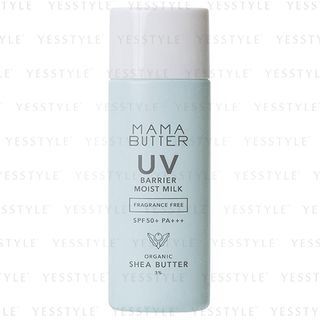
MAMA BUTTER UV Barrier Moist Milk Fragrance Free SPF 50+ PA+++
Works for
0 of 1 advertised claim delivered
Sun protectionSPF 50 · 2 UV filters · Broad spectrumWeak protectionLow filter dose
This product can be considered "reef safe" because it does not contain the UV filters (oxybenzone and octinoxate) that can be harmful to coral reefs when present in the water in high concentrations.
Anti-agingNot advertised by the brand · 3 ingredients credited for this claimModerate support
This product contains lysine. This ingredient might be able to help reduce and prevent fine lines and wrinkles, improve skin elasticity and firmness, but there is not enough evidence that it actually works. The biggest anti-aging effect in this product comes from sun protection. Sun damage is the main factor causing early signs of skin aging. We, however, do not recommend using this product as a sunscreen because the protection it offers is not strong enough).
MoisturizingNot advertised by the brand · 9 ingredients credited for this claimGood support
This product can help soften the skin and reduce its moisture loss with emollients and occlusives: butyrospermum parkii butter, caprylic/capric triglyceride.
Keep in mind that this product does not contain effective ingredients to attract water to the upper layer of the skin. This is why an additional product with humectants like glycerin or hyaluronic acid can be helpful (apply it before this product for the best results).
Can it cause trouble?
Irritancy1 strong irritant: Zingiber officinale root extractMedium risk
Comedogenic2 ingredients rated 2 or more on the 0–5 pore-clogging scale2 flagged
User reviews
Be the first — your take helps the next person decide.
Ingredients
Filter by role to see what each ingredient is doing.
Water~45–55%
Caprylic acid~8.1–9.9%
Capric acid~4.4–5.4%
Cocos nucifera oil~3.3–4%
- Irritation risk
- Low
- Comedogenicity
- 3/5
An emollient. Found to be as effective as a moisturizer for dry skin as mineral oil. Could be comedogenic
More about Cocos nucifera oilPropanediol~2.4–3%
- Irritation risk
- Low
Acts as a solvent for other ingredients. Speeds up the absorption of other ingredients into the skin
More about PropanediolZinc oxide~2.8–3.5%
- Irritation risk
- Low
A broad spectrum sunblock (protects from both UVA and UVB rays). Is suitable for most sensitive skins. In small concentrations, can be used as a colorant
More about Zinc oxideTitanium dioxide~2.1–2.6%
- Irritation risk
- Low
Works as a UV filter when used in high concentrations. It is photostable and is effective mostly against the UVB light, with some protection in the UVA range. In small concentrations, used for its ability to improve the color of cosmetic products. Is usually well tolerated by the skin
More about Titanium dioxideButyrospermum parkii butter~1.6–1.9%
- Irritation risk
- Low
- Comedogenicity
- 3/5
A great moisturising ingredient that softens the skin and reduces water loss from its upper layer. It also can be helpful in protecting skin from free radicals
More about Butyrospermum parkii butterCaprylic/capric triglyceride~1.3–1.6%
- Irritation risk
- Medium
A good mix of fatty acids that forms a protective layer on the skin. Improves the shelf life of products. Derived from coconut and glycerin
More about Caprylic/capric triglycerideStearic acid~1.1–1.3%
- Irritation risk
- Low
Helps oil and water mix together and works as an emollient
More about Stearic acidPolyhydroxystearic acid~0.75–1.1%
- Irritation risk
- Medium
Used to create a thicker product consistency and stabilize the formulation
More about Polyhydroxystearic acidPotassium hydroxide~0.6–0.9%
Zingiber officinale root extract~0.5–0.75%
- Irritation risk
- High
A plant extract that can contain an irritating essential oil. Might have some anti-oxidant effect, but evidence is lacking
More about Zingiber officinale root extractNiacin~0.5–0.75%
- Irritation risk
- High
A form of vitamin B3. It is similar in action to niacinamide, but is more likely to cause red flashes in skin as the side effect
More about NiacinSilica~0.65–0.95%
Taurine~0.45–0.7%
- Irritation risk
- Medium
Could be helpful in reducing inflammation in skin, evening out the skin tone and neutralizing free radicals, but more research is needed to confirm its effectiveness
More about TaurineBehenyl alcohol~0.5–0.75%
- Irritation risk
- Low
Non-drying alcohol that helps water and oil mix together. Also serves as an emollient
More about Behenyl alcoholPentylene glycol~0.45–0.7%
- Irritation risk
- Medium
Used to preserve products, dissolve other ingredients and create a nice product texture
More about Pentylene glycolPolyglyceryl-10 pentastearate~0.3–0.6%
- Irritation risk
- Low
Xanthan gum~0.3–0.6%
- Irritation risk
- Low
Used to create a thicker product consistency
More about Xanthan gumIsostearic acid~0.4–0.6%
- Irritation risk
- Low
Used to create a nice product texture
More about Isostearic acidBehenic acid~0.4–0.6%
Sodium stearoyl lactylate~0.25–0.45%
- Irritation risk
- Medium
Helps oil and water mix together
More about Sodium stearoyl lactylatePotassium glycyrrhizinate~0.2–0.4%
- Irritation risk
- Low
Bisabolol~0.15–0.3%
- Irritation risk
- Low
An active component of chamomile plant that historically has been used to calm down irritated skin. A recent study shows that bisabolol indeed can have some anti-inflammatory effect on skin, even though conclusive data is lacking. Bisabolol has a sweet floral scent and can be added to products for its aromatic properties
More about BisabololTocopheryl acetate~0.2–0.35%
- Irritation risk
- Medium
A more stable but less bio-available form of vitamin E compared to Tocopherol. Might help moisturize and protect the skin from free radicals, but mostly used in low concentrations to stabilize other ingredients.
More about Tocopheryl acetateButylene glycol~0.15–0.3%
- Irritation risk
- Low
Used to create a nice product texture and help delivery of other ingredients. Might be somewhat helpful in attracting water to the upper layer of the skin
More about Butylene glycolLysine~0.15–0.25%
- Irritation risk
- Low
An amino-acid that helps to attract water to the upper layer of the skin. In combination with other amino-acids, might help to reduce fine lines and wrinkles
More about LysineSodium glutamate~0.1–0.15%
- Irritation risk
- Low
Phenoxyethanol~0.1–0.2%
- Irritation risk
- Low
A preservative. It helps prevent bacterial growth in cosmetic products
More about PhenoxyethanolIngredient list view
Water, Caprylic acid, Capric acid, Cocos nucifera oil, Unknown, Propanediol, Zinc oxide, Titanium dioxide, Butyrospermum parkii butter, Caprylic/capric triglyceride, Stearic acid, Polyhydroxystearic acid, Unknown, Potassium hydroxide, Zingiber officinale root extract, Niacin, Silica, Taurine, Unknown, Behenyl alcohol, Pentylene glycol, Polyglyceryl-10 pentastearate, Xanthan gum, Isostearic acid, Behenic acid, Unknown, Sodium stearoyl lactylate, Potassium glycyrrhizinate, Bisabolol, Tocopheryl acetate, Butylene glycol, Lysine, Unknown, Sodium glutamate, Phenoxyethanol
Compare prices
Retailers ranked by price — lowest first.

Affiliate links · prices updated regularly
Product summary
"MAMA BUTTER - UV Barrier Moist Milk Fragrance Free SPF 50+ PA+++" is using UV filters in a relatively low concentration. Because of this, it might not be able to provide reliable sun protection.
It also works as a moisturizer, so you do not have to use an additional hydrating product.
Sunscreen filters
It is a mineral sunscreen. It uses titanium dioxide and zinc oxide for sun protection. Both titanium dioxide and zinc oxide almost never irritate even the most sensitive skin and eyes, but can leave a white cast.
Irritation risk
This formulation includes some common irritants, including ingredients that do not provide a benefit for the skin. We assess the overall irritancy of this sunscreen to be medium. For a detailed overview of all potential irritants: click here
You can see the detailed formula review with the breakdown of all actives in the product and the full ingredient list with estimated concentrations in the tables below.
Price
The product retails for 35.40$ in the United States.
For a detailed price comparison: click here.
Sources cited in this review
Every concentration estimate and effectiveness label is anchored to one of these 9 studies and safety reviews.
- 1A review of inorganic UV filters zinc oxide and titanium dioxideonlinelibrary.wiley.com
- 2
- 3
- 4
- 5
- 6

Affiliate links · As an Amazon Associate, WIMJ earns from qualifying purchases.