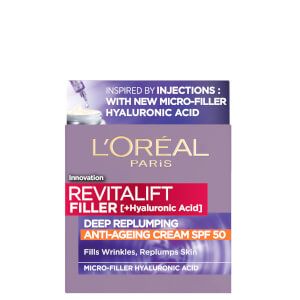
L'Oréal Paris Revitalift Filler Hyaluronic Acid Anti-Ageing SPF50 Day Cream
Works for
2 of 2 advertised claims delivered
Sun protectionSPF 50 · 4 UV filtersBroad spectrum
This product offers a good level of protection against both UVB and UVA rays.
This sunscreen uses organic (so-called "chemical") sunscreen filters. Organic, or "chemical" filters usually provide reliable sun protection and rarely leave a white cast. Sunscreens with organic filters can sting eyes.
This product can be considered "reef safe" because it does not contain the UV filters (oxybenzone and octinoxate) that can be harmful to coral reefs when present in the water in high concentrations.
Anti-aging2 ingredients credited for this claimStrong support
“Revitalift Filler Hyaluronic Acid Anti-Ageing SPF50 Day Cream”
This product can help reduce and prevent fine lines and wrinkles, improve skin elasticity and firmness because it contains adenosine.
Keep in mind that it typically takes at least 6 weeks to notice any results because the changes that are needed to improve fine lines and elasticity happen in the deeper layers of the skin. No topical anti-aging product can “erase” wrinkles or fully reverse signs of aging.
This product can also help prevent early signs of skin aging because it offers a good level of broad spectrum sun protection. Sun damage is the main cause of premature skin aging, and protecting your skin from the sun is the best anti-aging strategy.
ExfoliationNot advertised by the brand · 1 ingredient credited for this claimStrong support
This product can help exfoliate the skin. In other words, it helps break down the bonds between dead cells on the surface of the skin and speed up the skin turnover. Skin often appears softer and brighter after exfoliation, but overdoing it can result in disrupted skin barrier. The following ingredient is doing the exfoliating job in this product: capryloyl salicylic acid.
Evens skin toneNot advertised by the brand · 1 ingredient credited for this claimStrong support
This product offers broad spectrum sun protection. It means that it can prevent hyperpigmentation and help keep the skin tone even (sun damage is the main factor causing age spots, darkening of post-acne marks and other discolorations).
MoisturizingNot advertised by the brand · 17 ingredients credited for this claimGood support
This product can help improve hydration of the skin with the two types of ingredients.
The first type is called “humectants”:
these ingredients help attract water.
When humectants are on the surface of the skin, they “pull in” the moisture from the outside environment, or from
within deeper layers of the skin. The following ingredients in this product do the job:
glycerin, sodium acetylated hyaluronate.
This product also contains ingredients called “occlusives”. They help reduce the speed with which our skin loses moisture to the outside environment. These ingredients also help soften the upper layer of the skin, so it feels less tight and nicer to the touch. The following ingredients in this product do the job: dimethicone, glycine soja oil.
Can it cause trouble?
Irritancy4 strong irritants: Citronellol, Limonene + 2 more — patch-test recommendedHigh risk
Comedogenic7 ingredients rated 2 or more on the 0–5 pore-clogging scale7 flagged


User reviews
Ingredients
Filter by role to see what each ingredient is doing.
Water~45–55%
Glycerin~4.6–5.6%
- Irritation risk
- Low
One of the best moisturizing ingredients. Naturally present in skin. It attracts water to the upper layer of the skin working as a humectant
More about GlycerinEthylhexyl salicylate~4.2–5.1%
- Irritation risk
- Low
Octisalate. A UV filter. It offers some protection against the sun rays that cause sunburn (UVB), but does not protect against the most aging sun rays (UVA). It loses its effectiveness quickly when exposed to sunlight. It is an organic, or so called "chemical" sunscreen
More about Ethylhexyl salicylateEthylhexyl triazone~3.3–4.1%
- Irritation risk
- Medium
Uvinul T. A UV filter. Effective against UVB rays. It is photostable. Can increase water resistance properties of the sunscreen. Unfortunately, not approved by the FDA (US) yet
More about Ethylhexyl triazoneAlcohol denat.~2.3–2.8%
- Irritation risk
- High
Produces temporary toning effect. Can help dissolve other ingredients or preserve products
More about Alcohol denat.Bis-ethylhexyloxyphenol methoxyphenyl triazine~2.4–3%
- Irritation risk
- Medium
Tinosorb S. One of the most effective broad spectrum sunscreen ingredients. Protects from both UVA and UVB rays. It is photostable. Unfortunately, not approved by FDA (US) yet.
More about Bis-ethylhexyloxyphenol methoxyphenyl triazineLauroyl lysine~1.6–1.9%
- Irritation risk
- Low
Helps soften the upper layer of the skin and creates a nice product texture
More about Lauroyl lysineButyl methoxydibenzoylmethane~2–2.4%
- Irritation risk
- Medium
Avobenzone. An organic, or so-called "chemical" UV filter. Protects against both UVA and UVB rays. Needs to be combined with other filters in a formulation to be stable.
More about Butyl methoxydibenzoylmethaneIsopropyl myristate~1.2–1.4%
- Irritation risk
- Low
- Comedogenicity
- 3/5
An emollient that helps soften the skin. Could be comedogenic
More about Isopropyl myristateOctyldodecanol~0.75–1.15%
- Irritation risk
- Low
An emollient that helps to soften the skin and create a pleasant product texture and stabilize the formulation
More about OctyldodecanolBehenyl alcohol~0.65–0.95%
- Irritation risk
- Low
Non-drying alcohol that helps water and oil mix together. Also serves as an emollient
More about Behenyl alcoholIsopropyl isostearate~0.45–0.7%
- Irritation risk
- Low
- Comedogenicity
- 3/5
An emollient that helps soften the skin
More about Isopropyl isostearateDimethicone~0.3–0.55%
- Irritation risk
- Low
A silicone that helps to reduce water loss from the surface of the skin. Can temporarily "fill in" lines and wrinkles, absorb oil, and create a nice product finish
More about DimethiconePerlite~0.3–0.5%
- Irritation risk
- Low
A type of volcanic glass. Absorbs moisture and can temporarily mattify the skin
More about PerliteAluminum starch octenylsuccinate~0.2–0.4%
- Irritation risk
- Medium
Used to thicken the product's consistency
More about Aluminum starch octenylsuccinateCetyl alcohol~0.25–0.45%
- Irritation risk
- Low
A non-drying alcohol that works to soften the skin and stabilize product formulations helping oil and water mix together
More about Cetyl alcoholTocopherol~0.2–0.4%
- Irritation risk
- Low
Pure form of vitamin E. Can help moisturise and protect the skin from free radicals. Often used to help stabilise other ingredients or the formula itself
More about TocopherolAcrylamide/sodium acryloyldimethyltaurate copolymer~0.2–0.4%
- Irritation risk
- Low
Helps water and oil mix together and create gel-like textures
More about Acrylamide/sodium acryloyldimethyltaurate copolymerAdenosine~0.2–0.35%
- Irritation risk
- Low
Might help improve cell turnover and reduce inflammation in skin. One study shows that the ingredients might be able to help reduce dynamic wrinkles (for example, in the corners of the eyes or on the forehead)
More about AdenosineAmmonium polyacryloyldimethyl taurate~0.2–0.35%
- Irritation risk
- Low
Used to create a thicker product consistency
More about Ammonium polyacryloyldimethyl taurateCapryloyl salicylic acid~0.15–0.3%
- Irritation risk
- High
Cetearyl alcohol~0.2–0.4%
- Irritation risk
- Low
- Comedogenicity
- 2/5
A non-drying alcohol. Works as an emollient. Helps water and oil mix together and creates a nice product texture
More about Cetearyl alcoholCetearyl glucoside~0.15–0.3%
- Irritation risk
- Medium
Helps water and oil in the product mix well together and improves product texture
More about Cetearyl glucosideGlycine soja oil~0.15–0.3%
- Irritation risk
- Medium
- Comedogenicity
- 2/5
A good emollient that helps soften the skin and helps repair its barrier function. It can clog pores if used in high concentrations.
More about Glycine soja oilHydroxyacetophenone~0.15–0.25%
Isohexadecane~0.25–0.4%
- Irritation risk
- Low
Improves the texture of the product and helps soften the skin. Helps oil and water mix together and can be used as a cleansing agent
More about IsohexadecaneMyristic acid~0.15–0.3%
- Irritation risk
- Medium
- Comedogenicity
- 3/5
Helps oil and water mix together. Could be comedogenic
More about Myristic acidPalmitic acid~0.2–0.35%
- Irritation risk
- Low
An emollient that is naturally present in skin and helps soften it
More about Palmitic acidPeg-100 stearate~0.2–0.4%
- Irritation risk
- Low
Helps oil and water mix togehter and creates a nice product texture
More about Peg-100 stearatePhytic acid~0.15–0.25%
- Irritation risk
- Medium
An alpha-hydroxy acid (AHA), but is mostly used to stabilize product formulations in cosmetics
More about Phytic acidPoly c10-30 alkyl acrylate~0.15–0.25%
- Irritation risk
- Low
Polyepsilon-lysine~0.15–0.25%
- Irritation risk
- Low
Polysorbate 80~0.15–0.3%
Potassium hydroxide~0.15–0.25%
Sodium acetylated hyaluronate~0.15–0.25%
- Irritation risk
- Low
A type of hyaluronic acid that works as an excellent moisturizer by attracting water into the upper layer of the skin. Is typically feels less sticky on the skin compared to the usual hyaluronic acid
More about Sodium acetylated hyaluronateSodium hyaluronate~0.15–0.25%
- Irritation risk
- Low
One of the best moisturizing ingredients. Attracts water into the upper layer of the skin
More about Sodium hyaluronateSodium polyacrylate starch~0.15–0.3%
- Irritation risk
- Low
Used to create a thicker product consistency
More about Sodium polyacrylate starchSodium stearoyl glutamate~0.2–0.35%
- Irritation risk
- Medium
Helps oil and water mix together
More about Sodium stearoyl glutamateSorbitan oleate~0.15–0.3%
- Irritation risk
- Medium
- Comedogenicity
- 2/5
Helps oil and water mix together
More about Sorbitan oleateStearic acid~0.25–0.45%
- Irritation risk
- Low
Helps oil and water mix together and works as an emollient
More about Stearic acidTrisodium ethylenediamine disuccinate~0.15–0.25%
- Irritation risk
- Medium
Used to improve stability of the formulation
More about Trisodium ethylenediamine disuccinateCarvone~0.1–0.2%
- Irritation risk
- Low
Citronellol~0.1–0.2%
Limonene~0.1–0.2%
- Irritation risk
- High
A common frangrance that can easily irritate skin, especially if exposed to air, light or heat
More about LimoneneLinalool~0.15–0.25%
Linalyl acetate~0.15–0.3%
- Irritation risk
- Low
Pinene~0.2–0.35%
- Irritation risk
- Low
Terpineol~0.15–0.25%
- Irritation risk
- Low
Ci 15985~0.15–0.25%
Ci 16035~0.15–0.3%
Phenoxyethanol~0.15–0.3%
- Irritation risk
- Low
A preservative. It helps prevent bacterial growth in cosmetic products
More about PhenoxyethanolParfum~0.05–0.15%
- Irritation risk
- High
An aromatic blend of unspecified and possibly irritating ingredients
More about ParfumIngredient list view
Water, Glycerin, Ethylhexyl salicylate, Ethylhexyl triazone, Alcohol denat., Bis-ethylhexyloxyphenol methoxyphenyl triazine, Lauroyl lysine, Butyl methoxydibenzoylmethane, Isopropyl myristate, Octyldodecanol, Behenyl alcohol, Isopropyl isostearate, Dimethicone, Perlite, Aluminum starch octenylsuccinate, Cetyl alcohol, Tocopherol, Acrylamide/sodium acryloyldimethyltaurate copolymer, Adenosine, Ammonium polyacryloyldimethyl taurate, Capryloyl salicylic acid, Cetearyl alcohol, Cetearyl glucoside, Glycine soja oil, Hydroxyacetophenone, Isohexadecane, Myristic acid, Palmitic acid, Peg-100 stearate, Phytic acid, Poly c10-30 alkyl acrylate, Polyepsilon-lysine, Polysorbate 80, Potassium hydroxide, Sodium acetylated hyaluronate, Sodium hyaluronate, Sodium polyacrylate starch, Sodium stearoyl glutamate, Sorbitan oleate, Stearic acid, Trisodium ethylenediamine disuccinate, Carvone, Citronellol, Limonene, Linalool, Linalyl acetate, Pinene, Terpineol, Ci 15985, Ci 16035, Phenoxyethanol, Parfum
Compare prices
Retailers ranked by price — lowest first.


Worth comparing, line by line.
Match % combines shared ingredients, the first five ingredients, shared actives and hero ingredients, irritancy (lower counts in the alternative's favour), texture and body area. Only products in the same routine step are compared.
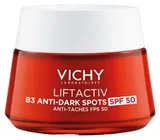
| L'Oréal ParisRevitalift Filler Hyaluronic Acid Anti-Ageing SPF50 Day CreamYOUR PRODUCT | VichyLiftActiv Cream B3 Anti-Spot SPF50 | La Roche-PosayHYALU B5 SURACTIVATED CREAM SPF30 | L'Oréal ParisDark Spot UV Fluid SPF 50+, Niacinamide | |
|---|---|---|---|---|
| Match | — | 74% | 65% | 57% |
| Price | $19.82 | $39.66+$19.84 | — | $18.82−$1.00 |
| Shared key ingredients | — | 9 of 12 | 8 of 12 | 9 of 12 |
| Key difference | — | Niacinamide | Panthenol | Niacinamide |
| Irritancy | High | Medium | Medium | Medium |
| SPF | SPF 50 | SPF 50 | SPF 30 | SPF 50 |
| Drying alcohol | Contains drying alcohol | Contains drying alcohol | Contains drying alcohol | Contains drying alcohol |
| View product | Shop | Shop | Shop |

Product summary
We assess that "L'Oréal Paris - Revitalift Filler Hyaluronic Acid Anti-Ageing SPF50 Day Cream" can provide reliable sun protection based on the ingredient list. We love that it can protect from both UVA and UVB rays (not all sunscreens with SPF ratings give UVA protection. UVA rays do not cause sunburn, but still damage our skin and lead to early aging).
It also works as a moisturizer, so you do not have to use an additional hydrating product. Like all broad-spectrum sunscreens, this product has an anti-aging benefit.
Sunscreen filters
This sunscreen uses so-called "chemical", or organic UV filters (organic simply means that their molecules contain atoms of carbon). These filters typically give good sun protection and rarely leave a white cast, but they can be irritating for sensitive skin. The UV filters in this sunscreen are: tinosorb s 2.40% - 3.00%, avobenzone 1.70% - 2.00%, octisalate 4.20% - 5.10% and uvinul t 3.30% - 4.10%.
Irritation risk
There are quite a few common irritants in this product, including ingredients without particular skin benefits. We would not recommend it for sensitive skin. We assess the overall irritancy of this moisturizer to be high. For a detailed overview of all potential irritants: click here
You can see the detailed formula review with the breakdown of all actives in the product and the full ingredient list with estimated concentrations in the tables below.
Price
The product retails from 13.31£ up to 19.99£ in the United Kingdom.
For a detailed price comparison: click here.
Sources cited in this review
Every concentration estimate and effectiveness label is anchored to one of these 14 studies and safety reviews.
- 1
- 2
- 3Final Report on the Safety Assessment of Dimethicone Copolyoljournals.sagepub.com
- 4Vitamin E in dermatologyncbi.nlm.nih.gov
- 5Vitamin E and Skin Healthlpi.oregonstate.edu
- 6

Affiliate links · As an Amazon Associate, WIMJ earns from qualifying purchases.