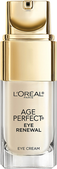
L'Oréal Paris Age Perfect Eye Renewal Eye Cream
Works for
2 of 2 advertised claims delivered
Moisturizing20 ingredients credited for this claimStrong support
“Moisturize Age Perfect Cell Renewal Day Cream or Age Perfect Cell Renewal Night Cream.”
This product can help improve hydration of the skin with the two types of ingredients.
The first type is called “humectants”:
these ingredients help attract water.
When humectants are on the surface of the skin, they “pull in” the moisture from the outside environment, or from
within deeper layers of the skin. The following ingredients in this product do the job:
glycerin, propylene glycol.
This product also contains ingredients called “occlusives”. They help reduce the speed with which our skin loses moisture to the outside environment. These ingredients also help soften the upper layer of the skin, so it feels less tight and nicer to the touch. The following ingredients in this product do the job: beeswax, butyrospermum parkii butter.
The following ingredients in this product are especially good for supporting the skin barrier and helping with the hydration level: paraffinum liquidum
Anti-aging3 ingredients credited for this claimModerate support
“Age Perfect Eye Renewal Eye Cream”
This product contains retinyl palmitate. This ingredient might be able to help reduce and prevent fine lines and wrinkles, improve skin elasticity and firmness, but there is not enough evidence that it actually works.
Evens skin toneNot advertised by the brand · 2 ingredients credited for this claimModerate support
The following ingredient (ingredients) in this product might be helpful, but there is no evidence to confirm that it actually works: capryloyl salicylic acid, retinyl palmitate.
Can it cause trouble?
Irritancy2 strong irritants: Alcohol denat., Retinyl palmitateMedium risk
Comedogenic3 ingredients rated 2 or more on the 0–5 pore-clogging scale3 flagged
User reviews
Be the first — your take helps the next person decide.
Ingredients
Filter by role to see what each ingredient is doing.
Water~45–55%
Cyclohexasiloxane~6.4–7.8%
- Irritation risk
- Low
A silicone that serves as an emollient. Helps create a nice non-greasy feels
More about CyclohexasiloxaneGlycerin~4.6–5.6%
- Irritation risk
- Low
One of the best moisturizing ingredients. Naturally present in skin. It attracts water to the upper layer of the skin working as a humectant
More about GlycerinAlcohol denat.~3.6–4.4%
- Irritation risk
- High
Produces temporary toning effect. Can help dissolve other ingredients or preserve products
More about Alcohol denat.Paraffinum liquidum~3–3.6%
- Irritation risk
- Low
Mineral oil. One of the most effective and well studied occlusive and emollient moisturizing ingredients. Helps reduce moisture loss in skin and repair skin barrier function
More about Paraffinum liquidumPrunus armeniaca kernel oil~2.5–3%
- Irritation risk
- Medium
An emollient that helps soften the skin
More about Prunus armeniaca kernel oilButyrospermum parkii butter~2.2–2.7%
- Irritation risk
- Low
- Comedogenicity
- 3/5
A great moisturising ingredient that softens the skin and reduces water loss from its upper layer. It also can be helpful in protecting skin from free radicals
More about Butyrospermum parkii butterDimethicone~2–2.5%
- Irritation risk
- Low
A silicone that helps to reduce water loss from the surface of the skin. Can temporarily "fill in" lines and wrinkles, absorb oil, and create a nice product finish
More about DimethiconeStearic acid~1.7–2.1%
- Irritation risk
- Low
Helps oil and water mix together and works as an emollient
More about Stearic acidPalmitic acid~1.4–1.8%
- Irritation risk
- Low
An emollient that is naturally present in skin and helps soften it
More about Palmitic acidPeg-100 stearate~1.3–1.6%
- Irritation risk
- Low
Helps oil and water mix togehter and creates a nice product texture
More about Peg-100 stearateCera alba~1.2–1.4%
- Irritation risk
- Medium
Forms a protective barrier that holds water and keeps dry skin hydrated. Keeps an emulsion from separating into its oil and liquid components, and increases the thickness of a product. Can be an allergen
More about Cera albaBeeswax~0.95–1.2%
- Irritation risk
- Low
Forms a protective barrier that holds water and keeps dry skin hydrated. Keeps an emulsion from separating into its oil and liquid components, and increases the thickness of a product. Can be an allergen
More about BeeswaxGlyceryl stearate~0.9–1.1%
- Irritation risk
- Low
An emollient that softens the skin and forms a protective layer on its surface. Helps water and oil mix together
More about Glyceryl stearateCetearyl alcohol~0.8–1.2%
- Irritation risk
- Low
- Comedogenicity
- 2/5
A non-drying alcohol. Works as an emollient. Helps water and oil mix together and creates a nice product texture
More about Cetearyl alcoholSilica~1–1.2%
Rosa canina fruit oil~0.75–1.1%
- Irritation risk
- Medium
A great emollient. Contains vitamin E (tocopherol) which may give it some anti-oxidant properties. Can contain volatile compounds and can be irritating
More about Rosa canina fruit oilTin oxide~0.75–1.15%
- Irritation risk
- Low
A colorant that can add a pearl-like appearance to the formulation
More about Tin oxideC13-14 isoparaffin~0.7–1.05%
- Irritation risk
- Low
Helps soften the upper layer of the skin, dissolve other ingredients and create a thicker product consistency
More about C13-14 isoparaffinPeg-20 stearate~0.65–1%
Triethanolamine~0.65–0.95%
- Irritation risk
- Medium
Used to adjust pH of the product and can help improve the product's smell
More about TriethanolamineDimethiconol~0.65–0.95%
- Irritation risk
- Low
A silicone that makes products more spreadable and keeps skin smooth. Helps to add gloss to skin and may visually fill in fine lines/wrinkles for short time
More about DimethiconolCaffeine~0.5–0.75%
- Irritation risk
- Medium
Might be helpful in neutralizing free radicals. Can have a dehydration effect that might somewhat decrease the look of puffy eyes
More about CaffeineSodium cocoyl glutamate~0.7–1.05%
- Irritation risk
- Medium
Helps oil and water mix together
More about Sodium cocoyl glutamateVigna aconitifolia seed extract~0.55–0.85%
- Irritation risk
- Low
Ammonium polyacryloyldimethyl taurate~0.6–0.85%
- Irritation risk
- Low
Used to create a thicker product consistency
More about Ammonium polyacryloyldimethyl taurateDisodium edta~0.55–0.85%
Propylene glycol~0.55–0.85%
- Irritation risk
- High
Helps oil and water mix together and can enhance the penetration of other ingredients into the skin. It can be irritating
More about Propylene glycolHydrolyzed cicer seed extract~0.6–0.85%
- Irritation risk
- Low
Hydroxypropyl tetrahydropyrantriol~0.55–0.85%
- Irritation risk
- High
A sugar-derived compound that helps to attract water to the upper layer of the skin and might be able to stimulate synthesis of skin's own moisturizing factors, but solid research is lacking. It could be irritating
More about Hydroxypropyl tetrahydropyrantriolCapryloyl salicylic acid~0.55–0.85%
- Irritation risk
- High
Laureth-7~0.6–0.9%
Lauroyl lysine~0.55–0.85%
- Irritation risk
- Low
Helps soften the upper layer of the skin and creates a nice product texture
More about Lauroyl lysineSynthetic fluorphlogopite~0.55–0.8%
- Irritation risk
- Low
A mineral that is used as an optical filter (makes the skin looks nicer through light reflection) and to improve the texture of cosmetic products
More about Synthetic fluorphlogopiteOxothiazolidinecarboxylic acid~0.55–0.85%
- Irritation risk
- Low
Ethylhexyl methoxycinnamate~0.7–1.1%
- Irritation risk
- High
Octinoxate. When used in higher concentrations, works as a sunscreen protecting the skin from UVB rays. When used in lower concentration, helps to preserve the product formulation. Is shown to be harmful to coral reefs - consider avoiding bathing in coral reef areas when wearing a product with this ingredient. It can be irritating
More about Ethylhexyl methoxycinnamatePolyacrylamide~0.6–0.9%
- Irritation risk
- Medium
Used to improve product texture and help oil and water mix together
More about PolyacrylamidePolymethyl methacrylate~0.55–0.85%
- Irritation risk
- Low
Is used to enhance product texture and can help to optically mask skin imperfections
More about Polymethyl methacrylatePolyurethane-2~0.55–0.85%
- Irritation risk
- Low
Octyldodecanol~0.55–0.8%
- Irritation risk
- Low
An emollient that helps to soften the skin and create a pleasant product texture and stabilize the formulation
More about OctyldodecanolRetinyl palmitate~0.5–0.75%
- Irritation risk
- High
Three steps removed from the active form of vitamin A - retinoic acid. To have an effect in the skin, it first needs to be converted twice to become the retinoic acid. This means it is less potent than retinol, but could also be less irritating. Once converted to the retinoic acid in the skin, it helps against all signs of aging, improves skin cell turnover and helps fight blemishes and clogged pores. However, in many cosmetic formulations, it is used in a concentration that is too low to have the full effect
More about Retinyl palmitateTocopherol~0.45–0.65%
- Irritation risk
- Low
Pure form of vitamin E. Can help moisturise and protect the skin from free radicals. Often used to help stabilise other ingredients or the formula itself
More about TocopherolPhenoxyethanol~0.45–0.7%
- Irritation risk
- Low
A preservative. It helps prevent bacterial growth in cosmetic products
More about PhenoxyethanolCi 16035~0.45–0.65%
Ci 19140~0.45–0.7%
Ci 77891~0.45–0.65%
- Irritation risk
- Low
Titanium dioxide~0.4–0.6%
- Irritation risk
- Low
Works as a UV filter when used in high concentrations. It is photostable and is effective mostly against the UVB light, with some protection in the UVA range. In small concentrations, used for its ability to improve the color of cosmetic products. Is usually well tolerated by the skin
More about Titanium dioxideSodium dehydroacetate~0.3–0.6%
Ingredient list view
Water, Cyclohexasiloxane, Glycerin, Alcohol denat., Paraffinum liquidum, Prunus armeniaca kernel oil, Butyrospermum parkii butter, Dimethicone, Stearic acid, Palmitic acid, Peg-100 stearate, Cera alba, Beeswax, Glyceryl stearate, Cetearyl alcohol, Silica, Rosa canina fruit oil, Tin oxide, C13-14 isoparaffin, Peg-20 stearate, Triethanolamine, Dimethiconol, Caffeine, Sodium cocoyl glutamate, Unknown, Vigna aconitifolia seed extract, Ammonium polyacryloyldimethyl taurate, Disodium edta, Propylene glycol, Hydrolyzed cicer seed extract, Hydroxypropyl tetrahydropyrantriol, Capryloyl salicylic acid, Laureth-7, Lauroyl lysine, Synthetic fluorphlogopite, Oxothiazolidinecarboxylic acid, Ethylhexyl methoxycinnamate, Polyacrylamide, Polymethyl methacrylate, Polyurethane-2, Octyldodecanol, Retinyl palmitate, Tocopherol, Phenoxyethanol, Ci 16035, Ci 19140, Ci 77891, Titanium dioxide, Sodium dehydroacetate
Compare prices
Retailers ranked by price — lowest first.

Product summary
"L'Oréal Paris - Age Perfect Eye Renewal Eye Cream" is effective for: Moisturizing
This moisturizer could be helpful for: Anti-aging and Evens skin tone, but its actives are not the most effective or are not well-studied.
Ingredient callouts
- this moisturizer includes a form of Retinoids (vitamin A) - retinyl palmitate 0.50% - 0.75%, but this type of vitamin A is not very effective. It could in theory help with fine lines and wrinkles, but the effect is most likely minimal.
Sources cited in this review
Every concentration estimate and effectiveness label is anchored to one of these 20 studies and safety reviews.
- 1
- 2A review on the extensive skin benefits of mineral oilncbi.nlm.nih.gov
- 3
- 4Final Report on the Safety Assessment of Dimethicone Copolyoljournals.sagepub.com
- 5
- 6Safety Assessment of Tin(IV) Oxide as Used in Cosmeticscir-safety.org

Affiliate links · As an Amazon Associate, WIMJ earns from qualifying purchases.