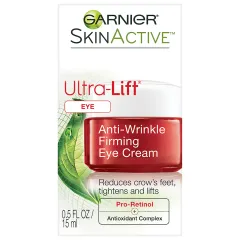
Works for:
based on ingredients and %- Moisturizing
- Anti-aging
- Exfoliation
- Anti-oxidation
Can it cause trouble?
- Irritation risk: low
- Comedogenic risk ingredients: 4
Key actives
Exfoliation
This product can help exfoliate the skin. In other words, it helps break down the bonds between dead cells on the surface of the skin and speed up the skin turnover. Skin often appears softer and brighter after exfoliation, but overdoing it can result in disrupted skin barrier. The following ingredient is doing the exfoliating job in this product: capryloyl salicylic acid.
Anti-aging
What does the product description say?
This anti-aging eye treatment reduces the appearance of fine lines and wrinkles
Source: Walgreens
This product contains ascorbyl glucoside. This ingredient might be able to help reduce and prevent fine lines and wrinkles, improve skin elasticity and firmness, but there is not enough evidence that it actually works.
A vitamin C derivative that is more stable but less potent than pure form of vitamin C. Has a potential to boost collagen production, nutralise free radicals and reduce hyperpigmentation, but the required concentration is likely to be much higher than for the pure form of vitamin C, limiting the ingredient's effectiveness in products
A great moisturising ingredient that softens the skin and reduces water loss from its upper layer. It also can be helpful in protecting skin from free radicals
An ester of a retinoid and linoleic acid. Three steps removed from the bioactive form of retinoid, retinoic acid. Once converted to retinoic acid in skin, it can help reduce wrinkles, stimulate collagen production, even out skin tone and reduce blemishes. The concentrations used in cosmetic products are often not high enough to have a positive effect in skin.
Anti-oxidation
This product contains antioxidants (ascorbyl glucoside) that might be able to help neutralize free radicals in skin to lessen the damage it gets from the UV light (sun). There is not enough evidence to confirm their effectiveness in skin though.
A vitamin C derivative that is more stable but less potent than pure form of vitamin C. Has a potential to boost collagen production, nutralise free radicals and reduce hyperpigmentation, but the required concentration is likely to be much higher than for the pure form of vitamin C, limiting the ingredient's effectiveness in products
A great moisturising ingredient that softens the skin and reduces water loss from its upper layer. It also can be helpful in protecting skin from free radicals
Might be helpful in neutralizing free radicals. Can have a dehydration effect that might somewhat decrease the look of puffy eyes
Helps attract water to the upper layer of the skin. Might have some anti-oxidant properties
An ester of a retinoid and linoleic acid. Three steps removed from the bioactive form of retinoid, retinoic acid. Once converted to retinoic acid in skin, it can help reduce wrinkles, stimulate collagen production, even out skin tone and reduce blemishes. The concentrations used in cosmetic products are often not high enough to have a positive effect in skin.
Evens skin tone
The following ingredient (ingredients) in this product might be helpful, but there is no evidence to confirm that it actually works: ascorbyl glucoside, capryloyl salicylic acid.
A vitamin C derivative that is more stable but less potent than pure form of vitamin C. Has a potential to boost collagen production, nutralise free radicals and reduce hyperpigmentation, but the required concentration is likely to be much higher than for the pure form of vitamin C, limiting the ingredient's effectiveness in products
An ester of a retinoid and linoleic acid. Three steps removed from the bioactive form of retinoid, retinoic acid. Once converted to retinoic acid in skin, it can help reduce wrinkles, stimulate collagen production, even out skin tone and reduce blemishes. The concentrations used in cosmetic products are often not high enough to have a positive effect in skin.
Moisturizing
What does the product description say?
Ultra-Lift anti-wrinkle eye cream deeply hydrates and improves elasticity
Source: Walgreens
This product can help improve hydration of the skin with the two types of ingredients.
The first type is called “humectants”:
these ingredients help attract water.
When humectants are on the surface of the skin, they “pull in” the moisture from the outside environment, or from
within deeper layers of the skin. The following ingredients in this product do the job:
glycerin, hydrolyzed rice protein.
This product also contains ingredients called “occlusives”. They help reduce the speed with which our skin loses moisture to the outside environment. These ingredients also help soften the upper layer of the skin, so it feels less tight and nicer to the touch. The following ingredients in this product do the job: butyrospermum parkii butter, dimethicone.
A silicone that helps to reduce water loss from the surface of the skin. Can temporarily "fill in" lines and wrinkles, absorb oil, and create a nice product finish
A great moisturising ingredient that softens the skin and reduces water loss from its upper layer. It also can be helpful in protecting skin from free radicals
One of the best moisturizing ingredients. Naturally present in skin. It attracts water to the upper layer of the skin working as a humectant
A silicone that makes products more spreadable and keeps skin smooth. Helps to add gloss to skin and may visually fill in fine lines/wrinkles for short time
Helps soften the upper layer of the skin and create a nice product consistency
Helps create a nice product texture and attract water to the upper layer of the skin
A non-drying alcohol. Works as an emollient. Helps water and oil mix together and creates a nice product texture
Helps attract water to the upper layer of the skin. Might have some anti-oxidant properties
An emollient that is naturally present in skin and helps soften it
An emollient that softens the skin and forms a protective layer on its surface. Helps water and oil mix together
Helps soften the upper layer of the skin and create a thicker product consistency
Used to create a nice product texture and help delivery of other ingredients. Might be somewhat helpful in attracting water to the upper layer of the skin
Helps oil and water mix together and works as an emollient
How honest is this product?
| Promise | Can it deliver? |
|---|---|
| Anti-aging | |
| Moisturizing |
Total Promises Fulfilled score: 75/100.
Potential irritants
Comedogenic ingredients
User reviews (0)
Averages from community submissions.
No reviews yet for this product.
Be the first to share your experience!
Tried this product?
Help capture what the ingredient list can't—texture, finish, pilling, scent, and more. Answer what you can, skip the rest.
Takes ~30 seconds.
Reviews are shown in aggregate. No personal details.
Key Actives
An ester of a retinoid and linoleic acid. Three steps removed from the bioactive form of retinoid, retinoic acid. Once converted to retinoic acid in skin, it can help reduce wrinkles, stimulate collagen production, even out skin tone and reduce blemishes. The concentrations used in cosmetic products are often not high enough to have a positive effect in skin.
A vitamin C derivative that is more stable but less potent than pure form of vitamin C. Has a potential to boost collagen production, nutralise free radicals and reduce hyperpigmentation, but the required concentration is likely to be much higher than for the pure form of vitamin C, limiting the ingredient's effectiveness in products
A great moisturising ingredient that softens the skin and reduces water loss from its upper layer. It also can be helpful in protecting skin from free radicals
A silicone that helps to reduce water loss from the surface of the skin. Can temporarily "fill in" lines and wrinkles, absorb oil, and create a nice product finish
Might be helpful in neutralizing free radicals. Can have a dehydration effect that might somewhat decrease the look of puffy eyes
One of the best moisturizing ingredients. Naturally present in skin. It attracts water to the upper layer of the skin working as a humectant
Works as a UV filter when used in high concentrations. It is photostable and is effective mostly against the UVB light, with some protection in the UVA range. In small concentrations, used for its ability to improve the color of cosmetic products. Is usually well tolerated by the skin
A silicone that makes products more spreadable and keeps skin smooth. Helps to add gloss to skin and may visually fill in fine lines/wrinkles for short time
Used to create a gel-like product texture, as well as to stabilize emulsions
Potential irritants
An ester of a retinoid and linoleic acid. Three steps removed from the bioactive form of retinoid, retinoic acid. Once converted to retinoic acid in skin, it can help reduce wrinkles, stimulate collagen production, even out skin tone and reduce blemishes. The concentrations used in cosmetic products are often not high enough to have a positive effect in skin.
Helps soften the upper layer of the skin and create a thicker product consistency
Helps soften the upper layer of the skin and create a nice product consistency
A vitamin C derivative that is more stable but less potent than pure form of vitamin C. Has a potential to boost collagen production, nutralise free radicals and reduce hyperpigmentation, but the required concentration is likely to be much higher than for the pure form of vitamin C, limiting the ingredient's effectiveness in products
Might be helpful in neutralizing free radicals. Can have a dehydration effect that might somewhat decrease the look of puffy eyes
Used to thicken the product's consistency
Comedogenic ingredients
Helps soften the upper layer of the skin and create a thicker product consistency
A non-drying alcohol. Works as an emollient. Helps water and oil mix together and creates a nice product texture
A great moisturising ingredient that softens the skin and reduces water loss from its upper layer. It also can be helpful in protecting skin from free radicals
Used to thicken the product's consistency
All ingredients
Used to create a nice product texture and help delivery of other ingredients. Might be somewhat helpful in attracting water to the upper layer of the skin
One of the best moisturizing ingredients. Naturally present in skin. It attracts water to the upper layer of the skin working as a humectant
A silicone that helps to reduce water loss from the surface of the skin. Can temporarily "fill in" lines and wrinkles, absorb oil, and create a nice product finish
Helps soften the upper layer of the skin and create a thicker product consistency
A non-drying alcohol. Works as an emollient. Helps water and oil mix together and creates a nice product texture
Helps soften the upper layer of the skin and create a nice product consistency
The same compound that is used safely in dental implants and bone cements. In cosmetics, it is used to improve the consistency of products
Used to create a thicker product consistency
A vitamin C derivative that is more stable but less potent than pure form of vitamin C. Has a potential to boost collagen production, nutralise free radicals and reduce hyperpigmentation, but the required concentration is likely to be much higher than for the pure form of vitamin C, limiting the ingredient's effectiveness in products
A great moisturising ingredient that softens the skin and reduces water loss from its upper layer. It also can be helpful in protecting skin from free radicals
Might be helpful in neutralizing free radicals. Can have a dehydration effect that might somewhat decrease the look of puffy eyes
Works as a UV filter when used in high concentrations. It is photostable and is effective mostly against the UVB light, with some protection in the UVA range. In small concentrations, used for its ability to improve the color of cosmetic products. Is usually well tolerated by the skin
Used to stabilize product formulations and create a nice product texture
A silicone that makes products more spreadable and keeps skin smooth. Helps to add gloss to skin and may visually fill in fine lines/wrinkles for short time
An emollient that softens the skin and forms a protective layer on its surface. Helps water and oil mix together
Helps attract water to the upper layer of the skin. Might have some anti-oxidant properties
Creates an illusion of smoother and more radiant skin tone. Adds shimmer to the skin by reflecting light
An emollient that is naturally present in skin and helps soften it
Helps oil and water mix togehter and creates a nice product texture
Helps create a nice product texture and attract water to the upper layer of the skin
A preservative. It helps prevent bacterial growth in cosmetic products
An ester of a retinoid and linoleic acid. Three steps removed from the bioactive form of retinoid, retinoic acid. Once converted to retinoic acid in skin, it can help reduce wrinkles, stimulate collagen production, even out skin tone and reduce blemishes. The concentrations used in cosmetic products are often not high enough to have a positive effect in skin.
Used to create a gel-like product texture, as well as to stabilize emulsions
Used to thicken the product's consistency
Ingredient list view
Water, Butylene glycol, Glycerin, Dimethicone, Isopropyl palmitate, Cetearyl alcohol, Isopropyl lauroyl sarcosinate, Alumina, Ammonium polyacryloyldimethyl taurate, Ascorbyl glucoside, Butyrospermum parkii butter, Caffeine, Capryloyl salicylic acid, Chlorhexidine digluconate, Chlorphenesin, Titanium dioxide, Dimethicone/vinyl dimethicone crosspolymer, Dimethiconol, Disodium edta, Glyceryl stearate, Hydrolyzed rice protein, Isopropyl titanium triisostearate, Methylparaben, Mica, Palmitic acid, Peg-100 stearate, Peg/ppg/polybutylene glycol-8/5/3 glycerin, Phenoxyethanol, Retinyl linoleate, Sodium hydroxide, Sodium polyacrylate, Stearic acid, Zea mays starch
- Glycerol and the skin: holistic approach to its origin and functions
- Dimethicone as a protective ingredient in topical medications
- Final Report on the Safety Assessment of Dimethicone Copolyol
- Final Report on the Safety Assessment of Isopropyl Isostearate
- Safety Assessment of Alumina and Aluminum Hydroxide as Used in Cosmetics
- Safety Assessment of Acryloyldimethyltaurate Polymers as Used in Cosmetics
- The Roles of Vitamin C in Skin Health
- Stability, transdermal penetration, and cutaneous effects of ascorbic acid and its derivatives
- Protection Against Free Radicals (UVB Irradiation) of a Water-Soluble Enzymatic Extract from Rice Bran. Study Using Human Keratinocyte Monolayer and Reconstructed Human Epidermis
- Amended final report on the safety assessment of Oryza Sativa (rice) Bran Oil, Oryza Sativa (rice) Germ Oil, Rice Bran Acid,Oryza Sativa (rice) Bran Wax, Hydrogenated Rice Bran Wax, Oryza Sativa (rice)Bran Extract, Oryza Sativa (rice) Extract, Oryza Sativa (rice) Germ Powder, Oryza Sativa (rice) Starch, Oryza Sativa (rice) Bran, Hydrolyzed Rice Bran Extract, Hydrolyzed Rice Bran Protein, Hydrolyzed Rice Extract, and Hydrolyzed Rice Protein
- Metabolism of topical retinaldehyde and retinol by mouse skin in vivo: predominant formation of retinyl esters and identification of 14‐hydroxy‐4, 14‐retro‐retinol
- Auto-regulation of Retinoic Acid Biosynthesis through Regulation of Retinol Esterification in Human Keratinocytes