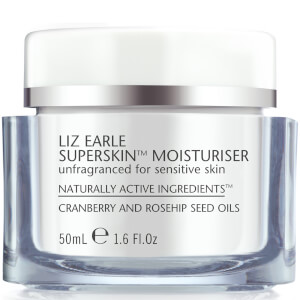
Liz Earle Superskin Moisturiser Original Jar
Works for
1 of 2 advertised claims delivered
Moisturizing11 ingredients credited for this claimGood support
“Superskin Moisturiser Original Jar”
This product can help improve hydration of the skin with the two types of ingredients.
The first type is called “humectants”:
these ingredients help attract water.
When humectants are on the surface of the skin, they “pull in” the moisture from the outside environment, or from
within deeper layers of the skin. The following ingredients in this product do the job:
glycerin.
This product also contains ingredients called “occlusives”. They help reduce the speed with which our skin loses moisture to the outside environment. These ingredients also help soften the upper layer of the skin, so it feels less tight and nicer to the touch. The following ingredients in this product do the job: borago officinalis seed oil, rosa rubiginosa seed oil.
Anti-aging3 ingredients credited for this claimLimited support
“Pomegranate flowers sourced from India adds to the cream’s antioxidant and firming properties, making this anti-ageing cream a protective mask that deflects external aggressors that can cause ageing.”
This product does not contain ingredients that are able to reduce fine lines and wrinkles or help with skin elasticity, but it can improve the look of the skin temporarily through moisturization. Well-moisturized skin might also be able to repair the sun damage better.This ingredient - sodium ascorbyl phosphate - could be helpful for preventing or repairing signs of aging in theory, but there is no evidence that it actually works.
This ingredient sodium ascorbyl phosphate might be able to help neutralize free radicals in skin and help it fight off some of the sun damage.
Anti-oxidationNot advertised by the brand · 5 ingredients credited for this claimModerate support
This product contains antioxidants (sodium ascorbyl phosphate, vaccinium macrocarpon seed oil) that might be able to help neutralize free radicals in skin to lessen the damage it gets from the UV light (sun). There is not enough evidence to confirm their effectiveness in skin though.
Can it cause trouble?
Irritancy1 strong irritant: Rosa rubiginosa seed oilMedium risk
Comedogenic2 ingredients rated 2 or more on the 0–5 pore-clogging scale2 flagged
User reviews
Be the first — your take helps the next person decide.
Ingredients
Filter by role to see what each ingredient is doing.
Water~40–60%
Glycerin~4.1–6.2%
- Irritation risk
- Low
One of the best moisturizing ingredients. Naturally present in skin. It attracts water to the upper layer of the skin working as a humectant
More about GlycerinEthylhexyl stearate~3.8–5.7%
- Irritation risk
- Low
Helps soften the upper layer of the skin
More about Ethylhexyl stearateVaccinium macrocarpon seed oil~2.8–4.3%
- Irritation risk
- Medium
A plant oil that can help neutralize free radicals, soften the upper layer of the skin, and support skin's barrier function
More about Vaccinium macrocarpon seed oilDiheptyl succinate~2.2–3.3%
- Irritation risk
- Low
Helps to soften the upper layer of the skin and creates a nice product finish on the skin
More about Diheptyl succinateRosa rubiginosa seed oil~1.8–2.8%
- Irritation risk
- High
Plant oil that due to the high content of linoleic acid can support skin's barrier function and reduce moisture loss
More about Rosa rubiginosa seed oilBorago officinalis seed oil~1.5–2.2%
- Irritation risk
- Low
A plant oil that is effective in reducing irritation in skin, restore the barrier function and support its hydration
More about Borago officinalis seed oilCetearyl alcohol~1.3–2%
- Irritation risk
- Low
- Comedogenicity
- 2/5
A non-drying alcohol. Works as an emollient. Helps water and oil mix together and creates a nice product texture
More about Cetearyl alcoholPentaerythrityl distearate~1.1–1.6%
Glyceryl stearate~0.85–1.3%
- Irritation risk
- Low
An emollient that softens the skin and forms a protective layer on its surface. Helps water and oil mix together
More about Glyceryl stearateButyrospermum parkii butter~0.55–1.25%
- Irritation risk
- Low
- Comedogenicity
- 3/5
A great moisturising ingredient that softens the skin and reduces water loss from its upper layer. It also can be helpful in protecting skin from free radicals
More about Butyrospermum parkii butterPunica granatum flower extract~0.4–0.95%
- Irritation risk
- Low
Maltodextrin~0.4–0.9%
- Irritation risk
- Low
Used to stabilize the product formulation and can help absorb oil
More about MaltodextrinPhenoxyethanol~0.35–0.8%
- Irritation risk
- Low
A preservative. It helps prevent bacterial growth in cosmetic products
More about PhenoxyethanolTocopherol~0.3–0.75%
- Irritation risk
- Low
Pure form of vitamin E. Can help moisturise and protect the skin from free radicals. Often used to help stabilise other ingredients or the formula itself
More about TocopherolCitronellyl methylcrotonate~0.15–0.65%
- Irritation risk
- Low
Sodium polyacrylate~0.2–0.75%
- Irritation risk
- Low
Used to create a gel-like product texture, as well as to stabilize emulsions
More about Sodium polyacrylateSodium stearoyl glutamate~0.2–0.75%
- Irritation risk
- Medium
Helps oil and water mix together
More about Sodium stearoyl glutamateCapryloyl glycerin/sebacic acid copolymer~0.15–0.5%
- Irritation risk
- Low
Helps soften the upper layer of the skin
More about Capryloyl glycerin/sebacic acid copolymerEthylhexylglycerin~0.1–0.4%
Benzoic acid~0.1–0.35%
Xanthan gum~0.1–0.3%
- Irritation risk
- Low
Used to create a thicker product consistency
More about Xanthan gumDehydroacetic acid~0.05–0.25%
Sodium ascorbyl phosphate~0.05–0.2%
- Irritation risk
- Medium
A stable derivative of vitamin C. It is oil-soluble which means it is more likely to penetrate the skin compared to the pure form of vitamin C (which is water-soluble), but it is less bio-available and is way less effective in stimulating collagen and reducing wrinkles compared to the pure form of vitamin C (L-ascorbic acid) and its other derivatives (for example, magnesium ascorbyl phosphate). At the same time, this vitamin C derivative has been shown in studies to be effective in reducing acne, blemishes and clogged pores. It is less irritating then the pure form of vitamin C
More about Sodium ascorbyl phosphateCitric acid~0.05–0.1%
- Irritation risk
- Medium
Can work as an exfoliant but is typically used to adjust the product pH
More about Citric acidIngredient list view
Water, Glycerin, Ethylhexyl stearate, Vaccinium macrocarpon seed oil, Diheptyl succinate, Rosa rubiginosa seed oil, Borago officinalis seed oil, Cetearyl alcohol, Pentaerythrityl distearate, Glyceryl stearate, Butyrospermum parkii butter, Punica granatum flower extract, Maltodextrin, Phenoxyethanol, Tocopherol, Citronellyl methylcrotonate, Sodium polyacrylate, Sodium stearoyl glutamate, Capryloyl glycerin/sebacic acid copolymer, Ethylhexylglycerin, Benzoic acid, Xanthan gum, Dehydroacetic acid, Sodium ascorbyl phosphate, Citric acid
Compare prices
Retailers ranked by price — lowest first.

Affiliate links · prices updated regularly
Sources cited in this review
Every concentration estimate and effectiveness label is anchored to one of these 15 studies and safety reviews.
- 1
- 2Wound‐healing Properties of the Oils of Vitis vinifera and Vaccinium macrocarpononlinelibrary.wiley.com
- 3
- 4
- 5
- 6Vitamin E in dermatologyncbi.nlm.nih.gov

Affiliate links · As an Amazon Associate, WIMJ earns from qualifying purchases.