Works for
2 of 2 advertised claims delivered
Moisturizing18 ingredients credited for this claimGood support
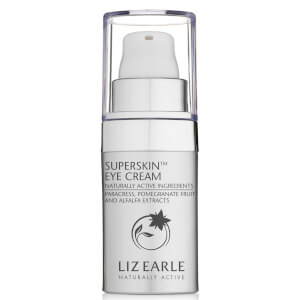
“Superskin Eye Cream”
This product can help improve hydration of the skin with the two types of ingredients.
The first type is called “humectants”:
these ingredients help attract water.
When humectants are on the surface of the skin, they “pull in” the moisture from the outside environment, or from
within deeper layers of the skin. The following ingredients in this product do the job:
arginine, aspartic acid.
This product also contains ingredients called “occlusives”. They help reduce the speed with which our skin loses moisture to the outside environment. These ingredients also help soften the upper layer of the skin, so it feels less tight and nicer to the touch. The following ingredients in this product do the job: arginine, butyrospermum parkii butter.
Anti-aging6 ingredients credited for this claimModerate support
“Formulated to reduce the appearance of fine lines, wrinkles and dark circles, the velvety cream encourages a firmer and brighter undereye.”
This product contains aspartic acid. This ingredient might be able to help reduce and prevent fine lines and wrinkles, improve skin elasticity and firmness, but there is not enough evidence that it actually works.
Anti-oxidationNot advertised by the brand · 11 ingredients credited for this claimModerate support
This product contains antioxidants (camellia sinensis leaf extract, vaccinium macrocarpon seed oil) that might be able to help neutralize free radicals in skin to lessen the damage it gets from the UV light (sun). There is not enough evidence to confirm their effectiveness in skin though.
Can it cause trouble?
Irritancy1 strong irritant: Rosa rubiginosa seed oilMedium risk
Comedogenic3 ingredients rated 2 or more on the 0–5 pore-clogging scale3 flagged
User reviews
Be the first — your take helps the next person decide.
Ingredients
Filter by role to see what each ingredient is doing.
Water~45–55%
Caprylic/capric triglyceride~6.3–7.7%
- Irritation risk
- Medium
A good mix of fatty acids that forms a protective layer on the skin. Improves the shelf life of products. Derived from coconut and glycerin
More about Caprylic/capric triglycerideButyrospermum parkii butter~4.3–5.3%
- Irritation risk
- Low
- Comedogenicity
- 3/5
A great moisturising ingredient that softens the skin and reduces water loss from its upper layer. It also can be helpful in protecting skin from free radicals
More about Butyrospermum parkii butterSodium polyacrylate~3.3–4%
- Irritation risk
- Low
Used to create a gel-like product texture, as well as to stabilize emulsions
More about Sodium polyacrylateBorago officinalis seed oil~2.4–2.9%
- Irritation risk
- Low
A plant oil that is effective in reducing irritation in skin, restore the barrier function and support its hydration
More about Borago officinalis seed oilRosa rubiginosa seed oil~2–2.4%
- Irritation risk
- High
Plant oil that due to the high content of linoleic acid can support skin's barrier function and reduce moisture loss
More about Rosa rubiginosa seed oilMyristyl myristate~1.7–2.1%
- Irritation risk
- Medium
- Comedogenicity
- 3/5
An emollient. Is not recommended for acne-prone skin as it can be comedogenic
More about Myristyl myristateVaccinium macrocarpon seed oil~1.4–1.7%
- Irritation risk
- Medium
A plant oil that can help neutralize free radicals, soften the upper layer of the skin, and support skin's barrier function
More about Vaccinium macrocarpon seed oilSoybean glycerides~1.1–1.4%
- Irritation risk
- Low
Help soften the upper layer of the skin
More about Soybean glyceridesPropanediol~0.75–1.15%
- Irritation risk
- Low
Acts as a solvent for other ingredients. Speeds up the absorption of other ingredients into the skin
More about PropanediolTocopherol~0.6–0.9%
- Irritation risk
- Low
Pure form of vitamin E. Can help moisturise and protect the skin from free radicals. Often used to help stabilise other ingredients or the formula itself
More about TocopherolCamellia sinensis leaf extract~0.5–0.75%
- Irritation risk
- Low
Can contain potent anti-oxidant compounds (abbreviated ECG, GCG, EGC, and EGCG) that might help protect the skin from free radicals. Can help calm down inflammation and has some anti-bacterial properties. Unfortunately, these antioxidants are unstable and lose their effectiveness very quickly in products. The concentration of the antioxidant compounds in the extract also tends to be low to be effective in topical formulation
More about Camellia sinensis leaf extractPunica granatum fruit extract~0.35–0.65%
- Irritation risk
- High
A fruit extract that is used to add a fragrance to the product. It might have some antioxidant properties
More about Punica granatum fruit extractMedicago sativa seed extract~0.3–0.55%
- Irritation risk
- Low
Spilanthes acmella flower extract~0.25–0.5%
- Irritation risk
- High
Plant extract that might hep calm down inflammation in skin
More about Spilanthes acmella flower extractAlaria esculenta extract~0.3–0.55%
- Irritation risk
- Low
Works as a humectant helping to attract water to the upper layer of the skin and might be effective as an anti-oxidant.
More about Alaria esculenta extractRheum rhaponticum root extract~0.25–0.5%
- Irritation risk
- Low
Phenoxyethanol~0.25–0.5%
- Irritation risk
- Low
A preservative. It helps prevent bacterial growth in cosmetic products
More about PhenoxyethanolSodium stearoyl glutamate~0.25–0.5%
- Irritation risk
- Medium
Helps oil and water mix together
More about Sodium stearoyl glutamateLactobacillus ferment lysate~0.2–0.35%
- Irritation risk
- Low
A "broth" with parts of dead cells of lactobacteria. Might be helpful supporting diverse microbiome in skin, but evidence is lacking
More about Lactobacillus ferment lysateButyrospermum parkii butter unsaponifiables~0.15–0.3%
- Irritation risk
- Low
- Comedogenicity
- 2/5
A great moisturizing ingredient that softens the skin and reduces water loss from its upper layer. It also can be helpful in protecting skin from free radicals
More about Butyrospermum parkii butter unsaponifiablesSodium hyaluronate~0.2–0.35%
- Irritation risk
- Low
One of the best moisturizing ingredients. Attracts water into the upper layer of the skin
More about Sodium hyaluronateXanthan gum~0.15–0.3%
- Irritation risk
- Low
Used to create a thicker product consistency
More about Xanthan gumSaccharomyces cerevisiae extract~0.15–0.25%
- Irritation risk
- Medium
A moisturizing ingredient that works as a humectant to attract water to the upper layer of the skin.
More about Saccharomyces cerevisiae extractHydrolyzed lupine protein~0.15–0.3%
- Irritation risk
- Low
Arginine~0.15–0.25%
- Irritation risk
- Low
An amino acid that is naturally present in skin and helps keep it hydrated. When used together with AHAs, it can reduce their irritating effect on the skin
More about ArginineTrisodium ethylenediamine disuccinate~0.15–0.25%
- Irritation risk
- Medium
Used to improve stability of the formulation
More about Trisodium ethylenediamine disuccinateLactobacillus ferment~0.15–0.3%
- Irritation risk
- Low
A fermentation product created by bacteria Lactobacillus. The fermented product has anti-bacterial properties and might be helpful in calming down inflammation, but studies are lacking. Helps attract water to the upper layer of the skin. Can be used as a preservative
More about Lactobacillus fermentHydrolyzed hyaluronic acid~0.15–0.3%
- Irritation risk
- Low
One of the best moisturizing ingredients. Attracts water into the upper layer of the skin. A version of it is naturally present in skin
More about Hydrolyzed hyaluronic acidChlorphenesin~0.1–0.2%
Caffeine~0.1–0.2%
- Irritation risk
- Medium
Might be helpful in neutralizing free radicals. Can have a dehydration effect that might somewhat decrease the look of puffy eyes
More about CaffeineEthylhexylglycerin~0.1–0.2%
Aspartic acid~0.1–0.15%
- Irritation risk
- Low
An amino-acid that helps increase skin hydration and might help to slightly improve skin firmness, potentially reducing lines and wrinkles
More about Aspartic acidAscorbyl palmitate~0.05–0.1%
- Irritation risk
- Medium
Being a lipid soluble form of vitamin C, it is more stable and can penetrate the skin better than L-Ascorbic acid. It is effective in protecting the skin from free radicals, as well as evening the skin tone, but is less effective in stimulating collagen production compared to L-Ascorbic acid.
More about Ascorbyl palmitateSodium chloride~0.05–0.1%
- Irritation risk
- Low
Used to stabilize mixtures of oil and water, and create thicker, gel-like product textures
More about Sodium chlorideCitric acid~0.01–0.05%
- Irritation risk
- Medium
Can work as an exfoliant but is typically used to adjust the product pH
More about Citric acidIngredient list view
Water, Caprylic/capric triglyceride, Butyrospermum parkii butter, Sodium polyacrylate, Borago officinalis seed oil, Rosa rubiginosa seed oil, Myristyl myristate, Vaccinium macrocarpon seed oil, Soybean glycerides, Propanediol, Tocopherol, Camellia sinensis leaf extract, Punica granatum fruit extract, Medicago sativa seed extract, Spilanthes acmella flower extract, Alaria esculenta extract, Rheum rhaponticum root extract, Phenoxyethanol, Sodium stearoyl glutamate, Lactobacillus ferment lysate, Butyrospermum parkii butter unsaponifiables, Sodium hyaluronate, Xanthan gum, Saccharomyces cerevisiae extract, Hydrolyzed lupine protein, Arginine, Trisodium ethylenediamine disuccinate, Lactobacillus ferment, Hydrolyzed hyaluronic acid, Chlorphenesin, Caffeine, Ethylhexylglycerin, Aspartic acid, Ascorbyl palmitate, Sodium chloride, Citric acid
Compare prices
Retailers ranked by price — lowest first.
Affiliate links · prices updated regularly · As an Amazon Associate, WIMJ earns from qualifying purchases.
Sources cited in this review
Every concentration estimate and effectiveness label is anchored to one of these 16 studies and safety reviews.
- 1
- 2
- 3Wound‐healing Properties of the Oils of Vitis vinifera and Vaccinium macrocarpononlinelibrary.wiley.com
- 4
- 5Vitamin E in dermatologyncbi.nlm.nih.gov
- 6Vitamin E and Skin Healthlpi.oregonstate.edu

Affiliate links · As an Amazon Associate, WIMJ earns from qualifying purchases.