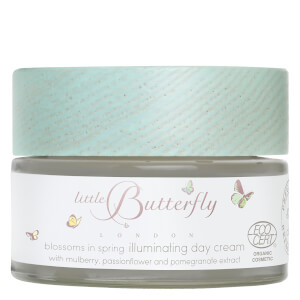
Little Butterfly London Blossoms in Spring Illuminating Day Cream
Works for
1 of 2 advertised claims delivered
Moisturizing14 ingredients credited for this claimGood support
“Blossoms in Spring Illuminating Day Cream”
This product can help improve hydration of the skin with the two types of ingredients.
The first type is called “humectants”:
these ingredients help attract water.
When humectants are on the surface of the skin, they “pull in” the moisture from the outside environment, or from
within deeper layers of the skin. The following ingredients in this product do the job:
glycerin, aloe barbadensis leaf juice.
This product also contains ingredients called “occlusives”. They help reduce the speed with which our skin loses moisture to the outside environment. These ingredients also help soften the upper layer of the skin, so it feels less tight and nicer to the touch. The following ingredients in this product do the job: borago officinalis seed oil, cucumis sativus oil.
Anti-aging4 ingredients credited for this claimWeak support
“Also harnesses the collagen-enhancing properties of Argan Leaf to promotes firmness, plus White Mulberry to brighten the look of skin and encourage a radiant, energised and youthful-looking complexion. Housed in recyclable packaging. Made in England. Not tested on animals. Cruelty free. Vegetarian Society approved.”
Effective ingredients missing or their concentration is too low.
Can it cause trouble?
Irritancy3 strong irritants: Parfum, Passiflora incarnata seed oil + 1 more — patch-test recommendedHigh risk
Comedogenic1 ingredient rated 2 or more on the 0–5 pore-clogging scale1 flagged
User reviews
Be the first — your take helps the next person decide.
Ingredients
Filter by role to see what each ingredient is doing.
Water~45–55%
Aloe barbadensis leaf juice~6.8–8.4%
- Irritation risk
- Medium
Traditionally used to treat sunburns, dermatitis and inflammation, but evidence for its effectiveness is lacking. The extract can contain humectants that help attract water into the skin
More about Aloe barbadensis leaf juiceCoco-caprylate~4.3–5.3%
- Irritation risk
- Medium
An emollient that softens skin and creates a nice product texture
More about Coco-caprylateCetearyl alcohol~2.5–3%
- Irritation risk
- Low
- Comedogenicity
- 2/5
A non-drying alcohol. Works as an emollient. Helps water and oil mix together and creates a nice product texture
More about Cetearyl alcoholGlycerin~2.3–2.9%
- Irritation risk
- Low
One of the best moisturizing ingredients. Naturally present in skin. It attracts water to the upper layer of the skin working as a humectant
More about GlycerinGlyceryl stearate~1.9–2.3%
- Irritation risk
- Low
An emollient that softens the skin and forms a protective layer on its surface. Helps water and oil mix together
More about Glyceryl stearatePrunus persica kernel oil~1.6–2%
- Irritation risk
- Low
Cetearyl glucoside~1.4–1.7%
- Irritation risk
- Medium
Helps water and oil in the product mix well together and improves product texture
More about Cetearyl glucosideGlyceryl caprylate~1.2–1.4%
- Irritation risk
- Low
An emollient that can also help water and oil mix together, as well as prevent bacteria growth in products
More about Glyceryl caprylateTocopherol~0.9–1.1%
- Irritation risk
- Low
Pure form of vitamin E. Can help moisturise and protect the skin from free radicals. Often used to help stabilise other ingredients or the formula itself
More about TocopherolBenzyl alcohol~0.55–0.85%
- Irritation risk
- High
A preservative. Can be used to mask unpleasant smell. Can be irritating
More about Benzyl alcoholSodium stearoyl glutamate~0.6–0.85%
- Irritation risk
- Medium
Helps oil and water mix together
More about Sodium stearoyl glutamateCitric acid~0.45–0.7%
- Irritation risk
- Medium
Can work as an exfoliant but is typically used to adjust the product pH
More about Citric acidVitis vinifera seed oil~0.45–0.7%
- Irritation risk
- Medium
A great emollient that can also have anti-oxidant properties
More about Vitis vinifera seed oilXanthan gum~0.4–0.6%
- Irritation risk
- Low
Used to create a thicker product consistency
More about Xanthan gumArgania spinosa extract~0.35–0.6%
- Irritation risk
- Low
Borago officinalis seed oil~0.35–0.65%
- Irritation risk
- Low
A plant oil that is effective in reducing irritation in skin, restore the barrier function and support its hydration
More about Borago officinalis seed oilCarica papaya seed oil~0.3–0.55%
- Irritation risk
- Low
Cucumis sativus oil~0.3–0.55%
- Irritation risk
- Low
A plant oil that works as a great moisturizer by softening the upper layer of the skin. Due to the high linoleic acid content, can help reduce inflammation in skin
More about Cucumis sativus oilParfum~0.25–0.45%
- Irritation risk
- High
An aromatic blend of unspecified and possibly irritating ingredients
More about ParfumPassiflora incarnata seed oil~0.25–0.45%
- Irritation risk
- High
A plant oil that can help soften the upper layer of the skin. Contains essential oil that can be irritating
More about Passiflora incarnata seed oilPrunus armeniaca kernel oil~0.25–0.5%
- Irritation risk
- Medium
An emollient that helps soften the skin
More about Prunus armeniaca kernel oilMaltodextrin~0.2–0.4%
- Irritation risk
- Low
Used to stabilize the product formulation and can help absorb oil
More about MaltodextrinSodium phytate~0.2–0.4%
Dehydroacetic acid~0.25–0.4%
Morus alba root extract~0.2–0.4%
- Irritation risk
- Low
Sodium benzoate~0.2–0.4%
Lactic acid~0.2–0.4%
- Irritation risk
- Medium
An exfoliating and moisturizing alpha-hydroxy acid (AHA). Typically causes less irritation than other AHAs, for example, glycolic acid. At high concentrations (about 15%), lactic acid can help reduce lines and wrinkles. Recent studies show that lactic acid can support the "good" bacteria living on skin's surface (healthy skin microbiome)
More about Lactic acidPotassium sorbate~0.2–0.35%
Arctium lappa root extract~0.15–0.3%
- Irritation risk
- High
Plant extract. Has some anti-microbial and anti-oxidant properties. Can be irritating
More about Arctium lappa root extractCamellia sinensis leaf extract~0.15–0.3%
- Irritation risk
- Low
Can contain potent anti-oxidant compounds (abbreviated ECG, GCG, EGC, and EGCG) that might help protect the skin from free radicals. Can help calm down inflammation and has some anti-bacterial properties. Unfortunately, these antioxidants are unstable and lose their effectiveness very quickly in products. The concentration of the antioxidant compounds in the extract also tends to be low to be effective in topical formulation
More about Camellia sinensis leaf extractEuterpe oleracea fruit extract~0.15–0.25%
- Irritation risk
- Medium
A plant extract that can have some anti-oxidant effect in skin
More about Euterpe oleracea fruit extractOcimum sanctum leaf extract~0.1–0.2%
- Irritation risk
- High
A plant extract that is rich in a fragrance compound eugenol that is a frequent allergen and can be irritating. It might also contain anti-oxidants to help neutralize free radicals
More about Ocimum sanctum leaf extractPunica granatum fruit extract~0.1–0.15%
- Irritation risk
- High
A fruit extract that is used to add a fragrance to the product. It might have some antioxidant properties
More about Punica granatum fruit extractIngredient list view
Water, Aloe barbadensis leaf juice, Coco-caprylate, Cetearyl alcohol, Glycerin, Glyceryl stearate, Prunus persica kernel oil, Cetearyl glucoside, Glyceryl caprylate, Tocopherol, Benzyl alcohol, Sodium stearoyl glutamate, Citric acid, Vitis vinifera seed oil, Xanthan gum, Argania spinosa extract, Borago officinalis seed oil, Carica papaya seed oil, Cucumis sativus oil, Parfum, Passiflora incarnata seed oil, Prunus armeniaca kernel oil, Maltodextrin, Sodium phytate, Dehydroacetic acid, Morus alba root extract, Sodium benzoate, Lactic acid, Potassium sorbate, Arctium lappa root extract, Camellia sinensis leaf extract, Euterpe oleracea fruit extract, Ocimum sanctum leaf extract, Punica granatum fruit extract, Unknown
Compare prices
Retailers ranked by price — lowest first.
Affiliate links · prices updated regularly · As an Amazon Associate, WIMJ earns from qualifying purchases.
Sources cited in this review
Every concentration estimate and effectiveness label is anchored to one of these 14 studies and safety reviews.
- 1
- 2Vitamin E in dermatologyncbi.nlm.nih.gov
- 3Vitamin E and Skin Healthlpi.oregonstate.edu
- 4
- 5
- 6

Affiliate links · As an Amazon Associate, WIMJ earns from qualifying purchases.