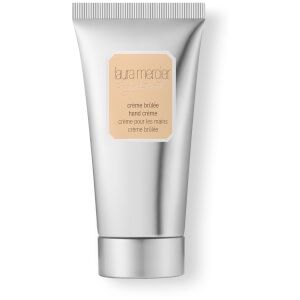
Laura Mercier Crème Brûlée Hand Crème
Works for
1 of 1 advertised claim delivered
Moisturizing32 ingredients credited for this claimGood support
“A luscious formulation of olive, sunflower and jojoba oils, this hydrates skin and nails and leaves them silkily smooth and sumptuously soft.”
This product can help improve hydration of the skin with the two types of ingredients.
The first type is called “humectants”:
these ingredients help attract water.
When humectants are on the surface of the skin, they “pull in” the moisture from the outside environment, or from
within deeper layers of the skin. The following ingredients in this product do the job:
cyclomethicone, glycerin.
This product also contains ingredients called “occlusives”. They help reduce the speed with which our skin loses moisture to the outside environment. These ingredients also help soften the upper layer of the skin, so it feels less tight and nicer to the touch. The following ingredients in this product do the job: dimethicone, dimethiconol.
Anti-oxidationNot advertised by the brand · 8 ingredients credited for this claimModerate support
This product contains antioxidants (ficus carica fruit extract) that might be able to help neutralize free radicals in skin to lessen the damage it gets from the UV light (sun). There is not enough evidence to confirm their effectiveness in skin though.
Can it cause trouble?
Irritancy18 strong irritants: Parfum, Benzophenone-3 + 16 more — patch-test recommendedHigh risk
Comedogenic8 ingredients rated 2 or more on the 0–5 pore-clogging scale8 flagged

User reviews
Be the first — your take helps the next person decide.
Ingredients
Filter by role to see what each ingredient is doing.
Water~45–55%
Cetearyl alcohol~5.1–6.2%
- Irritation risk
- Low
- Comedogenicity
- 2/5
A non-drying alcohol. Works as an emollient. Helps water and oil mix together and creates a nice product texture
More about Cetearyl alcoholCyclomethicone~4–4.9%
- Irritation risk
- Low
A type of silicone that leaves a nice silky finish on the skin and can help soften its upper layer
More about CyclomethiconeDimethiconol~3.1–3.8%
- Irritation risk
- Low
A silicone that makes products more spreadable and keeps skin smooth. Helps to add gloss to skin and may visually fill in fine lines/wrinkles for short time
More about DimethiconolParfum~1.8–2.2%
- Irritation risk
- High
An aromatic blend of unspecified and possibly irritating ingredients
More about ParfumGlyceryl stearate~1.9–2.3%
- Irritation risk
- Low
An emollient that softens the skin and forms a protective layer on its surface. Helps water and oil mix together
More about Glyceryl stearatePeg-100 stearate~1.6–2%
- Irritation risk
- Low
Helps oil and water mix togehter and creates a nice product texture
More about Peg-100 stearateJojoba esters~1.3–1.6%
- Irritation risk
- Medium
An emollient made of jojoba oil. Helps soften the skin and support its barrier function
More about Jojoba estersPhenoxyethanol~0.5–1%
- Irritation risk
- Low
A preservative. It helps prevent bacterial growth in cosmetic products
More about PhenoxyethanolCetyl phosphate~0.75–1.1%
Stearic acid~0.7–1.05%
- Irritation risk
- Low
Helps oil and water mix together and works as an emollient
More about Stearic acidDimethicone~0.5–0.8%
- Irritation risk
- Low
A silicone that helps to reduce water loss from the surface of the skin. Can temporarily "fill in" lines and wrinkles, absorb oil, and create a nice product finish
More about DimethiconeCarbomer~0.4–0.6%
- Irritation risk
- Low
Helps create a thicker or gel-like product texture. It is not a surfactant but can be used in gentle cleansing formulations
More about CarbomerAcrylates/c10-30 alkyl acrylate crosspolymer~0.35–0.6%
- Irritation risk
- Medium
Maintains the texture of skincare products. Allows the product to spread evenly. Helps oil and water mix together
More about Acrylates/c10-30 alkyl acrylate crosspolymerTetrasodium edta~0.3–0.5%
Methylparaben~0.15–0.3%
Vitis vinifera seed oil~0.3–0.55%
- Irritation risk
- Medium
A great emollient that can also have anti-oxidant properties
More about Vitis vinifera seed oilOlea europaea fruit oil~0.25–0.45%
- Irritation risk
- Medium
An emollient that helps soften the skin but is not effective for restoring its barrier function. Might be helpful to calm down inflammation
More about Olea europaea fruit oilSimmondsia chinensis seed oil~0.25–0.5%
- Irritation risk
- Medium
Softens the upper layer of skin and helps restore the healthy skin barrier. Has shown to help calm down inflammation in skin. It is a stable oil, meaning that it retains its properties even when exposed to air.
More about Simmondsia chinensis seed oilSorbitan stearate~0.2–0.4%
Propylparaben~0.15–0.3%
Benzophenone-3~0.3–0.6%
- Irritation risk
- High
Same as oxybenzone. Protects in the UVB and short UVA range. In small concentrations, used to stabilize product formulation. Can be irritating. Is shown to be harmful to coral reefs - consider avoiding bathing in coral reef areas when wearing a product with this ingredient. It can penetrate the skin and get absorbed into bloodstream faster than other popular filters available in the US. The study that produced this finding did not address any potential health effects of the absorption
More about Benzophenone-3Triethanolamine~0.15–0.3%
- Irritation risk
- Medium
Used to adjust pH of the product and can help improve the product's smell
More about TriethanolamineAloe barbadensis leaf juice~0.15–0.3%
- Irritation risk
- Medium
Traditionally used to treat sunburns, dermatitis and inflammation, but evidence for its effectiveness is lacking. The extract can contain humectants that help attract water into the skin
More about Aloe barbadensis leaf juiceHydrolyzed soy protein~0.15–0.3%
- Irritation risk
- Low
Helps attract water to the upper layer of the skin. Might have some anti-aging, anti-oxidant, and skin lightening properties, but solid evidence is missing
More about Hydrolyzed soy proteinTocopherol~0.15–0.3%
- Irritation risk
- Low
Pure form of vitamin E. Can help moisturise and protect the skin from free radicals. Often used to help stabilise other ingredients or the formula itself
More about TocopherolBenzyl benzoate~0.15–0.25%
- Irritation risk
- High
Fragrance with sweet balsamic smell. Help to preserve products and dissolve other ingredients. Could trigger allergic reactions and be irritating
More about Benzyl benzoateAnise alcohol~0.15–0.25%
- Irritation risk
- Low
Citronellol~0.15–0.25%
Coumarin~0.15–0.25%
Limonene~0.15–0.25%
- Irritation risk
- High
A common frangrance that can easily irritate skin, especially if exposed to air, light or heat
More about LimoneneEugenol~0.1–0.2%
Geraniol~0.15–0.25%
Hexyl cinnamal~0.15–0.25%
Linalool~0.15–0.25%
Alpha-isomethyl ionone~0.1–0.2%
- Irritation risk
- High
A fragrance. Potential allergen and can be irritating
More about Alpha-isomethyl iononeCi 19140~0.15–0.3%
Ci 16035~0.15–0.3%
Ci 60730~0.15–0.3%
- Irritation risk
- Low
Ci 42053~0.15–0.3%
- Irritation risk
- Low
Water~0.15–0.3%
Cetearyl alcohol~0.2–0.35%
- Irritation risk
- Low
- Comedogenicity
- 2/5
A non-drying alcohol. Works as an emollient. Helps water and oil mix together and creates a nice product texture
More about Cetearyl alcoholParfum~0.15–0.25%
- Irritation risk
- High
An aromatic blend of unspecified and possibly irritating ingredients
More about ParfumHydrogenated polydecene~0.15–0.3%
- Irritation risk
- Low
Helps to soften the upper layer of the skin and create a nice product texture
More about Hydrogenated polydeceneCaprylic/capric triglyceride~0.2–0.4%
- Irritation risk
- Medium
A good mix of fatty acids that forms a protective layer on the skin. Improves the shelf life of products. Derived from coconut and glycerin
More about Caprylic/capric triglycerideSorbitan stearate~0.15–0.3%
Pentylene glycol~0.2–0.35%
- Irritation risk
- Medium
Used to preserve products, dissolve other ingredients and create a nice product texture
More about Pentylene glycolIsononyl isononanoate~0.2–0.35%
- Irritation risk
- Low
Forms a protective film on the surface of the skin to prevent moisture loss. Gives a velvety feel to products while reducing tackiness
More about Isononyl isononanoateGlyceryl stearate~0.2–0.35%
- Irritation risk
- Low
An emollient that softens the skin and forms a protective layer on its surface. Helps water and oil mix together
More about Glyceryl stearatePeg-100 stearate~0.25–0.45%
- Irritation risk
- Low
Helps oil and water mix togehter and creates a nice product texture
More about Peg-100 stearateTocopherol~0.15–0.3%
- Irritation risk
- Low
Pure form of vitamin E. Can help moisturise and protect the skin from free radicals. Often used to help stabilise other ingredients or the formula itself
More about TocopherolTocopheryl acetate~0.15–0.3%
- Irritation risk
- Medium
A more stable but less bio-available form of vitamin E compared to Tocopherol. Might help moisturize and protect the skin from free radicals, but mostly used in low concentrations to stabilize other ingredients.
More about Tocopheryl acetateAloe barbadensis leaf juice~0.15–0.3%
- Irritation risk
- Medium
Traditionally used to treat sunburns, dermatitis and inflammation, but evidence for its effectiveness is lacking. The extract can contain humectants that help attract water into the skin
More about Aloe barbadensis leaf juiceHelianthus annuus seed oil~0.2–0.35%
- Irritation risk
- Low
A great emollient due to its high linoleic acid content. One of the most effective plant oils in helping skin hydration and repairing skin barrier function
More about Helianthus annuus seed oilVitis vinifera seed oil~0.2–0.35%
- Irritation risk
- Medium
A great emollient that can also have anti-oxidant properties
More about Vitis vinifera seed oilOlea europaea fruit oil~0.15–0.3%
- Irritation risk
- Medium
An emollient that helps soften the skin but is not effective for restoring its barrier function. Might be helpful to calm down inflammation
More about Olea europaea fruit oilSimmondsia chinensis seed oil~0.2–0.35%
- Irritation risk
- Medium
Softens the upper layer of skin and helps restore the healthy skin barrier. Has shown to help calm down inflammation in skin. It is a stable oil, meaning that it retains its properties even when exposed to air.
More about Simmondsia chinensis seed oilJojoba esters~0.2–0.35%
- Irritation risk
- Medium
An emollient made of jojoba oil. Helps soften the skin and support its barrier function
More about Jojoba estersHydrolyzed oat protein~0.15–0.25%
- Irritation risk
- Low
Helps attract water to the upper layer of the skin
More about Hydrolyzed oat proteinCarbomer~0.15–0.3%
- Irritation risk
- Low
Helps create a thicker or gel-like product texture. It is not a surfactant but can be used in gentle cleansing formulations
More about CarbomerTetrasodium edta~0.15–0.25%
Triethanolamine~0.15–0.3%
- Irritation risk
- Medium
Used to adjust pH of the product and can help improve the product's smell
More about TriethanolamineCaprylyl glycol~0.2–0.35%
- Irritation risk
- Medium
Helps preserve products and creates a nice product texture
More about Caprylyl glycolPhenoxyethanol~0.15–0.3%
- Irritation risk
- Low
A preservative. It helps prevent bacterial growth in cosmetic products
More about PhenoxyethanolHexylene glycol~0.15–0.25%
- Irritation risk
- Medium
Helps create a more spreadable product texture
More about Hexylene glycolAlcohol~0.15–0.3%
- Irritation risk
- High
Can be drying and contribute to skin irritation. Used in formulars to dissolve other ingredients, create a thinner product consistency or for its antibacterial properties
More about AlcoholBenzyl alcohol~0.1–0.25%
- Irritation risk
- High
A preservative. Can be used to mask unpleasant smell. Can be irritating
More about Benzyl alcoholBenzyl benzoate~0.15–0.25%
- Irritation risk
- High
Fragrance with sweet balsamic smell. Help to preserve products and dissolve other ingredients. Could trigger allergic reactions and be irritating
More about Benzyl benzoateCitral~0.15–0.25%
Coumarin~0.15–0.25%
Limonene~0.15–0.25%
- Irritation risk
- High
A common frangrance that can easily irritate skin, especially if exposed to air, light or heat
More about LimoneneWater~0.15–0.3%
Glycerin~0.2–0.35%
- Irritation risk
- Low
One of the best moisturizing ingredients. Naturally present in skin. It attracts water to the upper layer of the skin working as a humectant
More about GlycerinCaprylic/capric triglyceride~0.2–0.4%
- Irritation risk
- Medium
A good mix of fatty acids that forms a protective layer on the skin. Improves the shelf life of products. Derived from coconut and glycerin
More about Caprylic/capric triglycerideC12-15 alkyl benzoate~0.15–0.3%
- Irritation risk
- Low
Enhances the product texture and makes it more spreadable. Helps reduce water loss from the outer layer of skin. Extands the shelf life by preventing bacteria growth
More about C12-15 alkyl benzoateParfum~0.15–0.25%
- Irritation risk
- High
An aromatic blend of unspecified and possibly irritating ingredients
More about ParfumCetearyl alcohol~0.25–0.45%
- Irritation risk
- Low
- Comedogenicity
- 2/5
A non-drying alcohol. Works as an emollient. Helps water and oil mix together and creates a nice product texture
More about Cetearyl alcoholMyristyl myristate~0.2–0.4%
- Irritation risk
- Medium
- Comedogenicity
- 3/5
An emollient. Is not recommended for acne-prone skin as it can be comedogenic
More about Myristyl myristateGlyceryl stearate~0.25–0.45%
- Irritation risk
- Low
An emollient that softens the skin and forms a protective layer on its surface. Helps water and oil mix together
More about Glyceryl stearatePeg-100 stearate~0.25–0.5%
- Irritation risk
- Low
Helps oil and water mix togehter and creates a nice product texture
More about Peg-100 stearateHydrogenated vegetable oil~0.2–0.4%
- Irritation risk
- Low
- Comedogenicity
- 2/5
An oil from a mixture of different vegetables. Helps soften the upper layer of the skin
More about Hydrogenated vegetable oilButylene glycol~0.2–0.35%
- Irritation risk
- Low
Used to create a nice product texture and help delivery of other ingredients. Might be somewhat helpful in attracting water to the upper layer of the skin
More about Butylene glycolIsododecane~0.2–0.35%
- Irritation risk
- Low
An emollient that helps soften the skin and can decrease moisture loss. Helps create a nice product texture
More about IsododecaneAluminum starch octenylsuccinate~0.2–0.35%
- Irritation risk
- Medium
Used to thicken the product's consistency
More about Aluminum starch octenylsuccinateAmmonium acryloyldimethyltaurate/vp copolymer~0.2–0.35%
- Irritation risk
- Low
Increases thickness of a product. Texture enhancer for oil-in-water emulsions
More about Ammonium acryloyldimethyltaurate/vp copolymerSteareth-2~0.2–0.4%
Vitis vinifera seed oil~0.25–0.45%
- Irritation risk
- Medium
A great emollient that can also have anti-oxidant properties
More about Vitis vinifera seed oilCaprylyl glycol~0.2–0.4%
- Irritation risk
- Medium
Helps preserve products and creates a nice product texture
More about Caprylyl glycolCetyl alcohol~0.25–0.45%
- Irritation risk
- Low
A non-drying alcohol that works to soften the skin and stabilize product formulations helping oil and water mix together
More about Cetyl alcoholPhenoxyethanol~0.2–0.4%
- Irritation risk
- Low
A preservative. It helps prevent bacterial growth in cosmetic products
More about PhenoxyethanolStearyl alcohol~0.25–0.45%
- Irritation risk
- Low
An emollient that helps soften the skin
More about Stearyl alcoholButyrospermum parkii butter~0.25–0.45%
- Irritation risk
- Low
- Comedogenicity
- 3/5
A great moisturising ingredient that softens the skin and reduces water loss from its upper layer. It also can be helpful in protecting skin from free radicals
More about Butyrospermum parkii butterAloe barbadensis leaf juice~0.2–0.35%
- Irritation risk
- Medium
Traditionally used to treat sunburns, dermatitis and inflammation, but evidence for its effectiveness is lacking. The extract can contain humectants that help attract water into the skin
More about Aloe barbadensis leaf juiceOlea europaea fruit oil~0.2–0.4%
- Irritation risk
- Medium
An emollient that helps soften the skin but is not effective for restoring its barrier function. Might be helpful to calm down inflammation
More about Olea europaea fruit oilChlorphenesin~0.16–0.32%
Disodium edta~0.2–0.35%
Sorbic acid~0.2–0.35%
Xanthan gum~0.2–0.4%
- Irritation risk
- Low
Used to create a thicker product consistency
More about Xanthan gumHydrolyzed rice protein~0.2–0.35%
- Irritation risk
- Low
Helps attract water to the upper layer of the skin. Might have some anti-oxidant properties
More about Hydrolyzed rice proteinPanthenol~0.2–0.35%
- Irritation risk
- Low
Helps attract water to the upper layer of the skin and can help improve skin barrier function
More about PanthenolAminomethyl propanol~0.2–0.35%
Bht~0.2–0.35%
Benzophenone-4~0.35–0.65%
- Irritation risk
- High
Sulisobenzone. A UV filter. Is typically used to improve the product stability under exposure to UV light. It is effective against both UVA and UVB rays. It can be used is larger concentrations as a sun protection ingredient for the skin, but can be irritating
More about Benzophenone-4Jojoba esters~0.25–0.45%
- Irritation risk
- Medium
An emollient made of jojoba oil. Helps soften the skin and support its barrier function
More about Jojoba estersPentaerythrityl tetra-di-t-butyl hydroxyhydrocinnamate~0.2–0.4%
- Irritation risk
- Low
Used to increase stability of product formulations
More about Pentaerythrityl tetra-di-t-butyl hydroxyhydrocinnamateHydrolyzed soy protein~0.2–0.35%
- Irritation risk
- Low
Helps attract water to the upper layer of the skin. Might have some anti-aging, anti-oxidant, and skin lightening properties, but solid evidence is missing
More about Hydrolyzed soy proteinFicus carica fruit extract~0.2–0.35%
- Irritation risk
- Medium
A plant extract that can help neutralize free radicals. The concentrations typically used in cosmetics are too small to have an effect
More about Ficus carica fruit extractPrunus amygdalus dulcis protein~0.2–0.35%
- Irritation risk
- Low
Sodium hyaluronate~0.2–0.35%
- Irritation risk
- Low
One of the best moisturizing ingredients. Attracts water into the upper layer of the skin
More about Sodium hyaluronateTocopheryl acetate~0.2–0.4%
- Irritation risk
- Medium
A more stable but less bio-available form of vitamin E compared to Tocopherol. Might help moisturize and protect the skin from free radicals, but mostly used in low concentrations to stabilize other ingredients.
More about Tocopheryl acetateCinnamomum zeylanicum bark extract~0.2–0.35%
- Irritation risk
- High
Coffea arabica seed extract~0.2–0.35%
- Irritation risk
- Low
Might be helpful in neutralizing free radicals in skin
More about Coffea arabica seed extractMel extract~0.2–0.4%
- Irritation risk
- Low
Honey extract~0.2–0.4%
- Irritation risk
- Medium
Helps attract water to the upper layer of the skin
More about Honey extractMyristica fragrans extract~0.2–0.35%
- Irritation risk
- Low
Theobroma cacao extract~0.2–0.35%
- Irritation risk
- Low
- Comedogenicity
- 3/5
Vanilla planifolia fruit extract~0.2–0.35%
- Irritation risk
- High
A plant extract used as a fragrance. Can be irritating
More about Vanilla planifolia fruit extractBenzyl benzoate~0.15–0.3%
- Irritation risk
- High
Fragrance with sweet balsamic smell. Help to preserve products and dissolve other ingredients. Could trigger allergic reactions and be irritating
More about Benzyl benzoateCinnamal~0.15–0.25%
- Irritation risk
- High
Cinnamyl alcohol~0.15–0.25%
- Irritation risk
- High
Coumarin~0.15–0.25%
Limonene~0.1–0.2%
- Irritation risk
- High
A common frangrance that can easily irritate skin, especially if exposed to air, light or heat
More about LimoneneLinalool~0.1–0.15%
Ci 14700~0.1–0.2%
Ci 17200~0.1–0.2%
Ci 60730~0.05–0.1%
- Irritation risk
- Low
Ingredient list view
Water, Cetearyl alcohol, Cyclomethicone, Dimethiconol, Parfum, Glyceryl stearate, Peg-100 stearate, Unknown, Jojoba esters, Phenoxyethanol, Cetyl phosphate, Stearic acid, Dimethicone, Carbomer, Acrylates/c10-30 alkyl acrylate crosspolymer, Tetrasodium edta, Methylparaben, Vitis vinifera seed oil, Olea europaea fruit oil, Simmondsia chinensis seed oil, Sorbitan stearate, Propylparaben, Benzophenone-3, Triethanolamine, Aloe barbadensis leaf juice, Hydrolyzed soy protein, Tocopherol, Benzyl benzoate, Anise alcohol, Citronellol, Coumarin, Limonene, Eugenol, Geraniol, Hexyl cinnamal, Linalool, Alpha-isomethyl ionone, Ci 19140, Ci 16035, Unknown, Ci 60730, Unknown, Ci 42053, Water, Cetearyl alcohol, Parfum, Hydrogenated polydecene, Caprylic/capric triglyceride, Sorbitan stearate, Pentylene glycol, Isononyl isononanoate, Glyceryl stearate, Peg-100 stearate, Tocopherol, Tocopheryl acetate, Aloe barbadensis leaf juice, Helianthus annuus seed oil, Vitis vinifera seed oil, Olea europaea fruit oil, Simmondsia chinensis seed oil, Jojoba esters, Hydrolyzed oat protein, Carbomer, Tetrasodium edta, Triethanolamine, Caprylyl glycol, Phenoxyethanol, Hexylene glycol, Unknown, Alcohol, Benzyl alcohol, Benzyl benzoate, Citral, Coumarin, Limonene, Water, Glycerin, Caprylic/capric triglyceride, C12-15 alkyl benzoate, Parfum, Cetearyl alcohol, Myristyl myristate, Glyceryl stearate, Peg-100 stearate, Hydrogenated vegetable oil, Butylene glycol, Isododecane, Aluminum starch octenylsuccinate, Ammonium acryloyldimethyltaurate/vp copolymer, Steareth-2, Vitis vinifera seed oil, Caprylyl glycol, Cetyl alcohol, Phenoxyethanol, Stearyl alcohol, Butyrospermum parkii butter, Aloe barbadensis leaf juice, Olea europaea fruit oil, Chlorphenesin, Disodium edta, Sorbic acid, Xanthan gum, Hydrolyzed rice protein, Panthenol, Aminomethyl propanol, Bht, Benzophenone-4, Jojoba esters, Pentaerythrityl tetra-di-t-butyl hydroxyhydrocinnamate, Hydrolyzed soy protein, Ficus carica fruit extract, Prunus amygdalus dulcis protein, Sodium hyaluronate, Tocopheryl acetate, Cinnamomum zeylanicum bark extract, Coffea arabica seed extract, Mel extract, Honey extract, Myristica fragrans extract, Theobroma cacao extract, Vanilla planifolia fruit extract, Benzyl benzoate, Cinnamal, Cinnamyl alcohol, Coumarin, Limonene, Linalool, Ci 14700, Ci 17200, Ci 60730, Unknown
Compare prices
Retailers ranked by price — lowest first.
Affiliate links · prices updated regularly · As an Amazon Associate, WIMJ earns from qualifying purchases.
Worth comparing, line by line.
Match % combines shared ingredients, the first five ingredients, shared actives and hero ingredients, irritancy (lower counts in the alternative's favour), texture and body area. Only products in the same routine step are compared.
| Laura MercierCrème Brûlée Hand CrèmeYOUR PRODUCT | Elizabeth Grant CACaviar Nutruriche Hand Cream | The Body ShopAlmond Hand & Nail Manicure Cream | MesoesteticRadiance DNA Hand Cream | |
|---|---|---|---|---|
| Match | — | 56% | 56% | 56% |
| Price | $21.10 | $18.00−$3.10 | $43.05+$21.95 | $91.88+$70.78 |
| Shared key ingredients | — | 6 of 16 | 5 of 16 | 5 of 16 |
| Key difference | — | Allantoin | Squalane | Lactic Acid |
| Irritancy | High | Medium | Medium | Medium |
| Drying alcohol | Contains drying alcohol | — | — | — |
| View product | Shop | Shop | Shop |


Sources cited in this review
Every concentration estimate and effectiveness label is anchored to one of these 30 studies and safety reviews.
- 1
- 2
- 3Final Report on the Safety Assessment of Dimethicone Copolyoljournals.sagepub.com
- 4Use of “natural” oils for moisturization: Review of olive, coconut, and sunflower seed oilonlinelibrary.wiley.com
- 5
- 6

Affiliate links · As an Amazon Associate, WIMJ earns from qualifying purchases.