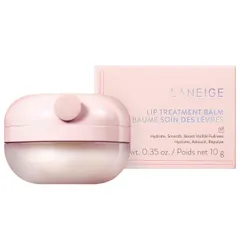
Works for:
based on ingredients and %- Anti-aging
- Moisturizing
Can it cause trouble?
- Irritation risk: medium
- Comedogenic risk ingredients: 3
Key actives

Product Summary
"LANEIGE - Lip Treatment Balm" is effective for: Anti-aging and Moisturizing
Ingredient callouts
- We like that this moisturizer contains peptides (palmitoyl tripeptide-1 0.15% - 0.55%). There are many different kind of Peptides and they are naturally present in our skin. They all are a combination of aminoacids. Some of them work as natural antibiotics, promote wound-healing and production of collagen. The science is still not settled on how effective Peptides are in skincare, but it is very likely that they have a benefit. Peptides might help restore the skin barrier and fight the signs of aging. At the very least, Peptides work as humectants: they attract water to the upper layer of the skin and improve its hydration.
- Adenosine 0.10% - 0.45%. It is a compound that in involved in many biological processes inside the skin cells. According one high-quality clinical trial, topical Adenosine in low concentrations can somewhat help improve "deep wrinkles" - the wrinkles that appear with age in places where our faces are most dynamic (for example, on the forehead or in the corners of the eyes).
Price
The product retails from 25.00$ up to 29.00$ in the United States, for 32.00CA$ in Canada, from 32.00A$ up to 46.64A$ in Australia, from 22.00£ up to 162.00£ in the United Kingdom and for 37.00NZ$ in New Zealand.
For a detailed price comparison: click here.
Works for
Anti-aging
What does the product description say?
What it does This pearlescent, piña colada-scented treatment is formulated with coconut oil to deeply moisturize and peptide and adenosine to help visibly smooth and firm lip wrinkles.
Source: Sephora AU
This product can help reduce and prevent fine lines and wrinkles, improve skin elasticity and firmness because it contains adenosine.
These ingredients in the product can also be helpful, even though there is less evidence for their effectiveness: palmitoyl tripeptide-1.
Keep in mind that it typically takes at least 6 weeks to notice any results because the changes that are needed to improve fine lines and elasticity happen in the deeper layers of the skin. No topical anti-aging product can “erase” wrinkles or fully reverse signs of aging.
Might help improve cell turnover and reduce inflammation in skin. One study shows that the ingredients might be able to help reduce dynamic wrinkles (for example, in the corners of the eyes or on the forehead)
A type of peptide. Peptides are excellent moisturizers and might be able support collagen production reducing fine lines and wrinkles
A great moisturising ingredient that softens the skin and reduces water loss from its upper layer. It also can be helpful in protecting skin from free radicals
An exfoliating and moisturizing alpha-hydroxy acid (AHA). Typically causes less irritation than other AHAs, for example, glycolic acid. At high concentrations (about 15%), lactic acid can help reduce lines and wrinkles. Recent studies show that lactic acid can support the "good" bacteria living on skin's surface (healthy skin microbiome)
Pure form of vitamin E. Can help moisturise and protect the skin from free radicals. Often used to help stabilise other ingredients or the formula itself
Moisturizing
What does the product description say?
Targeting Dehydration Lack of Firmness Hydrate and nourish the lips with the help of the Laneige Lip Treatment Balm, a lip treatment that provides a cooling sensation to help leave the lips looking fuller.
Source: SpaceNK US
This product can help improve hydration of the skin with the two types of ingredients.
The first type is called “humectants”:
these ingredients help attract water.
When humectants are on the surface of the skin, they “pull in” the moisture from the outside environment, or from
within deeper layers of the skin. The following ingredients in this product do the job:
glycerin.
This product also contains ingredients called “occlusives”. They help reduce the speed with which our skin loses moisture to the outside environment. These ingredients also help soften the upper layer of the skin, so it feels less tight and nicer to the touch. The following ingredients in this product do the job: butyrospermum parkii butter, cera microcristallina.
The following ingredients in this product are especially good for supporting the skin barrier and helping with the hydration level: palmitoyl tripeptide-1
Helps to soften the upper layer of the skin, reduce water loss from its surface and create a thicker product consistency
One of the best moisturizing ingredients. Naturally present in skin. It attracts water to the upper layer of the skin working as a humectant
An emollient. Found to be as effective as a moisturizer for dry skin as mineral oil. Could be comedogenic
A type of peptide. Peptides are excellent moisturizers and might be able support collagen production reducing fine lines and wrinkles
Helps soften the upper layer of the skin and can support skin barrier function
Helps soften the upper layer of the skin. Could be comedogenic due to the myrisic acid content
Helps to soften the upper layer of the skin and create a nice product consistency
A great moisturising ingredient that softens the skin and reduces water loss from its upper layer. It also can be helpful in protecting skin from free radicals
Might help improve cell turnover and reduce inflammation in skin. One study shows that the ingredients might be able to help reduce dynamic wrinkles (for example, in the corners of the eyes or on the forehead)
Brazilian palm wax. Helps soften the upper layer of the skin
Helps to soften the upper layer of the skin
An emollient that helps soften the skin and create a nice product texture
Helps soften the upper layer of the skin and create a nice product texture
Used to improve the product consistency and soften the upper layer of the skin
Helps soften the upper layer of the skin and create a nice product consistency
Used to create a thicker product consistency and soften the upper layer of the skin
An exfoliating and moisturizing alpha-hydroxy acid (AHA). Typically causes less irritation than other AHAs, for example, glycolic acid. At high concentrations (about 15%), lactic acid can help reduce lines and wrinkles. Recent studies show that lactic acid can support the "good" bacteria living on skin's surface (healthy skin microbiome)
Used mostly for creating emulsions - helping oil and water mix together. Helps soften the upper layer of the skin
Pure form of vitamin E. Can help moisturise and protect the skin from free radicals. Often used to help stabilise other ingredients or the formula itself
How honest is this product?
| Promise | Can it deliver? |
|---|---|
| Anti-aging | |
| Moisturizing |
Total Promises Fulfilled score: 100/100.
We receive a small commission for purchases made through these links at no cost for you. Thank you for your support! Learn more
Potential irritants
Comedogenic ingredients
User reviews (0)
Averages from community submissions.
No reviews yet for this product.
Be the first to share your experience!
Tried this product?
Help capture what the ingredient list can't—texture, finish, pilling, scent, and more. Answer what you can, skip the rest.
Takes ~30 seconds.
Reviews are shown in aggregate. No personal details.
Key Actives
Helps soften the upper layer of the skin and can support skin barrier function
A great moisturising ingredient that softens the skin and reduces water loss from its upper layer. It also can be helpful in protecting skin from free radicals
Might help improve cell turnover and reduce inflammation in skin. One study shows that the ingredients might be able to help reduce dynamic wrinkles (for example, in the corners of the eyes or on the forehead)
A type of peptide. Peptides are excellent moisturizers and might be able support collagen production reducing fine lines and wrinkles
Helps to soften the upper layer of the skin, reduce water loss from its surface and create a thicker product consistency
Works as a UV filter when used in high concentrations. It is photostable and is effective mostly against the UVB light, with some protection in the UVA range. In small concentrations, used for its ability to improve the color of cosmetic products. Is usually well tolerated by the skin
Helps soften the upper layer of the skin. Could be comedogenic due to the myrisic acid content
One of the best moisturizing ingredients. Naturally present in skin. It attracts water to the upper layer of the skin working as a humectant
An emollient. Found to be as effective as a moisturizer for dry skin as mineral oil. Could be comedogenic
Helps to soften the upper layer of the skin and create a nice product consistency
Helps to soften the upper layer of the skin and create a nice product consistency
Potential irritants
An aromatic blend of unspecified and possibly irritating ingredients
Helps soften the upper layer of the skin. Could be comedogenic due to the myrisic acid content
Helps soften the upper layer of the skin and can support skin barrier function
An exfoliating and moisturizing alpha-hydroxy acid (AHA). Typically causes less irritation than other AHAs, for example, glycolic acid. At high concentrations (about 15%), lactic acid can help reduce lines and wrinkles. Recent studies show that lactic acid can support the "good" bacteria living on skin's surface (healthy skin microbiome)
Comedogenic ingredients
A great moisturising ingredient that softens the skin and reduces water loss from its upper layer. It also can be helpful in protecting skin from free radicals
An emollient that helps soften the skin and create a nice product texture
An emollient. Found to be as effective as a moisturizer for dry skin as mineral oil. Could be comedogenic
All ingredients
Used to improve the product consistency and soften the upper layer of the skin
Helps soften the upper layer of the skin and create a nice product consistency
Helps soften the upper layer of the skin and create a nice product texture
A great moisturising ingredient that softens the skin and reduces water loss from its upper layer. It also can be helpful in protecting skin from free radicals
Helps to soften the upper layer of the skin, reduce water loss from its surface and create a thicker product consistency
Used to stabilize product formulations and thicken product consistency
Used to create a thicker product consistency
Creates an illusion of smoother and more radiant skin tone. Adds shimmer to the skin by reflecting light
Works as a UV filter when used in high concentrations. It is photostable and is effective mostly against the UVB light, with some protection in the UVA range. In small concentrations, used for its ability to improve the color of cosmetic products. Is usually well tolerated by the skin
An emollient that helps soften the skin and create a nice product texture
An aromatic blend of unspecified and possibly irritating ingredients
Helps soften the upper layer of the skin. Could be comedogenic due to the myrisic acid content
Used to create a thicker product consistency and soften the upper layer of the skin
One of the best moisturizing ingredients. Naturally present in skin. It attracts water to the upper layer of the skin working as a humectant
An emollient. Found to be as effective as a moisturizer for dry skin as mineral oil. Could be comedogenic
Helps soften the upper layer of the skin and can support skin barrier function
Used mostly for creating emulsions - helping oil and water mix together. Helps soften the upper layer of the skin
Used to create a gel-like product texture
Helps to soften the upper layer of the skin and create a nice product consistency
Brazilian palm wax. Helps soften the upper layer of the skin
Helps to soften the upper layer of the skin and create a nice product consistency
Might help improve cell turnover and reduce inflammation in skin. One study shows that the ingredients might be able to help reduce dynamic wrinkles (for example, in the corners of the eyes or on the forehead)
Pure form of vitamin E. Can help moisturise and protect the skin from free radicals. Often used to help stabilise other ingredients or the formula itself
An exfoliating and moisturizing alpha-hydroxy acid (AHA). Typically causes less irritation than other AHAs, for example, glycolic acid. At high concentrations (about 15%), lactic acid can help reduce lines and wrinkles. Recent studies show that lactic acid can support the "good" bacteria living on skin's surface (healthy skin microbiome)
Used to increase stability of product formulations
A type of peptide. Peptides are excellent moisturizers and might be able support collagen production reducing fine lines and wrinkles
Ingredient list view
Diisostearyl malate, Hydrogenated polyisobutene, Phytosteryl/isostearyl/cetyl/stearyl/behenyl dimer dilinoleate, Polybutene, Hydrogenated poly(c6-14 olefin), Butyrospermum parkii butter, Microcrystalline wax, Cera microcristallina, Synthetic wax, Ethylene/propylene/styrene copolymer, Sucrose tetrastearate triacetate, Mica, Titanium dioxide, Ci 77891, Euphorbia cerifera wax, Candelilla cera hydrocarbons, Candelilla cera, Ethylhexyl palmitate, Parfum, Candelilla wax esters, Astrocaryum murumuru seed butter, Tribehenin, Menthoxypropanediol, Glycerin, Cocos nucifera oil, Oenothera biennis oil, Lecithin, Butylene/ethylene/styrene copolymer, Sorbitan isostearate, Copernicia cerifera wax, Copernicia cerifera cera, Copernicia cerifera wax, Dehydroacetic acid, Adenosine, Tocopherol, Lactic acid, Pentaerythrityl tetra-di-t-butyl hydroxyhydrocinnamate, Palmitoyl tripeptide-1
- Final report of the cosmetic ingredient review expert panel on the safety assessment of Polyisobutene and Hydrogenated Polyisobutene as used in cosmetics
- Final report of the cosmetic ingredient review expert panel on the safety assessment of Polyisobutene and Hydrogenated Polyisobutene as used in cosmetics
- AMAZON RAINFOREST COSMETICS: CHEMICAL APPROACH FOR QUALITY CONTROL
- Glycerol and the skin: holistic approach to its origin and functions
- Safety Assessment of Styrene and Vinyl-type Styrene Copolymers as Used in Cosmetics
- 4 Final Report on the Safety Assessment of Sodium Dehydroacetate and Dehydroacetic Acid
- Evaluation of anti-wrinkle efficacy of adenosine-containing products using the FOITS technique
- Vitamin E in dermatology
- Vitamin E and Skin Health
- Epidermal and dermal effects of topical lactic acid
- Dual Effects of Alpha-Hydroxy Acids on the Skin
- Safety Assessment of Pentaerythrityl Tetra-Di-t-Butyl Hydroxyhydrocinnamate as Used in Cosmetics