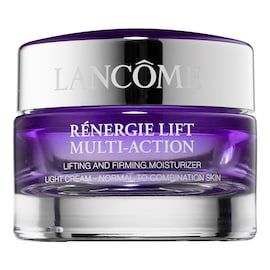
Lancôme Rnergie Lift Multi-Action Lifting and Firming Moisturizer Light Cream
Works for
2 of 2 advertised claims delivered
Anti-aging3 ingredients credited for this claimStrong support
“Solutions for. . Loss of firmness and elasticity.”
This product can help reduce and prevent fine lines and wrinkles, improve skin elasticity and firmness because it contains adenosine.
Keep in mind that it typically takes at least 6 weeks to notice any results because the changes that are needed to improve fine lines and elasticity happen in the deeper layers of the skin. No topical anti-aging product can “erase” wrinkles or fully reverse signs of aging.
Moisturizing10 ingredients credited for this claimGood support
“Rnergie Lift Multi-Action Lifting and Firming Moisturizer Light Cream”
This product can help improve hydration of the skin with the two types of ingredients.
The first type is called “humectants”:
these ingredients help attract water.
When humectants are on the surface of the skin, they “pull in” the moisture from the outside environment, or from
within deeper layers of the skin. The following ingredients in this product do the job:
glycerin.
This product also contains ingredients called “occlusives”. They help reduce the speed with which our skin loses moisture to the outside environment. These ingredients also help soften the upper layer of the skin, so it feels less tight and nicer to the touch. The following ingredients in this product do the job: dimethicone, peg-10 dimethicone.
Can it cause trouble?
Irritancy7 strong irritants: Alcohol denat., Rosa damascena extract + 5 more — patch-test recommendedHigh risk
ComedogenicClean of flagged comedogenic ingredientsNone flagged


User reviews
Be the first — your take helps the next person decide.
Ingredients
Filter by role to see what each ingredient is doing.
Water~40–60%
Glycerin~4.1–6.1%
- Irritation risk
- Low
One of the best moisturizing ingredients. Naturally present in skin. It attracts water to the upper layer of the skin working as a humectant
More about GlycerinDimethicone~3.5–5.3%
- Irritation risk
- Low
A silicone that helps to reduce water loss from the surface of the skin. Can temporarily "fill in" lines and wrinkles, absorb oil, and create a nice product finish
More about DimethiconeIsohexadecane~2.5–3.7%
- Irritation risk
- Low
Improves the texture of the product and helps soften the skin. Helps oil and water mix together and can be used as a cleansing agent
More about IsohexadecaneAlcohol denat.~2–3%
- Irritation risk
- High
Produces temporary toning effect. Can help dissolve other ingredients or preserve products
More about Alcohol denat.Dipropylene glycol~1.6–2.3%
- Irritation risk
- Low
Helps to dissolve other ingredients in a formulation. Slows down the rate of product drying
More about Dipropylene glycolSynthetic wax~1.4–2%
- Irritation risk
- Low
Used to stabilize product formulations and thicken product consistency
More about Synthetic waxPeg-10 dimethicone~1.3–1.9%
- Irritation risk
- Low
A silicone that works to soften the upper layer of the skin and reduce its water loss
More about Peg-10 dimethiconeHydroxyethylpiperazine ethane sulfonic acid~1–1.5%
- Irritation risk
- Medium
Used to regulate product's pH, but can be also used as an exfoliator when included in higher concentrations. There is a controversy about whether it can generate free radicals and induce skin cell damage when used in topical products
More about Hydroxyethylpiperazine ethane sulfonic acidCi 14700~0.55–1.3%
Ci 19140~0.4–0.95%
Guanosine~0.35–0.8%
- Irritation risk
- Low
Cyathea medullaris leaf extract~0.15–0.55%
- Irritation risk
- Low
Ascorbyl glucoside~0.1–0.5%
- Irritation risk
- Medium
A vitamin C derivative that is more stable but less potent than pure form of vitamin C. Has a potential to boost collagen production, nutralise free radicals and reduce hyperpigmentation, but the required concentration is likely to be much higher than for the pure form of vitamin C, limiting the ingredient's effectiveness in products
More about Ascorbyl glucosideRosa damascena extract~0.1–0.45%
- Irritation risk
- High
Oil of a very fragrant pink rose used as fragrance in cosmetics. Extensive research has shown it has mixed benefits. In the pro column, inhaling this flower’s scent seems to have relaxing properties and the plant’s petals contain skin-soothing and antioxidant compounds that can benefit skin. On the flipside, the numerous chemicals that create this rose’s distinctive fragrance pose a risk of causing skin aggravation.
More about Rosa damascena extractTocopheryl acetate~0.1–0.5%
- Irritation risk
- Medium
A more stable but less bio-available form of vitamin E compared to Tocopherol. Might help moisturize and protect the skin from free radicals, but mostly used in low concentrations to stabilize other ingredients.
More about Tocopheryl acetateSodium acrylates copolymer~0.1–0.4%
- Irritation risk
- Medium
Used to create a thicker product consistency
More about Sodium acrylates copolymerSodium polyacrylate~0.15–0.55%
- Irritation risk
- Low
Used to create a gel-like product texture, as well as to stabilize emulsions
More about Sodium polyacrylatePhenoxyethanol~0.1–0.5%
- Irritation risk
- Low
A preservative. It helps prevent bacterial growth in cosmetic products
More about PhenoxyethanolFaex extract~0.1–0.4%
- Irritation risk
- Low
Yeast extract. Helps attract water to the upper layer of the skin
More about Faex extractYeast extract~0.1–0.35%
- Irritation risk
- Low
Helps attract water to the upper layer of the skin and might have some anti-oxidant and skin lightening properties. It can help calm down inflammation in skin
More about Yeast extractAdenosine~0.1–0.3%
- Irritation risk
- Low
Might help improve cell turnover and reduce inflammation in skin. One study shows that the ingredients might be able to help reduce dynamic wrinkles (for example, in the corners of the eyes or on the forehead)
More about AdenosineMagnesium sulfate~0.05–0.3%
Ethylhexylglycerin~0.05–0.25%
Nylon-12~0.1–0.35%
Dimethicone/peg-10/15 crosspolymer~0.05–0.2%
Dimethicone/polyglycerin-3 crosspolymer~0.4–0.9%
- Irritation risk
- Medium
Helps oil and water mix together
More about Dimethicone/polyglycerin-3 crosspolymerLimonene~0.05–0.2%
- Irritation risk
- High
A common frangrance that can easily irritate skin, especially if exposed to air, light or heat
More about LimonenePentylene glycol~0.1–0.35%
- Irritation risk
- Medium
Used to preserve products, dissolve other ingredients and create a nice product texture
More about Pentylene glycolBenzyl alcohol~0.05–0.2%
- Irritation risk
- High
A preservative. Can be used to mask unpleasant smell. Can be irritating
More about Benzyl alcoholLinalool~0.05–0.25%
Caprylic/capric triglyceride~0.1–0.45%
- Irritation risk
- Medium
A good mix of fatty acids that forms a protective layer on the skin. Improves the shelf life of products. Derived from coconut and glycerin
More about Caprylic/capric triglycerideParfum~0.05–0.2%
- Irritation risk
- High
An aromatic blend of unspecified and possibly irritating ingredients
More about ParfumDisteardimonium hectorite~0.05–0.25%
- Irritation risk
- Low
A type of clay that is used to thicken the product consistency
More about Disteardimonium hectoriteDisodium edta~0.05–0.2%
Citronellol~0.05–0.15%
Coumarin~0.01–0.05%
Glycine soja protein~0.05–0.2%
- Irritation risk
- Low
A plant extract that helps to attract water to the upper layer of the skin and soften it. It might be helpful in neutralizing free radicals. It might be somewhat helpful for evening out the skin tone. It might be able to support elastin production but solid research is lacking
More about Glycine soja proteinIngredient list view
Water, Glycerin, Dimethicone, Isohexadecane, Alcohol denat., Dipropylene glycol, Synthetic wax, Peg-10 dimethicone, Hydroxyethylpiperazine ethane sulfonic acid, Ci 14700, Ci 19140, Guanosine, Cyathea medullaris leaf extract, Ascorbyl glucoside, Rosa damascena extract, Tocopheryl acetate, Sodium acrylates copolymer, Sodium polyacrylate, Phenoxyethanol, Faex extract, Yeast extract, Adenosine, Magnesium sulfate, Ethylhexylglycerin, Nylon-12, Dimethicone/peg-10/15 crosspolymer, Dimethicone/polyglycerin-3 crosspolymer, Limonene, Pentylene glycol, Benzyl alcohol, Linalool, Caprylic/capric triglyceride, Parfum, Disteardimonium hectorite, Disodium edta, Citronellol, Coumarin, Glycine soja protein
Compare prices
Retailers ranked by price — lowest first.
Worth comparing, line by line.
Match % combines shared ingredients, the first five ingredients, shared actives and hero ingredients, irritancy (lower counts in the alternative's favour), texture and body area. Only products in the same routine step are compared.
| LancômeRnergie Lift Multi-Action Lifting and Firming Moisturizer Light CreamYOUR PRODUCT | BIOTHERMBLUE THERAPY ACCELERATED DAY CREAM | BIOBLUE THERAPY ACCELERATED DAY CREAM | VichyLiftactiv Collagen Specialist Peptide & Vitamin C Firming Moisturiser | |
|---|---|---|---|---|
| Match | — | 72% | 72% | 70% |
| Price | $102.00 | $63.85−$38.15 | $126.92+$24.92 | $35.00−$67.00 |
| Shared key ingredients | — | 6 of 7 | 6 of 7 | 5 of 7 |
| Key difference | — | Niacinamide | Niacinamide | Niacinamide |
| Irritancy | High | Medium | Medium | Medium |
| Drying alcohol | Contains drying alcohol | Contains drying alcohol | Contains drying alcohol | Contains drying alcohol |
| View product | Shop | Shop | Shop |

Sources cited in this review
Every concentration estimate and effectiveness label is anchored to one of these 14 studies and safety reviews.
- 1
- 2
- 3Final Report on the Safety Assessment of Dimethicone Copolyoljournals.sagepub.com
- 4
- 5
- 6The Roles of Vitamin C in Skin Healthncbi.nlm.nih.gov

Affiliate links · As an Amazon Associate, WIMJ earns from qualifying purchases.