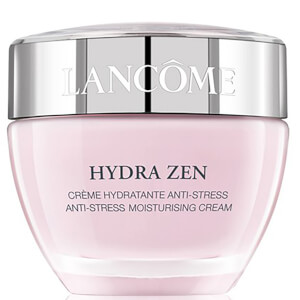
Lancôme Hydra Zen Neurocalm Day Cream Normal Skin
Works for
1 of 1 advertised claim delivered
Moisturizing21 ingredients credited for this claimStrong support
“Deeply nourish your complexion with the Hydra Zen Neurocalm™ Day Cream from Lancôme . Specifically developed for normal to combination skin types, the non-greasy moisturiser absorbs effortlessly into skin to deliver long-lasting hydration.”
This product can help improve hydration of the skin with the two types of ingredients.
The first type is called “humectants”:
these ingredients help attract water.
When humectants are on the surface of the skin, they “pull in” the moisture from the outside environment, or from
within deeper layers of the skin. The following ingredients in this product do the job:
glycerin, sodium hyaluronate.
This product also contains ingredients called “occlusives”. They help reduce the speed with which our skin loses moisture to the outside environment. These ingredients also help soften the upper layer of the skin, so it feels less tight and nicer to the touch. The following ingredients in this product do the job: caprylic/capric triglyceride, dimethiconol.
The following ingredients in this product are especially good for supporting the skin barrier and helping with the hydration level: ceramide 3, hydroxypalmitoyl sphinganine
Can it cause trouble?
Irritancy5 strong irritants: Eugenol, Limonene + 3 more — patch-test recommendedHigh risk
Comedogenic2 ingredients rated 2 or more on the 0–5 pore-clogging scale2 flagged


User reviews
Be the first — your take helps the next person decide.
Ingredients
Filter by role to see what each ingredient is doing.
Water~45–55%
Glycerin~4.6–5.6%
- Irritation risk
- Low
One of the best moisturizing ingredients. Naturally present in skin. It attracts water to the upper layer of the skin working as a humectant
More about GlycerinCyclohexasiloxane~4.1–5%
- Irritation risk
- Low
A silicone that serves as an emollient. Helps create a nice non-greasy feels
More about CyclohexasiloxaneIsononyl isononanoate~3.1–3.8%
- Irritation risk
- Low
Forms a protective film on the surface of the skin to prevent moisture loss. Gives a velvety feel to products while reducing tackiness
More about Isononyl isononanoateCaprylic/capric triglyceride~2.4–2.9%
- Irritation risk
- Medium
A good mix of fatty acids that forms a protective layer on the skin. Improves the shelf life of products. Derived from coconut and glycerin
More about Caprylic/capric triglycerideButylene glycol~1.9–2.3%
- Irritation risk
- Low
Used to create a nice product texture and help delivery of other ingredients. Might be somewhat helpful in attracting water to the upper layer of the skin
More about Butylene glycolCetyl alcohol~1.6–2%
- Irritation risk
- Low
A non-drying alcohol that works to soften the skin and stabilize product formulations helping oil and water mix together
More about Cetyl alcoholStearyl dimethicone~1.4–1.8%
- Irritation risk
- Low
Helps soften the upper layer of the skin
More about Stearyl dimethiconeGlyceryl stearate~1.2–1.5%
- Irritation risk
- Low
An emollient that softens the skin and forms a protective layer on its surface. Helps water and oil mix together
More about Glyceryl stearateStearic acid~1–1.3%
- Irritation risk
- Low
Helps oil and water mix together and works as an emollient
More about Stearic acidStearyl alcohol~0.75–1.1%
- Irritation risk
- Low
An emollient that helps soften the skin
More about Stearyl alcoholPeg-8 stearate~0.55–0.85%
- Irritation risk
- Medium
- Comedogenicity
- 2/5
Helps water and oil mix together
More about Peg-8 stearateSynthetic wax~0.5–0.8%
- Irritation risk
- Low
Used to stabilize product formulations and thicken product consistency
More about Synthetic waxCyclopentasiloxane~0.5–0.7%
- Irritation risk
- Low
A silicone that helps improve the product texture and spreadability. Can absorb oil creating a short-term mattifying effect on the skin
More about CyclopentasiloxaneLecithin~0.45–0.65%
- Irritation risk
- Low
Used mostly for creating emulsions - helping oil and water mix together. Helps soften the upper layer of the skin
More about LecithinSodium dextran sulfate~0.4–0.6%
- Irritation risk
- Low
Sodium chloride~0.45–0.65%
- Irritation risk
- Low
Used to stabilize mixtures of oil and water, and create thicker, gel-like product textures
More about Sodium chlorideHydroxypalmitoyl sphinganine~0.3–0.55%
- Irritation risk
- Low
A type of lipid similar to ceramides naturally present in skin. Helps to soften the upper layer of the skin and supports the skin barrier function to keep it hydrated. Can help to prevent inflammation in skin
More about Hydroxypalmitoyl sphinganineSodium hyaluronate~0.3–0.55%
- Irritation risk
- Low
One of the best moisturizing ingredients. Attracts water into the upper layer of the skin
More about Sodium hyaluronatePaeonia suffruticosa root extract~0.25–0.5%
Eugenol~0.2–0.4%
Ethylparaben~0.25–0.4%
Triethanolamine~0.2–0.4%
- Irritation risk
- Medium
Used to adjust pH of the product and can help improve the product's smell
More about TriethanolamineCrithmum maritimum extract~0.2–0.35%
- Irritation risk
- Low
- Comedogenicity
- 3/5
An algae extract that might have anti-oxidant properties
More about Crithmum maritimum extractPalmitic acid~0.25–0.45%
- Irritation risk
- Low
An emollient that is naturally present in skin and helps soften it
More about Palmitic acidSilica~0.3–0.55%
Cellulose acetate butyrate~0.2–0.4%
- Irritation risk
- Low
Polyphosphorylcholine glycol acrylate~0.25–0.45%
- Irritation risk
- Low
Polycaprolactone~0.2–0.4%
- Irritation risk
- Low
Polyvinyl alcohol~0.25–0.45%
Poloxamer 188~0.2–0.4%
Ammonium polyacryloyldimethyl taurate~0.2–0.4%
- Irritation risk
- Low
Used to create a thicker product consistency
More about Ammonium polyacryloyldimethyl taurateDimethiconol~0.25–0.45%
- Irritation risk
- Low
A silicone that makes products more spreadable and keeps skin smooth. Helps to add gloss to skin and may visually fill in fine lines/wrinkles for short time
More about DimethiconolLimonene~0.15–0.3%
- Irritation risk
- High
A common frangrance that can easily irritate skin, especially if exposed to air, light or heat
More about LimoneneBenzyl alcohol~0.15–0.3%
- Irritation risk
- High
A preservative. Can be used to mask unpleasant smell. Can be irritating
More about Benzyl alcohol2-oleamido-1,3-octadecanediol~0.2–0.35%
- Irritation risk
- Low
Helps soften the upper layer of the skin and slow down the water loss over time
More about 2-oleamido-1,3-octadecanediolCaprylyl glycol~0.2–0.4%
- Irritation risk
- Medium
Helps preserve products and creates a nice product texture
More about Caprylyl glycolAlpha-isomethyl ionone~0.15–0.3%
- Irritation risk
- High
A fragrance. Potential allergen and can be irritating
More about Alpha-isomethyl iononeMoringa pterygosperma seed extract~0.15–0.3%
- Irritation risk
- Low
Might help attract water to the upper layer of the skin
More about Moringa pterygosperma seed extractCeramide 3~0.2–0.4%
- Irritation risk
- Low
A type of lipid similar to ceramides naturally present in skin. Helps to soften the upper layer of the skin and supports the skin barrier function to keep it hydrated. Can help to prevent inflammation in skin
More about Ceramide 3Disodium edta~0.15–0.25%
Rosa gallica flower extract~0.15–0.25%
- Irritation risk
- High
Methylparaben~0.15–0.25%
Octyldodecanol~0.15–0.3%
- Irritation risk
- Low
An emollient that helps to soften the skin and create a pleasant product texture and stabilize the formulation
More about OctyldodecanolParfum~0.05–0.15%
- Irritation risk
- High
An aromatic blend of unspecified and possibly irritating ingredients
More about ParfumPhenoxyethanol~0.15–0.25%
- Irritation risk
- Low
A preservative. It helps prevent bacterial growth in cosmetic products
More about PhenoxyethanolIngredient list view
Water, Glycerin, Cyclohexasiloxane, Isononyl isononanoate, Caprylic/capric triglyceride, Butylene glycol, Cetyl alcohol, Stearyl dimethicone, Glyceryl stearate, Stearic acid, Stearyl alcohol, Peg-8 stearate, Synthetic wax, Cyclopentasiloxane, Lecithin, Sodium dextran sulfate, Sodium chloride, Hydroxypalmitoyl sphinganine, Sodium hyaluronate, Paeonia suffruticosa root extract, Unknown, Eugenol, Ethylparaben, Triethanolamine, Crithmum maritimum extract, Palmitic acid, Silica, Cellulose acetate butyrate, Polyphosphorylcholine glycol acrylate, Polycaprolactone, Polyvinyl alcohol, Poloxamer 188, Ammonium polyacryloyldimethyl taurate, Dimethiconol, Limonene, Benzyl alcohol, 2-oleamido-1,3-octadecanediol, Caprylyl glycol, Alpha-isomethyl ionone, Moringa pterygosperma seed extract, Ceramide 3, Disodium edta, Rosa gallica flower extract, Methylparaben, Octyldodecanol, Parfum, Phenoxyethanol
Compare prices
Retailers ranked by price — lowest first.

Affiliate links · prices updated regularly
Worth comparing, line by line.
Match % combines shared ingredients, the first five ingredients, shared actives and hero ingredients, irritancy (lower counts in the alternative's favour), texture and body area. Only products in the same routine step are compared.
| LancômeHydra Zen Neurocalm Day Cream Normal SkinYOUR PRODUCT | BIOTHERMAquasource Rich Cream for Dry Skin | Derm InstituteAnti-Oxidant Hydration Cream | BB LABORATORIESEmollient Lift Cream | |
|---|---|---|---|---|
| Match | — | 56% | 53% | 51% |
| Price | $62.14 | $68.75+$6.61 | $150.00+$87.86 | $172.26+$110.12 |
| Shared key ingredients | — | 5 of 9 | 5 of 9 | 4 of 9 |
| Key difference | — | Panthenol | Niacinamide | Ceramide 1 |
| Irritancy | High | High | Medium | Medium |
| Drying alcohol | — | Contains drying alcohol | — | — |
| View product | Shop | Shop | Shop |


Product summary
"Lancôme - Hydra Zen Neurocalm Day Cream Normal Skin" has a good moisturizing formula. This moisturizer uses a good combo of humectants and emollients. These both types of ingredients are essentials for improving the skin hydration and keeping the skin barrier healthy. Humectants in this product (glycerin, sodium hyaluronate, butylene glycol and caprylyl glycol) help to increase the water content in the upper layer of the skin. (These ingredients do so by "capturing" water molecules from the outside air or from within the deeper layers of the skin). Ceramide 3, stearyl dimethicone, caprylic/capric triglyceride, dimethiconol and cetyl alcohol in this product help decrease the water evoporation from the skin, so that it stays hydrated for longer. These ingredients also soften the skin and take away the feeling of tightness and dryness.
Ingredient callouts
- As a plus, this moisturizer also contains ceramides (ceramide 3 0.20% - 0.40%). Ceramides are a type of lipids that our skin produces itself. They are a building block of the skin's barrier. Ceramides used in skincare are synthetic or extracted from plants. They work well for softening the skin surface and "patch holes" in the skin's barrier.
Irritation risk
This moisturizer contains a bunch of common irritants, including ingredients that do not provide any known benefit for the skin. It might not be the best choice if your skin is sensitive. We assess the overall irritancy of this moisturizer to be high. For a detailed overview of all potential irritants: click here
You can see the detailed formula review with the breakdown of all actives in the product and the full ingredient list with estimated concentrations in the tables below.
Price
The product retails for 46.00£ in the United Kingdom.
For a detailed price comparison: click here.
Sources cited in this review
Every concentration estimate and effectiveness label is anchored to one of these 9 studies and safety reviews.
- 1
- 2Safety Assessment of PEG Diesters as Used in Cosmeticscir-safety.org
- 3
- 4
- 5Hyaluronic acid: A key molecule in skin agingncbi.nlm.nih.gov
- 6

Affiliate links · As an Amazon Associate, WIMJ earns from qualifying purchases.