Works for
2 of 2 advertised claims delivered
Anti-aging5 ingredients credited for this claimStrong support
“What it does Targets the visible signs of fatigue to help restore skin's luminosity and youthful complexion while you sleep.”
This product can help reduce and prevent fine lines and wrinkles, improve skin elasticity and firmness because it contains adenosine.
Keep in mind that it typically takes at least 6 weeks to notice any results because the changes that are needed to improve fine lines and elasticity happen in the deeper layers of the skin. No topical anti-aging product can “erase” wrinkles or fully reverse signs of aging.
Moisturizing29 ingredients credited for this claimStrong support
“Your skin will be intensely moisturised, smooth and appear more radiant.”
This product can help improve hydration of the skin with the two types of ingredients.
The first type is called “humectants”:
these ingredients help attract water.
When humectants are on the surface of the skin, they “pull in” the moisture from the outside environment, or from
within deeper layers of the skin. The following ingredients in this product do the job:
glycerin, polyglycerin-3.
This product also contains ingredients called “occlusives”. They help reduce the speed with which our skin loses moisture to the outside environment. These ingredients also help soften the upper layer of the skin, so it feels less tight and nicer to the touch. The following ingredients in this product do the job: helianthus annuus seed oil, helianthus annuus seed cera.
The following ingredients in this product are especially good for supporting the skin barrier and helping with the hydration level: ceramide np, hydroxypalmitoyl sphinganine, salicyloyl phytosphingosine
ExfoliationNot advertised by the brand · 2 ingredients credited for this claimStrong support
This product can help exfoliate the skin. In other words, it helps break down the bonds between dead cells on the surface of the skin and speed up the skin turnover. Skin often appears softer and brighter after exfoliation, but overdoing it can result in disrupted skin barrier. The following ingredient is doing the exfoliating job in this product: capryloyl salicylic acid.
Anti-oxidationNot advertised by the brand · 5 ingredients credited for this claimModerate support
This product contains antioxidants (bifida ferment lysate) that might be able to help neutralize free radicals in skin to lessen the damage it gets from the UV light (sun). There is not enough evidence to confirm their effectiveness in skin though.
Evens skin toneNot advertised by the brand · 5 ingredients credited for this claimModerate support
The following ingredient (ingredients) in this product might be helpful, but there is no evidence to confirm that it actually works: bifida ferment lysate, capryloyl salicylic acid.
Can it cause trouble?
Irritancy4 strong irritants: Linalool, Limonene + 2 more — patch-test recommendedHigh risk
ComedogenicClean of flagged comedogenic ingredientsNone flagged


User reviews
Be the first — your take helps the next person decide.
Ingredients
Filter by role to see what each ingredient is doing.
Water~45–55%
Bifida ferment lysate~5.1–6.3%
- Irritation risk
- Low
Consists of remains of dead yeast bacteria cells. Helps to hydrate the skin and reduce irritation. Might has some anti-oxidant effect
More about Bifida ferment lysateGlycerin~4.1–5%
- Irritation risk
- Low
One of the best moisturizing ingredients. Naturally present in skin. It attracts water to the upper layer of the skin working as a humectant
More about GlycerinDicaprylyl ether~3.1–3.7%
- Irritation risk
- Low
Helps soften the upper layer of the skin while creating a non-greasy feel on the skin. Helps to dissolve other ingredients
More about Dicaprylyl etherPentylene glycol~2.3–2.8%
- Irritation risk
- Medium
Used to preserve products, dissolve other ingredients and create a nice product texture
More about Pentylene glycolPolyglyceryl-6 distearate~1.8–2.2%
- Irritation risk
- Medium
Helps oil and water mix together while softening the upper layer of the skin
More about Polyglyceryl-6 distearatePropanediol~1.5–1.8%
- Irritation risk
- Low
Acts as a solvent for other ingredients. Speeds up the absorption of other ingredients into the skin
More about PropanediolCetyl esters~1.3–1.6%
- Irritation risk
- Low
Helps soften upper layer of the skin and can enhance penetration of other ingredients into the upper layer of the skin
More about Cetyl estersJojoba esters~1.1–1.3%
- Irritation risk
- Medium
An emollient made of jojoba oil. Helps soften the skin and support its barrier function
More about Jojoba estersAmmonium polyacryloyldimethyl taurate~0.7–1.1%
- Irritation risk
- Low
Used to create a thicker product consistency
More about Ammonium polyacryloyldimethyl taurateBehenyl alcohol~0.65–0.95%
- Irritation risk
- Low
Non-drying alcohol that helps water and oil mix together. Also serves as an emollient
More about Behenyl alcoholOctyldodecanol~0.5–0.75%
- Irritation risk
- Low
An emollient that helps to soften the skin and create a pleasant product texture and stabilize the formulation
More about OctyldodecanolAcacia decurrens flower cera~0.45–0.65%
- Irritation risk
- High
Mimosa flower fax. Helps soften the upper layer of the skin. It adds a nice smell, but could be irritating
More about Acacia decurrens flower ceraAcacia decurrens flower wax~0.35–0.6%
Helianthus annuus seed cera~0.35–0.65%
- Irritation risk
- Low
Helps soften the upper layer of the skin
More about Helianthus annuus seed ceraHelianthus annuus seed wax~0.3–0.6%
- Irritation risk
- Low
Helps soften the upper layer of the skin and support skin's barrier function while creating a thicker product consistency
More about Helianthus annuus seed waxHelianthus annuus seed oil~0.35–0.6%
- Irritation risk
- Low
A great emollient due to its high linoleic acid content. One of the most effective plant oils in helping skin hydration and repairing skin barrier function
More about Helianthus annuus seed oilPolymnia sonchifolia root juice~0.3–0.5%
- Irritation risk
- High
A plant extract that helps attract water to the upper layer of the skin and might have some anti-oxidant properties
More about Polymnia sonchifolia root juiceCeramide np~0.3–0.55%
- Irritation risk
- Low
A type of lipid similar to ceramides naturally present in skin. Helps to soften the upper layer of the skin and supports the skin barrier function to keep it hydrated. Can help to prevent inflammation in skin
More about Ceramide npAlpha-glucan oligosaccharide~0.3–0.5%
- Irritation risk
- Low
Helps attract water to the upper layer of the skin
More about Alpha-glucan oligosaccharideSodium hyaluronate~0.2–0.4%
- Irritation risk
- Low
One of the best moisturizing ingredients. Attracts water into the upper layer of the skin
More about Sodium hyaluronateSodium hydroxide~0.25–0.45%
Sodium stearoyl glutamate~0.25–0.5%
- Irritation risk
- Medium
Helps oil and water mix together
More about Sodium stearoyl glutamateSalicyloyl phytosphingosine~0.2–0.4%
- Irritation risk
- Low
Helps attract water to the upper layer of the skin. Might have anti-aging benefits but solid study data is lacking
More about Salicyloyl phytosphingosine2-oleamido-1,3-octadecanediol~0.2–0.4%
- Irritation risk
- Low
Helps soften the upper layer of the skin and slow down the water loss over time
More about 2-oleamido-1,3-octadecanediolAdenosine~0.2–0.4%
- Irritation risk
- Low
Might help improve cell turnover and reduce inflammation in skin. One study shows that the ingredients might be able to help reduce dynamic wrinkles (for example, in the corners of the eyes or on the forehead)
More about AdenosineMannose~0.2–0.4%
- Irritation risk
- Low
Coco-caprylate/caprate~0.25–0.45%
- Irritation risk
- Low
Helps to soften the upper layer of the skin without creating a greasy texture
More about Coco-caprylate/caprateAscorbyl glucoside~0.2–0.4%
- Irritation risk
- Medium
A vitamin C derivative that is more stable but less potent than pure form of vitamin C. Has a potential to boost collagen production, nutralise free radicals and reduce hyperpigmentation, but the required concentration is likely to be much higher than for the pure form of vitamin C, limiting the ingredient's effectiveness in products
More about Ascorbyl glucosideHydroxyacetophenone~0.2–0.4%
Hydroxypalmitoyl sphinganine~0.2–0.4%
- Irritation risk
- Low
A type of lipid similar to ceramides naturally present in skin. Helps to soften the upper layer of the skin and supports the skin barrier function to keep it hydrated. Can help to prevent inflammation in skin
More about Hydroxypalmitoyl sphinganineHydroxypropyl starch phosphate~0.25–0.45%
- Irritation risk
- Medium
Helps oil and water mix together and used to stabilize product formulations
More about Hydroxypropyl starch phosphateCapryloyl salicylic acid~0.2–0.4%
- Irritation risk
- High
Trisodium ethylenediamine disuccinate~0.2–0.4%
- Irritation risk
- Medium
Used to improve stability of the formulation
More about Trisodium ethylenediamine disuccinateLactic acid~0.2–0.4%
- Irritation risk
- Medium
An exfoliating and moisturizing alpha-hydroxy acid (AHA). Typically causes less irritation than other AHAs, for example, glycolic acid. At high concentrations (about 15%), lactic acid can help reduce lines and wrinkles. Recent studies show that lactic acid can support the "good" bacteria living on skin's surface (healthy skin microbiome)
More about Lactic acidLactobacillus~0.2–0.4%
- Irritation risk
- Low
A non-living ingredient made by fermentation with the bacteria Lactobacillus. It can help attract water to the upper layer of the skin and might help reduce inflammation
More about LactobacillusAcetic acid~0.2–0.4%
- Irritation risk
- Low
Maltodextrin~0.2–0.4%
- Irritation risk
- Low
Used to stabilize the product formulation and can help absorb oil
More about MaltodextrinFaex extract~0.2–0.4%
- Irritation risk
- Low
Yeast extract. Helps attract water to the upper layer of the skin
More about Faex extractYeast extract~0.2–0.4%
- Irritation risk
- Low
Helps attract water to the upper layer of the skin and might have some anti-oxidant and skin lightening properties. It can help calm down inflammation in skin
More about Yeast extractPolyglycerin-3~0.2–0.4%
- Irritation risk
- Low
Helps to attract water to the upper layer of the skin
More about Polyglycerin-3Polyglyceryl-3 beeswax~0.25–0.45%
- Irritation risk
- Medium
Helps water and oil mix together. Could be an allergen (beeswax)
More about Polyglyceryl-3 beeswaxCetyl alcohol~0.25–0.45%
- Irritation risk
- Low
A non-drying alcohol that works to soften the skin and stabilize product formulations helping oil and water mix together
More about Cetyl alcoholTocopherol~0.2–0.35%
- Irritation risk
- Low
Pure form of vitamin E. Can help moisturise and protect the skin from free radicals. Often used to help stabilise other ingredients or the formula itself
More about TocopherolSodium benzoate~0.15–0.25%
Linalool~0.1–0.2%
Limonene~0.15–0.25%
- Irritation risk
- High
A common frangrance that can easily irritate skin, especially if exposed to air, light or heat
More about LimoneneCitronellol~0.1–0.2%
Parfum~0.05–0.15%
- Irritation risk
- High
An aromatic blend of unspecified and possibly irritating ingredients
More about ParfumIngredient list view
Water, Bifida ferment lysate, Glycerin, Dicaprylyl ether, Pentylene glycol, Polyglyceryl-6 distearate, Propanediol, Cetyl esters, Jojoba esters, Ammonium polyacryloyldimethyl taurate, Behenyl alcohol, Octyldodecanol, Acacia decurrens flower cera, Acacia decurrens flower wax, Helianthus annuus seed cera, Helianthus annuus seed wax, Helianthus annuus seed oil, Polymnia sonchifolia root juice, Ceramide np, Alpha-glucan oligosaccharide, Sodium hyaluronate, Sodium hydroxide, Sodium stearoyl glutamate, Salicyloyl phytosphingosine, 2-oleamido-1,3-octadecanediol, Adenosine, Mannose, Coco-caprylate/caprate, Ascorbyl glucoside, Hydroxyacetophenone, Hydroxypalmitoyl sphinganine, Hydroxypropyl starch phosphate, Capryloyl salicylic acid, Trisodium ethylenediamine disuccinate, Lactic acid, Lactobacillus, Acetic acid, Maltodextrin, Faex extract, Yeast extract, Polyglycerin-3, Polyglyceryl-3 beeswax, Cetyl alcohol, Tocopherol, Sodium benzoate, Linalool, Limonene, Citronellol, Parfum
Compare prices
Retailers ranked by price — lowest first.
Affiliate links · prices updated regularly · As an Amazon Associate, WIMJ earns from qualifying purchases.
Worth comparing, line by line.
Match % combines shared ingredients, the first five ingredients, shared actives and hero ingredients, irritancy (lower counts in the alternative's favour), texture and body area. Only products in the same routine step are compared.
| LancômeGenifique Night CreamYOUR PRODUCT | BIOTHERMCera Repair Barrier Cream | VichyMinéral 89 72 Hr Hyaluronic Acid & Squalane Moisture Boosting Cream | |
|---|---|---|---|
| Match | — | 57% | 52% |
| Price | $259.12 | $31.89−$227.23 | $24.72−$234.40 |
| Shared key ingredients | — | 9 of 20 | 8 of 20 |
| Key difference | — | Centella Asiatica Extract | Niacinamide |
| Irritancy | High | Medium | Medium |
| Drying alcohol | — | — | — |
| View product | Shop | Shop |

Product summary
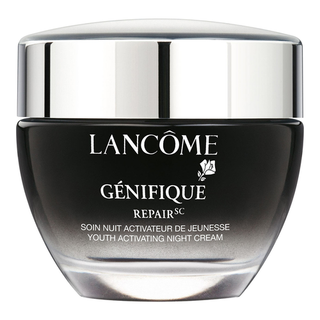
"Lancôme - Genifique Night Cream" has a good moisturizing formula. As we expect from a proper moisturizer, the formula includes a combo of effective humectants and emollients. These are the two different types of ingredients that are essential for improving the skin hydration and supporting a healthy skin barrier. Humectants in this product (salicyloyl phytosphingosine, glycerin, polyglycerin-3 and sodium hyaluronate) help to increase the water content in the upper layer of the skin. (These ingredients do so by "capturing" water molecules from the outside air or from within the deeper layers of the skin). Ceramide np, helianthus annuus seed cera, helianthus annuus seed wax, jojoba esters and helianthus annuus seed oil in this product help decrease the water evoporation from the skin, so that it stays hydrated for longer. These ingredients also soften the skin and take away the feeling of tightness and dryness.
Ingredient callouts
- Another benefit is that this moisturizer contain ceramides (salicyloyl phytosphingosine 0.20% - 0.40% and ceramide np 0.30% - 0.55%). Ceramides are an important part of our natural skin barrier. The Ceramides used in skincare are synthetic or come from plants. They help soften the skin and can help "fill the gaps" in the skin barrier, keeping the skin hydrated and resilient for longer.
- Adenosine 0.20% - 0.40%. It is a compound that in involved in many biological processes inside the skin cells. According one high-quality clinical trial, topical Adenosine in low concentrations can somewhat help improve "deep wrinkles" - the wrinkles that appear with age in places where our faces are most dynamic (for example, on the forehead or in the corners of the eyes).
Irritation risk
There are quite a few common irritants in this product, including ingredients without particular skin benefits. We would not recommend it for sensitive skin. We assess the overall irritancy of this moisturizer to be high. For a detailed overview of all potential irritants: click here
You can see the detailed formula review with the breakdown of all actives in the product and the full ingredient list with estimated concentrations in the tables below.
Price
The product retails for 196.00A$ in Australia and for 215.00NZ$ in New Zealand.
For a detailed price comparison: click here.
Sources cited in this review
Every concentration estimate and effectiveness label is anchored to one of these 31 studies and safety reviews.
- 1Bifidobacterium longumlysate, a new ingredient forreactive skinonlinelibrary.wiley.com
- 2Use of Probiotics for Dermal Applicationsresearchgate.net
- 3
- 4
- 5
- 6

Affiliate links · As an Amazon Associate, WIMJ earns from qualifying purchases.