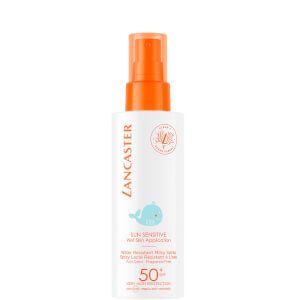
Lancaster Sun Sensitive Face and Body Sun Protection Cream For Kids SPF50

Lancaster Sun Sensitive Face and Body Sun Protection Cream For Kids SPF50

SPF 50Efficacy90/100IrritancyHigh·5 UV filters
Edit

Works for

1 of 1 advertised claim delivered

Sun protection
SPF 50 · 5 UV filters
Broad spectrum
SPF 50Broad spectrumChemical filtersWater-resistantNo white castNano filters

This product offers a good level of protection against both UVB and UVA rays.

This sunscreen uses organic (so-called "chemical") sunscreen filters. Organic, or "chemical" filters usually provide reliable sun protection and rarely leave a white cast. Sunscreens with organic filters can sting eyes.

This product can be considered "reef safe" because it does not contain the UV filters (oxybenzone and octinoxate) that can be harmful to coral reefs when present in the water in high concentrations.

UV spectrum
UVB290–320 nmUVA II320–340 nmUVA I340–400 nm
Uvinul T
Octisalate
Amiloxate
Tinosorb S
Avobenzone
FilterCoverageWhat it doesEst. amount
Uvinul TEthylhexyl TriazoneUVB Photo-stable Uvinul T. A UV filter. Effective against UVB rays. It is photostable. Can increase water resistance properties of the sunscreen. Unfortunately, not approved by the FDA (US) yet~2–2.5%
OctisalateEthylhexyl SalicylateUVBOctisalate. A UV filter. It offers some protection against the sun rays that cause sunburn (UVB), but does not protect against the most aging sun rays (UVA). It loses its effectiveness quickly when exposed to sunlight. It is an organic, or so called "chemical" sunscreen~0.5–0.7%
AmiloxateIsoamyl P-methoxycinnamateUVBUVA2Amiloxate or Neo Heliopan E1000. A UV filter. It is effective against UVB and UVA II rays. Not available in the US. It can be irritating~1.5–1.8%
Tinosorb SBis-ethylhexyloxyphenol Methoxyphenyl TriazineUVBUVA Photo-stable Tinosorb S. One of the most effective broad spectrum sunscreen ingredients. Protects from both UVA and UVB rays. It is photostable. Unfortunately, not approved by FDA (US) yet.~2.6–3.1%
AvobenzoneButyl MethoxydibenzoylmethaneUVA1Avobenzone. An organic, or so-called "chemical" UV filter. Protects against both UVA and UVB rays. Needs to be combined with other filters in a formulation to be stable.~2.2–2.7%
~ marks concentrations estimated from label position and typical use levels
Reef-safe
No oxybenzone or octinoxate — the two filters banned in Hawaii, Florida Keys and Aruba.
Anti-oxidation
Not advertised by the brand · 6 ingredients credited for this claim
Strong support

This product contains antioxidants (dimethylmethoxy chromanol) that can help neutralize free radicals in skin. By doing so, they can lessen the damage the skin gets from the UV light (sun).

Dimethylmethoxy chromanolKey activeEffect: HighCan help neutralize free radicals in skin~0.3–0.6%
TocopherolUnder-dosedEffect: HighPure form of vitamin E. Can help moisturise and protect the skin from free radicals. Often used to help stabilise other ingredients or the formula itself~0.15–0.3%
Ascorbic acidUnder-dosedEffect: HighThe most well-researched antioxidant that works in skin. Helps neutralize free radicals supporting collagen production, helping to even out the skin tone and preventing early signs of aging~0.5–0.7%
GluconolactoneUnder-dosedEffect: MediumA polyhydroxy acid (PHA) that helps shed the dead cells from the skin surface revealing smoother skin. Is believed to be genter than AHAs. It helps attract water to the upper layer of the skin and can stimulate production of skin's own hyaluronic acid resulting in improved hydration levels. It has been shown to be helpful against acne and clogged pores if used consistently (e.g over a period of 12 weeks) in high enough concentration. It can help reduce fine lines and wrinkles and improve skin tone with long-term application. Can help neutralize free radicals~0.25–0.45%
BisabololEffect: Low, below effective doseAn active component of chamomile plant that historically has been used to calm down irritated skin. A recent study shows that bisabolol indeed can have some anti-inflammatory effect on skin, even though conclusive data is lacking. Bisabolol has a sweet floral scent and can be added to products for its aromatic properties~0.4–0.6%
Ascorbyl palmitateEffect: Low, below effective doseBeing a lipid soluble form of vitamin C, it is more stable and can penetrate the skin better than L-Ascorbic acid. It is effective in protecting the skin from free radicals, as well as evening the skin tone, but is less effective in stimulating collagen production compared to L-Ascorbic acid.~0.45–0.65%
Evens skin tone
Not advertised by the brand · 2 ingredients credited for this claim
Strong support

This product offers broad spectrum sun protection. It means that it can prevent hyperpigmentation and help keep the skin tone even (sun damage is the main factor causing age spots, darkening of post-acne marks and other discolorations).

Ascorbic acidUnder-dosedEffect: HighThe most well-researched antioxidant that works in skin. Helps neutralize free radicals supporting collagen production, helping to even out the skin tone and preventing early signs of aging~0.5–0.7%
GluconolactoneUnder-dosedEffect: HighA polyhydroxy acid (PHA) that helps shed the dead cells from the skin surface revealing smoother skin. Is believed to be genter than AHAs. It helps attract water to the upper layer of the skin and can stimulate production of skin's own hyaluronic acid resulting in improved hydration levels. It has been shown to be helpful against acne and clogged pores if used consistently (e.g over a period of 12 weeks) in high enough concentration. It can help reduce fine lines and wrinkles and improve skin tone with long-term application. Can help neutralize free radicals~0.25–0.45%
Anti-aging
Not advertised by the brand · 4 ingredients credited for this claim
Strong support

This product can help prevent early signs of skin aging because it offers a good level of broad spectrum sun protection. Sun damage is the main cause of premature skin aging, and protecting your skin from the sun is the best anti-aging strategy.

Ascorbic acidUnder-dosedEffect: HighThe most well-researched antioxidant that works in skin. Helps neutralize free radicals supporting collagen production, helping to even out the skin tone and preventing early signs of aging~0.5–0.7%
GluconolactoneUnder-dosedEffect: HighA polyhydroxy acid (PHA) that helps shed the dead cells from the skin surface revealing smoother skin. Is believed to be genter than AHAs. It helps attract water to the upper layer of the skin and can stimulate production of skin's own hyaluronic acid resulting in improved hydration levels. It has been shown to be helpful against acne and clogged pores if used consistently (e.g over a period of 12 weeks) in high enough concentration. It can help reduce fine lines and wrinkles and improve skin tone with long-term application. Can help neutralize free radicals~0.25–0.45%
TocopherolEffect: Low, below effective dosePure form of vitamin E. Can help moisturise and protect the skin from free radicals. Often used to help stabilise other ingredients or the formula itself~0.15–0.3%
Ascorbyl palmitateEffect: Low, below effective doseBeing a lipid soluble form of vitamin C, it is more stable and can penetrate the skin better than L-Ascorbic acid. It is effective in protecting the skin from free radicals, as well as evening the skin tone, but is less effective in stimulating collagen production compared to L-Ascorbic acid.~0.45–0.65%
Moisturizing
Not advertised by the brand · 7 ingredients credited for this claim
Good support

This product contains good ingredients to attract water to the upper layer of the skin. These ingredients are called "humectants": glycerin, peg-8.

When humectants are on the surface of the skin, they “pull in” the moisture from the outside environment, or from within deeper layers of the skin. If the air is dry, humectants can speed up the moisture loss from the skin. This is why it is a good idea to use another product on top of this one to help "seal in" the moisture (look for ingredients like dimethicone, squalane, oils and butters).

GlycerinKey active· HumectantEffect: HighOne of the best moisturizing ingredients. Naturally present in skin. It attracts water to the upper layer of the skin working as a humectant~3.1–3.8%
Diisopropyl sebacateKey active· EmollientEffect: MediumHelps soften the upper layer of the skin without creatng a greasy finish~4.4–5.4%
Pentylene glycol· EmollientEffect: LowUsed to preserve products, dissolve other ingredients and create a nice product texture~0.25–0.5%
Dicaprylyl carbonate· EmollientEffect: LowHelps products spread more easily and works as an emollient to soften skin~5.3–6.5%
Peg-8· HumectantEffect: LowUsed to create a nice product consistency~0.25–0.45%
GluconolactoneUnder-dosedEffect: HighA polyhydroxy acid (PHA) that helps shed the dead cells from the skin surface revealing smoother skin. Is believed to be genter than AHAs. It helps attract water to the upper layer of the skin and can stimulate production of skin's own hyaluronic acid resulting in improved hydration levels. It has been shown to be helpful against acne and clogged pores if used consistently (e.g over a period of 12 weeks) in high enough concentration. It can help reduce fine lines and wrinkles and improve skin tone with long-term application. Can help neutralize free radicals~0.25–0.45%
TocopherolEffect: Low, below effective dosePure form of vitamin E. Can help moisturise and protect the skin from free radicals. Often used to help stabilise other ingredients or the formula itself~0.15–0.3%

Can it cause trouble?

Irritancy
3 strong irritants: Isoamyl p-methoxycinnamate, Citrus aurantium amara flower extract + 1 more — patch-test recommended
High risk
We flagged 18 ingredients with irritancy potential. Severity depends on your sensitivity threshold; the table lists the worst offenders first.
IngredientFunctionIrritationEst. amount
AlcoholCan be drying and contribute to skin irritation. Used in formulars to dissolve other ingredients, create a thinner product consistency or for its antibacterial propertiesHigh~1.2–1.5%est.
Isoamyl p-methoxycinnamateAmiloxate or Neo Heliopan E1000. A UV filter. It is effective against UVB and UVA II rays. Not available in the US. It can be irritatingHigh~1.5–1.8%est.
Ascorbic acidThe most well-researched antioxidant that works in skin. Helps neutralize free radicals supporting collagen production, helping to even out the skin tone and preventing early signs of agingHigh~0.5–0.7%est.
Citrus aurantium amara flower extractUsed as a fragrance for its citrus smell. Can be irritatingHigh~0.35–0.65%est.
Jasminum officinale flower extractFragrance. Can be irritatingHigh~0.2–0.4%est.
Bis-ethylhexyloxyphenol methoxyphenyl triazineTinosorb S. One of the most effective broad spectrum sunscreen ingredients. Protects from both UVA and UVB rays. It is photostable. Unfortunately, not approved by FDA (US) yet.Medium~2.6–3.1%est.
Butyl methoxydibenzoylmethaneAvobenzone. An organic, or so-called "chemical" UV filter. Protects against both UVA and UVB rays. Needs to be combined with other filters in a formulation to be stable.Medium~2.2–2.7%est.
Ethylhexyl triazoneUvinul T. A UV filter. Effective against UVB rays. It is photostable. Can increase water resistance properties of the sunscreen. Unfortunately, not approved by the FDA (US) yetMedium~2–2.5%est.
Potassium cetyl phosphateHelps oil and water mix togetherMedium~0.6–0.9%est.
Ascorbyl palmitateBeing a lipid soluble form of vitamin C, it is more stable and can penetrate the skin better than L-Ascorbic acid. It is effective in protecting the skin from free radicals, as well as evening the skin tone, but is less effective in stimulating collagen production compared to L-Ascorbic acid.Medium~0.45–0.65%est.
Citric acidCan work as an exfoliant but is typically used to adjust the product pHMedium~0.4–0.65%est.
Disodium edtaStabilizes the product formulationMedium~0.3–0.55%est.
GluconolactoneA polyhydroxy acid (PHA) that helps shed the dead cells from the skin surface revealing smoother skin. Is believed to be genter than AHAs. It helps attract water to the upper layer of the skin and can stimulate production of skin's own hyaluronic acid resulting in improved hydration levels. It has been shown to be helpful against acne and clogged pores if used consistently (e.g over a period of 12 weeks) in high enough concentration. It can help reduce fine lines and wrinkles and improve skin tone with long-term application. Can help neutralize free radicalsMedium~0.25–0.45%est.
Peg-8Used to create a nice product consistencyMedium~0.25–0.45%est.
Pentylene glycolUsed to preserve products, dissolve other ingredients and create a nice product textureMedium~0.25–0.5%est.
Sorbitan caprylateHelps oil and water mix togetherMedium~0.15–0.3%est.
Tribehenin peg-20 estersHelps oil and water mix togetherMedium~0.15–0.3%est.
Potassium sorbateA preservativeMedium~0.15–0.25%est.
Comedogenic
Clean of flagged comedogenic ingredients
None flagged
Edit

User reviews

Would you recommend?
No community reviews yet.

Be the first — your take helps the next person decide.

Write a review · ~30s

Ingredients

Filter by role to see what each ingredient is doing.

Water~45–55%
Formula
Irritation risk
Low

Plain old water

More about Water
Dicaprylyl carbonate~5.3–6.5%
Formula
Irritation risk
Low
Works for
Moisturizing

Helps products spread more easily and works as an emollient to soften skin

More about Dicaprylyl carbonate
Diisopropyl sebacate~4.4–5.4%
Key active
Irritation risk
Low
Works for
Moisturizing

Helps soften the upper layer of the skin without creatng a greasy finish

More about Diisopropyl sebacate
Glycerin~3.1–3.8%
Key active
Irritation risk
Low
Works for
Moisturizing

One of the best moisturizing ingredients. Naturally present in skin. It attracts water to the upper layer of the skin working as a humectant

More about Glycerin
Decyl cocoate~2.4–3%
Formula
Irritation risk
Low
More about Decyl cocoate
Bis-ethylhexyloxyphenol methoxyphenyl triazine~2.6–3.1%
UV filterKey activeIrritant · medium
Irritation risk
Medium
Works for
Sun protection

Tinosorb S. One of the most effective broad spectrum sunscreen ingredients. Protects from both UVA and UVB rays. It is photostable. Unfortunately, not approved by FDA (US) yet.

More about Bis-ethylhexyloxyphenol methoxyphenyl triazine
Butyl methoxydibenzoylmethane~2.2–2.7%
UV filterKey activeIrritant · medium
Irritation risk
Medium
Works for
Sun protection

Avobenzone. An organic, or so-called "chemical" UV filter. Protects against both UVA and UVB rays. Needs to be combined with other filters in a formulation to be stable.

More about Butyl methoxydibenzoylmethane
Ethylhexyl triazone~2–2.5%
UV filterKey activeIrritant · medium
Irritation risk
Medium
Works for
Sun protection

Uvinul T. A UV filter. Effective against UVB rays. It is photostable. Can increase water resistance properties of the sunscreen. Unfortunately, not approved by the FDA (US) yet

More about Ethylhexyl triazone
Alcohol~1.2–1.5%
Irritant · high
Irritation risk
High
Works for
Antibacterial

Can be drying and contribute to skin irritation. Used in formulars to dissolve other ingredients, create a thinner product consistency or for its antibacterial properties

More about Alcohol
Isoamyl p-methoxycinnamate~1.5–1.8%
UV filterKey activeIrritant · high
Irritation risk
High
Works for
Sun protection

Amiloxate or Neo Heliopan E1000. A UV filter. It is effective against UVB and UVA II rays. Not available in the US. It can be irritating

More about Isoamyl p-methoxycinnamate
Poly c10-30 alkyl acrylate~0.7–1.05%
Formula
Potassium cetyl phosphate~0.6–0.9%
Irritant · medium
Irritation risk
Medium
Works for
Cleansing

Helps oil and water mix together

More about Potassium cetyl phosphate
Acrylates/vinyl neodecanoate crosspolymer~0.55–0.8%
Formula
Ascorbic acid~0.5–0.7%
Under-dosedIrritant · high
Irritation risk
High
Works for
Anti-agingAnti-oxidationEvens skin tone

The most well-researched antioxidant that works in skin. Helps neutralize free radicals supporting collagen production, helping to even out the skin tone and preventing early signs of aging

More about Ascorbic acid
Ascorbyl palmitate~0.45–0.65%
Irritant · medium
Irritation risk
Medium
Works for
Anti-oxidationAnti-aging

Being a lipid soluble form of vitamin C, it is more stable and can penetrate the skin better than L-Ascorbic acid. It is effective in protecting the skin from free radicals, as well as evening the skin tone, but is less effective in stimulating collagen production compared to L-Ascorbic acid.

More about Ascorbyl palmitate
Bisabolol~0.4–0.6%
Formula
Irritation risk
Low
Works for
Anti-inflammatoryReduces irritationAnti-oxidation

An active component of chamomile plant that historically has been used to calm down irritated skin. A recent study shows that bisabolol indeed can have some anti-inflammatory effect on skin, even though conclusive data is lacking. Bisabolol has a sweet floral scent and can be added to products for its aromatic properties

More about Bisabolol
Citric acid~0.4–0.65%
Irritant · medium
Irritation risk
Medium

Can work as an exfoliant but is typically used to adjust the product pH

More about Citric acid
Citrus aurantium amara flower extract~0.35–0.65%
Irritant · high
Irritation risk
High

Used as a fragrance for its citrus smell. Can be irritating

More about Citrus aurantium amara flower extract
Dimethylmethoxy chromanol~0.3–0.6%
Key active
Irritation risk
Low
Works for
Anti-oxidation

Can help neutralize free radicals in skin

More about Dimethylmethoxy chromanol
Disodium edta~0.3–0.55%
Irritant · medium
Irritation risk
Medium

Stabilizes the product formulation

More about Disodium edta
Ethylhexyl salicylate~0.5–0.7%
UV filter
Irritation risk
Low
Works for
Sun protection

Octisalate. A UV filter. It offers some protection against the sun rays that cause sunburn (UVB), but does not protect against the most aging sun rays (UVA). It loses its effectiveness quickly when exposed to sunlight. It is an organic, or so called "chemical" sunscreen

More about Ethylhexyl salicylate
Gluconolactone~0.25–0.45%
Under-dosedIrritant · medium
Irritation risk
Medium
Works for
Evens skin toneAnti-agingMoisturizingExfoliationAnti-blemishAnti-oxidation

A polyhydroxy acid (PHA) that helps shed the dead cells from the skin surface revealing smoother skin. Is believed to be genter than AHAs. It helps attract water to the upper layer of the skin and can stimulate production of skin's own hyaluronic acid resulting in improved hydration levels. It has been shown to be helpful against acne and clogged pores if used consistently (e.g over a period of 12 weeks) in high enough concentration. It can help reduce fine lines and wrinkles and improve skin tone with long-term application. Can help neutralize free radicals

More about Gluconolactone
Gossypium hirsutum extract~0.25–0.45%
Formula
Jasminum officinale flower extract~0.2–0.4%
Irritant · high
Irritation risk
High

Fragrance. Can be irritating

More about Jasminum officinale flower extract
Peg-8~0.25–0.45%
Irritant · medium
Irritation risk
Medium
Works for
Moisturizing

Used to create a nice product consistency

More about Peg-8
Pentylene glycol~0.25–0.5%
Irritant · medium
Irritation risk
Medium
Works for
Moisturizing

Used to preserve products, dissolve other ingredients and create a nice product texture

More about Pentylene glycol
Sodium hydroxide~0.2–0.35%
Formula
Irritation risk
Low

Used to adjust the product's pH

More about Sodium hydroxide
Sorbitan caprylate~0.15–0.3%
Irritant · medium
Irritation risk
Medium
Works for
Cleansing

Helps oil and water mix together

More about Sorbitan caprylate
Tocopherol~0.15–0.3%
Under-dosed
Irritation risk
Low
Works for
Anti-oxidationAnti-inflammatoryAnti-agingMoisturizing

Pure form of vitamin E. Can help moisturise and protect the skin from free radicals. Often used to help stabilise other ingredients or the formula itself

More about Tocopherol
Tribehenin peg-20 esters~0.15–0.3%
Irritant · medium
Irritation risk
Medium
Works for
Cleansing

Helps oil and water mix together

More about Tribehenin peg-20 esters
Potassium sorbate~0.15–0.25%
Irritant · medium
Irritation risk
Medium

A preservative

More about Potassium sorbate
Sodium benzoate~0.1–0.2%
Formula
Irritation risk
Low

A preservative

More about Sodium benzoate
Ingredient list view

Water, Dicaprylyl carbonate, Diisopropyl sebacate, Glycerin, Decyl cocoate, Bis-ethylhexyloxyphenol methoxyphenyl triazine, Butyl methoxydibenzoylmethane, Ethylhexyl triazone, Alcohol, Isoamyl p-methoxycinnamate, Poly c10-30 alkyl acrylate, Potassium cetyl phosphate, Acrylates/vinyl neodecanoate crosspolymer, Ascorbic acid, Ascorbyl palmitate, Bisabolol, Citric acid, Citrus aurantium amara flower extract, Dimethylmethoxy chromanol, Disodium edta, Ethylhexyl salicylate, Gluconolactone, Gossypium hirsutum extract, Jasminum officinale flower extract, Peg-8, Pentylene glycol, Sodium hydroxide, Sorbitan caprylate, Tocopherol, Tribehenin peg-20 esters, Potassium sorbate, Sodium benzoate

Compare prices

Retailers ranked by price — lowest first.

Lookfantastic US
$32.90
Buy

Affiliate links · prices updated regularly

Worth comparing, line by line.

Match % combines shared ingredients, the first five ingredients, shared actives and hero ingredients, irritancy (lower counts in the alternative's favour), texture and body area. Only products in the same routine step are compared.

Side-by-side comparison of this product against its closest alternatives
LancasterSun Sensitive Face and Body Sun Protection Cream For Kids SPF50YOUR PRODUCTCetaphilSheer Mineral Sunscreen Broad Spectrum SPF 50
Match—65%
Price$31.46$27.76−$3.70
Shared key ingredients—1 of 9
Key difference—Oatmeal Extract
Irritancy High Low
SPFSPF 50SPF 50
Drying alcohol Contains drying alcohol —
View product Shop
Cheaper alternatives? See how this stacks up against similar formulas.
We compare ingredient profiles across our catalog — pick the closest match for your budget.
Open dupe finder

Product summary

We assess that "Lancaster - Sun Sensitive Face and Body Sun Protection Cream For Kids SPF50" can provide reliable sun protection based on the ingredient list. It can protect from both UVA and UVB rays. This is great news because not all sunscreens with SPF ratings give UVA protection. (UVA rays do not cause sunburn, but still damage our skin and lead to early aging).

It contains good moisturizing ingredients and can double as a hydrating day cream. Like all broad-spectrum sunscreens, this product helps prevent early signs of aging.

Sunscreen filters

This sunscreen uses so-called "chemical", or organic UV filters (organic simply means that their molecules contain atoms of carbon). These filters typically give good sun protection and rarely leave a white cast, but they can be irritating for sensitive skin. These are the sun protection ingredients in this sunscreen: tinosorb s 2.60% - 3.10%, avobenzone 2.20% - 2.70%, octisalate 0.50% - 0.70%, uvinul t 2.00% - 2.50% and amiloxate 1.50% - 1.80%.

Irritation risk

This sunscreen contains some common irritants, including those without a benefit for the skin. We assess the overall irritancy of this sunscreen to be high. For a detailed overview of all potential irritants: click here

You can see the detailed formula review with the breakdown of all actives in the product and the full ingredient list with estimated concentrations in the tables below.

Price

The product retails for 32.90$ in the United States, at around 24.17£ in the United Kingdom and for 41.70CA$ in Canada.

For a detailed price comparison: click here.

Sources cited in this review

Every concentration estimate and effectiveness label is anchored to one of these 17 studies and safety reviews.

  1. 1
  2. 2
  3. 3
  4. 4
  5. 5
  6. 6
Lancaster Sun Sensitive Face and Body Sun Protection Cream For Kids SPF50
LancasterSun Sensitive Face and Body Sun Protection Cream For Kids SPF50

Affiliate links · As an Amazon Associate, WIMJ earns from qualifying purchases.

As an Amazon Associate, WIMJ earns from qualifying purchases.