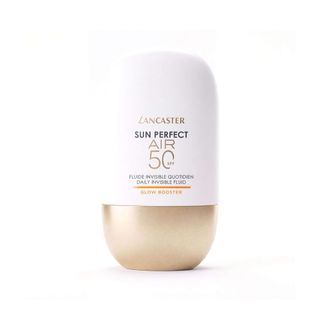
Lancaster Sun Perfect AIR Daily Invisible Fluid SPF50 Glow Booster
Works for
1 of 1 advertised claim delivered
Sun protectionSPF 50 · 5 UV filtersBroad spectrum
This product offers a good level of protection against both UVB and UVA rays.
This sunscreen uses organic (so-called "chemical") sunscreen filters. Organic, or "chemical" filters usually provide reliable sun protection and rarely leave a white cast. Sunscreens with organic filters can sting eyes.
This product can be considered "reef safe" because it does not contain the UV filters (oxybenzone and octinoxate) that can be harmful to coral reefs when present in the water in high concentrations.
Anti-agingNot advertised by the brand · 4 ingredients credited for this claimStrong support
This product can help prevent early signs of skin aging because it offers a good level of broad spectrum sun protection. Sun damage is the main cause of premature skin aging, and protecting your skin from the sun is the best anti-aging strategy.
These ingredients in the product might also be helpful for reducing and preventing fine lines, wrinkles, and skin elasticity, even though there is no conclusive evidence for their effectiveness: centella asiatica leaf extract, creatine.
Evens skin toneNot advertised by the brand · 3 ingredients credited for this claimStrong support
This product offers broad spectrum sun protection. It means that it can prevent hyperpigmentation and help keep the skin tone even (sun damage is the main factor causing age spots, darkening of post-acne marks and other discolorations).
Anti-oxidationNot advertised by the brand · 7 ingredients credited for this claimStrong support
This product contains antioxidants (dimethylmethoxy chromanol) that can help neutralize free radicals in skin. By doing so, they can lessen the damage the skin gets from the UV light (sun).
The following ingredients - creatine, ginkgo biloba leaf extract also can have an antioxidant effect, but there is less evidence to confirm their effectiveness in skin.
MoisturizingNot advertised by the brand · 12 ingredients credited for this claimGood support
This product contains good ingredients to attract water to the upper layer of the skin. These ingredients are called "humectants": fructose, glycerin.
When humectants are on the surface of the skin, they “pull in” the moisture from the outside environment, or from within deeper layers of the skin. If the air is dry, humectants can speed up the moisture loss from the skin. This is why it is a good idea to use another product on top of this one to help "seal in" the moisture (look for ingredients like dimethicone, squalane, oils and butters).
Can it cause trouble?
Irritancy3 strong irritants: Alcohol, Parfum + 1 more — patch-test recommendedHigh risk
ComedogenicClean of flagged comedogenic ingredientsNone flagged
User reviews
Be the first — your take helps the next person decide.
Ingredients
Filter by role to see what each ingredient is doing.
Water~45–55%
Dibutyl adipate~5.9–7.2%
- Irritation risk
- Low
Helps soften the upper layer of the skin and create a nice product consistency
More about Dibutyl adipateDiethylhexyl carbonate~4.3–5.3%
- Irritation risk
- Low
Helps soften the upper layer of the skin
More about Diethylhexyl carbonateAlcohol~3.2–3.9%
- Irritation risk
- High
Can be drying and contribute to skin irritation. Used in formulars to dissolve other ingredients, create a thinner product consistency or for its antibacterial properties
More about AlcoholGlycerin~2.5–3%
- Irritation risk
- Low
One of the best moisturizing ingredients. Naturally present in skin. It attracts water to the upper layer of the skin working as a humectant
More about GlycerinBis-ethylhexyloxyphenol methoxyphenyl triazine~2.5–3.1%
- Irritation risk
- Medium
Tinosorb S. One of the most effective broad spectrum sunscreen ingredients. Protects from both UVA and UVB rays. It is photostable. Unfortunately, not approved by FDA (US) yet.
More about Bis-ethylhexyloxyphenol methoxyphenyl triazineButyl methoxydibenzoylmethane~2.1–2.6%
- Irritation risk
- Medium
Avobenzone. An organic, or so-called "chemical" UV filter. Protects against both UVA and UVB rays. Needs to be combined with other filters in a formulation to be stable.
More about Butyl methoxydibenzoylmethaneEthylhexyl triazone~1.9–2.3%
- Irritation risk
- Medium
Uvinul T. A UV filter. Effective against UVB rays. It is photostable. Can increase water resistance properties of the sunscreen. Unfortunately, not approved by the FDA (US) yet
More about Ethylhexyl triazoneDiethylhexyl butamido triazone~1.6–2%
- Irritation risk
- Medium
Uvasorb HEB. A UV filter. Is effective against UVB and UVA II rays (but not UVA I). It is photostable. Unfortunately, is not approved by FDA (US) yet
More about Diethylhexyl butamido triazoneTrimethylpentanediol/adipic acid/glycerin crosspolymer~0.75–1.1%
- Irritation risk
- Low
Isoamyl laurate~0.6–0.9%
- Irritation risk
- Medium
Helps stabilize emulsions and create a nice product texture
More about Isoamyl lauratePolyglyceryl-6 stearate~0.55–0.8%
- Irritation risk
- Low
Helps soften the upper layer of the skin
More about Polyglyceryl-6 stearateSilica~0.65–1%
Saccharomyces ferment~0.35–0.65%
- Irritation risk
- Low
A product of yeast fermentation. Helps attract water to the upper layer of the skin
More about Saccharomyces fermentSynthetic fluorphlogopite~0.35–0.6%
- Irritation risk
- Low
A mineral that is used as an optical filter (makes the skin looks nicer through light reflection) and to improve the texture of cosmetic products
More about Synthetic fluorphlogopiteParfum~0.3–0.55%
- Irritation risk
- High
An aromatic blend of unspecified and possibly irritating ingredients
More about ParfumPotassium cetyl phosphate~0.35–0.6%
- Irritation risk
- Medium
Helps oil and water mix together
More about Potassium cetyl phosphateMica~0.3–0.55%
- Irritation risk
- Low
Creates an illusion of smoother and more radiant skin tone. Adds shimmer to the skin by reflecting light
More about MicaAscorbyl glucoside~0.25–0.45%
- Irritation risk
- Medium
A vitamin C derivative that is more stable but less potent than pure form of vitamin C. Has a potential to boost collagen production, nutralise free radicals and reduce hyperpigmentation, but the required concentration is likely to be much higher than for the pure form of vitamin C, limiting the ingredient's effectiveness in products
More about Ascorbyl glucosideCreatine~0.2–0.4%
- Irritation risk
- Low
Can support skin's ability to neutralize free radicals and produce collagen, though further research is needed to confirm effectiveness
More about CreatineSorbitan caprylate~0.25–0.45%
- Irritation risk
- Medium
Helps oil and water mix together
More about Sorbitan caprylateCaprylic/capric triglyceride~0.25–0.5%
- Irritation risk
- Medium
A good mix of fatty acids that forms a protective layer on the skin. Improves the shelf life of products. Derived from coconut and glycerin
More about Caprylic/capric triglyceridePropylene glycol~0.2–0.35%
- Irritation risk
- High
Helps oil and water mix together and can enhance the penetration of other ingredients into the skin. It can be irritating
More about Propylene glycolSodium benzoate~0.2–0.35%
Fructose~0.2–0.35%
- Irritation risk
- Low
Helps attract water to the upper layer of the skin
More about FructosePolyglyceryl-6 behenate~0.2–0.4%
Acrylates/c10-30 alkyl acrylate crosspolymer~0.2–0.4%
- Irritation risk
- Medium
Maintains the texture of skincare products. Allows the product to spread evenly. Helps oil and water mix together
More about Acrylates/c10-30 alkyl acrylate crosspolymerLauroyl lysine~0.2–0.35%
- Irritation risk
- Low
Helps soften the upper layer of the skin and creates a nice product texture
More about Lauroyl lysinePotassium sorbate~0.2–0.35%
Bifida ferment lysate~0.2–0.35%
- Irritation risk
- Low
Consists of remains of dead yeast bacteria cells. Helps to hydrate the skin and reduce irritation. Might has some anti-oxidant effect
More about Bifida ferment lysateTrisodium ethylenediamine disuccinate~0.2–0.35%
- Irritation risk
- Medium
Used to improve stability of the formulation
More about Trisodium ethylenediamine disuccinateGinkgo biloba leaf extract~0.2–0.35%
- Irritation risk
- High
A plant extract that might help neutralize free radicals and reduce inflammation in skin. It can be irritating
More about Ginkgo biloba leaf extractSechium edule fruit extract~0.15–0.3%
- Irritation risk
- Low
Sodium hydroxide~0.2–0.35%
Tin oxide~0.3–0.5%
- Irritation risk
- Low
A colorant that can add a pearl-like appearance to the formulation
More about Tin oxideGlucose~0.15–0.3%
- Irritation risk
- Low
Helps attract water to the upper layer of the skin. Could be helpful in restoring the skin barrier function
More about GlucoseLactic acid~0.15–0.3%
- Irritation risk
- Medium
An exfoliating and moisturizing alpha-hydroxy acid (AHA). Typically causes less irritation than other AHAs, for example, glycolic acid. At high concentrations (about 15%), lactic acid can help reduce lines and wrinkles. Recent studies show that lactic acid can support the "good" bacteria living on skin's surface (healthy skin microbiome)
More about Lactic acidBuddleja officinalis flower extract~0.3–0.55%
- Irritation risk
- High
A plant flower extract that might help calm down inflammation in skin and neutralize free radicals, but evidence of effectiveness in skin is lacking
More about Buddleja officinalis flower extractDimethylmethoxy chromanol~0.15–0.25%
- Irritation risk
- Low
Can help neutralize free radicals in skin
More about Dimethylmethoxy chromanolHordeum vulgare leaf extract~0.1–0.2%
- Irritation risk
- Low
Centella asiatica leaf extract~0.1–0.2%
- Irritation risk
- Medium
A plant extract that has been shown to be able to reduce inflammation in skin, support restoration of skin barrier function, as well as support collagen production. It can be irritating to sensitive skin. Might be helpful in preventing stretch marks. It could, however, itself be irritating.
More about Centella asiatica leaf extractRosmarinus officinalis leaf extract~0.1–0.2%
- Irritation risk
- High
Can be helpful in reducing inflammation in skin, including inflamed acne. It can be irritating
More about Rosmarinus officinalis leaf extractCitric acid~0.1–0.2%
- Irritation risk
- Medium
Can work as an exfoliant but is typically used to adjust the product pH
More about Citric acidTitanium dioxide~0.1–0.15%
- Irritation risk
- Low
Works as a UV filter when used in high concentrations. It is photostable and is effective mostly against the UVB light, with some protection in the UVA range. In small concentrations, used for its ability to improve the color of cosmetic products. Is usually well tolerated by the skin
More about Titanium dioxideIron oxides~0.1–0.15%
- Irritation risk
- Low
An umbrella term for the following three colorants: CI 77491, CI 77492, CI 77499. They might be able to offer some protection against visible light, but the degree of the protection is not clear
More about Iron oxidesIngredient list view
Water, Dibutyl adipate, Diethylhexyl carbonate, Alcohol, Glycerin, Bis-ethylhexyloxyphenol methoxyphenyl triazine, Butyl methoxydibenzoylmethane, Ethylhexyl triazone, Diethylhexyl butamido triazone, Trimethylpentanediol/adipic acid/glycerin crosspolymer, Isoamyl laurate, Polyglyceryl-6 stearate, Silica, Saccharomyces ferment, Synthetic fluorphlogopite, Parfum, Potassium cetyl phosphate, Mica, Ascorbyl glucoside, Creatine, Sorbitan caprylate, Caprylic/capric triglyceride, Propylene glycol, Sodium benzoate, Fructose, Polyglyceryl-6 behenate, Acrylates/c10-30 alkyl acrylate crosspolymer, Lauroyl lysine, Potassium sorbate, Bifida ferment lysate, Trisodium ethylenediamine disuccinate, Ginkgo biloba leaf extract, Sechium edule fruit extract, Sodium hydroxide, Tin oxide, Glucose, Lactic acid, Buddleja officinalis flower extract, Dimethylmethoxy chromanol, Hordeum vulgare leaf extract, Centella asiatica leaf extract, Rosmarinus officinalis leaf extract, Citric acid, Titanium dioxide, Iron oxides
Compare prices
Retailers ranked by price — lowest first.

Sources cited in this review
Every concentration estimate and effectiveness label is anchored to one of these 26 studies and safety reviews.
- 1
- 2The Roles of Vitamin C in Skin Healthncbi.nlm.nih.gov
- 3
- 4
- 5
- 6

Affiliate links · As an Amazon Associate, WIMJ earns from qualifying purchases.