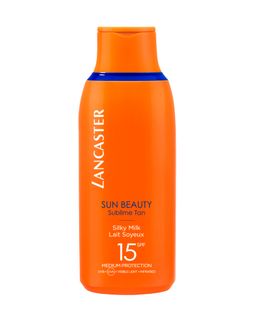
Lancaster Sun Beauty Silky Fluid Milk SPF15
Works for
1 of 2 advertised claims delivered
Sun protectionSPF 15 · 6 UV filters · Broad spectrumWeak protectionSPF under 30
This product offers broad spectrum sun protection, but it is weak. We recommend to use a broad spectrum sunscreen with at least SPF 30.
Anti-aging5 ingredients credited for this claimModerate support
“Take care of your skin with Lancaster's Sun Beauty Silky Fluid Milk SPF15, a lightweight and nourishing sunscreen for the whole body.Fortified with the brand's Full Light Technology , which protects skin against UVA/UVB, visible light and infrared , to provide protection against all four sun rays, this sun cream helps to prevent damage whilst also maintaining skin firmness and elasticity for a youthful-looking appearance.”
This product contains dimethylmethoxy chromanol. This ingredient help neutralize free radicals in skin. By doing so, they might be able to prevent early signs of aging (like fine lines and wrinkles), at least to some extent. These ingredients will not be able to "reverse" signs of aging. The biggest anti-aging effect in this product comes from sun protection. Sun damage is the main factor causing early signs of skin aging. We, however, do not recommend using this product as a sunscreen because the protection it offers is not strong enough).
Anti-oxidationNot advertised by the brand · 7 ingredients credited for this claimStrong support
This product contains antioxidants (dimethylmethoxy chromanol) that can help neutralize free radicals in skin. By doing so, they can lessen the damage the skin gets from the UV light (sun).
MoisturizingNot advertised by the brand · 19 ingredients credited for this claimGood support
This product can help improve hydration of the skin with the two types of ingredients.
The first type is called “humectants”:
these ingredients help attract water.
When humectants are on the surface of the skin, they “pull in” the moisture from the outside environment, or from
within deeper layers of the skin. The following ingredients in this product do the job:
glycerin, glycine.
This product also contains ingredients called “occlusives”. They help reduce the speed with which our skin loses moisture to the outside environment. These ingredients also help soften the upper layer of the skin, so it feels less tight and nicer to the touch. The following ingredients in this product do the job: dimethiconol, cetyl alcohol.
Can it cause trouble?
Irritancy14 strong irritants: Alcohol, Alpha-isomethyl ionone + 12 more — patch-test recommendedHigh risk
Comedogenic1 ingredient rated 2 or more on the 0–5 pore-clogging scale1 flagged
User reviews
Be the first — your take helps the next person decide.
Ingredients
Filter by role to see what each ingredient is doing.
Water52.92471%
Alcohol8.01957%
- Irritation risk
- High
Can be drying and contribute to skin irritation. Used in formulars to dissolve other ingredients, create a thinner product consistency or for its antibacterial properties
More about AlcoholDiisopropyl sebacate7%
- Irritation risk
- Low
Helps soften the upper layer of the skin without creatng a greasy finish
More about Diisopropyl sebacateEthylhexyl methoxycinnamate5.4945%
- Irritation risk
- High
Octinoxate. When used in higher concentrations, works as a sunscreen protecting the skin from UVB rays. When used in lower concentration, helps to preserve the product formulation. Is shown to be harmful to coral reefs - consider avoiding bathing in coral reef areas when wearing a product with this ingredient. It can be irritating
More about Ethylhexyl methoxycinnamateGlycerin5.0125%
- Irritation risk
- Low
One of the best moisturizing ingredients. Naturally present in skin. It attracts water to the upper layer of the skin working as a humectant
More about GlycerinButylene glycol3%
- Irritation risk
- Low
Used to create a nice product texture and help delivery of other ingredients. Might be somewhat helpful in attracting water to the upper layer of the skin
More about Butylene glycolButyl methoxydibenzoylmethane2.5%
- Irritation risk
- Medium
Avobenzone. An organic, or so-called "chemical" UV filter. Protects against both UVA and UVB rays. Needs to be combined with other filters in a formulation to be stable.
More about Butyl methoxydibenzoylmethaneVegetable oil2.175%
- Irritation risk
- Low
An oil from a mixture of different vegetables. Helps soften the upper layer of the skin
More about Vegetable oilEthylhexyl salicylate2%
- Irritation risk
- Low
Octisalate. A UV filter. It offers some protection against the sun rays that cause sunburn (UVB), but does not protect against the most aging sun rays (UVA). It loses its effectiveness quickly when exposed to sunlight. It is an organic, or so called "chemical" sunscreen
More about Ethylhexyl salicylateOctocrylene2%
- Irritation risk
- Medium
A weak sunscreen that protects against the sun rays that cause sunburn (UVB) and is somewhat effective against the UVA rays. It is quite stable and can help stabilize other, more vulnerable, sunscreen ingredients like Avobenzone. It is an organic, or so called "chemical" sunscreen
More about OctocryleneCyclopentasiloxane1.7%
- Irritation risk
- Low
A silicone that helps improve the product texture and spreadability. Can absorb oil creating a short-term mattifying effect on the skin
More about CyclopentasiloxaneAcrylates/c12-22 alkyl methacrylate copolymer0.48%
- Irritation risk
- Low
Alpha-isomethyl ionone0.02463%
- Irritation risk
- High
A fragrance. Potential allergen and can be irritating
More about Alpha-isomethyl iononeAmmonium acryloyldimethyltaurate/beheneth-25 methacrylate crosspolymer0.45%
- Irritation risk
- Medium
Used to stabilize product formulations
More about Ammonium acryloyldimethyltaurate/beheneth-25 methacrylate crosspolymerAmmonium acryloyldimethyltaurate/vp copolymer0.2%
- Irritation risk
- Low
Increases thickness of a product. Texture enhancer for oil-in-water emulsions
More about Ammonium acryloyldimethyltaurate/vp copolymerAngelica archangelica root extract0.001%
- Irritation risk
- Low
Ascorbic acid0.00101%
- Irritation risk
- High
The most well-researched antioxidant that works in skin. Helps neutralize free radicals supporting collagen production, helping to even out the skin tone and preventing early signs of aging
More about Ascorbic acidAscorbyl palmitate0.00505%
- Irritation risk
- Medium
Being a lipid soluble form of vitamin C, it is more stable and can penetrate the skin better than L-Ascorbic acid. It is effective in protecting the skin from free radicals, as well as evening the skin tone, but is less effective in stimulating collagen production compared to L-Ascorbic acid.
More about Ascorbyl palmitateBenzyl alcohol0.00153%
- Irritation risk
- High
A preservative. Can be used to mask unpleasant smell. Can be irritating
More about Benzyl alcoholBenzyl benzoate0.00295%
- Irritation risk
- High
Fragrance with sweet balsamic smell. Help to preserve products and dissolve other ingredients. Could trigger allergic reactions and be irritating
More about Benzyl benzoateBenzyl salicylate0.00108%
Bht0.0055%
Caffeine0.5%
- Irritation risk
- Medium
Might be helpful in neutralizing free radicals. Can have a dehydration effect that might somewhat decrease the look of puffy eyes
More about CaffeineCalcium sodium phosphosilicate0.0097%
- Irritation risk
- Low
Camellia sinensis leaf extract0.002%
- Irritation risk
- Low
Can contain potent anti-oxidant compounds (abbreviated ECG, GCG, EGC, and EGCG) that might help protect the skin from free radicals. Can help calm down inflammation and has some anti-bacterial properties. Unfortunately, these antioxidants are unstable and lose their effectiveness very quickly in products. The concentration of the antioxidant compounds in the extract also tends to be low to be effective in topical formulation
More about Camellia sinensis leaf extractEuphorbia cerifera wax~39–58%
- Irritation risk
- Low
Candelilla cera0.075%
- Irritation risk
- Low
Caprylyl glycol0.00042%
- Irritation risk
- Medium
Helps preserve products and creates a nice product texture
More about Caprylyl glycolCeteth-20~6.3–9.4%
Cetyl alcohol0.6375%
- Irritation risk
- Low
A non-drying alcohol that works to soften the skin and stabilize product formulations helping oil and water mix together
More about Cetyl alcoholCinnamal0.00155%
- Irritation risk
- High
Citric acid0.0013%
- Irritation risk
- Medium
Can work as an exfoliant but is typically used to adjust the product pH
More about Citric acidCitronellol0.07052%
Citrus aurantium amara peel extract0.001%
- Irritation risk
- High
Coffea arabica seed extract0.002%
- Irritation risk
- Low
Might be helpful in neutralizing free radicals in skin
More about Coffea arabica seed extractDiethylhexyl butamido triazone0.5%
- Irritation risk
- Medium
Uvasorb HEB. A UV filter. Is effective against UVB and UVA II rays (but not UVA I). It is photostable. Unfortunately, is not approved by FDA (US) yet
More about Diethylhexyl butamido triazoneDimethiconol0.3%
- Irritation risk
- Low
A silicone that makes products more spreadable and keeps skin smooth. Helps to add gloss to skin and may visually fill in fine lines/wrinkles for short time
More about DimethiconolDimethylmethoxy chromanol0.003%
- Irritation risk
- Low
Can help neutralize free radicals in skin
More about Dimethylmethoxy chromanolDisodium edta0.1%
Farnesol0.00149%
Geraniol0.01189%
Glyceryl stearate0.6375%
- Irritation risk
- Low
An emollient that softens the skin and forms a protective layer on its surface. Helps water and oil mix together
More about Glyceryl stearateGlycine0.05%
- Irritation risk
- Low
Helps to attract water to the upper layer of the skin and can help restore the skin barrier function
More about GlycineHydrogenated palm glycerides0.0745%
- Irritation risk
- Low
An emollient that softens the skin
More about Hydrogenated palm glyceridesHydrogenated palm kernel glycerides0.9255%
- Irritation risk
- Low
Help soften the upper layer of the skin
More about Hydrogenated palm kernel glyceridesHydrogenated vegetable oil0.25%
- Irritation risk
- Low
- Comedogenicity
- 2/5
An oil from a mixture of different vegetables. Helps soften the upper layer of the skin
More about Hydrogenated vegetable oilHydrolyzed citrus aurantium dulcis fruit extract0.01681%
- Irritation risk
- High
Hydroxycitronellal0.02037%
- Irritation risk
- High
A fragrance. A likely allergen and can be irritating
More about HydroxycitronellalLecithin0.006%
- Irritation risk
- Low
Used mostly for creating emulsions - helping oil and water mix together. Helps soften the upper layer of the skin
More about LecithinLimonene0.00114%
- Irritation risk
- High
A common frangrance that can easily irritate skin, especially if exposed to air, light or heat
More about LimoneneLinalool0.06611%
Magnesium aluminum silicate0.0008%
- Irritation risk
- Low
Might be helpful in restoring skin barrier function and, when combined with zinc carbonate and malonic acid, reducing fine lines and wrinkles by stimulating elastin production. Also helps stabilize the product formulation
More about Magnesium aluminum silicateMaltodextrin0.001%
- Irritation risk
- Low
Used to stabilize the product formulation and can help absorb oil
More about MaltodextrinMauritia flexuosa fruit oil0.1%
- Irritation risk
- Medium
Helps soften the upper layer of the skin
More about Mauritia flexuosa fruit oilMica0.0003%
- Irritation risk
- Low
Creates an illusion of smoother and more radiant skin tone. Adds shimmer to the skin by reflecting light
More about MicaNylon-12~4–6%
Peg-75 stearate0.255%
Peg-8~2.7–4.1%
- Irritation risk
- Medium
Used to create a nice product consistency
More about Peg-8Pentylene glycol0.06%
- Irritation risk
- Medium
Used to preserve products, dissolve other ingredients and create a nice product texture
More about Pentylene glycolPongamia pinnata seed extract0.002%
- Irritation risk
- Low
Sclerotium gum0.0003%
- Irritation risk
- Low
Used to create gel-like formulas and stabilize emulsions
More about Sclerotium gumSodium lactate methylsilanol0.14799%
- Irritation risk
- Low
Sodium polyacrylate0.2%
- Irritation risk
- Low
Used to create a gel-like product texture, as well as to stabilize emulsions
More about Sodium polyacrylateSteareth-20~2.1–3.2%
Synthetic fluorphlogopite0.0365%
- Irritation risk
- Low
A mineral that is used as an optical filter (makes the skin looks nicer through light reflection) and to improve the texture of cosmetic products
More about Synthetic fluorphlogopiteTin oxide0.0005%
- Irritation risk
- Low
A colorant that can add a pearl-like appearance to the formulation
More about Tin oxideTocopherol0.02424%
- Irritation risk
- Low
Pure form of vitamin E. Can help moisturise and protect the skin from free radicals. Often used to help stabilise other ingredients or the formula itself
More about TocopherolXanthan gum0.0008%
- Irritation risk
- Low
Used to create a thicker product consistency
More about Xanthan gumPhenoxyethanol0.00547%
- Irritation risk
- Low
A preservative. It helps prevent bacterial growth in cosmetic products
More about PhenoxyethanolSalicylic acid0.00081%
- Irritation risk
- High
Used for skin exfoliation. It has an anti-inflammatory and anti-bacterial effect, helps to unclog pores, prevent blemishes and speed up healing of the existing ones. Sometimes referred to as a BHA (beta-hydroxy acid)
More about Salicylic acidSorbic acid0.00006%
Parfum0.9%
- Irritation risk
- High
An aromatic blend of unspecified and possibly irritating ingredients
More about ParfumCi 14700~1.5–2.2%
Ci 15985~1.1–1.6%
Ci 19140~0.45–1%
Titanium dioxide0.00001%
- Irritation risk
- Low
Works as a UV filter when used in high concentrations. It is photostable and is effective mostly against the UVB light, with some protection in the UVA range. In small concentrations, used for its ability to improve the color of cosmetic products. Is usually well tolerated by the skin
More about Titanium dioxideCi 77891~0.15–0.55%
- Irritation risk
- Low
Ingredient list view
Water, Alcohol, Diisopropyl sebacate, Ethylhexyl methoxycinnamate, Glycerin, Butylene glycol, Butyl methoxydibenzoylmethane, Vegetable oil, Ethylhexyl salicylate, Octocrylene, Cyclopentasiloxane, Acrylates/c12-22 alkyl methacrylate copolymer, Alpha-isomethyl ionone, Ammonium acryloyldimethyltaurate/beheneth-25 methacrylate crosspolymer, Ammonium acryloyldimethyltaurate/vp copolymer, Angelica archangelica root extract, Ascorbic acid, Ascorbyl palmitate, Benzyl alcohol, Benzyl benzoate, Benzyl salicylate, Bht, Caffeine, Calcium sodium phosphosilicate, Camellia sinensis leaf extract, Euphorbia cerifera wax, Candelilla cera, Caprylyl glycol, Ceteth-20, Cetyl alcohol, Cinnamal, Citric acid, Citronellol, Citrus aurantium amara peel extract, Coffea arabica seed extract, Diethylhexyl butamido triazone, Dimethiconol, Dimethylmethoxy chromanol, Disodium edta, Farnesol, Geraniol, Glyceryl stearate, Glycine, Hydrogenated palm glycerides, Hydrogenated palm kernel glycerides, Hydrogenated vegetable oil, Hydrolyzed citrus aurantium dulcis fruit extract, Hydroxycitronellal, Lecithin, Limonene, Linalool, Magnesium aluminum silicate, Maltodextrin, Mauritia flexuosa fruit oil, Mica, Nylon-12, Peg-75 stearate, Peg-8, Pentylene glycol, Pongamia pinnata seed extract, Sclerotium gum, Sodium lactate methylsilanol, Sodium polyacrylate, Steareth-20, Synthetic fluorphlogopite, Tin oxide, Tocopherol, Xanthan gum, Phenoxyethanol, Salicylic acid, Sorbic acid, Parfum, Unknown, Ci 14700, Ci 15985, Ci 19140, Titanium dioxide, Ci 77891
Compare prices
Retailers ranked by price — lowest first.


Product summary
"Lancaster - Sun Beauty Silky Fluid Milk SPF15" "is a broad spectrum sunscreen meaning that it protects both from UVB rays (" burning "- they cause sunburn) and UVA rays (" aging "- they don't cause sunburn but lead to premature aging and pigmentation issues). However, this moisturizer does not offer enough sun protection. We recommend to use a sunscreen with at least SPF 30 daily.
Its formula is also hydrating, so you might not need an additional moistruizer during the day.
Sunscreen filters
This sunscreen uses so-called" chemical ", or organic UV filters (organic simply means that their molecules contain atoms of carbon). These filters typically give good sun protection and rarely leave a white cast, but they can be irritating for sensitive skin. Here are the exact UV filters in this sunscreen: avobenzone 2.50% (declared), uvasorb heb 0.50% (declared), octinoxate 5.49% (declared), octisalate 2.00% (declared) and octocrylene 2.00% (declared).
Irritation risk
This moisturizer contains a bunch of common irritants, including ingredients that do not provide any known benefit for the skin. It might not be the best choice if your skin is sensitive. We assess the overall irritancy of this moisturizer to be high. For a detailed overview of all potential irritants: click here
You can see the detailed formula review with the breakdown of all actives in the product and the full ingredient list with estimated concentrations in the tables below.
Price
The product retails from 28.00£ up to 35.00£ in the United Kingdom.
For a detailed price comparison: click here.
Sources cited in this review
Every concentration estimate and effectiveness label is anchored to one of these 17 studies and safety reviews.
- 1
- 2
- 3
- 4
- 5
- 6

Affiliate links · As an Amazon Associate, WIMJ earns from qualifying purchases.