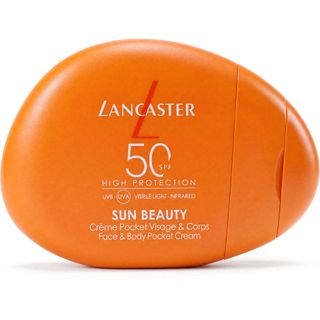
Lancaster Sun Beauty Face & Body Pocket Cream SPF50
Works for
1 of 1 advertised claim delivered
Sun protectionSPF 50 · 6 UV filtersBroad spectrum
This product offers a good level of protection against both UVB and UVA rays.
This sunscreen uses organic (so-called "chemical") sunscreen filters. Organic, or "chemical" filters usually provide reliable sun protection and rarely leave a white cast. Sunscreens with organic filters can sting eyes.
This product can be considered "reef safe" because it does not contain the UV filters (oxybenzone and octinoxate) that can be harmful to coral reefs when present in the water in high concentrations.
Anti-agingNot advertised by the brand · 1 ingredient credited for this claimStrong support
This product can help prevent early signs of skin aging because it offers a good level of broad spectrum sun protection. Sun damage is the main cause of premature skin aging, and protecting your skin from the sun is the best anti-aging strategy.
These ingredients in the product might also be helpful for reducing and preventing fine lines, wrinkles, and skin elasticity, even though there is no conclusive evidence for their effectiveness: creatine.
Evens skin toneNot advertised by the brand · 1 ingredient credited for this claimStrong support
This product offers broad spectrum sun protection. It means that it can prevent hyperpigmentation and help keep the skin tone even (sun damage is the main factor causing age spots, darkening of post-acne marks and other discolorations).
Anti-oxidationNot advertised by the brand · 4 ingredients credited for this claimStrong support
This product contains antioxidants (dimethylmethoxy chromanol) that can help neutralize free radicals in skin. By doing so, they can lessen the damage the skin gets from the UV light (sun).
The following ingredients - creatine also can have an antioxidant effect, but there is less evidence to confirm their effectiveness in skin.
MoisturizingNot advertised by the brand · 10 ingredients credited for this claimGood support
This product contains good ingredients to attract water to the upper layer of the skin. These ingredients are called "humectants": fructose, glycerin.
When humectants are on the surface of the skin, they “pull in” the moisture from the outside environment, or from within deeper layers of the skin. If the air is dry, humectants can speed up the moisture loss from the skin. This is why it is a good idea to use another product on top of this one to help "seal in" the moisture (look for ingredients like dimethicone, squalane, oils and butters).
Can it cause trouble?
Irritancy3 strong irritants: Alcohol, Parfum + 1 more — patch-test recommendedHigh risk
ComedogenicClean of flagged comedogenic ingredientsNone flagged
User reviews
Be the first — your take helps the next person decide.
Ingredients
Filter by role to see what each ingredient is doing.
Water~45–55%
Dibutyl adipate~6.5–7.9%
- Irritation risk
- Low
Helps soften the upper layer of the skin and create a nice product consistency
More about Dibutyl adipateAlcohol~4.3–5.3%
- Irritation risk
- High
Can be drying and contribute to skin irritation. Used in formulars to dissolve other ingredients, create a thinner product consistency or for its antibacterial properties
More about AlcoholGlycerin~3.2–3.9%
- Irritation risk
- Low
One of the best moisturizing ingredients. Naturally present in skin. It attracts water to the upper layer of the skin working as a humectant
More about GlycerinButyl methoxydibenzoylmethane~3.2–3.9%
- Irritation risk
- Medium
Avobenzone. An organic, or so-called "chemical" UV filter. Protects against both UVA and UVB rays. Needs to be combined with other filters in a formulation to be stable.
More about Butyl methoxydibenzoylmethaneDiethylamino hydroxybenzoyl hexyl benzoate~2.6–3.2%
- Irritation risk
- Medium
Uvinul A Plus. A new generation broad spectrum sunscreen that offers an effective protection especially in the UVA range. It is stable in formulations. Unfortunately, is not approved by the FDA (US) yet
More about Diethylamino hydroxybenzoyl hexyl benzoatePhenylbenzimidazole sulfonic acid~2.2–2.7%
- Irritation risk
- Medium
Ensulizole. A UV filter that is effective against UVB rays. Does not protect against UVA light. It is photostable and can be used to help stabilize other sunscreen ingredients. It is water-soluble meaning that it can help create lighter sunscreen formulations
More about Phenylbenzimidazole sulfonic acidDiethylhexyl butamido triazone~2–2.5%
- Irritation risk
- Medium
Uvasorb HEB. A UV filter. Is effective against UVB and UVA II rays (but not UVA I). It is photostable. Unfortunately, is not approved by FDA (US) yet
More about Diethylhexyl butamido triazoneSilica~1.5–1.8%
Tribehenin peg-20 esters~0.95–1.2%
- Irritation risk
- Medium
Helps oil and water mix together
More about Tribehenin peg-20 estersBis-ethylhexyloxyphenol methoxyphenyl triazine~1.1–1.3%
- Irritation risk
- Medium
Tinosorb S. One of the most effective broad spectrum sunscreen ingredients. Protects from both UVA and UVB rays. It is photostable. Unfortunately, not approved by FDA (US) yet.
More about Bis-ethylhexyloxyphenol methoxyphenyl triazineIsoamyl laurate~0.55–0.85%
- Irritation risk
- Medium
Helps stabilize emulsions and create a nice product texture
More about Isoamyl laurateSodium hydroxide~0.45–0.7%
Stearic acid~0.65–0.95%
- Irritation risk
- Low
Helps oil and water mix together and works as an emollient
More about Stearic acidCreatine~0.35–0.6%
- Irritation risk
- Low
Can support skin's ability to neutralize free radicals and produce collagen, though further research is needed to confirm effectiveness
More about CreatineParfum~0.3–0.55%
- Irritation risk
- High
An aromatic blend of unspecified and possibly irritating ingredients
More about ParfumPalmitic acid~0.4–0.65%
- Irritation risk
- Low
An emollient that is naturally present in skin and helps soften it
More about Palmitic acidCetyl alcohol~0.35–0.6%
- Irritation risk
- Low
A non-drying alcohol that works to soften the skin and stabilize product formulations helping oil and water mix together
More about Cetyl alcoholXanthan gum~0.25–0.5%
- Irritation risk
- Low
Used to create a thicker product consistency
More about Xanthan gumFructose~0.25–0.45%
- Irritation risk
- Low
Helps attract water to the upper layer of the skin
More about FructoseSodium benzoate~0.25–0.4%
Mica~0.25–0.4%
- Irritation risk
- Low
Creates an illusion of smoother and more radiant skin tone. Adds shimmer to the skin by reflecting light
More about MicaPotassium sorbate~0.2–0.35%
Mauritia flexuosa fruit oil~0.2–0.35%
- Irritation risk
- Medium
Helps soften the upper layer of the skin
More about Mauritia flexuosa fruit oilSodium gluconate~0.2–0.35%
Citric acid~0.2–0.35%
- Irritation risk
- Medium
Can work as an exfoliant but is typically used to adjust the product pH
More about Citric acidBifida ferment lysate~0.2–0.35%
- Irritation risk
- Low
Consists of remains of dead yeast bacteria cells. Helps to hydrate the skin and reduce irritation. Might has some anti-oxidant effect
More about Bifida ferment lysatePropylene glycol~0.2–0.35%
- Irritation risk
- High
Helps oil and water mix together and can enhance the penetration of other ingredients into the skin. It can be irritating
More about Propylene glycolSechium edule fruit extract~0.15–0.3%
- Irritation risk
- Low
Pentylene glycol~0.2–0.4%
- Irritation risk
- Medium
Used to preserve products, dissolve other ingredients and create a nice product texture
More about Pentylene glycolHydrolyzed citrus aurantium dulcis fruit extract~0.15–0.25%
- Irritation risk
- High
Buddleja officinalis flower extract~0.2–0.35%
- Irritation risk
- High
A plant flower extract that might help calm down inflammation in skin and neutralize free radicals, but evidence of effectiveness in skin is lacking
More about Buddleja officinalis flower extractDimethylmethoxy chromanol~0.1–0.15%
- Irritation risk
- Low
Can help neutralize free radicals in skin
More about Dimethylmethoxy chromanolTitanium dioxide~0.1–0.15%
- Irritation risk
- Low
Works as a UV filter when used in high concentrations. It is photostable and is effective mostly against the UVB light, with some protection in the UVA range. In small concentrations, used for its ability to improve the color of cosmetic products. Is usually well tolerated by the skin
More about Titanium dioxideIngredient list view
Water, Dibutyl adipate, Alcohol, Glycerin, Butyl methoxydibenzoylmethane, Diethylamino hydroxybenzoyl hexyl benzoate, Phenylbenzimidazole sulfonic acid, Diethylhexyl butamido triazone, Unknown, Silica, Tribehenin peg-20 esters, Bis-ethylhexyloxyphenol methoxyphenyl triazine, Isoamyl laurate, Sodium hydroxide, Stearic acid, Creatine, Parfum, Palmitic acid, Cetyl alcohol, Xanthan gum, Fructose, Sodium benzoate, Mica, Potassium sorbate, Mauritia flexuosa fruit oil, Sodium gluconate, Citric acid, Bifida ferment lysate, Propylene glycol, Sechium edule fruit extract, Pentylene glycol, Hydrolyzed citrus aurantium dulcis fruit extract, Buddleja officinalis flower extract, Dimethylmethoxy chromanol, Titanium dioxide
Compare prices
Retailers ranked by price — lowest first.

Affiliate links · prices updated regularly
Sources cited in this review
Every concentration estimate and effectiveness label is anchored to one of these 13 studies and safety reviews.
- 1
- 2
- 3
- 4
- 5Bifidobacterium longumlysate, a new ingredient forreactive skinonlinelibrary.wiley.com
- 6Use of Probiotics for Dermal Applicationsresearchgate.net

Affiliate links · As an Amazon Associate, WIMJ earns from qualifying purchases.