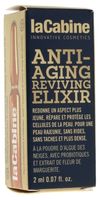
laCabine Anti-Aging Reviving Elixir 1 Phial
Works for
2 of 2 advertised claims delivered
Anti-agingCarnosine, Lactococcus ferment lysate + 1 moreModerate evidence
“Anti-Aging Reviving Elixir 1 Phial”
This product contains carnosine. This ingredient might be able to help reduce and prevent fine lines and wrinkles, improve skin elasticity and firmness, but there is not enough evidence that it actually works.
MoisturizingGlycerin, Lactococcus ferment lysate + 9 moreGood evidence
“Anti-Aging Reviving Elixir 1 Phial”
This product contains good ingredients to attract water to the upper layer of the skin. These ingredients are called "humectants": carnosine, glycerin.
When humectants are on the surface of the skin, they “pull in” the moisture from the outside environment, or from within deeper layers of the skin. If the air is dry, humectants can speed up the moisture loss from the skin. This is why it is a good idea to use another product on top of this one to help "seal in" the moisture (look for ingredients like dimethicone, squalane, oils and butters).
Anti-oxidationNot advertised by the brand · Carnosine, Lactococcus ferment lysate + 2 moreStrong evidence
This product contains antioxidants (carnosine) that can help neutralize free radicals in skin. By doing so, they can lessen the damage the skin gets from the UV light (sun).
Can it cause trouble?
Irritancy2 strong irritants: Bellis perennis flower extract, ParfumMedium risk
Comedogenic1 ingredient rated 2 or more on the 0–5 pore-clogging scale1 flagged

User reviews
Be the first — your take helps the next person decide.
Ingredients
Filter by role to see what each ingredient is doing.
Water~40–60%
Glycerin~4–5.9%
- Irritation risk
- Low
One of the best moisturizing ingredients. Naturally present in skin. It attracts water to the upper layer of the skin working as a humectant
More about GlycerinButylene glycol~3.5–5.3%
- Irritation risk
- Low
Used to create a nice product texture and help delivery of other ingredients. Might be somewhat helpful in attracting water to the upper layer of the skin
More about Butylene glycolLactococcus ferment lysate~2.7–4.1%
- Irritation risk
- Low
Consists of remains of dead bacteria cells. Is likely helpful in attracting water to the upper layer of the skin. Might be helpful in reducing inflammation and neutralizing free radicals in skin
More about Lactococcus ferment lysateMaltodextrin~2.1–3.1%
- Irritation risk
- Low
Used to stabilize the product formulation and can help absorb oil
More about MaltodextrinBellis perennis flower extract~1.7–2.5%
- Irritation risk
- High
A plant extract. Used as a fragrance. Can be irritating
More about Bellis perennis flower extractPeg-12 dimethicone~1.4–2.1%
- Irritation risk
- Low
Helps soften the upper layer of the skin and create a nice product texture
More about Peg-12 dimethiconeSwertia chirata extract~1.2–1.9%
- Irritation risk
- Medium
A plant extract that can have an anti-bacterial and anti-inflammatory effect, but evidence of effectiveness is lacking
More about Swertia chirata extractPorphyridium cruentum extract~1–1.5%
- Irritation risk
- Low
- Comedogenicity
- 3/5
A red algae extract. Can help attract water to the upper layer of the skin and might have an antioxidant effect
More about Porphyridium cruentum extractCarnosine~0.8–1.2%
- Irritation risk
- Low
A type of peptide. It attracts water to the upper layer of the skin. It can help neutralize free radicals in skin combatting the sun damage
More about CarnosineAlteromonas ferment extract~0.5–1.15%
- Irritation risk
- Low
A marine extract that helps attract water to the upper layer of the skin. It is claimed to have anti-inflammatory properties but research is lacking
More about Alteromonas ferment extractCoenochloris signiensis extract~0.4–0.95%
- Irritation risk
- Low
An algae extract that might help attract water to the upper layer of the skin and neutralize free radicals
More about Coenochloris signiensis extractXanthophylls~0.35–0.85%
Caprylyl glycol~0.35–0.85%
- Irritation risk
- Medium
Helps preserve products and creates a nice product texture
More about Caprylyl glycolLactic acid~0.3–0.7%
- Irritation risk
- Medium
An exfoliating and moisturizing alpha-hydroxy acid (AHA). Typically causes less irritation than other AHAs, for example, glycolic acid. At high concentrations (about 15%), lactic acid can help reduce lines and wrinkles. Recent studies show that lactic acid can support the "good" bacteria living on skin's surface (healthy skin microbiome)
More about Lactic acidLecithin~0.35–0.8%
- Irritation risk
- Low
Used mostly for creating emulsions - helping oil and water mix together. Helps soften the upper layer of the skin
More about LecithinPullulan~0.3–0.7%
- Irritation risk
- High
Creates a thin drying film on the skin resulting in a short-term tightening effect
More about PullulanHydroxypropyl methylcellulose~0.2–0.75%
- Irritation risk
- Medium
Used to create a thicker product consistency and stabilize the formulation
More about Hydroxypropyl methylcelluloseSodium chloride~0.15–0.7%
- Irritation risk
- Low
Used to stabilize mixtures of oil and water, and create thicker, gel-like product textures
More about Sodium chlorideDisodium edta~0.15–0.5%
Ammonium acryloyldimethyltaurate/vp copolymer~0.1–0.5%
- Irritation risk
- Low
Increases thickness of a product. Texture enhancer for oil-in-water emulsions
More about Ammonium acryloyldimethyltaurate/vp copolymerSodium phosphate~0.1–0.45%
T-butyl alcohol~0.1–0.4%
- Irritation risk
- Medium
Used to dissolve other ingredients and to improve smell of products. It could be irritating
More about T-butyl alcoholParfum~0.1–0.3%
- Irritation risk
- High
An aromatic blend of unspecified and possibly irritating ingredients
More about ParfumSodium benzoate~0.05–0.25%
Triethylene glycol~0.05–0.25%
- Irritation risk
- Low
Phenoxyethanol~0.05–0.25%
- Irritation risk
- Low
A preservative. It helps prevent bacterial growth in cosmetic products
More about PhenoxyethanolPotassium sorbate~0.05–0.25%
Phenethyl alcohol~0.05–0.15%
Ingredient list view
Water, Glycerin, Butylene glycol, Lactococcus ferment lysate, Maltodextrin, Bellis perennis flower extract, Peg-12 dimethicone, Swertia chirata extract, Porphyridium cruentum extract, Carnosine, Alteromonas ferment extract, Coenochloris signiensis extract, Xanthophylls, Caprylyl glycol, Lactic acid, Lecithin, Pullulan, Hydroxypropyl methylcellulose, Sodium chloride, Disodium edta, Ammonium acryloyldimethyltaurate/vp copolymer, Sodium phosphate, T-butyl alcohol, Parfum, Sodium benzoate, Triethylene glycol, Phenoxyethanol, Potassium sorbate, Phenethyl alcohol
Compare prices
Retailers ranked by price — lowest first.

Affiliate links · prices updated regularly
Worth comparing, line by line.
Match % combines shared ingredients, the first five ingredients, shared actives and hero ingredients, irritancy (lower counts in the alternative's favour), texture and body area. Only products in the same routine step are compared.
| laCabineAnti-Aging Reviving Elixir 1 PhialYOUR PRODUCT | DurexNaturals Moisture | |
|---|---|---|
| Match | — | 51% |
| Price | $2.43 | — |
| Shared key ingredients | — | 1 of 6 |
| Key difference | — | Sodium Hyaluronate |
| Irritancy | Medium | Low |
| Drying alcohol | — | — |
| View product | Shop |
Sources cited in this review
Every concentration estimate and effectiveness label is anchored to one of these 9 studies and safety reviews.
- 1
- 2
- 3Therapeutic Swertia chirata - An Overviewsearch.proquest.com
- 4
- 5
- 6Epidermal and dermal effects of topical lactic acidncbi.nlm.nih.gov

Affiliate links · As an Amazon Associate, WIMJ earns from qualifying purchases.