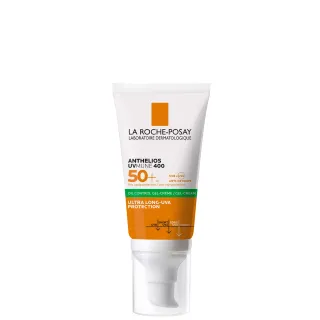
La Roche-Posay Anthelios Oil Control SPF 50+ Gel-Cream
Works for
Sun protectionSPF 50 · 10 UV filtersBroad spectrum
This product offers a good level of protection against both UVB and UVA rays.
This sunscreen uses organic (so-called "chemical") sunscreen filters. Organic, or "chemical" filters usually provide reliable sun protection and rarely leave a white cast. Sunscreens with organic filters can sting eyes.
This product can be considered "reef safe" because it does not contain the UV filters (oxybenzone and octinoxate) that can be harmful to coral reefs when present in the water in high concentrations.
Evens skin toneNo ingredient credited for this claimWorks well
“You’ll find a high PPD (Persistent Pigment Darkening) factor across every offering in the Anthelios range, making sure you get the best possible UVA protection for a more youthful and even skin tone.”
This product offers broad spectrum sun protection. It means that it can prevent hyperpigmentation and help keep the skin tone even (sun damage is the main factor causing age spots, darkening of post-acne marks and other discolorations).
Anti-agingSide benefit · No ingredient credited for this claimWorks well
This product can help prevent early signs of skin aging because it offers a good level of broad spectrum sun protection. Sun damage is the main cause of premature skin aging, and protecting your skin from the sun is the best anti-aging strategy.
MoisturizingSide benefit the brand mentions · C12-15 alkyl benzoate, Dimethicone + 6 moreWorks
“Plus, it's infused with the brand's very own Thermal Spring Water to ensure your complexion stays hydrated and soothed all day long.”
This product can help improve hydration of the skin with the two types of ingredients.
The first type is called “humectants”:
these ingredients help attract water.
When humectants are on the surface of the skin, they “pull in” the moisture from the outside environment, or from
within deeper layers of the skin. The following ingredients in this product do the job:
glycerin, butylene glycol.
This product also contains ingredients called “occlusives”. They help reduce the speed with which our skin loses moisture to the outside environment. These ingredients also help soften the upper layer of the skin, so it feels less tight and nicer to the touch. The following ingredients in this product do the job: dimethicone, c12-15 alkyl benzoate.
Can it cause trouble?
Irritancy16 flagged ingredientsLow risk
ComedogenicClean of flagged comedogenic ingredientsNone flagged
User reviews
Be the first — your take helps the next person decide.
Ingredients
Filter by role to see what each ingredient is doing.
Water~45–55%
Homosalate~5.5–6.7%
- Irritation risk
- Medium
A weak sunscreen that offers some protection against the sun rays that cause sunburn (UVB), but does not offer meaningful protection against protect against the most aging sun rays (UVA). It loses its effectiveness quickly when exposed to sunlight. It is an organic, or so called "chemical" sunscreen. When used in low concentrations, helps to stabilize the product formulation
More about HomosalateTitanium dioxide~4.8–5.8%
- Irritation risk
- Low
Works as a UV filter when used in high concentrations. It is photostable and is effective mostly against the UVB light, with some protection in the UVA range. In small concentrations, used for its ability to improve the color of cosmetic products. Is usually well tolerated by the skin
More about Titanium dioxideSilica~3.4–4.1%
Ethylhexyl salicylate~3.6–4.4%
- Irritation risk
- Low
Octisalate. A UV filter. It offers some protection against the sun rays that cause sunburn (UVB), but does not protect against the most aging sun rays (UVA). It loses its effectiveness quickly when exposed to sunlight. It is an organic, or so called "chemical" sunscreen
More about Ethylhexyl salicylateEthylhexyl triazone~2.9–3.5%
- Irritation risk
- Medium
Uvinul T. A UV filter. Effective against UVB rays. It is photostable. Can increase water resistance properties of the sunscreen. Unfortunately, not approved by the FDA (US) yet
More about Ethylhexyl triazoneC12-15 alkyl benzoate~2–2.4%
- Irritation risk
- Low
Enhances the product texture and makes it more spreadable. Helps reduce water loss from the outer layer of skin. Extands the shelf life by preventing bacteria growth
More about C12-15 alkyl benzoateBis-ethylhexyloxyphenol methoxyphenyl triazine~2.2–2.7%
- Irritation risk
- Medium
Tinosorb S. One of the most effective broad spectrum sunscreen ingredients. Protects from both UVA and UVB rays. It is photostable. Approved by the US FDA in 2026 (listed as bemotrizinol on US labels).
More about Bis-ethylhexyloxyphenol methoxyphenyl triazineDrometrizole trisiloxane~1.9–2.4%
- Irritation risk
- Medium
Mexoryl XL. A UV filter. Effective in the UVB and UVA range. It is stable. Unfortunately, not approved in the US yet
More about Drometrizole trisiloxaneButyl methoxydibenzoylmethane~1.7–2.1%
- Irritation risk
- Medium
Avobenzone. An organic, or so-called "chemical" UV filter. Protects against both UVA and UVB rays. Needs to be combined with other filters in a formulation to be stable.
More about Butyl methoxydibenzoylmethaneOctocrylene~1.4–1.7%
- Irritation risk
- Medium
A weak sunscreen that protects against the sun rays that cause sunburn (UVB) and is somewhat effective against the UVA rays. It is quite stable and can help stabilize other, more vulnerable, sunscreen ingredients like Avobenzone. It is an organic, or so called "chemical" sunscreen
More about OctocryleneStyrene/acrylates copolymer~0.95–1.15%
- Irritation risk
- Low
Used to create an even product consistency. Can help boost efficiency of sunscreen filters
More about Styrene/acrylates copolymerTitanium dioxide~1.1–1.3%
- Irritation risk
- Low
Works as a UV filter when used in high concentrations. It is photostable and is effective mostly against the UVB light, with some protection in the UVA range. In small concentrations, used for its ability to improve the color of cosmetic products. Is usually well tolerated by the skin
More about Titanium dioxideAluminum starch octenylsuccinate~0.7–1.1%
- Irritation risk
- Medium
Used to thicken the product's consistency
More about Aluminum starch octenylsuccinateCi 77491~0.7–1.05%
- Irritation risk
- Low
A red colorant made of iron oxide. Typically is not irritating
More about Ci 77491Ci 77492~0.7–1%
Ci 77499~0.6–0.9%
Potassium cetyl phosphate~0.6–0.9%
- Irritation risk
- Medium
Helps oil and water mix together
More about Potassium cetyl phosphateMethylene bis-benzotriazolyl tetramethylbutylphenol~0.7–1.1%
- Irritation risk
- Medium
Tinosorb M. A UV filter. Is effective against both UVA and UVB rays. It also provides some protection against visible light. It is photostable and can also be used to improve photostability of other sunscreen ingredients. Its physical properties help to create lightweight sunscreen formulations. It can leave a slight white cast. Unfortunately, it is not approved by the FDA (US) yet
More about Methylene bis-benzotriazolyl tetramethylbutylphenolPropylene glycol~0.5–0.75%
- Irritation risk
- High
Helps oil and water mix together and can enhance the penetration of other ingredients into the skin. It can be irritating
More about Propylene glycolCaprylyl methicone~0.5–0.7%
- Irritation risk
- Low
A type of silicone that helps to soften the upper layer of the skin and create a nice product finish on the skin
More about Caprylyl methiconePentylene glycol~0.45–0.7%
- Irritation risk
- Medium
Used to preserve products, dissolve other ingredients and create a nice product texture
More about Pentylene glycolAcrylates/c10-30 alkyl acrylate crosspolymer~0.35–0.65%
- Irritation risk
- Medium
Maintains the texture of skincare products. Allows the product to spread evenly. Helps oil and water mix together
More about Acrylates/c10-30 alkyl acrylate crosspolymerAluminum hydroxide~0.4–0.65%
- Irritation risk
- Low
Is used to add opaque (non-transparent) appearance to formulations. Can be used to coat other ingredients for even dispersion. This is a different ingredient compared to the ones used in antipersperants (aluminium chloride and aluminium chlorohydrate)
More about Aluminum hydroxideButylene glycol~0.3–0.6%
- Irritation risk
- Low
Used to create a nice product texture and help delivery of other ingredients. Might be somewhat helpful in attracting water to the upper layer of the skin
More about Butylene glycolCaprylyl glycol~0.35–0.6%
- Irritation risk
- Medium
Helps preserve products and creates a nice product texture
More about Caprylyl glycolDimethicone~0.35–0.65%
- Irritation risk
- Low
A silicone that helps to reduce water loss from the surface of the skin. Can temporarily "fill in" lines and wrinkles, absorb oil, and create a nice product finish
More about DimethiconeDisodium edta~0.25–0.5%
Glycerin~0.3–0.55%
- Irritation risk
- Low
One of the best moisturizing ingredients. Naturally present in skin. It attracts water to the upper layer of the skin working as a humectant
More about GlycerinInulin lauryl carbamate~0.25–0.45%
Peg-8 laurate~0.25–0.45%
Phenoxyethanol~0.15–0.3%
- Irritation risk
- Low
A preservative. It helps prevent bacterial growth in cosmetic products
More about PhenoxyethanolStearyl alcohol~0.2–0.35%
- Irritation risk
- Low
An emollient that helps soften the skin
More about Stearyl alcoholTerephthalylidene dicamphor sulfonic acid~0.2–0.35%
- Irritation risk
- Medium
Ecamsule, Mexoryl SX. A UV filter. Is effective mostly against the UVA rays. It is legally marketed in the US with the FDA approval since 2006, even though the ingredient is not on the official FDA list of the approved sunscreen active ingredients. It is photostable
More about Terephthalylidene dicamphor sulfonic acidXanthan gum~0.1–0.15%
- Irritation risk
- Low
Used to create a thicker product consistency
More about Xanthan gumIngredient list view
Water, Homosalate, Titanium dioxide, Silica, Ethylhexyl salicylate, Ethylhexyl triazone, C12-15 alkyl benzoate, Bis-ethylhexyloxyphenol methoxyphenyl triazine, Drometrizole trisiloxane, Butyl methoxydibenzoylmethane, Octocrylene, Styrene/acrylates copolymer, Titanium dioxide, Aluminum starch octenylsuccinate, Ci 77491, Ci 77492, Ci 77499, Potassium cetyl phosphate, Methylene bis-benzotriazolyl tetramethylbutylphenol, Propylene glycol, Caprylyl methicone, Pentylene glycol, Acrylates/c10-30 alkyl acrylate crosspolymer, Aluminum hydroxide, Butylene glycol, Caprylyl glycol, Dimethicone, Disodium edta, Glycerin, Inulin lauryl carbamate, Peg-8 laurate, Phenoxyethanol, Unknown, Stearyl alcohol, Terephthalylidene dicamphor sulfonic acid, Xanthan gum
Compare prices
Retailers ranked by price — lowest first.

Worth comparing, line by line.
Match % combines shared ingredients, the first five ingredients, shared actives and hero ingredients, irritancy (lower counts in the alternative's favour), texture and body area. Only products in the same routine step are compared.
| La Roche-PosayAnthelios Oil Control SPF 50+ Gel-CreamYOUR PRODUCT | SkinCeuticalsOil Shield UV Defense Sunscreen SPF 50 | Coco & EveDaily Water Gel SPF50+ Sunscreen | VichyIdéal Soleil 3-in-1 Tinted Anti-Dark Spots Care SPF50+ | |
|---|---|---|---|---|
| Match | — | 39% | 37% | 35% |
| Price | — | $40.67 | — | $17.38 |
| Shared key ingredients | — | 9 of 11 | 6 of 11 | 10 of 11 |
| Key difference | — | Ensulizole | Butyloctyl Salicylate | Phenylethyl Resorcinol |
| Irritancy | Low | Low | Low | High |
| SPF | SPF 50 | SPF 50 | SPF 50 | SPF 50 |
| Drying alcohol | — | — | — | — |
| View product | Shop | Shop | Shop |


More alternatives: Orjena Aqua UV Perfect Sun Gel SPF50+ PA++++Ambre Solaire Kids Sensitive Sand Resistant Sun Cream SPF50+
Product summary
Based on the ingredient list, we assess that "La Roche-Posay - Anthelios Oil Control SPF 50+ Gel-Cream" can provide reliable sun protection. It can protect from both UVA and UVB rays. This is great news because not all sunscreens with SPF ratings give UVA protection. (UVA rays do not cause sunburn, but still damage our skin and lead to early aging).
As a plus, this sunscreen uses some of the new generation UV filters (Tinosorb M). These filters are more stable and more gentle on the skin.
It contains good moisturizing ingredients and can double as a hydrating day cream. This product prevents early signs of aging by protecting against sun damage (all broad spectrum sunscreens do that).
Sunscreen filters
This sunscreen uses a mixture of both mineral and organic (so-called "chemical") UV filters. Here are the organic filters this product uses: tinosorb s, avobenzone, mexoryl xl, octisalate, uvinul t, homosalate, tinosorb m and octocrylene. As for the mineral filters, this sunscreen uses titanium dioxide.
Irritation risk
There are some common irritants in this product, including ingredients that do not have benefits for the skin. We assess the overall irritancy of this moisturizer to be low. For a detailed overview of all potential irritants: click here
You can see the detailed formula review with the breakdown of all actives in the product and the full ingredient list with estimated concentrations in the tables below.
Price
The product retails for 18.00£ in the United Kingdom.
For a detailed price comparison: click here.
Sources cited in this review
Every concentration estimate and effectiveness label is anchored to one of these 9 studies and safety reviews.
- 1
- 2
- 3Surfactants and experimental irritant contact dermatitisncbi.nlm.nih.gov
- 4Propylene Glycolpubmed.ncbi.nlm.nih.gov
- 5Skin-sensitizing and irritant properties of propylene glycolonlinelibrary.wiley.com
- 6

Affiliate links · As an Amazon Associate, WIMJ earns from qualifying purchases.