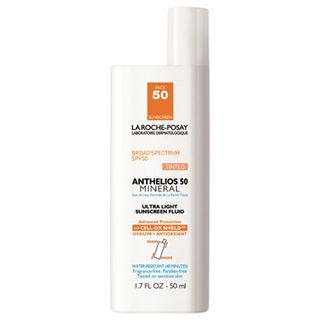
La Roche-Posay Anthelios 50 Mineral Sunscreen Fluid SPF 50 Tinted
Works for
0 of 1 advertised claim delivered
Sun protectionSPF 50 · 2 UV filters · Partial spectrumWeak protection
This product does not offer good protection against UVA rays.
This product can be considered "reef safe" because it does not contain the UV filters (oxybenzone and octinoxate) that can be harmful to coral reefs when present in the water in high concentrations.
MoisturizingNot advertised by the brand · 17 ingredients credited for this claimGood support
This product can help soften the skin and reduce its moisture loss with emollients and occlusives: dimethicone, helianthus annuus seed oil.
Keep in mind that this product does not contain effective ingredients to attract water to the upper layer of the skin. This is why an additional product with humectants like glycerin or hyaluronic acid can be helpful (apply it before this product for the best results).
Can it cause trouble?
Irritancy20 flagged ingredientsMedium risk
ComedogenicClean of flagged comedogenic ingredientsNone flagged
User reviews
Be the first — your take helps the next person decide.
Ingredients
Filter by role to see what each ingredient is doing.
Titanium dioxide11%
- Irritation risk
- Low
Works as a UV filter when used in high concentrations. It is photostable and is effective mostly against the UVB light, with some protection in the UVA range. In small concentrations, used for its ability to improve the color of cosmetic products. Is usually well tolerated by the skin
More about Titanium dioxideWater~45–55%
Isododecane~7.1–8.6%
- Irritation risk
- Low
An emollient that helps soften the skin and can decrease moisture loss. Helps create a nice product texture
More about IsododecaneC12-15 alkyl benzoate~5.8–7.1%
- Irritation risk
- Low
Enhances the product texture and makes it more spreadable. Helps reduce water loss from the outer layer of skin. Extands the shelf life by preventing bacteria growth
More about C12-15 alkyl benzoateDimethicone~4–4.9%
- Irritation risk
- Low
A silicone that helps to reduce water loss from the surface of the skin. Can temporarily "fill in" lines and wrinkles, absorb oil, and create a nice product finish
More about DimethiconeUndecane~2.6–3.2%
- Irritation risk
- Medium
Helps create a non-greasy finish on the skin
More about UndecaneTriethylhexanoin~1.8–2.2%
- Irritation risk
- Medium
Helps soften the upper layer of the skin
More about TriethylhexanoinIsohexadecane~1.9–2.3%
- Irritation risk
- Low
Improves the texture of the product and helps soften the skin. Helps oil and water mix together and can be used as a cleansing agent
More about IsohexadecaneStyrene/acrylates copolymer~1.6–1.9%
- Irritation risk
- Low
Used to create an even product consistency. Can help boost efficiency of sunscreen filters
More about Styrene/acrylates copolymerNylon-12~1.5–1.8%
Caprylyl methicone~1.1–1.3%
- Irritation risk
- Low
A type of silicone that helps to soften the upper layer of the skin and create a nice product finish on the skin
More about Caprylyl methiconeButyloctyl salicylate~0.75–1.15%
- Irritation risk
- Medium
A synthetic ester of salicylic acid that is used to help disperse pigments and boost effectiveness of sunscreen ingredients. It is able to absorb UV light (working as an organic, or chemical filter), but is not approved as a sunscreen ingredient on its own
More about Butyloctyl salicylatePhenethyl benzoate~0.7–1.1%
Silica~1–1.3%
Tridecane~0.55–0.85%
Dicaprylyl carbonate~0.6–0.9%
- Irritation risk
- Low
Helps products spread more easily and works as an emollient to soften skin
More about Dicaprylyl carbonateDicaprylyl ether~0.6–0.9%
- Irritation risk
- Low
Helps soften the upper layer of the skin while creating a non-greasy feel on the skin. Helps to dissolve other ingredients
More about Dicaprylyl etherTalc~0.75–1.1%
Dimethicone/peg-10/15 crosspolymer~0.5–0.75%
Aluminum stearate~0.45–0.7%
- Irritation risk
- Medium
Used to help evenly disperse other ingredients (for example, pigment) in a formulation
More about Aluminum stearatePeg-9 polydimethylsiloxyethyl dimethicone~0.45–0.7%
- Irritation risk
- Medium
A type of silicone that helps water and oil mix together
More about Peg-9 polydimethylsiloxyethyl dimethiconePentylene glycol~0.5–0.75%
- Irritation risk
- Medium
Used to preserve products, dissolve other ingredients and create a nice product texture
More about Pentylene glycolAlumina~0.55–0.85%
- Irritation risk
- Low
The same compound that is used safely in dental implants and bone cements. In cosmetics, it is used to improve the consistency of products
More about AluminaAluminum hydroxide~0.5–0.7%
- Irritation risk
- Low
Is used to add opaque (non-transparent) appearance to formulations. Can be used to coat other ingredients for even dispersion. This is a different ingredient compared to the ones used in antipersperants (aluminium chloride and aluminium chlorohydrate)
More about Aluminum hydroxideBenzoic acid~0.25–0.5%
Caprylic/capric triglyceride~0.5–0.75%
- Irritation risk
- Medium
A good mix of fatty acids that forms a protective layer on the skin. Improves the shelf life of products. Derived from coconut and glycerin
More about Caprylic/capric triglycerideCaprylyl glycol~0.45–0.7%
- Irritation risk
- Medium
Helps preserve products and creates a nice product texture
More about Caprylyl glycolCassia alata leaf extract~0.4–0.6%
- Irritation risk
- Medium
Might have some anti-oxidant properties. Can be used as a fragrance. Can be irritating
More about Cassia alata leaf extractDiethylhexyl syringylidenemalonate~0.4–0.6%
- Irritation risk
- Medium
Used to stabilize the product formulation
More about Diethylhexyl syringylidenemalonateDipropylene glycol~0.3–0.6%
- Irritation risk
- Low
Helps to dissolve other ingredients in a formulation. Slows down the rate of product drying
More about Dipropylene glycolDisodium edta~0.3–0.6%
Disodium stearoyl glutamate~0.45–0.65%
- Irritation risk
- Medium
Helps oil and water mix together and workd as a cleanser
More about Disodium stearoyl glutamateDisteardimonium hectorite~0.3–0.6%
- Irritation risk
- Low
A type of clay that is used to thicken the product consistency
More about Disteardimonium hectoriteHelianthus annuus seed oil~0.45–0.65%
- Irritation risk
- Low
A great emollient due to its high linoleic acid content. One of the most effective plant oils in helping skin hydration and repairing skin barrier function
More about Helianthus annuus seed oilCi 77491~0.3–0.6%
- Irritation risk
- Low
A red colorant made of iron oxide. Typically is not irritating
More about Ci 77491Ci 77492~0.3–0.55%
Ci 77499~0.3–0.55%
Magnesium sulfate~0.3–0.6%
Maltodextrin~0.3–0.55%
- Irritation risk
- Low
Used to stabilize the product formulation and can help absorb oil
More about MaltodextrinPeg-8 laurate~0.3–0.55%
Phenoxyethanol~0.25–0.45%
- Irritation risk
- Low
A preservative. It helps prevent bacterial growth in cosmetic products
More about PhenoxyethanolPolyhydroxystearic acid~0.25–0.5%
- Irritation risk
- Medium
Used to create a thicker product consistency and stabilize the formulation
More about Polyhydroxystearic acidPropylene carbonate~0.25–0.45%
- Irritation risk
- Low
Is used to dissolve other ingredients and create nice product texture
More about Propylene carbonatePropylene glycol~0.2–0.35%
- Irritation risk
- High
Helps oil and water mix together and can enhance the penetration of other ingredients into the skin. It can be irritating
More about Propylene glycolSodium citrate~0.2–0.35%
- Irritation risk
- Medium
Helps to control the skin's pH level. Maintains the skin's natural film of amino-lactic acids and oils. Helps to preserve products
More about Sodium citrateStearic acid~0.3–0.6%
- Irritation risk
- Low
Helps oil and water mix together and works as an emollient
More about Stearic acidTocopherol~0.1–0.2%
- Irritation risk
- Low
Pure form of vitamin E. Can help moisturise and protect the skin from free radicals. Often used to help stabilise other ingredients or the formula itself
More about TocopherolIngredient list view
Titanium dioxide, Water, Isododecane, C12-15 alkyl benzoate, Dimethicone, Undecane, Triethylhexanoin, Isohexadecane, Styrene/acrylates copolymer, Nylon-12, Caprylyl methicone, Butyloctyl salicylate, Phenethyl benzoate, Silica, Tridecane, Dicaprylyl carbonate, Dicaprylyl ether, Talc, Dimethicone/peg-10/15 crosspolymer, Aluminum stearate, Peg-9 polydimethylsiloxyethyl dimethicone, Pentylene glycol, Alumina, Aluminum hydroxide, Benzoic acid, Caprylic/capric triglyceride, Caprylyl glycol, Cassia alata leaf extract, Diethylhexyl syringylidenemalonate, Dipropylene glycol, Disodium edta, Disodium stearoyl glutamate, Disteardimonium hectorite, Helianthus annuus seed oil, Ci 77491, Ci 77492, Ci 77499, Magnesium sulfate, Maltodextrin, Peg-8 laurate, Phenoxyethanol, Polyhydroxystearic acid, Propylene carbonate, Propylene glycol, Sodium citrate, Stearic acid, Tocopherol
Compare prices
Retailers ranked by price — lowest first.

Worth comparing, line by line.
Match % combines shared ingredients, the first five ingredients, shared actives and hero ingredients, irritancy (lower counts in the alternative's favour), texture and body area. Only products in the same routine step are compared.
| La Roche-PosayAnthelios 50 Mineral Sunscreen Fluid SPF 50 TintedYOUR PRODUCT | SkinCeuticalsProtect Sheer Mineral UV Defense Sunscreen SPF50 | |
|---|---|---|
| Match | — | 52% |
| Price | $36.90 | $36.95 |
| Shared key ingredients | — | 6 of 6 |
| Key difference | — | Artemia Extract |
| Irritancy | Medium | Low |
| SPF | SPF 50 | SPF 50 |
| Drying alcohol | — | — |
| View product | Shop |


Product summary
"La Roche-Posay - Anthelios 50 Mineral Sunscreen Fluid SPF 50 Tinted" does not provide enough UVA protection. UVA rays do not cause sunburn, but still damage the skin, leading to early signs of aging and pigmentation issues.
It also works as a moisturizer, so you do not have to use an additional hydrating product.
Sunscreen filters
This is a "mixed" sunscreen in the sense that it uses both mineral and organic (so-called "chemical") sun filters. Here are the organic filters this product uses: butyloctyl salicylate. As for the mineral filters, this sunscreen uses titanium dioxide.
Irritation risk
There are some common irritants in this product, including ingredients that do not have benefits for the skin. We assess the overall irritancy of it to be medium. For a detailed overview of all potential irritants: click here
You can see the detailed formula review with the breakdown of all actives in the product and the full ingredient list with estimated concentrations in the tables below.
Price
The product retails at around 38.00$ in the United States and from 32.25CA$ up to 37.95CA$ in Canada.
For a detailed price comparison: click here.
Sources cited in this review
Every concentration estimate and effectiveness label is anchored to one of these 16 studies and safety reviews.
- 1
- 2Final Report on the Safety Assessment of Dimethicone Copolyoljournals.sagepub.com
- 3
- 4
- 5
- 6

Affiliate links · As an Amazon Associate, WIMJ earns from qualifying purchases.