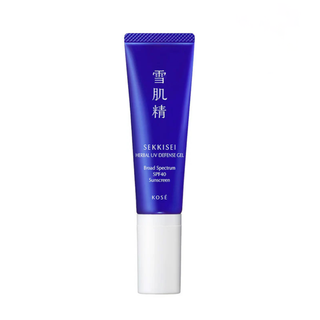
Kose Herbal UV Defense Gel Broad Spectrum SPF 40 Sunscreen
Works for
1 of 1 advertised claim delivered
Sun protectionSPF 40 · 5 UV filtersBroad spectrum
This product offers a good level of protection against both UVB and UVA rays.
This sunscreen uses organic (so-called "chemical") sunscreen filters. Organic, or "chemical" filters usually provide reliable sun protection and rarely leave a white cast. Sunscreens with organic filters can sting eyes.
This product can be considered "reef safe" because it does not contain the UV filters (oxybenzone and octinoxate) that can be harmful to coral reefs when present in the water in high concentrations.
Evens skin toneNot advertised by the brand · Glycyrrhiza glabra root extractStrong evidence
This product offers broad spectrum sun protection. It means that it can prevent hyperpigmentation and help keep the skin tone even (sun damage is the main factor causing age spots, darkening of post-acne marks and other discolorations).
Anti-agingNot advertised by the brand · No ingredient credited for this claimStrong evidence
This product can help prevent early signs of skin aging because it offers a good level of broad spectrum sun protection. Sun damage is the main cause of premature skin aging, and protecting your skin from the sun is the best anti-aging strategy.
MoisturizingNot advertised by the brand · Betaine, Kappaphycus alvarezii extract + 5 moreGood evidence
This product contains good ingredients to attract water to the upper layer of the skin. These ingredients are called "humectants": betaine, glycerin.
When humectants are on the surface of the skin, they “pull in” the moisture from the outside environment, or from within deeper layers of the skin. If the air is dry, humectants can speed up the moisture loss from the skin. This is why it is a good idea to use another product on top of this one to help "seal in" the moisture (look for ingredients like dimethicone, squalane, oils and butters).
Can it cause trouble?
Irritancy6 strong irritants: Citrus aurantium dulcis peel oil, Citrus limon peel oil + 4 more — patch-test recommendedHigh risk
ComedogenicClean of flagged comedogenic ingredientsNone flagged
User reviews
Be the first — your take helps the next person decide.
Ingredients
Filter by role to see what each ingredient is doing.
Butyl methoxydibenzoylmethane3%
- Irritation risk
- Medium
Avobenzone. An organic, or so-called "chemical" UV filter. Protects against both UVA and UVB rays. Needs to be combined with other filters in a formulation to be stable.
More about Butyl methoxydibenzoylmethaneHomosalate9.5%
- Irritation risk
- Medium
A weak sunscreen that offers some protection against the sun rays that cause sunburn (UVB), but does not offer meaningful protection against protect against the most aging sun rays (UVA). It loses its effectiveness quickly when exposed to sunlight. It is an organic, or so called "chemical" sunscreen. When used in low concentrations, helps to stabilize the product formulation
More about HomosalateEthylhexyl salicylate5%
- Irritation risk
- Low
Octisalate. A UV filter. It offers some protection against the sun rays that cause sunburn (UVB), but does not protect against the most aging sun rays (UVA). It loses its effectiveness quickly when exposed to sunlight. It is an organic, or so called "chemical" sunscreen
More about Ethylhexyl salicylateOctocrylene2.6%
- Irritation risk
- Medium
A weak sunscreen that protects against the sun rays that cause sunburn (UVB) and is somewhat effective against the UVA rays. It is quite stable and can help stabilize other, more vulnerable, sunscreen ingredients like Avobenzone. It is an organic, or so called "chemical" sunscreen
More about OctocryleneWater~45–55%
Butyloctyl salicylate~7.3–8.9%
- Irritation risk
- Medium
A synthetic ester of salicylic acid that is used to help disperse pigments and boost effectiveness of sunscreen ingredients. It is able to absorb UV light (working as an organic, or chemical filter), but is not approved as a sunscreen ingredient on its own
More about Butyloctyl salicylateDipropylene glycol~5.7–6.9%
- Irritation risk
- Low
Helps to dissolve other ingredients in a formulation. Slows down the rate of product drying
More about Dipropylene glycolCaprylyl methicone~4.4–5.4%
- Irritation risk
- Low
A type of silicone that helps to soften the upper layer of the skin and create a nice product finish on the skin
More about Caprylyl methiconeMethyl trimethicone~3.2–3.9%
- Irritation risk
- Low
A type of silicone that helps create a silky product finish and dissolve other ingredients
More about Methyl trimethiconeBetaine~2.3–2.9%
- Irritation risk
- Low
Helps attract water to the upper layer of the skin and improves the product texture
More about BetaineSilica~2–2.4%
Aloe barbadensis leaf extract~1.6–2%
- Irritation risk
- Medium
Traditionally used to treat sunburns, dermatitis and inflammation, but evidence for its effectiveness is lacking. The extract can contain humectants that help attract water into the skin
More about Aloe barbadensis leaf extractBioflavonoids~1.1–1.4%
- Irritation risk
- Low
Brassica oleracea italica extract~1–1.3%
- Irritation risk
- Medium
Might have some anti-inflammatory properties but research is lacking
More about Brassica oleracea italica extractCaesalpinia spinosa fruit extract~0.75–1.15%
- Irritation risk
- Low
Citrus aurantium dulcis peel oil~0.65–0.95%
- Irritation risk
- High
An essentil oil from orange peel. Potential allergen and can be irritating
More about Citrus aurantium dulcis peel oilCitrus limon peel oil~0.55–0.85%
Coix lacryma-jobi ma-yuen seed extract~0.55–0.8%
- Irritation risk
- Low
Glycyrrhiza glabra root extract~0.5–0.8%
- Irritation risk
- Medium
A plant extract that can help lighten the skin and calm down inflammation. Might be helpful in neutralizing free radicals
More about Glycyrrhiza glabra root extractKappaphycus alvarezii extract~0.5–0.75%
- Irritation risk
- Low
A red algae extract that can help attract water to the upper layer of the skin and might have some antioxidant properties
More about Kappaphycus alvarezii extractLavandula angustifolia oil~0.45–0.7%
- Irritation risk
- High
An essential oil. Potential allergen and can be irritating. It has some anti-bacterial properties
More about Lavandula angustifolia oilTocopheryl acetate~0.45–0.7%
- Irritation risk
- Medium
A more stable but less bio-available form of vitamin E compared to Tocopherol. Might help moisturize and protect the skin from free radicals, but mostly used in low concentrations to stabilize other ingredients.
More about Tocopheryl acetateTropaeolum majus flower/leaf/stem extract~0.4–0.65%
- Irritation risk
- Low
1,2-hexanediol~0.35–0.65%
Aminomethyl propanol~0.35–0.6%
Ammonium acryloyldimethyltaurate/vp copolymer~0.3–0.6%
- Irritation risk
- Low
Increases thickness of a product. Texture enhancer for oil-in-water emulsions
More about Ammonium acryloyldimethyltaurate/vp copolymerAngelica gigas root extract~0.3–0.55%
- Irritation risk
- Low
Biosaccharide gum-4~0.3–0.55%
Butylene glycol~0.3–0.55%
- Irritation risk
- Low
Used to create a nice product texture and help delivery of other ingredients. Might be somewhat helpful in attracting water to the upper layer of the skin
More about Butylene glycolCarbomer~0.3–0.6%
- Irritation risk
- Low
Helps create a thicker or gel-like product texture. It is not a surfactant but can be used in gentle cleansing formulations
More about CarbomerCitrus aurantium bergamia fruit oil~0.3–0.5%
- Irritation risk
- High
A plant oil with a high content of volatile compounds that can irritate the skin and lead to allergic reactions. Can lead to photosensitivity
More about Citrus aurantium bergamia fruit oilDibutyl ethylhexanoyl glutamide~0.3–0.6%
- Irritation risk
- Medium
Helps improve the product texture and soften the upper layer of the skin
More about Dibutyl ethylhexanoyl glutamideDibutyl lauroyl glutamide~0.45–0.7%
- Irritation risk
- Medium
Helps improve the product texture and soften the upper layer of the skin
More about Dibutyl lauroyl glutamideDisodium edta~0.3–0.6%
Ethylhexylglycerin~0.3–0.55%
Glycerin~0.35–0.6%
- Irritation risk
- Low
One of the best moisturizing ingredients. Naturally present in skin. It attracts water to the upper layer of the skin working as a humectant
More about GlycerinHydrolyzed wheat protein/pvp crosspolymer~0.4–0.65%
- Irritation risk
- Low
Hydroxyacetophenone~0.25–0.5%
Ocimum basilicum oil~0.25–0.45%
Pelargonium graveolens flower oil~0.25–0.45%
- Irritation risk
- High
An essential oil. Can be irritating. Can become an allergen with oxidation
More about Pelargonium graveolens flower oilPropanediol~0.25–0.4%
- Irritation risk
- Low
Acts as a solvent for other ingredients. Speeds up the absorption of other ingredients into the skin
More about PropanediolPhenoxyethanol~0.25–0.45%
- Irritation risk
- Low
A preservative. It helps prevent bacterial growth in cosmetic products
More about PhenoxyethanolPotassium sorbate~0.2–0.4%
Ingredient list view
Butyl methoxydibenzoylmethane, Homosalate, Ethylhexyl salicylate, Octocrylene, Water, Butyloctyl salicylate, Dipropylene glycol, Caprylyl methicone, Methyl trimethicone, Betaine, Silica, Aloe barbadensis leaf extract, Bioflavonoids, Brassica oleracea italica extract, Caesalpinia spinosa fruit extract, Citrus aurantium dulcis peel oil, Citrus limon peel oil, Coix lacryma-jobi ma-yuen seed extract, Glycyrrhiza glabra root extract, Kappaphycus alvarezii extract, Lavandula angustifolia oil, Tocopheryl acetate, Tropaeolum majus flower/leaf/stem extract, 1,2-hexanediol, Aminomethyl propanol, Ammonium acryloyldimethyltaurate/vp copolymer, Angelica gigas root extract, Biosaccharide gum-4, Butylene glycol, Carbomer, Citrus aurantium bergamia fruit oil, Dibutyl ethylhexanoyl glutamide, Dibutyl lauroyl glutamide, Disodium edta, Ethylhexylglycerin, Glycerin, Hydrolyzed wheat protein/pvp crosspolymer, Hydroxyacetophenone, Ocimum basilicum oil, Pelargonium graveolens flower oil, Propanediol, Phenoxyethanol, Potassium sorbate
Compare prices
Retailers ranked by price — lowest first.

Affiliate links · prices updated regularly
Sources cited in this review
Every concentration estimate and effectiveness label is anchored to one of these 8 studies and safety reviews.
- 1
- 2
- 3
- 4
- 5
- 6Air oxidation increases skin irritation from fragrance terpenesonlinelibrary.wiley.com

Affiliate links · As an Amazon Associate, WIMJ earns from qualifying purchases.