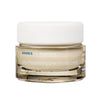
KORRES White Pine Restorative Overnight Facial Cream
Works for
1 of 2 advertised claims delivered
Moisturizing23 ingredients credited for this claimGood support
“White Pine Restorative Overnight Facial Cream”
This product can help improve hydration of the skin with the two types of ingredients.
The first type is called “humectants”:
these ingredients help attract water.
When humectants are on the surface of the skin, they “pull in” the moisture from the outside environment, or from
within deeper layers of the skin. The following ingredients in this product do the job:
glycerin, sodium hyaluronate.
This product also contains ingredients called “occlusives”. They help reduce the speed with which our skin loses moisture to the outside environment. These ingredients also help soften the upper layer of the skin, so it feels less tight and nicer to the touch. The following ingredients in this product do the job: caprylic/capric triglyceride, helianthus annuus seed oil.
Anti-aging4 ingredients credited for this claimLimited support
“This overnight Sleeping Facial works to smooth the appearance of wrinkles and replenish moisture to postmenopausal skin as you sleep.”
This product does not contain ingredients that are able to reduce fine lines and wrinkles or help with skin elasticity, but it can improve the look of the skin temporarily through moisturization. Well-moisturized skin might also be able to repair the sun damage better.This ingredient - nicotiana benthamiana hexapeptide-40 sh-polypeptide-76 - could be helpful for preventing or repairing signs of aging in theory, but there is no evidence that it actually works.
Evens skin toneNot advertised by the brand · 4 ingredients credited for this claimModerate support
The following ingredient (ingredients) in this product might be helpful, but there is no evidence to confirm that it actually works: ethyl linoleate, pancratium maritimum extract.
Anti-blemishNot advertised by the brand · 2 ingredients credited for this claimGood support
This product might be able to help reduce blemishes and clogged pores because it contains ethyl linoleate.
Can it cause trouble?
Irritancy2 strong irritants: Passiflora incarnata seed oil, ParfumMedium risk
Comedogenic1 ingredient rated 2 or more on the 0–5 pore-clogging scale1 flagged


User reviews
Be the first — your take helps the next person decide.
Ingredients
Filter by role to see what each ingredient is doing.
Water~45–55%
Caprylic/capric/myristic/stearic triglyceride~4.7–5.8%
- Irritation risk
- Low
Helps to soften the upper layer of the skin
More about Caprylic/capric/myristic/stearic triglyceridePropanediol~4.1–5%
- Irritation risk
- Low
Acts as a solvent for other ingredients. Speeds up the absorption of other ingredients into the skin
More about PropanediolGlycerin~3.1–3.8%
- Irritation risk
- Low
One of the best moisturizing ingredients. Naturally present in skin. It attracts water to the upper layer of the skin working as a humectant
More about GlycerinCaprylic/capric triglyceride~2.5–3%
- Irritation risk
- Medium
A good mix of fatty acids that forms a protective layer on the skin. Improves the shelf life of products. Derived from coconut and glycerin
More about Caprylic/capric triglycerideCetearyl alcohol~2–2.4%
- Irritation risk
- Low
- Comedogenicity
- 2/5
A non-drying alcohol. Works as an emollient. Helps water and oil mix together and creates a nice product texture
More about Cetearyl alcoholGlyceryl stearate citrate~1.7–2.1%
- Irritation risk
- Low
Helps oil and water mix together while softening the upper layer of the skin
More about Glyceryl stearate citrateIsoamyl laurate~1.4–1.8%
- Irritation risk
- Medium
Helps stabilize emulsions and create a nice product texture
More about Isoamyl laurateCetyl palmitate~1.2–1.5%
- Irritation risk
- Low
An emollient that helps soften the skin and is used to improve product texture and stability
More about Cetyl palmitateCrambe abyssinica seed oil~0.95–1.15%
- Irritation risk
- Medium
Helps soften the upper layer of the skin
More about Crambe abyssinica seed oilOlus oil~0.75–1.1%
- Irritation risk
- Low
An oil from a mixture of different vegetables. Helps soften the upper layer of the skin
More about Olus oilVegetable oil~0.6–0.9%
- Irritation risk
- Low
An oil from a mixture of different vegetables. Helps soften the upper layer of the skin
More about Vegetable oilPassiflora incarnata seed oil~0.5–0.8%
- Irritation risk
- High
A plant oil that can help soften the upper layer of the skin. Contains essential oil that can be irritating
More about Passiflora incarnata seed oilSqualane~0.5–0.8%
- Irritation risk
- Low
An oil naturally present in skin. Works as an emollient to soften the skin and form a protective layer on its surface without a greasy feeling.
More about SqualaneEthyl linoleate~0.45–0.65%
- Irritation risk
- Medium
Helps reduce acne and blemishes. Helps to soften the upper layer of the skin and reduce inflammation. Might be helpful in reducing hyperpigmentation and evening out the skin tone, but evidence of effectiveness in skin are lacking
More about Ethyl linoleateButylene glycol~0.45–0.65%
- Irritation risk
- Low
Used to create a nice product texture and help delivery of other ingredients. Might be somewhat helpful in attracting water to the upper layer of the skin
More about Butylene glycolBehenyl alcohol~0.5–0.7%
- Irritation risk
- Low
Non-drying alcohol that helps water and oil mix together. Also serves as an emollient
More about Behenyl alcoholAscorbyl palmitate~0.35–0.6%
- Irritation risk
- Medium
Being a lipid soluble form of vitamin C, it is more stable and can penetrate the skin better than L-Ascorbic acid. It is effective in protecting the skin from free radicals, as well as evening the skin tone, but is less effective in stimulating collagen production compared to L-Ascorbic acid.
More about Ascorbyl palmitateAvena strigosa seed extract~0.3–0.55%
- Irritation risk
- Low
Citric acid~0.3–0.5%
- Irritation risk
- Medium
Can work as an exfoliant but is typically used to adjust the product pH
More about Citric acidCynara scolymus leaf extract~0.25–0.45%
- Irritation risk
- High
A plant extract that might have some anti-oxidant properties. It might be irritating
More about Cynara scolymus leaf extractDimethyl isosorbide~0.25–0.5%
- Irritation risk
- Low
Used to dissolve other ingredients in a product and can enhance their ability to penetrate the skin
More about Dimethyl isosorbideEthyl linolenate~0.25–0.5%
- Irritation risk
- Low
Ethyl oleate~0.25–0.45%
- Irritation risk
- Medium
Ethyl oleate is a long-chain fatty acid ethyl ester resulting from the formal condensation of the carboxy group of oleic acid with the hydroxy group of ethanol. It derives from an oleic acid. In skincare, it is used to soften the upper layer of the skin, improve the product texture and smell
More about Ethyl oleateEthyl palmitate~0.25–0.45%
- Irritation risk
- Low
Ethyl stearate~0.25–0.45%
- Irritation risk
- Low
Ethylhexylglycerin~0.25–0.45%
Glyceryl caprylate~0.3–0.5%
- Irritation risk
- Low
An emollient that can also help water and oil mix together, as well as prevent bacteria growth in products
More about Glyceryl caprylateHelianthus annuus seed oil~0.25–0.45%
- Irritation risk
- Low
A great emollient due to its high linoleic acid content. One of the most effective plant oils in helping skin hydration and repairing skin barrier function
More about Helianthus annuus seed oilLactic acid~0.2–0.4%
- Irritation risk
- Medium
An exfoliating and moisturizing alpha-hydroxy acid (AHA). Typically causes less irritation than other AHAs, for example, glycolic acid. At high concentrations (about 15%), lactic acid can help reduce lines and wrinkles. Recent studies show that lactic acid can support the "good" bacteria living on skin's surface (healthy skin microbiome)
More about Lactic acidLecithin~0.25–0.5%
- Irritation risk
- Low
Used mostly for creating emulsions - helping oil and water mix together. Helps soften the upper layer of the skin
More about LecithinLonicera caprifolium flower extract~0.2–0.35%
- Irritation risk
- High
A plant extract that might help neutralize free radicals in skin. Can contain volalite oils and be irritating
More about Lonicera caprifolium flower extractLonicera japonica flower extract~0.2–0.4%
- Irritation risk
- High
A plant extract that might help neutralize free radicals in skin. Can contain volalite oils and be irritating
More about Lonicera japonica flower extractNicotiana benthamiana hexapeptide-40 sh-polypeptide-76~0.2–0.4%
- Irritation risk
- Low
A fusion peptide that combines peptides produced by human and plant cells. It might have anti-aging effect in skin and can help the skin moisturization
More about Nicotiana benthamiana hexapeptide-40 sh-polypeptide-76Pancratium maritimum extract~0.25–0.4%
- Irritation risk
- High
A plant extract that might help neutralize free radicals in skin. It might help reduce hyperpigmentation
More about Pancratium maritimum extractPinus heldreichii bark extract~0.25–0.45%
- Irritation risk
- Low
Sesamum indicum seed extract~0.2–0.35%
- Irritation risk
- Low
Plant oil that due to its high content of linoleic acid can help support skin's barrier function improving its hydration
More about Sesamum indicum seed extractSodium carboxymethyl beta-glucan~0.6–0.95%
- Irritation risk
- Low
Helps thicken the product formulation and create a gel-like texture
More about Sodium carboxymethyl beta-glucanSodium citrate~0.25–0.4%
- Irritation risk
- Medium
Helps to control the skin's pH level. Maintains the skin's natural film of amino-lactic acids and oils. Helps to preserve products
More about Sodium citrateSodium hyaluronate~0.2–0.4%
- Irritation risk
- Low
One of the best moisturizing ingredients. Attracts water into the upper layer of the skin
More about Sodium hyaluronateSpilanthes acmella flower extract~0.2–0.4%
- Irritation risk
- High
Plant extract that might hep calm down inflammation in skin
More about Spilanthes acmella flower extractTetrasodium glutamate diacetate~0.2–0.35%
- Irritation risk
- Low
Helps stabilize the product formulation
More about Tetrasodium glutamate diacetateTocopherol~0.2–0.4%
- Irritation risk
- Low
Pure form of vitamin E. Can help moisturise and protect the skin from free radicals. Often used to help stabilise other ingredients or the formula itself
More about TocopherolTocopheryl acetate~0.2–0.4%
- Irritation risk
- Medium
A more stable but less bio-available form of vitamin E compared to Tocopherol. Might help moisturize and protect the skin from free radicals, but mostly used in low concentrations to stabilize other ingredients.
More about Tocopheryl acetateXanthan gum~0.2–0.35%
- Irritation risk
- Low
Used to create a thicker product consistency
More about Xanthan gumBenzyl alcohol~0.1–0.2%
- Irritation risk
- High
A preservative. Can be used to mask unpleasant smell. Can be irritating
More about Benzyl alcoholPhenoxyethanol~0.15–0.3%
- Irritation risk
- Low
A preservative. It helps prevent bacterial growth in cosmetic products
More about PhenoxyethanolPotassium sorbate~0.15–0.25%
Salicylic acid~0.15–0.3%
- Irritation risk
- High
Used for skin exfoliation. It has an anti-inflammatory and anti-bacterial effect, helps to unclog pores, prevent blemishes and speed up healing of the existing ones. Sometimes referred to as a BHA (beta-hydroxy acid)
More about Salicylic acidSodium benzoate~0.15–0.3%
Sorbic acid~0.15–0.25%
Parfum~0.1–0.15%
- Irritation risk
- High
An aromatic blend of unspecified and possibly irritating ingredients
More about ParfumIngredient list view
Water, Caprylic/capric/myristic/stearic triglyceride, Propanediol, Glycerin, Caprylic/capric triglyceride, Cetearyl alcohol, Glyceryl stearate citrate, Isoamyl laurate, Cetyl palmitate, Crambe abyssinica seed oil, Olus oil, Vegetable oil, Passiflora incarnata seed oil, Squalane, Ethyl linoleate, Butylene glycol, Behenyl alcohol, Ascorbyl palmitate, Avena strigosa seed extract, Citric acid, Cynara scolymus leaf extract, Dimethyl isosorbide, Ethyl linolenate, Ethyl oleate, Ethyl palmitate, Ethyl stearate, Ethylhexylglycerin, Glyceryl caprylate, Helianthus annuus seed oil, Lactic acid, Lecithin, Lonicera caprifolium flower extract, Lonicera japonica flower extract, Nicotiana benthamiana hexapeptide-40 sh-polypeptide-76, Pancratium maritimum extract, Pinus heldreichii bark extract, Sesamum indicum seed extract, Sodium carboxymethyl beta-glucan, Sodium citrate, Sodium hyaluronate, Spilanthes acmella flower extract, Tetrasodium glutamate diacetate, Tocopherol, Tocopheryl acetate, Xanthan gum, Benzyl alcohol, Phenoxyethanol, Potassium sorbate, Salicylic acid, Sodium benzoate, Sorbic acid, Parfum
Compare prices
Retailers ranked by price — lowest first.
Affiliate links · prices updated regularly · As an Amazon Associate, WIMJ earns from qualifying purchases.
Worth comparing, line by line.
Match % combines shared ingredients, the first five ingredients, shared actives and hero ingredients, irritancy (lower counts in the alternative's favour), texture and body area. Only products in the same routine step are compared.
| KORRESWhite Pine Restorative Overnight Facial CreamYOUR PRODUCT | BeautycounterCountermatch Recovery Sleeping Cream | e.l.f. CosmeticsBlemish Breakthrough Blemish Calming Water Cream | VichyLiftActiv Supreme Anti-Wrinkle and Hydrating Face Cream for Dry Skin | |
|---|---|---|---|---|
| Match | — | 88% | 87% | 83% |
| Price | $40.60 | $62.00+$21.40 | — | $42.00+$1.40 |
| Shared key ingredients | — | 7 of 12 | 4 of 12 | 4 of 12 |
| Key difference | — | Betaine | Niacinamide | Meadowfoam Seed Oil |
| Irritancy | Medium | Low | Low | Medium |
| Drying alcohol | — | — | — | Contains drying alcohol |
| View product | Shop | Shop | Shop |


Sources cited in this review
Every concentration estimate and effectiveness label is anchored to one of these 25 studies and safety reviews.
- 1
- 2
- 3
- 4
- 5
- 6

Affiliate links · As an Amazon Associate, WIMJ earns from qualifying purchases.