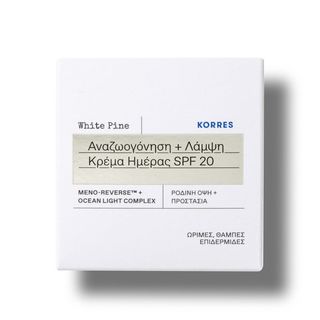
KORRES White Pine Luminous Awakening Moisturizer SPF 20
Works for
1 of 2 advertised claims delivered
Sun protectionSPF 20 · 5 UV filters · Broad spectrumWeak protectionSPF under 30
This product offers broad spectrum sun protection, but it is weak. We recommend to use a broad spectrum sunscreen with at least SPF 30.
This product can be considered "reef safe" because it does not contain the UV filters (oxybenzone and octinoxate) that can be harmful to coral reefs when present in the water in high concentrations.
Moisturizing12 ingredients credited for this claimGood support
“White Pine Luminous Awakening Moisturizer SPF 20”
This product contains good ingredients to attract water to the upper layer of the skin. These ingredients are called "humectants": glycerin, saccharide isomerate.
When humectants are on the surface of the skin, they “pull in” the moisture from the outside environment, or from within deeper layers of the skin. If the air is dry, humectants can speed up the moisture loss from the skin. This is why it is a good idea to use another product on top of this one to help "seal in" the moisture (look for ingredients like dimethicone, squalane, oils and butters).
Evens skin toneNot advertised by the brand · 2 ingredients credited for this claimModerate support
The following ingredient (ingredients) in this product might be helpful, but there is no evidence to confirm that it actually works: pancratium maritimum extract.
The biggest effect for evening out skin tone in this product comes from sun protection. Sun damage is the main factor causing age spots, darkening of post-acne marks and other discolorations. This is why sun protection is the best strategy for maintaining an even skin tone. We, however, do not recommend using this product as a sunscreen because the protection it offers is not strong enough).
Can it cause trouble?
Irritancy8 strong irritants: Zingiber officinale root extract, Alpha-isomethyl ionone + 6 more — patch-test recommendedHigh risk
Comedogenic1 ingredient rated 2 or more on the 0–5 pore-clogging scale1 flagged
User reviews
Be the first — your take helps the next person decide.
Ingredients
Filter by role to see what each ingredient is doing.
Water~45–55%
Dibutyl adipate~5.5–6.8%
- Irritation risk
- Low
Helps soften the upper layer of the skin and create a nice product consistency
More about Dibutyl adipateButylene glycol dicaprylate/dicaprate~4.5–5.5%
- Irritation risk
- Low
Helps soften the upper layer of the skin
More about Butylene glycol dicaprylate/dicaprateEthylhexyl salicylate~3.7–4.5%
- Irritation risk
- Low
Octisalate. A UV filter. It offers some protection against the sun rays that cause sunburn (UVB), but does not protect against the most aging sun rays (UVA). It loses its effectiveness quickly when exposed to sunlight. It is an organic, or so called "chemical" sunscreen
More about Ethylhexyl salicylateGlycerin~2.5–3%
- Irritation risk
- Low
One of the best moisturizing ingredients. Naturally present in skin. It attracts water to the upper layer of the skin working as a humectant
More about GlycerinBis-ethylhexyloxyphenol methoxyphenyl triazine~2.5–3.1%
- Irritation risk
- Medium
Tinosorb S. One of the most effective broad spectrum sunscreen ingredients. Protects from both UVA and UVB rays. It is photostable. Unfortunately, not approved by FDA (US) yet.
More about Bis-ethylhexyloxyphenol methoxyphenyl triazinePropanediol~1.7–2.1%
- Irritation risk
- Low
Acts as a solvent for other ingredients. Speeds up the absorption of other ingredients into the skin
More about PropanediolUndecane~1.4–1.8%
- Irritation risk
- Medium
Helps create a non-greasy finish on the skin
More about UndecaneTris-biphenyl triazine~1.2–1.5%
- Irritation risk
- Medium
Tinosorb A2B. A UV filter. It is effective against both UVA and UVB rays. It is photostable. Soluble in water, which helps to create lighter sunscreen formulations. Unfortunately, not approved by the FDA in the US yet
More about Tris-biphenyl triazineCetearyl alcohol~1–1.2%
- Irritation risk
- Low
- Comedogenicity
- 2/5
A non-drying alcohol. Works as an emollient. Helps water and oil mix together and creates a nice product texture
More about Cetearyl alcoholCaprylic/capric triglyceride~0.7–1.05%
- Irritation risk
- Medium
A good mix of fatty acids that forms a protective layer on the skin. Improves the shelf life of products. Derived from coconut and glycerin
More about Caprylic/capric triglyceridePolymethyl methacrylate~0.65–0.95%
- Irritation risk
- Low
Is used to enhance product texture and can help to optically mask skin imperfections
More about Polymethyl methacrylatePeg-100 stearate~0.6–0.9%
- Irritation risk
- Low
Helps oil and water mix togehter and creates a nice product texture
More about Peg-100 stearateTridecane~0.45–0.65%
Avena strigosa seed extract~0.45–0.65%
- Irritation risk
- Low
Bisabolol~0.35–0.65%
- Irritation risk
- Low
An active component of chamomile plant that historically has been used to calm down irritated skin. A recent study shows that bisabolol indeed can have some anti-inflammatory effect on skin, even though conclusive data is lacking. Bisabolol has a sweet floral scent and can be added to products for its aromatic properties
More about BisabololButylene glycol~0.4–0.6%
- Irritation risk
- Low
Used to create a nice product texture and help delivery of other ingredients. Might be somewhat helpful in attracting water to the upper layer of the skin
More about Butylene glycolCitric acid~0.35–0.6%
- Irritation risk
- Medium
Can work as an exfoliant but is typically used to adjust the product pH
More about Citric acidCynara scolymus leaf extract~0.3–0.6%
- Irritation risk
- High
A plant extract that might have some anti-oxidant properties. It might be irritating
More about Cynara scolymus leaf extractDecyl glucoside~0.45–0.65%
- Irritation risk
- High
Helps oil and water mix together. Can be irritating
More about Decyl glucosideDicaprylyl carbonate~0.3–0.6%
- Irritation risk
- Low
Helps products spread more easily and works as an emollient to soften skin
More about Dicaprylyl carbonateDisodium cetearyl sulfosuccinate~0.4–0.65%
Disodium phosphate~0.25–0.5%
- Irritation risk
- Low
Helps adjust the product pH and stabilize the formulation
More about Disodium phosphateEthylhexyl triazone~0.45–0.7%
- Irritation risk
- Medium
Uvinul T. A UV filter. Effective against UVB rays. It is photostable. Can increase water resistance properties of the sunscreen. Unfortunately, not approved by the FDA (US) yet
More about Ethylhexyl triazoneEthylhexylglycerin~0.25–0.5%
Isopropyl titanium triisostearate~0.3–0.6%
- Irritation risk
- Medium
Helps water and oil mix together
More about Isopropyl titanium triisostearateLactic acid~0.25–0.45%
- Irritation risk
- Medium
An exfoliating and moisturizing alpha-hydroxy acid (AHA). Typically causes less irritation than other AHAs, for example, glycolic acid. At high concentrations (about 15%), lactic acid can help reduce lines and wrinkles. Recent studies show that lactic acid can support the "good" bacteria living on skin's surface (healthy skin microbiome)
More about Lactic acidLecithin~0.3–0.55%
- Irritation risk
- Low
Used mostly for creating emulsions - helping oil and water mix together. Helps soften the upper layer of the skin
More about LecithinLonicera caprifolium flower extract~0.25–0.4%
- Irritation risk
- High
A plant extract that might help neutralize free radicals in skin. Can contain volalite oils and be irritating
More about Lonicera caprifolium flower extractLonicera japonica flower extract~0.25–0.45%
- Irritation risk
- High
A plant extract that might help neutralize free radicals in skin. Can contain volalite oils and be irritating
More about Lonicera japonica flower extractMica~0.3–0.55%
- Irritation risk
- Low
Creates an illusion of smoother and more radiant skin tone. Adds shimmer to the skin by reflecting light
More about MicaPancratium maritimum extract~0.25–0.5%
- Irritation risk
- High
A plant extract that might help neutralize free radicals in skin. It might help reduce hyperpigmentation
More about Pancratium maritimum extractPinus heldreichii bark extract~0.3–0.55%
- Irritation risk
- Low
Polyglyceryl-3 caprate~0.3–0.55%
- Irritation risk
- Medium
Helps oil and water mix together
More about Polyglyceryl-3 caprateSaccharide isomerate~0.25–0.5%
- Irritation risk
- Low
Helps attract water to the upper layer of the skin
More about Saccharide isomerateSilica~0.45–0.65%
Sodium carboxymethyl beta-glucan~0.65–1%
- Irritation risk
- Low
Helps thicken the product formulation and create a gel-like texture
More about Sodium carboxymethyl beta-glucanSodium polyacrylate~0.3–0.55%
- Irritation risk
- Low
Used to create a gel-like product texture, as well as to stabilize emulsions
More about Sodium polyacrylateSpilanthes acmella flower extract~0.25–0.45%
- Irritation risk
- High
Plant extract that might hep calm down inflammation in skin
More about Spilanthes acmella flower extractSynthetic fluorphlogopite~0.3–0.55%
- Irritation risk
- Low
A mineral that is used as an optical filter (makes the skin looks nicer through light reflection) and to improve the texture of cosmetic products
More about Synthetic fluorphlogopiteTetrasodium glutamate diacetate~0.25–0.5%
- Irritation risk
- Low
Helps stabilize the product formulation
More about Tetrasodium glutamate diacetateTin oxide~0.4–0.6%
- Irritation risk
- Low
A colorant that can add a pearl-like appearance to the formulation
More about Tin oxideTocopherol~0.25–0.5%
- Irritation risk
- Low
Pure form of vitamin E. Can help moisturise and protect the skin from free radicals. Often used to help stabilise other ingredients or the formula itself
More about TocopherolTocopheryl acetate~0.3–0.5%
- Irritation risk
- Medium
A more stable but less bio-available form of vitamin E compared to Tocopherol. Might help moisturize and protect the skin from free radicals, but mostly used in low concentrations to stabilize other ingredients.
More about Tocopheryl acetateXanthan gum~0.25–0.5%
- Irritation risk
- Low
Used to create a thicker product consistency
More about Xanthan gumZingiber officinale root extract~0.2–0.35%
- Irritation risk
- High
A plant extract that can contain an irritating essential oil. Might have some anti-oxidant effect, but evidence is lacking
More about Zingiber officinale root extractCi 77491~0.25–0.5%
- Irritation risk
- Low
A red colorant made of iron oxide. Typically is not irritating
More about Ci 77491Iron oxides~0.25–0.45%
- Irritation risk
- Low
An umbrella term for the following three colorants: CI 77491, CI 77492, CI 77499. They might be able to offer some protection against visible light, but the degree of the protection is not clear
More about Iron oxidesCi 77492~0.25–0.5%
Iron oxides~0.25–0.45%
- Irritation risk
- Low
An umbrella term for the following three colorants: CI 77491, CI 77492, CI 77499. They might be able to offer some protection against visible light, but the degree of the protection is not clear
More about Iron oxidesCi 77891~0.25–0.45%
- Irritation risk
- Low
Titanium dioxide~0.35–0.6%
- Irritation risk
- Low
Works as a UV filter when used in high concentrations. It is photostable and is effective mostly against the UVB light, with some protection in the UVA range. In small concentrations, used for its ability to improve the color of cosmetic products. Is usually well tolerated by the skin
More about Titanium dioxidePhenoxyethanol~0.25–0.45%
- Irritation risk
- Low
A preservative. It helps prevent bacterial growth in cosmetic products
More about PhenoxyethanolPotassium sorbate~0.25–0.45%
Sodium benzoate~0.2–0.4%
Alpha-isomethyl ionone~0.2–0.35%
- Irritation risk
- High
A fragrance. Potential allergen and can be irritating
More about Alpha-isomethyl iononeBenzyl salicylate~0.15–0.3%
Citronellol~0.15–0.25%
Coumarin~0.15–0.3%
Hexyl cinnamal~0.15–0.25%
Linalool~0.1–0.2%
Parfum~0.1–0.15%
- Irritation risk
- High
An aromatic blend of unspecified and possibly irritating ingredients
More about ParfumIngredient list view
Water, Dibutyl adipate, Butylene glycol dicaprylate/dicaprate, Ethylhexyl salicylate, Glycerin, Bis-ethylhexyloxyphenol methoxyphenyl triazine, Propanediol, Undecane, Tris-biphenyl triazine, Cetearyl alcohol, Caprylic/capric triglyceride, Polymethyl methacrylate, Peg-100 stearate, Tridecane, Avena strigosa seed extract, Bisabolol, Butylene glycol, Citric acid, Cynara scolymus leaf extract, Decyl glucoside, Dicaprylyl carbonate, Disodium cetearyl sulfosuccinate, Disodium phosphate, Ethylhexyl triazone, Ethylhexylglycerin, Isopropyl titanium triisostearate, Lactic acid, Lecithin, Lonicera caprifolium flower extract, Lonicera japonica flower extract, Mica, Pancratium maritimum extract, Pinus heldreichii bark extract, Polyglyceryl-3 caprate, Saccharide isomerate, Silica, Sodium carboxymethyl beta-glucan, Sodium polyacrylate, Spilanthes acmella flower extract, Synthetic fluorphlogopite, Tetrasodium glutamate diacetate, Tin oxide, Tocopherol, Tocopheryl acetate, Xanthan gum, Zingiber officinale root extract, Ci 77491, Iron oxides, Ci 77492, Iron oxides, Ci 77891, Titanium dioxide, Phenoxyethanol, Potassium sorbate, Sodium benzoate, Alpha-isomethyl ionone, Benzyl salicylate, Citronellol, Coumarin, Hexyl cinnamal, Linalool, Parfum
Compare prices
Retailers ranked by price — lowest first.

Affiliate links · prices updated regularly
Product summary
"KORRES - White Pine Luminous Awakening Moisturizer SPF 20" "is a broad spectrum sunscreen meaning that it protects both from UVB rays (" burning "- they cause sunburn) and UVA rays (" aging "- they don't cause sunburn but lead to premature aging and pigmentation issues). However, this moisturizer does not offer enough sun protection. We recommend to use a sunscreen with at least SPF 30 daily.
This moisturizer should also be hydrating enough to use without an additional moisturizer during the day.
Sunscreen filters
This sunscreen uses so-called" chemical ", or organic UV filters (organic simply means that their molecules contain atoms of carbon). These filters typically give good sun protection and rarely leave a white cast, but they can be irritating for sensitive skin. The UV filters in this sunscreen are: tinosorb s 2.50% - 3.10%, octisalate 3.70% - 4.50%, uvinul t 0.45% - 0.70% and tinosrob a2b 1.20% - 1.50%.
Irritation risk
This moisturizer contains a bunch of common irritants, including ingredients that do not provide any known benefit for the skin. It might not be the best choice if your skin is sensitive. We assess the overall irritancy of this moisturizer to be high. For a detailed overview of all potential irritants: click here
You can see the detailed formula review with the breakdown of all actives in the product and the full ingredient list with estimated concentrations in the tables below.
About the brand
According to Cruelty-Free Kitty" KORRES "is cruelty free, but its parent company is not.
Price
The product retails for 58.60€ in Greece.
For a detailed price comparison: click here.
Sources cited in this review
Every concentration estimate and effectiveness label is anchored to one of these 14 studies and safety reviews.
- 1
- 2
- 3
- 4
- 5Epidermal and dermal effects of topical lactic acidncbi.nlm.nih.gov
- 6Dual Effects of Alpha-Hydroxy Acids on the Skinpdfs.semanticscholar.org

Affiliate links · As an Amazon Associate, WIMJ earns from qualifying purchases.