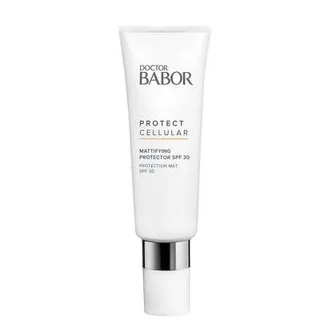
BABOR Doctor Babor Protect Cellular: Mattifying Protector SPF30
Works for
Sun protectionSPF 30 · 6 UV filtersBroad spectrum
This product offers a good level of protection against both UVB and UVA rays.
This sunscreen uses organic (so-called "chemical") sunscreen filters. Organic, or "chemical" filters usually provide reliable sun protection and rarely leave a white cast. Sunscreens with organic filters can sting eyes.
This product can be considered "reef safe" because it does not contain the UV filters (oxybenzone and octinoxate) that can be harmful to coral reefs when present in the water in high concentrations.
Evens skin toneAscorbyl tetraisopalmitateWorks well
“Used regularly, it aids in preventing premature light-induced and environmentally induced skin ageing and helps to counteract the formation of new pigment spots.”
This product offers broad spectrum sun protection. It means that it can prevent hyperpigmentation and help keep the skin tone even (sun damage is the main factor causing age spots, darkening of post-acne marks and other discolorations).
Anti-agingTocopherol, Ascorbyl tetraisopalmitateWorks well
“Protection against pollu-ageing Biosaccharides and vitamin E provide protection against free radicals and harmful environmental influences.”
This product can help prevent early signs of skin aging because it offers a good level of broad spectrum sun protection. Sun damage is the main cause of premature skin aging, and protecting your skin from the sun is the best anti-aging strategy.
MoisturizingSide benefit · Panthenol, Glycerin + 14 moreWorks well
This product can help improve hydration of the skin with the two types of ingredients.
The first type is called “humectants”:
these ingredients help attract water.
When humectants are on the surface of the skin, they “pull in” the moisture from the outside environment, or from
within deeper layers of the skin. The following ingredients in this product do the job:
glycerin, pantolactone.
This product also contains ingredients called “occlusives”. They help reduce the speed with which our skin loses moisture to the outside environment. These ingredients also help soften the upper layer of the skin, so it feels less tight and nicer to the touch. The following ingredients in this product do the job: helianthus annuus seed oil, propylheptyl caprylate.
The following ingredients in this product are especially good for supporting the skin barrier and helping with the hydration level: panthenol
Can it cause trouble?
Irritancy18 flagged ingredientsLow risk
ComedogenicClean of flagged comedogenic ingredientsNone flagged

User reviews
0 of 1 community members would buy it again.
I wanted to love the product because of the outstanding uv filters but unfortunately it pills a lot if you use the recommended amount of product (2 g = 7 pumps). It helps a bit to spread 4 pumps at first and after a few minutes the remaining 3 pumps. But it is still pilling a bit.
Ingredients
Filter by role to see what each ingredient is doing.
Water~45–55%
Dibutyl adipate~5.8–7.1%
- Irritation risk
- Low
Helps soften the upper layer of the skin and create a nice product consistency
More about Dibutyl adipateDicaprylyl ether~4.4–5.4%
- Irritation risk
- Low
Helps soften the upper layer of the skin while creating a non-greasy feel on the skin. Helps to dissolve other ingredients
More about Dicaprylyl etherEthylhexyl salicylate~3.7–4.5%
- Irritation risk
- Low
Octisalate. A UV filter. It offers some protection against the sun rays that cause sunburn (UVB), but does not protect against the most aging sun rays (UVA). It loses its effectiveness quickly when exposed to sunlight. It is an organic, or so called "chemical" sunscreen
More about Ethylhexyl salicylateGlycerin~2.5–3%
- Irritation risk
- Low
One of the best moisturizing ingredients. Naturally present in skin. It attracts water to the upper layer of the skin working as a humectant
More about GlycerinDiethylamino hydroxybenzoyl hexyl benzoate~2.5–3.1%
- Irritation risk
- Medium
Uvinul A Plus. A new generation broad spectrum sunscreen that offers an effective protection especially in the UVA range. It is stable in formulations. Unfortunately, is not approved by the FDA (US) yet
More about Diethylamino hydroxybenzoyl hexyl benzoatePropylheptyl caprylate~1.7–2.1%
- Irritation risk
- Low
Helps soften the upper layer of the skin
More about Propylheptyl caprylateTris-biphenyl triazine~1.5–1.8%
- Irritation risk
- Medium
Tinosorb A2B. A UV filter. It is effective against both UVA and UVB rays. It is photostable. Soluble in water, which helps to create lighter sunscreen formulations. Unfortunately, not approved by the FDA in the US yet
More about Tris-biphenyl triazineMethyl methacrylate crosspolymer~1.3–1.5%
- Irritation risk
- Low
Helps thicken the product consistency
More about Methyl methacrylate crosspolymerEthylhexyl triazone~1.4–1.7%
- Irritation risk
- Medium
Uvinul T. A UV filter. Effective against UVB rays. It is photostable. Can increase water resistance properties of the sunscreen. Unfortunately, not approved by the FDA (US) yet
More about Ethylhexyl triazoneMethylene bis-benzotriazolyl tetramethylbutylphenol~1.1–1.3%
- Irritation risk
- Medium
Tinosorb M. A UV filter. Is effective against both UVA and UVB rays. It also provides some protection against visible light. It is photostable and can also be used to improve photostability of other sunscreen ingredients. Its physical properties help to create lightweight sunscreen formulations. It can leave a slight white cast. Unfortunately, it is not approved by the FDA (US) yet
More about Methylene bis-benzotriazolyl tetramethylbutylphenolUndecane~0.6–0.9%
- Irritation risk
- Medium
Helps create a non-greasy finish on the skin
More about UndecanePolyglyceryl-2 dipolyhydroxystearate~0.55–0.8%
- Irritation risk
- Low
Helps to soften the upper layer of the skin
More about Polyglyceryl-2 dipolyhydroxystearateLauryl glucoside~0.55–0.85%
Tridecane~0.45–0.65%
Tocopheryl acetate~0.45–0.7%
- Irritation risk
- Medium
A more stable but less bio-available form of vitamin E compared to Tocopherol. Might help moisturize and protect the skin from free radicals, but mostly used in low concentrations to stabilize other ingredients.
More about Tocopheryl acetateBis-ethylhexyloxyphenol methoxyphenyl triazine~0.6–0.85%
- Irritation risk
- Medium
Tinosorb S. One of the most effective broad spectrum sunscreen ingredients. Protects from both UVA and UVB rays. It is photostable. Approved by the US FDA in 2026 (listed as bemotrizinol on US labels).
More about Bis-ethylhexyloxyphenol methoxyphenyl triazinePhenoxyethanol~0.4–0.6%
- Irritation risk
- Low
A preservative. It helps prevent bacterial growth in cosmetic products
More about PhenoxyethanolPanthenol~0.3–0.6%
- Irritation risk
- Low
Helps attract water to the upper layer of the skin and can help improve skin barrier function
More about PanthenolMaltodextrin~0.3–0.6%
- Irritation risk
- Low
Used to stabilize the product formulation and can help absorb oil
More about MaltodextrinDecyl glucoside~0.4–0.6%
- Irritation risk
- High
Helps oil and water mix together. Can be irritating
More about Decyl glucosideXanthan gum~0.3–0.55%
- Irritation risk
- Low
Used to create a thicker product consistency
More about Xanthan gumButylene glycol~0.25–0.5%
- Irritation risk
- Low
Used to create a nice product texture and help delivery of other ingredients. Might be somewhat helpful in attracting water to the upper layer of the skin
More about Butylene glycolDisodium edta~0.25–0.5%
Ethylhexylglycerin~0.25–0.5%
Sclerotium gum~0.25–0.45%
- Irritation risk
- Low
Used to create gel-like formulas and stabilize emulsions
More about Sclerotium gumPentylene glycol~0.3–0.55%
- Irritation risk
- Medium
Used to preserve products, dissolve other ingredients and create a nice product texture
More about Pentylene glycolCassia alata leaf extract~0.25–0.5%
- Irritation risk
- Medium
Might have some anti-oxidant properties. Can be used as a fragrance. Can be irritating
More about Cassia alata leaf extractCitric acid~0.25–0.5%
- Irritation risk
- Medium
Can work as an exfoliant but is typically used to adjust the product pH
More about Citric acidCaesalpinia spinosa fruit extract~0.25–0.45%
- Irritation risk
- Low
Caprylic/capric triglyceride~0.3–0.55%
- Irritation risk
- Medium
A good mix of fatty acids that forms a protective layer on the skin. Improves the shelf life of products. Derived from coconut and glycerin
More about Caprylic/capric triglycerideDisodium phosphate~0.25–0.45%
- Irritation risk
- Low
Helps adjust the product pH and stabilize the formulation
More about Disodium phosphateSodium carboxymethyl betaglucan~0.25–0.45%
- Irritation risk
- Low
Propylene glycol~0.25–0.4%
- Irritation risk
- High
Helps oil and water mix together and can enhance the penetration of other ingredients into the skin. It can be irritating
More about Propylene glycolTocopherol~0.25–0.4%
- Irritation risk
- Low
Pure form of vitamin E. Can help moisturise and protect the skin from free radicals. Often used to help stabilise other ingredients or the formula itself
More about TocopherolAscorbyl tetraisopalmitate~0.25–0.45%
- Irritation risk
- Medium
A vitamin C derivative. Studies show that is might be effective in reducing hyperpigmentation, but there are no studies confirming that it is effectively converted into the bioavailable form of Vitamin C in skin. It is not clear how this derivative compares in effectiveness to the topical application of bioavailable form of vitamin C (L-ascorbic acid)
More about Ascorbyl tetraisopalmitateBiosaccharide gum-4~0.2–0.35%
Helianthus annuus sprout extract~0.15–0.3%
- Irritation risk
- Low
Helps soften the upper layer of the skin and can help support the skin barrier
More about Helianthus annuus sprout extractPantolactone~0.15–0.25%
- Irritation risk
- Low
Helps attract water to the upper layer of the skin
More about PantolactoneCarbomer~0.15–0.25%
- Irritation risk
- Low
Helps create a thicker or gel-like product texture. It is not a surfactant but can be used in gentle cleansing formulations
More about CarbomerHelianthus annuus seed oil~0.15–0.25%
- Irritation risk
- Low
A great emollient due to its high linoleic acid content. One of the most effective plant oils in helping skin hydration and repairing skin barrier function
More about Helianthus annuus seed oilDna~0.1–0.2%
- Irritation risk
- Low
Ingredient list view
Water, Dibutyl adipate, Dicaprylyl ether, Ethylhexyl salicylate, Glycerin, Diethylamino hydroxybenzoyl hexyl benzoate, Propylheptyl caprylate, Tris-biphenyl triazine, Methyl methacrylate crosspolymer, Ethylhexyl triazone, Methylene bis-benzotriazolyl tetramethylbutylphenol, Undecane, Polyglyceryl-2 dipolyhydroxystearate, Lauryl glucoside, Tridecane, Tocopheryl acetate, Bis-ethylhexyloxyphenol methoxyphenyl triazine, Phenoxyethanol, Panthenol, Maltodextrin, Decyl glucoside, Xanthan gum, Butylene glycol, Disodium edta, Ethylhexylglycerin, Sclerotium gum, Pentylene glycol, Cassia alata leaf extract, Citric acid, Caesalpinia spinosa fruit extract, Caprylic/capric triglyceride, Disodium phosphate, Sodium carboxymethyl betaglucan, Propylene glycol, Tocopherol, Ascorbyl tetraisopalmitate, Biosaccharide gum-4, Helianthus annuus sprout extract, Pantolactone, Carbomer, Helianthus annuus seed oil, Dna
Compare prices
Retailers ranked by price — lowest first.
Worth comparing, line by line.
Match % combines shared ingredients, the first five ingredients, shared actives and hero ingredients, irritancy (lower counts in the alternative's favour), texture and body area. Only products in the same routine step are compared.
| BABORDoctor Babor Protect Cellular: Mattifying Protector SPF30YOUR PRODUCT | Dr. Barbara SturmSun Drops SPF 50 | BaleaNiacinamide Tagescreme LSF30 | RITUALSThe Ritual of Namaste SPF 50 Daily Sun Protection | |
|---|---|---|---|---|
| Match | — | 53% | 50% | 49% |
| Price | — | $151.70 | — | $39.55 |
| Shared key ingredients | — | 10 of 14 | 4 of 14 | 7 of 14 |
| Key difference | — | Cyclopentasiloxane | Niacinamide | Citrulline |
| Irritancy | Low | Low | Low | Low |
| SPF | SPF 30 | SPF 50 | SPF 30 | SPF 50 |
| Drying alcohol | — | — | — | Contains drying alcohol |
| View product | Shop | Shop | Shop |


More alternatives: Bioderma Atopic skin sunlotion spf 50+Beauty of Joseon Relief Sun Aqua-Fresh : Rice + B5
Product summary
We believe that "BABOR - Doctor Babor Protect Cellular: Mattifying Protector SPF30" can provide reliable sun protection based on the ingredients listed. We love that it can protect from both UVA and UVB rays (not all sunscreens with SPF ratings give UVA protection. UVA rays do not cause sunburn, but still damage our skin and lead to early aging).
As a plus, this sunscreen uses some of the new generation UV filters (Tinosorb M). These filters are more stable and more gentle on the skin.
It also works as a moisturizer, so you do not have to use an additional hydrating product. Like all broad-spectrum sunscreens, this product has an anti-aging benefit.
Sunscreen filters
This sunscreen uses so-called "chemical", or organic UV filters (organic simply means that their molecules contain atoms of carbon). These filters typically give good sun protection and rarely leave a white cast, but they can be irritating for sensitive skin. The UV filters in this sunscreen are: tinosorb s 0.60% - 0.85%, uvinul a plus 2.50% - 3.10%, octisalate 3.70% - 4.50%, uvinul t 1.40% - 1.70%, tinosorb m 1.10% - 1.30% and tinosrob a2b 1.50% - 1.80%.
Irritation risk
There are some common irritants in this product, including ingredients that do not have benefits for the skin. We assess the overall irritancy of this product to be low. For a detailed overview of all potential irritants: click here
You can see the detailed formula review with the breakdown of all actives in the product and the full ingredient list with estimated concentrations in the tables below.
What our users say
Based on 1 review 0% recommend this product- When it comes to comedogenicity, the reviewer found that it does not clog pores.
- As for the white cast, the reviewer reported a noticeable whitish residue.
- When it comes to using this sunscreen under makeup, the user found that it pills under a foundation.
- As for using this sunscreen in the eye area, the reviewer reported that it does not sting eyes.
Sources cited in this review
Every concentration estimate and effectiveness label is anchored to one of these 19 studies and safety reviews.
- 1
- 2
- 3Skin moisturizing effects of panthenol-based formulationspdfs.semanticscholar.org
- 4
- 5
- 6Surfactants and experimental irritant contact dermatitisncbi.nlm.nih.gov

Affiliate links · As an Amazon Associate, WIMJ earns from qualifying purchases.