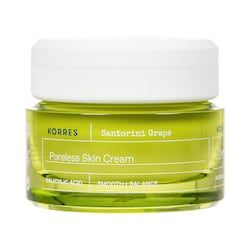
KORRES Santorini Grape Poreless Skin Cream
Works for
1 of 3 advertised claims delivered
Moisturizing18 ingredients credited for this claimGood support
“What it is: A lightweight gel-moisturizer that visibly blurs pores and mattifies skin while providing optimal hydration.”
This product can help improve hydration of the skin with the two types of ingredients.
The first type is called “humectants”:
these ingredients help attract water.
When humectants are on the surface of the skin, they “pull in” the moisture from the outside environment, or from
within deeper layers of the skin. The following ingredients in this product do the job:
glycerin, sodium hyaluronate.
This product also contains ingredients called “occlusives”. They help reduce the speed with which our skin loses moisture to the outside environment. These ingredients also help soften the upper layer of the skin, so it feels less tight and nicer to the touch. The following ingredients in this product do the job: helianthus annuus seed oil, simmondsia chinensis seed oil.
Exfoliation2 ingredients credited for this claimWeak support
“What Else You Need to Know: This moisturizer helps minimize the look of pores, exfoliates dead skin cells to reveal a smooth texture, absorbs shine, and keeps blemishes at bay.”
This product does not contain effective exfoliating ingredients. It might be able to deliver physical exfoliation, that is scrub off some of the dead cells on the surface of the skin. We do not recommend physical exfoliation, because it is not uniform (some bits of skin can get exfoliated too much while others not at all). It can also traumatize the skin and aggrevate acne and other skin conditions.
Anti-blemish2 ingredients credited for this claimWeak support
“- Salicylic Acid: Visibly unclogs pores and aids in the reduction of visible blemishes.”
Effective ingredients missing or their concentration is too low.
Can it cause trouble?
Irritancy1 strong irritant: Rosmarinus officinalis leaf extractMedium risk
Comedogenic2 ingredients rated 2 or more on the 0–5 pore-clogging scale2 flagged


User reviews
Be the first — your take helps the next person decide.
Ingredients
Filter by role to see what each ingredient is doing.
Water~45–55%
Glycerin~4.7–5.7%
- Irritation risk
- Low
One of the best moisturizing ingredients. Naturally present in skin. It attracts water to the upper layer of the skin working as a humectant
More about GlycerinSimmondsia chinensis seed oil~4.2–5.1%
- Irritation risk
- Medium
Softens the upper layer of skin and helps restore the healthy skin barrier. Has shown to help calm down inflammation in skin. It is a stable oil, meaning that it retains its properties even when exposed to air.
More about Simmondsia chinensis seed oilC12-15 alkyl benzoate~3.1–3.8%
- Irritation risk
- Low
Enhances the product texture and makes it more spreadable. Helps reduce water loss from the outer layer of skin. Extands the shelf life by preventing bacteria growth
More about C12-15 alkyl benzoateDicaprylyl carbonate~2.3–2.8%
- Irritation risk
- Low
Helps products spread more easily and works as an emollient to soften skin
More about Dicaprylyl carbonateAmmonium acryloyldimethyltaurate/vp copolymer~1.9–2.3%
- Irritation risk
- Low
Increases thickness of a product. Texture enhancer for oil-in-water emulsions
More about Ammonium acryloyldimethyltaurate/vp copolymerDicaprylyl ether~1.6–2%
- Irritation risk
- Low
Helps soften the upper layer of the skin while creating a non-greasy feel on the skin. Helps to dissolve other ingredients
More about Dicaprylyl etherMacadamia integrifolia seed oil~1.4–1.8%
- Irritation risk
- Low
A plant oil that helps soften the upper layer of the skin
More about Macadamia integrifolia seed oilPotassium cetyl phosphate~1.2–1.4%
- Irritation risk
- Medium
Helps oil and water mix together
More about Potassium cetyl phosphateVitis vinifera fruit extract~0.95–1.15%
- Irritation risk
- Medium
A plant extract that helps attract water to the upper layer of the skin. It might be helpful in neutralizing free radicals in skin, but is less potent than the extract from the seeds
More about Vitis vinifera fruit extractAcrylates/c10-30 alkyl acrylate crosspolymer~0.75–1.1%
- Irritation risk
- Medium
Maintains the texture of skincare products. Allows the product to spread evenly. Helps oil and water mix together
More about Acrylates/c10-30 alkyl acrylate crosspolymerAscorbyl palmitate~0.55–0.85%
- Irritation risk
- Medium
Being a lipid soluble form of vitamin C, it is more stable and can penetrate the skin better than L-Ascorbic acid. It is effective in protecting the skin from free radicals, as well as evening the skin tone, but is less effective in stimulating collagen production compared to L-Ascorbic acid.
More about Ascorbyl palmitateCalendula officinalis extract~0.5–0.75%
- Irritation risk
- High
A plant extract that might help neutralize free radicals in skin
More about Calendula officinalis extractCaprylyl glycol~0.5–0.75%
- Irritation risk
- Medium
Helps preserve products and creates a nice product texture
More about Caprylyl glycolCitric acid~0.45–0.65%
- Irritation risk
- Medium
Can work as an exfoliant but is typically used to adjust the product pH
More about Citric acidCyclodextrin~0.45–0.65%
- Irritation risk
- Low
A type of sugar that is used to support delivery of active ingredients and can enhance their penetration into the skin without disrupting the skin's barrier
More about CyclodextrinEpilobium fleischeri flower/leaf/stem extract~0.4–0.6%
- Irritation risk
- Low
Glyceryl stearate~0.45–0.7%
- Irritation risk
- Low
An emollient that softens the skin and forms a protective layer on its surface. Helps water and oil mix together
More about Glyceryl stearateGlycine soja oil~0.35–0.6%
- Irritation risk
- Medium
- Comedogenicity
- 2/5
A good emollient that helps soften the skin and helps repair its barrier function. It can clog pores if used in high concentrations.
More about Glycine soja oilHelianthus annuus seed oil~0.35–0.6%
- Irritation risk
- Low
A great emollient due to its high linoleic acid content. One of the most effective plant oils in helping skin hydration and repairing skin barrier function
More about Helianthus annuus seed oilLactic acid~0.25–0.5%
- Irritation risk
- Medium
An exfoliating and moisturizing alpha-hydroxy acid (AHA). Typically causes less irritation than other AHAs, for example, glycolic acid. At high concentrations (about 15%), lactic acid can help reduce lines and wrinkles. Recent studies show that lactic acid can support the "good" bacteria living on skin's surface (healthy skin microbiome)
More about Lactic acidOlea europaea fruit oil~0.3–0.55%
- Irritation risk
- Medium
An emollient that helps soften the skin but is not effective for restoring its barrier function. Might be helpful to calm down inflammation
More about Olea europaea fruit oilPanthenol~0.25–0.5%
- Irritation risk
- Low
Helps attract water to the upper layer of the skin and can help improve skin barrier function
More about PanthenolPersea gratissima oil~0.3–0.55%
- Irritation risk
- Medium
An emollient that helps soften the skin and could be helpful in repairing its barrier function
More about Persea gratissima oilPhytosterols~0.3–0.55%
- Irritation risk
- Medium
Lipids that work as an emollient and can be helpful in repairing skin barrier function
More about PhytosterolsPunica granatum fruit extract~0.25–0.45%
- Irritation risk
- High
A fruit extract that is used to add a fragrance to the product. It might have some antioxidant properties
More about Punica granatum fruit extractRosmarinus officinalis leaf extract~0.2–0.4%
- Irritation risk
- High
Can be helpful in reducing inflammation in skin, including inflamed acne. It can be irritating
More about Rosmarinus officinalis leaf extractSodium gluceptate~0.25–0.45%
- Irritation risk
- Low
Sodium hyaluronate~0.25–0.4%
- Irritation risk
- Low
One of the best moisturizing ingredients. Attracts water into the upper layer of the skin
More about Sodium hyaluronateSodium hydroxide~0.2–0.4%
Sorbitan oleate~0.2–0.4%
- Irritation risk
- Medium
- Comedogenicity
- 2/5
Helps oil and water mix together
More about Sorbitan oleateTocopherol~0.2–0.4%
- Irritation risk
- Low
Pure form of vitamin E. Can help moisturise and protect the skin from free radicals. Often used to help stabilise other ingredients or the formula itself
More about TocopherolTocopheryl acetate~0.2–0.4%
- Irritation risk
- Medium
A more stable but less bio-available form of vitamin E compared to Tocopherol. Might help moisturize and protect the skin from free radicals, but mostly used in low concentrations to stabilize other ingredients.
More about Tocopheryl acetateTroxerutin~0.15–0.3%
- Irritation risk
- Low
Phenoxyethanol~0.15–0.25%
- Irritation risk
- Low
A preservative. It helps prevent bacterial growth in cosmetic products
More about PhenoxyethanolPotassium sorbate~0.15–0.25%
Salicylic acid~0.1–0.2%
- Irritation risk
- High
Used for skin exfoliation. It has an anti-inflammatory and anti-bacterial effect, helps to unclog pores, prevent blemishes and speed up healing of the existing ones. Sometimes referred to as a BHA (beta-hydroxy acid)
More about Salicylic acidSodium benzoate~0.1–0.2%
Ingredient list view
Water, Glycerin, Simmondsia chinensis seed oil, C12-15 alkyl benzoate, Dicaprylyl carbonate, Ammonium acryloyldimethyltaurate/vp copolymer, Dicaprylyl ether, Macadamia integrifolia seed oil, Potassium cetyl phosphate, Vitis vinifera fruit extract, Acrylates/c10-30 alkyl acrylate crosspolymer, Ascorbyl palmitate, Calendula officinalis extract, Caprylyl glycol, Citric acid, Cyclodextrin, Epilobium fleischeri flower/leaf/stem extract, Glyceryl stearate, Glycine soja oil, Helianthus annuus seed oil, Lactic acid, Olea europaea fruit oil, Panthenol, Persea gratissima oil, Phytosterols, Punica granatum fruit extract, Rosmarinus officinalis leaf extract, Sodium gluceptate, Sodium hyaluronate, Sodium hydroxide, Sorbitan oleate, Tocopherol, Tocopheryl acetate, Troxerutin, Phenoxyethanol, Potassium sorbate, Salicylic acid, Sodium benzoate, Unknown
Compare prices
Retailers ranked by price — lowest first.

Worth comparing, line by line.
Match % combines shared ingredients, the first five ingredients, shared actives and hero ingredients, irritancy (lower counts in the alternative's favour), texture and body area. Only products in the same routine step are compared.
| KORRESSantorini Grape Poreless Skin CreamYOUR PRODUCT | bioClarityTreat Acne Clearing Gel | B. KaminsLactic-10 | CeraVeBlemish Control Gel Moisturiser with 2% Salicylic Acid & Niacinamide for Blemish-Prone Skin | |
|---|---|---|---|---|
| Match | — | 88% | 81% | 79% |
| Price | $36.00 | $14.00−$22.00 | $28.00−$8.00 | $14.54−$21.46 |
| Shared key ingredients | — | 5 of 12 | 4 of 12 | 4 of 12 |
| Key difference | — | Oatmeal Extract | Zinc Pca | Niacinamide |
| Irritancy | Medium | Low | Low | Low |
| Drying alcohol | — | — | — | — |
| View product | Shop | Shop | Shop |


Sources cited in this review
Every concentration estimate and effectiveness label is anchored to one of these 26 studies and safety reviews.
- 1
- 2
- 3
- 4
- 5
- 6

Affiliate links · As an Amazon Associate, WIMJ earns from qualifying purchases.