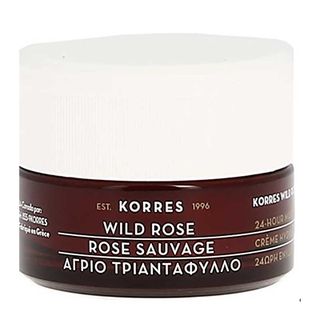
KORRES Apothecary Wild Rose Vitamin C Brightening 24h Moisturiser
Works for
2 of 3 advertised claims delivered
Anti-aging5 ingredients credited for this claimModerate support
“Working in conjunction with radiance-boosting vitamin C, the cream seeks to minimise the look of fine lines and uneven tone.”
This product contains vitis vinifera seed extract. This ingredient might be able to help reduce and prevent fine lines and wrinkles, improve skin elasticity and firmness, but there is not enough evidence that it actually works.
Moisturizing16 ingredients credited for this claimGood support
“Apothecary Wild Rose Vitamin C Brightening 24h Moisturiser”
This product can help improve hydration of the skin with the two types of ingredients.
The first type is called “humectants”:
these ingredients help attract water.
When humectants are on the surface of the skin, they “pull in” the moisture from the outside environment, or from
within deeper layers of the skin. The following ingredients in this product do the job:
arginine, glycerin.
This product also contains ingredients called “occlusives”. They help reduce the speed with which our skin loses moisture to the outside environment. These ingredients also help soften the upper layer of the skin, so it feels less tight and nicer to the touch. The following ingredients in this product do the job: arginine, cetyl alcohol.
Evens skin tone2 ingredients credited for this claimWeak support
“Working in conjunction with radiance-boosting vitamin C, the cream seeks to minimise the look of fine lines and uneven tone.”
Effective ingredients missing or their concentration is too low
Anti-oxidationNot advertised by the brand · 10 ingredients credited for this claimStrong support
This product contains antioxidants (vitis vinifera seed extract) that can help neutralize free radicals in skin. By doing so, they can lessen the damage the skin gets from the UV light (sun).
The following ingredients - imperata cylindrica root extract also can have an antioxidant effect, but there is less evidence to confirm their effectiveness in skin.
Can it cause trouble?
Irritancy8 strong irritants: Alcohol, Alpha-isomethyl ionone + 6 more — patch-test recommendedHigh risk
ComedogenicClean of flagged comedogenic ingredientsNone flagged
User reviews
Be the first — your take helps the next person decide.
Ingredients
Filter by role to see what each ingredient is doing.
Water~45–55%
C12-20 acid peg-8 ester~5.7–7%
- Irritation risk
- Medium
Helps oil and water mix together
More about C12-20 acid peg-8 esterGlycerin~4.2–5.2%
- Irritation risk
- Low
One of the best moisturizing ingredients. Naturally present in skin. It attracts water to the upper layer of the skin working as a humectant
More about GlycerinHexyldecanol~3.2–4%
- Irritation risk
- Low
Helps soften the upper layer of the skin
More about HexyldecanolHexyldecyl laurate~2.5–3%
- Irritation risk
- Low
Helps soften the upper layer of the skin
More about Hexyldecyl laurateAvena sativa kernel extract~2–2.4%
- Irritation risk
- Low
An effective moisturizing and skin barrier repair ingredient. Helps calm down inflammation and has some anti-oxidant properties
More about Avena sativa kernel extractTitanium dioxide~2–2.5%
- Irritation risk
- Low
Works as a UV filter when used in high concentrations. It is photostable and is effective mostly against the UVB light, with some protection in the UVA range. In small concentrations, used for its ability to improve the color of cosmetic products. Is usually well tolerated by the skin
More about Titanium dioxideDicaprylyl carbonate~1.5–1.8%
- Irritation risk
- Low
Helps products spread more easily and works as an emollient to soften skin
More about Dicaprylyl carbonatePentylene glycol~1.2–1.5%
- Irritation risk
- Medium
Used to preserve products, dissolve other ingredients and create a nice product texture
More about Pentylene glycolCetyl alcohol~1.1–1.3%
- Irritation risk
- Low
A non-drying alcohol that works to soften the skin and stabilize product formulations helping oil and water mix together
More about Cetyl alcoholHydrogenated olive oil myristyl esters~0.75–1.1%
- Irritation risk
- Low
Macadamia ternifolia seed oil~0.6–0.9%
- Irritation risk
- Medium
Plant oil from nuts that helps soften the upper layer of the skin. Contains a high concentration of oleic acid that can weaken skin's barrier function and increase water-loss while enhancing penetration of other ingredients
More about Macadamia ternifolia seed oilPeg-20 methyl glucose sesquistearate~0.55–0.8%
- Irritation risk
- Medium
Helps oil and water mix together
More about Peg-20 methyl glucose sesquistearateMethyl glucose sesquistearate~0.5–0.75%
- Irritation risk
- Medium
Helps water and oil mix together
More about Methyl glucose sesquistearateImperata cylindrica root extract~0.4–0.65%
- Irritation risk
- Medium
A plat extract that might help neutralize free radicals in skin and attract water to its upper layer
More about Imperata cylindrica root extractOlea europaea oil unsaponifiables~0.4–0.65%
- Irritation risk
- Low
Help soften the upper layer of the skin
More about Olea europaea oil unsaponifiablesAcrylates/c10-30 alkyl acrylate crosspolymer~0.45–0.65%
- Irritation risk
- Medium
Maintains the texture of skincare products. Allows the product to spread evenly. Helps oil and water mix together
More about Acrylates/c10-30 alkyl acrylate crosspolymerAlcohol~0.35–0.65%
- Irritation risk
- High
Can be drying and contribute to skin irritation. Used in formulars to dissolve other ingredients, create a thinner product consistency or for its antibacterial properties
More about AlcoholAlpha-isomethyl ionone~0.25–0.5%
- Irritation risk
- High
A fragrance. Potential allergen and can be irritating
More about Alpha-isomethyl iononeAlumina~0.45–0.7%
- Irritation risk
- Low
The same compound that is used safely in dental implants and bone cements. In cosmetics, it is used to improve the consistency of products
More about AluminaAluminum stearate~0.3–0.5%
- Irritation risk
- Medium
Used to help evenly disperse other ingredients (for example, pigment) in a formulation
More about Aluminum stearateArginine~0.25–0.45%
- Irritation risk
- Low
An amino acid that is naturally present in skin and helps keep it hydrated. When used together with AHAs, it can reduce their irritating effect on the skin
More about ArginineAscorbic acid~0.25–0.45%
- Irritation risk
- High
The most well-researched antioxidant that works in skin. Helps neutralize free radicals supporting collagen production, helping to even out the skin tone and preventing early signs of aging
More about Ascorbic acidAscorbyl palmitate~0.25–0.45%
- Irritation risk
- Medium
Being a lipid soluble form of vitamin C, it is more stable and can penetrate the skin better than L-Ascorbic acid. It is effective in protecting the skin from free radicals, as well as evening the skin tone, but is less effective in stimulating collagen production compared to L-Ascorbic acid.
More about Ascorbyl palmitateBenzoic acid~0.25–0.5%
Benzyl benzoate~0.25–0.4%
- Irritation risk
- High
Fragrance with sweet balsamic smell. Help to preserve products and dissolve other ingredients. Could trigger allergic reactions and be irritating
More about Benzyl benzoateBenzyl salicylate~0.25–0.4%
Butylphenyl methylpropional~0.25–0.4%
- Irritation risk
- High
A fragrance. Can trigger allergic reactions and be irritating
More about Butylphenyl methylpropionalCaprylyl glycol~0.25–0.5%
- Irritation risk
- Medium
Helps preserve products and creates a nice product texture
More about Caprylyl glycolCarbomer~0.25–0.45%
- Irritation risk
- Low
Helps create a thicker or gel-like product texture. It is not a surfactant but can be used in gentle cleansing formulations
More about CarbomerCitric acid~0.25–0.45%
- Irritation risk
- Medium
Can work as an exfoliant but is typically used to adjust the product pH
More about Citric acidDehydroacetic acid~0.25–0.45%
Ethylhexylglycerin~0.25–0.45%
Hexyl cinnamal~0.2–0.4%
Hydroxyisohexyl 3-cyclohexene carboxaldehyde~0.2–0.4%
- Irritation risk
- High
A fragrance. Can be irritating
More about Hydroxyisohexyl 3-cyclohexene carboxaldehydeIsodecyl salicylate~0.25–0.45%
- Irritation risk
- Low
Lactic acid~0.25–0.45%
- Irritation risk
- Medium
An exfoliating and moisturizing alpha-hydroxy acid (AHA). Typically causes less irritation than other AHAs, for example, glycolic acid. At high concentrations (about 15%), lactic acid can help reduce lines and wrinkles. Recent studies show that lactic acid can support the "good" bacteria living on skin's surface (healthy skin microbiome)
More about Lactic acidLonicera caprifolium flower extract~0.2–0.4%
- Irritation risk
- High
A plant extract that might help neutralize free radicals in skin. Can contain volalite oils and be irritating
More about Lonicera caprifolium flower extractLonicera japonica flower extract~0.25–0.45%
- Irritation risk
- High
A plant extract that might help neutralize free radicals in skin. Can contain volalite oils and be irritating
More about Lonicera japonica flower extractParfum~0.2–0.4%
- Irritation risk
- High
An aromatic blend of unspecified and possibly irritating ingredients
More about ParfumPeg-40 hydrogenated castor oil~0.25–0.5%
- Irritation risk
- Medium
Helps oil and water mix together
More about Peg-40 hydrogenated castor oilPeg-8~0.25–0.45%
- Irritation risk
- Medium
Used to create a nice product consistency
More about Peg-8Phenoxyethanol~0.25–0.45%
- Irritation risk
- Low
A preservative. It helps prevent bacterial growth in cosmetic products
More about PhenoxyethanolPolyaminopropyl biguanide~0.15–0.3%
- Irritation risk
- High
A preservative. There seem to be an increasing number of cases of allergic reactions to it
More about Polyaminopropyl biguanidePolyhydroxystearic acid~0.25–0.45%
- Irritation risk
- Medium
Used to create a thicker product consistency and stabilize the formulation
More about Polyhydroxystearic acidRosa canina fruit oil~0.2–0.4%
- Irritation risk
- Medium
A great emollient. Contains vitamin E (tocopherol) which may give it some anti-oxidant properties. Can contain volatile compounds and can be irritating
More about Rosa canina fruit oilSodium phytate~0.15–0.3%
Tocopherol~0.2–0.35%
- Irritation risk
- Low
Pure form of vitamin E. Can help moisturise and protect the skin from free radicals. Often used to help stabilise other ingredients or the formula itself
More about TocopherolTocopheryl acetate~0.2–0.35%
- Irritation risk
- Medium
A more stable but less bio-available form of vitamin E compared to Tocopherol. Might help moisturize and protect the skin from free radicals, but mostly used in low concentrations to stabilize other ingredients.
More about Tocopheryl acetateVitis vinifera seed extract~0.15–0.25%
- Irritation risk
- Low
A plant extract that contains resveratrol and other anti-oxidant compounds that can help neutralize free radicals, reduce inflammation in skin and even out its tone. Can be also used to stabilize the product formulation
More about Vitis vinifera seed extractXanthan gum~0.1–0.2%
- Irritation risk
- Low
Used to create a thicker product consistency
More about Xanthan gumIngredient list view
Water, C12-20 acid peg-8 ester, Glycerin, Hexyldecanol, Hexyldecyl laurate, Avena sativa kernel extract, Titanium dioxide, Dicaprylyl carbonate, Pentylene glycol, Cetyl alcohol, Hydrogenated olive oil myristyl esters, Macadamia ternifolia seed oil, Peg-20 methyl glucose sesquistearate, Methyl glucose sesquistearate, Imperata cylindrica root extract, Olea europaea oil unsaponifiables, Acrylates/c10-30 alkyl acrylate crosspolymer, Alcohol, Alpha-isomethyl ionone, Alumina, Aluminum stearate, Arginine, Ascorbic acid, Ascorbyl palmitate, Benzoic acid, Benzyl benzoate, Benzyl salicylate, Butylphenyl methylpropional, Caprylyl glycol, Carbomer, Citric acid, Dehydroacetic acid, Ethylhexylglycerin, Hexyl cinnamal, Hydroxyisohexyl 3-cyclohexene carboxaldehyde, Isodecyl salicylate, Lactic acid, Lonicera caprifolium flower extract, Lonicera japonica flower extract, Parfum, Peg-40 hydrogenated castor oil, Peg-8, Phenoxyethanol, Polyaminopropyl biguanide, Polyhydroxystearic acid, Rosa canina fruit oil, Sodium phytate, Tocopherol, Tocopheryl acetate, Vitis vinifera seed extract, Xanthan gum
Compare prices
Retailers ranked by price — lowest first.

.png)
Sources cited in this review
Every concentration estimate and effectiveness label is anchored to one of these 16 studies and safety reviews.
- 1
- 2
- 3Allergic contact dermatitis from grassespubmed.ncbi.nlm.nih.gov
- 4
- 5
- 6Epidermal and dermal effects of topical lactic acidncbi.nlm.nih.gov

Affiliate links · As an Amazon Associate, WIMJ earns from qualifying purchases.