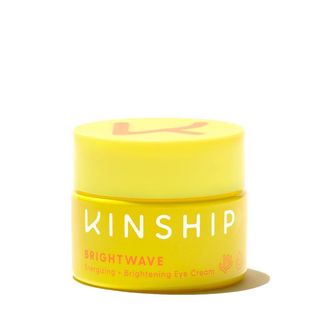
Kinship Brightwave Energizing + Brightening Eye Cream
Works for
1 of 3 advertised claims delivered
Moisturizing18 ingredients credited for this claimGood support
“ Kinship Brightwave Energizing + Brightening Eye Cream helps to awaken tired eyes by hydrating and blurring fine lines for a wide-awake look.”
This product can help improve hydration of the skin with the two types of ingredients.
The first type is called “humectants”:
these ingredients help attract water.
When humectants are on the surface of the skin, they “pull in” the moisture from the outside environment, or from
within deeper layers of the skin. The following ingredients in this product do the job:
glycerin, lactobacillus ferment.
This product also contains ingredients called “occlusives”. They help reduce the speed with which our skin loses moisture to the outside environment. These ingredients also help soften the upper layer of the skin, so it feels less tight and nicer to the touch. The following ingredients in this product do the job: simmondsia chinensis seed oil, squalene.
Anti-aging3 ingredients credited for this claimLimited support
“ Kinship Brightwave Energizing + Brightening Eye Cream helps to awaken tired eyes by hydrating and blurring fine lines for a wide-awake look.”
This product does not contain ingredients that are able to reduce fine lines and wrinkles or help with skin elasticity, but it can improve the look of the skin temporarily through moisturization. Well-moisturized skin might also be able to repair the sun damage better.
This ingredient squalene might be able to help neutralize free radicals in skin and help it fight off some of the sun damage.
Evens skin tone2 ingredients credited for this claimWeak support
“Immediately after use, 91% showed clinical improvement in the appearance of dark undereye discoloration*”
Effective ingredients missing or their concentration is too low
Anti-oxidationNot advertised by the brand · 7 ingredients credited for this claimModerate support
This product contains antioxidants (squalene) that might be able to help neutralize free radicals in skin to lessen the damage it gets from the UV light (sun). There is not enough evidence to confirm their effectiveness in skin though.
Can it cause trouble?
Irritancy16 flagged ingredientsMedium risk
Comedogenic2 ingredients rated 2 or more on the 0–5 pore-clogging scale2 flagged

User reviews
Be the first — your take helps the next person decide.
Ingredients
Filter by role to see what each ingredient is doing.
Water~40–60%
Cetyl alcohol~4.2–6.3%
- Irritation risk
- Low
A non-drying alcohol that works to soften the skin and stabilize product formulations helping oil and water mix together
More about Cetyl alcoholGlycerin~3.3–5%
- Irritation risk
- Low
One of the best moisturizing ingredients. Naturally present in skin. It attracts water to the upper layer of the skin working as a humectant
More about GlycerinPotassium cetyl phosphate~2.4–3.6%
- Irritation risk
- Medium
Helps oil and water mix together
More about Potassium cetyl phosphateAvena sativa kernel oil~2–3%
- Irritation risk
- Low
An effective moisturizing and skin barrier repair ingredient. Helps calm down inflammation and has some anti-oxidant properties
More about Avena sativa kernel oilSimmondsia chinensis seed oil~1.8–2.7%
- Irritation risk
- Medium
Softens the upper layer of skin and helps restore the healthy skin barrier. Has shown to help calm down inflammation in skin. It is a stable oil, meaning that it retains its properties even when exposed to air.
More about Simmondsia chinensis seed oilAstrocaryum tucuma seed butter~1.5–2.2%
- Irritation risk
- Low
C12-15 alkyl benzoate~1.3–1.9%
- Irritation risk
- Low
Enhances the product texture and makes it more spreadable. Helps reduce water loss from the outer layer of skin. Extands the shelf life by preventing bacteria growth
More about C12-15 alkyl benzoateCapryloyl glycerin/sebacic acid copolymer~1–1.5%
- Irritation risk
- Low
Helps soften the upper layer of the skin
More about Capryloyl glycerin/sebacic acid copolymerDiheptyl succinate~0.8–1.25%
- Irritation risk
- Low
Helps to soften the upper layer of the skin and creates a nice product finish on the skin
More about Diheptyl succinateTetrahexyldecyl ascorbate~0.45–1.1%
- Irritation risk
- Medium
Being a lipid soluble form of vitamin C, it is more stable than ascorbic acid, but still degrades quickly and needs to be stabilized in a formulation with another ingredient. It is claimed to penetrate skin better than pure vitamin C and have the the similar benefits, but solid studies of its effectiveness are lacking. Is likely to require a higher concentration in a product than pure vitamin C to be effective. It might be able to help reduce pore clogging.
More about Tetrahexyldecyl ascorbateSqualene~0.4–0.95%
- Irritation risk
- Low
- Comedogenicity
- 2/5
An oil that is naturally part of skin sebum that helps to soften its upper layer, reduce water loss and neutralize free radicals. It might be comedogenic. Avoid applying large concentrations (or pure oil) before sun exposure as oxidized squalene can clog pores and lead to skin irritation. Today squalene is mostly derived from vegetable oils or synthetized by yeast
More about SqualeneHippophae rhamnoides oil~0.35–0.85%
- Irritation risk
- High
A good emollient. Contains various ingredients including vitamins and fatty acids that could work in the skin to neutralize free radicals and minimize moisture loss - if enough of these compounds is able to penetrate the skin in an active form.
More about Hippophae rhamnoides oilJania rubens extract~0.2–0.75%
- Irritation risk
- Low
Lactobacillus ferment~0.15–0.7%
- Irritation risk
- Low
A fermentation product created by bacteria Lactobacillus. The fermented product has anti-bacterial properties and might be helpful in calming down inflammation, but studies are lacking. Helps attract water to the upper layer of the skin. Can be used as a preservative
More about Lactobacillus fermentInonotus obliquus extract~0.15–0.7%
- Irritation risk
- Low
Moringa oleifera seed oil~0.2–0.75%
- Irritation risk
- Medium
A plant oil that helps soften the upper layer of the skin. Is unlikely to be helpful in restoring skin barrier function due to the low content of linoleic acid
More about Moringa oleifera seed oilArachidyl alcohol~0.15–0.7%
- Irritation risk
- Low
Used to soften the upper layer of the skin and create a thicker product consistency
More about Arachidyl alcoholBehenyl alcohol~0.15–0.7%
- Irritation risk
- Low
Non-drying alcohol that helps water and oil mix together. Also serves as an emollient
More about Behenyl alcoholArachidyl glucoside~0.15–0.55%
Jojoba oil/macadamia seed oil esters~0.1–0.45%
- Irritation risk
- Low
Phytosteryl macadamiate~0.15–0.5%
- Irritation risk
- Low
Helps soften the upper layer of the skin
More about Phytosteryl macadamiatePhytosterols~0.1–0.45%
- Irritation risk
- Medium
Lipids that work as an emollient and can be helpful in repairing skin barrier function
More about PhytosterolsTocopherol~0.1–0.4%
- Irritation risk
- Low
Pure form of vitamin E. Can help moisturise and protect the skin from free radicals. Often used to help stabilise other ingredients or the formula itself
More about TocopherolBenzyl alcohol~0.05–0.3%
- Irritation risk
- High
A preservative. Can be used to mask unpleasant smell. Can be irritating
More about Benzyl alcoholSodium carrageenan~0.1–0.4%
Bentonite~0.1–0.4%
Olive oil decyl esters~0.05–0.3%
- Irritation risk
- Low
Hydrated silica~0.15–0.5%
Citric acid~0.05–0.3%
- Irritation risk
- Medium
Can work as an exfoliant but is typically used to adjust the product pH
More about Citric acidLactic acid~0.05–0.3%
- Irritation risk
- Medium
An exfoliating and moisturizing alpha-hydroxy acid (AHA). Typically causes less irritation than other AHAs, for example, glycolic acid. At high concentrations (about 15%), lactic acid can help reduce lines and wrinkles. Recent studies show that lactic acid can support the "good" bacteria living on skin's surface (healthy skin microbiome)
More about Lactic acidChlorella vulgaris extract~0.1–0.3%
- Irritation risk
- Medium
- Comedogenicity
- 3/5
A plant extract that can help to attract water to the upper layer of the skin and might have some anti-oxidant and anti-inflammatory properties
More about Chlorella vulgaris extractSea salt~0.1–0.3%
- Irritation risk
- Medium
Used to thicken the product formulation and might help to add minerals to the surface of the skin. It is used in scrubs as a physical exfoliant. Can increase sensitivity to other ingredients if left on the skin or used in high concentration
More about Sea saltEclipta prostrata extract~0.05–0.3%
- Irritation risk
- High
A plant extract that might help neutralize free radicals in skin. It can be irritating
More about Eclipta prostrata extractMelia azadirachta leaf extract~0.05–0.25%
- Irritation risk
- High
A plant extract that has anti-bacterial properties. Can be used to preserve the product. Can be irritating
More about Melia azadirachta leaf extractSodium phytate~0.05–0.25%
Dehydroacetic acid~0.05–0.15%
Potassium sorbate~0.05–0.2%
Phenoxyethanol~0.05–0.2%
- Irritation risk
- Low
A preservative. It helps prevent bacterial growth in cosmetic products
More about PhenoxyethanolEthylhexylglycerin~0.01–0.05%
Ingredient list view
Water, Cetyl alcohol, Glycerin, Potassium cetyl phosphate, Avena sativa kernel oil, Simmondsia chinensis seed oil, Astrocaryum tucuma seed butter, C12-15 alkyl benzoate, Capryloyl glycerin/sebacic acid copolymer, Diheptyl succinate, Tetrahexyldecyl ascorbate, Squalene, Hippophae rhamnoides oil, Jania rubens extract, Lactobacillus ferment, Inonotus obliquus extract, Moringa oleifera seed oil, Arachidyl alcohol, Behenyl alcohol, Arachidyl glucoside, Jojoba oil/macadamia seed oil esters, Phytosteryl macadamiate, Phytosterols, Tocopherol, Benzyl alcohol, Sodium carrageenan, Bentonite, Olive oil decyl esters, Hydrated silica, Citric acid, Lactic acid, Chlorella vulgaris extract, Sea salt, Eclipta prostrata extract, Melia azadirachta leaf extract, Sodium phytate, Dehydroacetic acid, Potassium sorbate, Phenoxyethanol, Ethylhexylglycerin
Compare prices
Retailers ranked by price — lowest first.


Worth comparing, line by line.
Match % combines shared ingredients, the first five ingredients, shared actives and hero ingredients, irritancy (lower counts in the alternative's favour), texture and body area. Only products in the same routine step are compared.
| KinshipBrightwave Energizing + Brightening Eye CreamYOUR PRODUCT | Alpha Skin CareNourishing Eye Cream | |
|---|---|---|
| Match | — | 50% |
| Price | $28.25 | $18.99−$9.26 |
| Shared key ingredients | — | 3 of 11 |
| Key difference | — | Urea |
| Irritancy | Medium | Medium |
| Drying alcohol | — | — |
| View product | Shop |
Sources cited in this review
Every concentration estimate and effectiveness label is anchored to one of these 20 studies and safety reviews.
- 1
- 2
- 3
- 4Squalene and its potential clinical useseuropepmc.org
- 5
- 6Enhanced comedo formation in rabbit ear skin by squalene and oleic acid peroxidesonlinelibrary.wiley.com

Affiliate links · As an Amazon Associate, WIMJ earns from qualifying purchases.