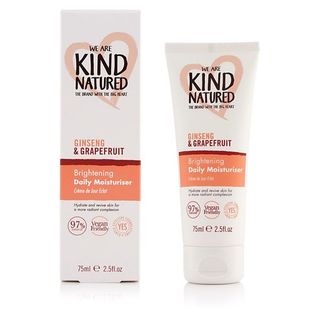
Kind Natured Brightening Daily Moisturiser
Works for
1 of 1 advertised claim delivered
Moisturizing10 ingredients credited for this claimStrong support
“Brightening Daily Moisturiser”
This product can help improve hydration of the skin with the two types of ingredients.
The first type is called “humectants”:
these ingredients help attract water.
When humectants are on the surface of the skin, they “pull in” the moisture from the outside environment, or from
within deeper layers of the skin. The following ingredients in this product do the job:
glycerin.
This product also contains ingredients called “occlusives”. They help reduce the speed with which our skin loses moisture to the outside environment. These ingredients also help soften the upper layer of the skin, so it feels less tight and nicer to the touch. The following ingredients in this product do the job: caprylic/capric triglyceride, cetyl alcohol.
The following ingredients in this product are especially good for supporting the skin barrier and helping with the hydration level: panthenol
Can it cause trouble?
Irritancy6 strong irritants: Parfum, Citrus paradisi peel oil + 4 more — patch-test recommendedHigh risk
ComedogenicClean of flagged comedogenic ingredientsNone flagged


User reviews
Be the first — your take helps the next person decide.
Ingredients
Filter by role to see what each ingredient is doing.
Water~40–60%
Glycerin~3.8–5.7%
- Irritation risk
- Low
One of the best moisturizing ingredients. Naturally present in skin. It attracts water to the upper layer of the skin working as a humectant
More about GlycerinCaprylic/capric triglyceride~3.8–5.6%
- Irritation risk
- Medium
A good mix of fatty acids that forms a protective layer on the skin. Improves the shelf life of products. Derived from coconut and glycerin
More about Caprylic/capric triglycerideCetyl alcohol~2.2–3.3%
- Irritation risk
- Low
A non-drying alcohol that works to soften the skin and stabilize product formulations helping oil and water mix together
More about Cetyl alcoholPolyglyceryl-3 dicitrate/stearate~2–3%
Coco-caprylate~1.7–2.6%
- Irritation risk
- Medium
An emollient that softens skin and creates a nice product texture
More about Coco-caprylateGlyceryl caprylate~1.5–2.2%
- Irritation risk
- Low
An emollient that can also help water and oil mix together, as well as prevent bacteria growth in products
More about Glyceryl caprylatePhenoxyethanol~0.5–1%
- Irritation risk
- Low
A preservative. It helps prevent bacterial growth in cosmetic products
More about PhenoxyethanolSodium polyacrylate~1.1–1.7%
- Irritation risk
- Low
Used to create a gel-like product texture, as well as to stabilize emulsions
More about Sodium polyacrylateAllantoin~0.55–1.25%
- Irritation risk
- Low
Helps calm down inflammation in skin and can help reduce itching. Helps to repair the skin barrier and keep skin hydrated
More about AllantoinSodium stearoyl glutamate~0.55–1.3%
- Irritation risk
- Medium
Helps oil and water mix together
More about Sodium stearoyl glutamatePanthenol~0.45–1%
- Irritation risk
- Low
Helps attract water to the upper layer of the skin and can help improve skin barrier function
More about PanthenolAcrylates/vinyl isodecanoate crosspolymer~0.4–0.95%
- Irritation risk
- Medium
Used to stabilize product formulation, help create an even product layer over skin (for example, in sunscreen), evenly disperse pigements and create a nice product consistency
More about Acrylates/vinyl isodecanoate crosspolymerChlorphenesin~0.16–0.32%
Parfum~0.3–0.75%
- Irritation risk
- High
An aromatic blend of unspecified and possibly irritating ingredients
More about ParfumDisodium edta~0.35–0.75%
Persea gratissima oil~0.35–0.85%
- Irritation risk
- Medium
An emollient that helps soften the skin and could be helpful in repairing its barrier function
More about Persea gratissima oilEthylhexylglycerin~0.2–0.8%
Tocopherol~0.2–0.75%
- Irritation risk
- Low
Pure form of vitamin E. Can help moisturise and protect the skin from free radicals. Often used to help stabilise other ingredients or the formula itself
More about TocopherolCyperus rotundus root extract~0.15–0.65%
- Irritation risk
- Low
Citrus paradisi peel oil~0.15–0.6%
Maltodextrin~0.15–0.6%
- Irritation risk
- Low
Used to stabilize the product formulation and can help absorb oil
More about MaltodextrinCitric acid~0.15–0.55%
- Irritation risk
- Medium
Can work as an exfoliant but is typically used to adjust the product pH
More about Citric acidPanax ginseng root extract~0.15–0.6%
- Irritation risk
- High
A plant extract that might have some anti-inflammatory properties, but solid evidence is lacking. It can be irritating
More about Panax ginseng root extractSodium benzoate~0.25–0.5%
Lactic acid~0.15–0.5%
- Irritation risk
- Medium
An exfoliating and moisturizing alpha-hydroxy acid (AHA). Typically causes less irritation than other AHAs, for example, glycolic acid. At high concentrations (about 15%), lactic acid can help reduce lines and wrinkles. Recent studies show that lactic acid can support the "good" bacteria living on skin's surface (healthy skin microbiome)
More about Lactic acidPotassium sorbate~0.15–0.5%
Silica~0.2–0.8%
Eugenol~0.1–0.35%
Limonene~0.1–0.35%
- Irritation risk
- High
A common frangrance that can easily irritate skin, especially if exposed to air, light or heat
More about LimoneneCitral~0.05–0.3%
Linalool~0.05–0.25%
Mica~0.05–0.25%
- Irritation risk
- Low
Creates an illusion of smoother and more radiant skin tone. Adds shimmer to the skin by reflecting light
More about MicaCi 77891~0.05–0.15%
- Irritation risk
- Low
Titanium dioxide~0.05–0.15%
- Irritation risk
- Low
Works as a UV filter when used in high concentrations. It is photostable and is effective mostly against the UVB light, with some protection in the UVA range. In small concentrations, used for its ability to improve the color of cosmetic products. Is usually well tolerated by the skin
More about Titanium dioxideIngredient list view
Water, Glycerin, Caprylic/capric triglyceride, Cetyl alcohol, Polyglyceryl-3 dicitrate/stearate, Coco-caprylate, Glyceryl caprylate, Phenoxyethanol, Sodium polyacrylate, Allantoin, Sodium stearoyl glutamate, Panthenol, Acrylates/vinyl isodecanoate crosspolymer, Chlorphenesin, Parfum, Disodium edta, Persea gratissima oil, Ethylhexylglycerin, Tocopherol, Cyperus rotundus root extract, Citrus paradisi peel oil, Maltodextrin, Citric acid, Panax ginseng root extract, Sodium benzoate, Lactic acid, Potassium sorbate, Silica, Eugenol, Limonene, Citral, Linalool, Mica, Ci 77891, Titanium dioxide
Compare prices
Retailers ranked by price — lowest first.
Affiliate links · prices updated regularly · As an Amazon Associate, WIMJ earns from qualifying purchases.
Worth comparing, line by line.
Match % combines shared ingredients, the first five ingredients, shared actives and hero ingredients, irritancy (lower counts in the alternative's favour), texture and body area. Only products in the same routine step are compared.
| Kind NaturedBrightening Daily MoisturiserYOUR PRODUCT | Elizabeth GrantCollagen Re-Inforce 3D Advanced 24HR Face Cream | Derma EFirming DMAE Moisturizer | Elizabeth Grant CAGreen Power with Hemp Seed Oil Day Cream | |
|---|---|---|---|---|
| Match | — | 63% | 61% | 60% |
| Price | $15.86 | $70.00+$54.14 | $19.96+$4.10 | $40.00+$24.14 |
| Shared key ingredients | — | 6 of 7 | 4 of 7 | 5 of 7 |
| Key difference | — | Palmitoyl Tetrapeptide-7 | Retinyl Palmitate | Palmitoyl Tripeptide-1 |
| Irritancy | High | Medium | Medium | Medium |
| Drying alcohol | — | — | — | — |
| View product | Shop | Shop | Shop |


Product summary
Judging from the ingredient list, "Kind Natured - Brightening Daily Moisturiser" works well for improving skin hydration This moisturizer uses a good combo of humectants and emollients. These both types of ingredients are essentials for improving the skin hydration and keeping the skin barrier healthy. Panthenol and glycerin in this product (humectants) attract water molecules to the upper layer of the skin (the water comes from the outside air or from the deeper layers of the skin if the air is dry). Caprylic/capric triglyceride, cetyl alcohol, coco-caprylate and glyceryl caprylate in this product help decrease the water evoporation from the skin, so that it stays hydrated for longer. These ingredients also soften the skin and take away the feeling of tightness and dryness.
Ingredient callouts
- This formulation also includes panthenol (pro-vitamin B5) at about 0.45% - 1.00% concentration. In this concentration, panthenol works effectively to improve the skin barrier and reduce inflammation.
- In addition, this moisturizer contains Allantoin (0.55% - 1.25%). Allantoin is helpful in wound-healing and can help restore the skin barrier faster. It might also be able to improve scars, but the evidence is not very strong for this.
Irritation risk
This moisturizer contains a bunch of common irritants, including ingredients that do not provide any known benefit for the skin. It might not be the best choice if your skin is sensitive. We assess the overall irritancy of this moisturizer to be high. For a detailed overview of all potential irritants: click here
You can see the detailed formula review with the breakdown of all actives in the product and the full ingredient list with estimated concentrations in the tables below.
Price
The product retails for 3.80£ in the United Kingdom.
For a detailed price comparison: click here.
Sources cited in this review
Every concentration estimate and effectiveness label is anchored to one of these 11 studies and safety reviews.
- 1
- 2
- 3Skin moisturizing effects of panthenol-based formulationspdfs.semanticscholar.org
- 4
- 5Safety Assessment of Cross-Linked Alkyl Acrylates as Used in Cosmeticsjournals.sagepub.com
- 6Vitamin E in dermatologyncbi.nlm.nih.gov

Affiliate links · As an Amazon Associate, WIMJ earns from qualifying purchases.