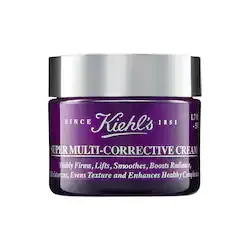
Kiehl's Super Multi-Corrective Anti-Aging Face and Neck Cream
Works for
3 of 3 advertised claims delivered
Anti-aging3 ingredients credited for this claimStrong support
“Super Multi-Corrective Anti-Aging Face and Neck Cream”
This product can help reduce and prevent fine lines and wrinkles, improve skin elasticity and firmness because it contains adenosine.
Keep in mind that it typically takes at least 6 weeks to notice any results because the changes that are needed to improve fine lines and elasticity happen in the deeper layers of the skin. No topical anti-aging product can “erase” wrinkles or fully reverse signs of aging.
Evens skin tone1 ingredient credited for this claimModerate support
“Targets melanin overproduction, helping skin appear more even-toned. . Hyaluronic Acid.”
The following ingredient (ingredients) in this product might be helpful, but there is no evidence to confirm that it actually works: capryloyl salicylic acid.
Moisturizing19 ingredients credited for this claimGood support
“Super Multi-Corrective Anti-Aging Face and Neck Cream”
This product can help improve hydration of the skin with the two types of ingredients.
The first type is called “humectants”:
these ingredients help attract water.
When humectants are on the surface of the skin, they “pull in” the moisture from the outside environment, or from
within deeper layers of the skin. The following ingredients in this product do the job:
glycerin, sodium hyaluronate.
This product also contains ingredients called “occlusives”. They help reduce the speed with which our skin loses moisture to the outside environment. These ingredients also help soften the upper layer of the skin, so it feels less tight and nicer to the touch. The following ingredients in this product do the job: butyrospermum parkii butter, dimethicone.
ExfoliationNot advertised by the brand · 2 ingredients credited for this claimStrong support
This product can help exfoliate the skin. In other words, it helps break down the bonds between dead cells on the surface of the skin and speed up the skin turnover. Skin often appears softer and brighter after exfoliation, but overdoing it can result in disrupted skin barrier. The following ingredient is doing the exfoliating job in this product: capryloyl salicylic acid.
Can it cause trouble?
Irritancy7 strong irritants: Jasminum officinale flower extract, Rosmarinus officinalis leaf oil + 5 more — patch-test recommendedHigh risk
Comedogenic4 ingredients rated 2 or more on the 0–5 pore-clogging scale4 flagged


User reviews
Be the first — your take helps the next person decide.
Ingredients
Filter by role to see what each ingredient is doing.
Water~45–55%
Glycerin~4.9–6%
- Irritation risk
- Low
One of the best moisturizing ingredients. Naturally present in skin. It attracts water to the upper layer of the skin working as a humectant
More about GlycerinDicaprylyl ether~4.1–5.1%
- Irritation risk
- Low
Helps soften the upper layer of the skin while creating a non-greasy feel on the skin. Helps to dissolve other ingredients
More about Dicaprylyl etherButyrospermum parkii butter~3.2–3.9%
- Irritation risk
- Low
- Comedogenicity
- 3/5
A great moisturising ingredient that softens the skin and reduces water loss from its upper layer. It also can be helpful in protecting skin from free radicals
More about Butyrospermum parkii butterHydroxypropyl tetrahydropyrantriol~2.3–2.8%
- Irritation risk
- High
A sugar-derived compound that helps to attract water to the upper layer of the skin and might be able to stimulate synthesis of skin's own moisturizing factors, but solid research is lacking. It could be irritating
More about Hydroxypropyl tetrahydropyrantriolIsononyl isononanoate~2–2.4%
- Irritation risk
- Low
Forms a protective film on the surface of the skin to prevent moisture loss. Gives a velvety feel to products while reducing tackiness
More about Isononyl isononanoatePropylene glycol~1.6–2%
- Irritation risk
- High
Helps oil and water mix together and can enhance the penetration of other ingredients into the skin. It can be irritating
More about Propylene glycolIsopropyl isostearate~1.5–1.8%
- Irritation risk
- Low
- Comedogenicity
- 3/5
An emollient that helps soften the skin
More about Isopropyl isostearateCetyl alcohol~1.3–1.6%
- Irritation risk
- Low
A non-drying alcohol that works to soften the skin and stabilize product formulations helping oil and water mix together
More about Cetyl alcoholDimethicone~1–1.3%
- Irritation risk
- Low
A silicone that helps to reduce water loss from the surface of the skin. Can temporarily "fill in" lines and wrinkles, absorb oil, and create a nice product finish
More about DimethiconeBehenyl alcohol~0.75–1.15%
- Irritation risk
- Low
Non-drying alcohol that helps water and oil mix together. Also serves as an emollient
More about Behenyl alcoholCandelilla cera~0.65–1%
- Irritation risk
- Low
Glyceryl stearate~0.55–0.85%
- Irritation risk
- Low
An emollient that softens the skin and forms a protective layer on its surface. Helps water and oil mix together
More about Glyceryl stearateStearic acid~0.6–0.9%
- Irritation risk
- Low
Helps oil and water mix together and works as an emollient
More about Stearic acidHydroxyethylpiperazine ethane sulfonic acid~0.45–0.65%
- Irritation risk
- Medium
Used to regulate product's pH, but can be also used as an exfoliator when included in higher concentrations. There is a controversy about whether it can generate free radicals and induce skin cell damage when used in topical products
More about Hydroxyethylpiperazine ethane sulfonic acidPalmitic acid~0.5–0.75%
- Irritation risk
- Low
An emollient that is naturally present in skin and helps soften it
More about Palmitic acidPhenoxyethanol~0.45–0.65%
- Irritation risk
- Low
A preservative. It helps prevent bacterial growth in cosmetic products
More about PhenoxyethanolCetearyl alcohol~0.45–0.65%
- Irritation risk
- Low
- Comedogenicity
- 2/5
A non-drying alcohol. Works as an emollient. Helps water and oil mix together and creates a nice product texture
More about Cetearyl alcoholCitric acid~0.3–0.6%
- Irritation risk
- Medium
Can work as an exfoliant but is typically used to adjust the product pH
More about Citric acidCarbomer~0.3–0.55%
- Irritation risk
- Low
Helps create a thicker or gel-like product texture. It is not a surfactant but can be used in gentle cleansing formulations
More about CarbomerCapryloyl salicylic acid~0.25–0.5%
- Irritation risk
- High
Sodium hydroxide~0.25–0.5%
Caprylyl glycol~0.3–0.5%
- Irritation risk
- Medium
Helps preserve products and creates a nice product texture
More about Caprylyl glycolPeg-100 stearate~0.35–0.6%
- Irritation risk
- Low
Helps oil and water mix togehter and creates a nice product texture
More about Peg-100 stearateVigna aconitifolia seed extract~0.25–0.45%
- Irritation risk
- Low
Tocopherol~0.25–0.5%
- Irritation risk
- Low
Pure form of vitamin E. Can help moisturise and protect the skin from free radicals. Often used to help stabilise other ingredients or the formula itself
More about TocopherolXanthan gum~0.25–0.5%
- Irritation risk
- Low
Used to create a thicker product consistency
More about Xanthan gumCetearyl glucoside~0.25–0.5%
- Irritation risk
- Medium
Helps water and oil in the product mix well together and improves product texture
More about Cetearyl glucosideSodium cocoyl glutamate~0.3–0.6%
- Irritation risk
- Medium
Helps oil and water mix together
More about Sodium cocoyl glutamateSodium hyaluronate~0.25–0.45%
- Irritation risk
- Low
One of the best moisturizing ingredients. Attracts water into the upper layer of the skin
More about Sodium hyaluronateDisodium edta~0.25–0.45%
Pentylene glycol~0.3–0.5%
- Irritation risk
- Medium
Used to preserve products, dissolve other ingredients and create a nice product texture
More about Pentylene glycolJasminum officinale flower extract~0.2–0.4%
Jasminum sambac flower extract~0.2–0.35%
- Irritation risk
- Low
Myristic acid~0.25–0.5%
- Irritation risk
- Medium
- Comedogenicity
- 3/5
Helps oil and water mix together. Could be comedogenic
More about Myristic acidRosmarinus officinalis leaf oil~0.2–0.4%
- Irritation risk
- High
A plant oil with high content of volatile compounds that can irritate the skin. Can be used as a fragrance. Has anti-bacterial properties and might help neutralize free radicals on the surface of the skin
More about Rosmarinus officinalis leaf oilAdenosine~0.2–0.35%
- Irritation risk
- Low
Might help improve cell turnover and reduce inflammation in skin. One study shows that the ingredients might be able to help reduce dynamic wrinkles (for example, in the corners of the eyes or on the forehead)
More about AdenosineInonotus obliquus extract~0.15–0.3%
- Irritation risk
- Low
Limonene~0.15–0.25%
- Irritation risk
- High
A common frangrance that can easily irritate skin, especially if exposed to air, light or heat
More about LimoneneLinalool~0.15–0.25%
Pelargonium graveolens flower oil~0.15–0.3%
- Irritation risk
- High
An essential oil. Can be irritating. Can become an allergen with oxidation
More about Pelargonium graveolens flower oilLavandula angustifolia oil~0.1–0.15%
- Irritation risk
- High
An essential oil. Potential allergen and can be irritating. It has some anti-bacterial properties
More about Lavandula angustifolia oilRosa damascena flower oil~0.1–0.15%
- Irritation risk
- High
Used as a fragrance. Can be irritating
More about Rosa damascena flower oilIngredient list view
Water, Glycerin, Dicaprylyl ether, Butyrospermum parkii butter, Hydroxypropyl tetrahydropyrantriol, Isononyl isononanoate, Propylene glycol, Isopropyl isostearate, Cetyl alcohol, Dimethicone, Behenyl alcohol, Candelilla cera, Glyceryl stearate, Stearic acid, Hydroxyethylpiperazine ethane sulfonic acid, Palmitic acid, Phenoxyethanol, Cetearyl alcohol, Citric acid, Carbomer, Capryloyl salicylic acid, Sodium hydroxide, Caprylyl glycol, Peg-100 stearate, Vigna aconitifolia seed extract, Tocopherol, Xanthan gum, Cetearyl glucoside, Sodium cocoyl glutamate, Sodium hyaluronate, Disodium edta, Pentylene glycol, Jasminum officinale flower extract, Jasminum sambac flower extract, Myristic acid, Rosmarinus officinalis leaf oil, Adenosine, Inonotus obliquus extract, Limonene, Linalool, Pelargonium graveolens flower oil, Lavandula angustifolia oil, Rosa damascena flower oil
Compare prices
Retailers ranked by price — lowest first.


Worth comparing, line by line.
Match % combines shared ingredients, the first five ingredients, shared actives and hero ingredients, irritancy (lower counts in the alternative's favour), texture and body area. Only products in the same routine step are compared.
| Kiehl'sSuper Multi-Corrective Anti-Aging Face and Neck CreamYOUR PRODUCT | VichyNeovadiol Perimenopause Plumping Day Cream for Dry Skin | BIOTHERMBLUE THERAPY REVITALIZE MOISTURIZING DAY CREAM | L'Oréal ParisTriple Power Day/Night Cream | |
|---|---|---|---|---|
| Match | — | 67% | 62% | 61% |
| Price | $70.00 | $30.92−$39.08 | $99.00+$29.00 | $9.99−$60.01 |
| Shared key ingredients | — | 8 of 9 | 7 of 9 | 6 of 9 |
| Key difference | — | Niacinamide | Panthenol | Hydrolyzed Hyaluronic Acid |
| Irritancy | High | Medium | Medium | High |
| Drying alcohol | — | Contains drying alcohol | — | — |
| View product | Shop | Shop | Shop |

Sources cited in this review
Every concentration estimate and effectiveness label is anchored to one of these 26 studies and safety reviews.
- 1
- 2
- 3
- 4
- 5Surfactants and experimental irritant contact dermatitisncbi.nlm.nih.gov
- 6Propylene Glycolpubmed.ncbi.nlm.nih.gov

Affiliate links · As an Amazon Associate, WIMJ earns from qualifying purchases.