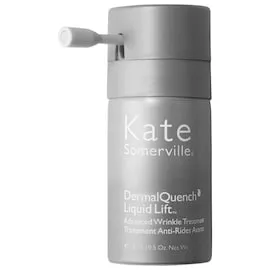
Kate Somerville DermalQuench Hyaluronic Acid Hydration Treatment
Works for
Anti-agingAdenosine, Retinyl palmitate + 1 moreWorks well
“Delivers quick and long-lasting hydration that visibly plumps skin, improving the look of elasticity, firmness, and texture. .”
This product can help reduce and prevent fine lines and wrinkles, improve skin elasticity and firmness because it contains adenosine.
These ingredients in the product can also be helpful, even though there is less evidence for their effectiveness: retinyl palmitate.
Keep in mind that it typically takes at least 6 weeks to notice any results because the changes that are needed to improve fine lines and elasticity happen in the deeper layers of the skin. No topical anti-aging product can “erase” wrinkles or fully reverse signs of aging.
MoisturizingDimethicone, Hydrolyzed hyaluronic acid + 9 moreWorks
“DermalQuench Hyaluronic Acid Hydration Treatment”
This product can help improve hydration of the skin with the two types of ingredients.
The first type is called “humectants”:
these ingredients help attract water.
When humectants are on the surface of the skin, they “pull in” the moisture from the outside environment, or from
within deeper layers of the skin. The following ingredients in this product do the job:
hydrolyzed hyaluronic acid.
This product also contains ingredients called “occlusives”. They help reduce the speed with which our skin loses moisture to the outside environment. These ingredients also help soften the upper layer of the skin, so it feels less tight and nicer to the touch. The following ingredients in this product do the job: dimethicone, isododecane.
Evens skin toneSide benefit · Retinyl palmitate, Salicylic acidMay help
The following ingredient (ingredients) in this product might be helpful, but there is no evidence to confirm that it actually works: retinyl palmitate.
Can it cause trouble?
Irritancy3 strong irritants: Retinyl palmitate, Lavandula angustifolia oil + 1 more — patch-test recommendedHigh risk
Comedogenic1 ingredient rated 2 or more on the 0–5 pore-clogging scale1 flagged


User reviews
Be the first — your take helps the next person decide.
Ingredients
Filter by role to see what each ingredient is doing.
Water~40–60%
Isobutane~4.7–7%
- Irritation risk
- High
Propane~3.7–5.6%
- Irritation risk
- Low
Perfluorohexane~2.7–4%
- Irritation risk
- Medium
Used in products to help dissolve oxygen and enhance oxygen molecule penetration into the skin. There is no evidence for benefits of the oxygen emulsion in topical creams, lotions or serums. There is a study available confirming a positive impact of oxygen therapy for skin wound healing, but it used an oxygen emulsion stored under high pressure using special equipment
More about PerfluorohexanePerfluoroperhydrophenanthrene~2–3%
- Irritation risk
- Low
Dimethicone~1.7–2.6%
- Irritation risk
- Low
A silicone that helps to reduce water loss from the surface of the skin. Can temporarily "fill in" lines and wrinkles, absorb oil, and create a nice product finish
More about DimethiconePerfluorodecalin~1.4–2.1%
- Irritation risk
- Low
Propanediol~1.2–1.8%
- Irritation risk
- Low
Acts as a solvent for other ingredients. Speeds up the absorption of other ingredients into the skin
More about PropanediolNeopentyl glycol diheptanoate~1–1.5%
- Irritation risk
- Low
Helps soften the upper layer of the skin and create a nice product consistency
More about Neopentyl glycol diheptanoateHydrolyzed hyaluronic acid~0.6–1.35%
- Irritation risk
- Low
One of the best moisturizing ingredients. Attracts water into the upper layer of the skin. A version of it is naturally present in skin
More about Hydrolyzed hyaluronic acidTropaeolum majus flower/leaf/stem extract~0.45–1.1%
- Irritation risk
- Low
Adenosine~0.4–0.9%
- Irritation risk
- Low
Might help improve cell turnover and reduce inflammation in skin. One study shows that the ingredients might be able to help reduce dynamic wrinkles (for example, in the corners of the eyes or on the forehead)
More about AdenosineTocopheryl acetate~0.35–0.85%
- Irritation risk
- Medium
A more stable but less bio-available form of vitamin E compared to Tocopherol. Might help moisturize and protect the skin from free radicals, but mostly used in low concentrations to stabilize other ingredients.
More about Tocopheryl acetateAscorbyl palmitate~0.3–0.75%
- Irritation risk
- Medium
Being a lipid soluble form of vitamin C, it is more stable and can penetrate the skin better than L-Ascorbic acid. It is effective in protecting the skin from free radicals, as well as evening the skin tone, but is less effective in stimulating collagen production compared to L-Ascorbic acid.
More about Ascorbyl palmitatePhospholipids~0.3–0.7%
- Irritation risk
- Low
Emollients that are naturaly present in skin. In addition, they help water and oil mix together in the product
More about PhospholipidsRetinyl palmitate~0.2–0.75%
- Irritation risk
- High
Three steps removed from the active form of vitamin A - retinoic acid. To have an effect in the skin, it first needs to be converted twice to become the retinoic acid. This means it is less potent than retinol, but could also be less irritating. Once converted to the retinoic acid in the skin, it helps against all signs of aging, improves skin cell turnover and helps fight blemishes and clogged pores. However, in many cosmetic formulations, it is used in a concentration that is too low to have the full effect
More about Retinyl palmitateCetearyl alcohol~0.35–0.8%
- Irritation risk
- Low
- Comedogenicity
- 2/5
A non-drying alcohol. Works as an emollient. Helps water and oil mix together and creates a nice product texture
More about Cetearyl alcoholGlyceryl stearate~0.3–0.7%
- Irritation risk
- Low
An emollient that softens the skin and forms a protective layer on its surface. Helps water and oil mix together
More about Glyceryl stearateCyclopentasiloxane~0.2–0.7%
- Irritation risk
- Low
A silicone that helps improve the product texture and spreadability. Can absorb oil creating a short-term mattifying effect on the skin
More about CyclopentasiloxaneCyclohexasiloxane~0.15–0.65%
- Irritation risk
- Low
A silicone that serves as an emollient. Helps create a nice non-greasy feels
More about CyclohexasiloxaneSodium lauroyl glutamate~0.15–0.5%
- Irritation risk
- Medium
Used as a cleansing agent. It creates foam
More about Sodium lauroyl glutamateStearic acid~0.2–0.7%
- Irritation risk
- Low
Helps oil and water mix together and works as an emollient
More about Stearic acidAcrylates/c10-30 alkyl acrylate crosspolymer~0.1–0.45%
- Irritation risk
- Medium
Maintains the texture of skincare products. Allows the product to spread evenly. Helps oil and water mix together
More about Acrylates/c10-30 alkyl acrylate crosspolymerEthylhexylglycerin~0.1–0.4%
Lavandula angustifolia oil~0.1–0.35%
- Irritation risk
- High
An essential oil. Potential allergen and can be irritating. It has some anti-bacterial properties
More about Lavandula angustifolia oilPhenoxyethanol~0.05–0.25%
- Irritation risk
- Low
A preservative. It helps prevent bacterial growth in cosmetic products
More about PhenoxyethanolIsododecane~0.1–0.3%
- Irritation risk
- Low
An emollient that helps soften the skin and can decrease moisture loss. Helps create a nice product texture
More about IsododecaneSodium hydroxide~0.05–0.25%
Salicylic acid~0.05–0.2%
- Irritation risk
- High
Used for skin exfoliation. It has an anti-inflammatory and anti-bacterial effect, helps to unclog pores, prevent blemishes and speed up healing of the existing ones. Sometimes referred to as a BHA (beta-hydroxy acid)
More about Salicylic acidSorbic acid~0.05–0.15%
Linalool~0.01–0.05%
Ingredient list view
Water, Isobutane, Propane, Perfluorohexane, Perfluoroperhydrophenanthrene, Dimethicone, Perfluorodecalin, Propanediol, Neopentyl glycol diheptanoate, Hydrolyzed hyaluronic acid, Tropaeolum majus flower/leaf/stem extract, Adenosine, Tocopheryl acetate, Ascorbyl palmitate, Phospholipids, Retinyl palmitate, Cetearyl alcohol, Glyceryl stearate, Cyclopentasiloxane, Cyclohexasiloxane, Sodium lauroyl glutamate, Stearic acid, Acrylates/c10-30 alkyl acrylate crosspolymer, Ethylhexylglycerin, Lavandula angustifolia oil, Phenoxyethanol, Isododecane, Sodium hydroxide, Salicylic acid, Sorbic acid, Linalool
Compare prices
Retailers ranked by price — lowest first.
Worth comparing, line by line.
Match % combines shared ingredients, the first five ingredients, shared actives and hero ingredients, irritancy (lower counts in the alternative's favour), texture and body area. Only products in the same routine step are compared.
| Kate SomervilleDermalQuench Hyaluronic Acid Hydration TreatmentYOUR PRODUCT | ThalgoBrightening Correcting Serum | NEOGEN X SUR.MEDICWhite Truffle Serum In Oil Drop | LumeneNordic Ageless [AJATON] Radiant Youth Pressed Serum | |
|---|---|---|---|---|
| Match | — | 56% | 56% | 56% |
| Price | — | $78.47 | $17.23 | $60.10 |
| Shared key ingredients | — | 3 of 5 | 4 of 5 | 3 of 5 |
| Key difference | — | Niacinamide | Niacinamide | N-Prolyl Palmitoyl Tripeptide-56 Acetate |
| Irritancy | High | Medium | Medium | Medium |
| Drying alcohol | — | — | — | — |
| View product | Shop | Shop | Shop |


More alternatives: SHOPIFY_ME [Triple Collagen] Glass Glow Serum 3.0Farm Stay Black Snail & Peptide9 Perfect Serum
Product summary
"Kate Somerville - DermalQuench Hyaluronic Acid Hydration Treatment" is effective for: Anti-inflammatory and Anti-aging
This product could be helpful for: Moisturizing, but its actives are not the most effective or are not well-studied.
Ingredient callouts
- this product includes a form of Retinoids (vitamin A) - retinyl palmitate 0.20% - 0.75%, but this type of vitamin A is not very effective. It could in theory help with fine lines and wrinkles, but the effect is most likely minimal.
- Adenosine 0.40% - 0.90%. It is a compound that in involved in many biological processes inside the skin cells. According one high-quality clinical trial, topical Adenosine in low concentrations can somewhat help improve "deep wrinkles" - the wrinkles that appear with age in places where our faces are most dynamic (for example, on the forehead or in the corners of the eyes).
- Humectants (hydrolyzed hyaluronic acid 0.60% - 1.35%). These ingredients help attract water to the upper layer of the skin and improve the skin hydration.
About the brand
According to Cruelty-Free Kitty "Kate Somerville" is cruelty free, but its parent company is not.
Sources cited in this review
Every concentration estimate and effectiveness label is anchored to one of these 10 studies and safety reviews.
- 1Topical Oxygen Emulsion A Novel Wound Therapyjamanetwork.com
- 2
- 3Final Report on the Safety Assessment of Dimethicone Copolyoljournals.sagepub.com
- 4Efficacy of a New Topical Nano-hyaluronic Acid in Humansncbi.nlm.nih.gov
- 5Physiochemical properties and application of hyaluronic acid: a systematic reviewonlinelibrary.wiley.com
- 6

Affiliate links · As an Amazon Associate, WIMJ earns from qualifying purchases.