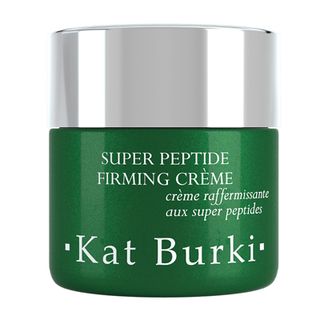
Works for
2 of 2 advertised claims delivered
MoisturizingDipeptide diaminobutyroyl benzylamide diacetate, Palmitoyl tetrapeptide-7 + 36 moreStrong evidence
“The potent Tri-Peptide Complex delivers transformative ingredients that quickly lock in moisture to reduce the appearance of wrinkles, improve skin texture, and restore skin’s elasticity – every day and night.”
This product can help improve hydration of the skin with the two types of ingredients.
The first type is called “humectants”:
these ingredients help attract water.
When humectants are on the surface of the skin, they “pull in” the moisture from the outside environment, or from
within deeper layers of the skin. The following ingredients in this product do the job:
alanine, arginine.
This product also contains ingredients called “occlusives”. They help reduce the speed with which our skin loses moisture to the outside environment. These ingredients also help soften the upper layer of the skin, so it feels less tight and nicer to the touch. The following ingredients in this product do the job: arginine, squalane.
The following ingredients in this product are especially good for supporting the skin barrier and helping with the hydration level: acetyl hexapeptide-1, dipeptide diaminobutyroyl benzylamide diacetate, palmitoyl tetrapeptide-7, palmitoyl tripeptide-1, palmitoyl tripeptide-5
Anti-agingAspartic acid, Dipeptide diaminobutyroyl benzylamide diacetate + 14 moreModerate evidence
“The potent Tri-Peptide Complex delivers transformative ingredients that quickly lock in moisture to reduce the appearance of wrinkles, improve skin texture, and restore skin’s elasticity – every day and night.”
This product contains acetyl hexapeptide-1, aspartic acid, dipeptide diaminobutyroyl benzylamide diacetate, palmitoyl tetrapeptide-7, palmitoyl tripeptide-1, palmitoyl tripeptide-5, serine, threonine. These ingredients might be able to help reduce and prevent fine lines and wrinkles, improve skin elasticity and firmness, but there is not enough evidence that it actually works.
Anti-oxidationNot advertised by the brand · Ubiquinone, Lonicera caprifolium flower extract + 5 moreStrong evidence
This product contains antioxidants (ubiquinone) that can help neutralize free radicals in skin. By doing so, they can lessen the damage the skin gets from the UV light (sun).
Can it cause trouble?
Irritancy9 strong irritants: Arnica montana flower water, Lavandula angustifolia flower water + 7 more — patch-test recommendedHigh risk
Comedogenic2 ingredients rated 2 or more on the 0–5 pore-clogging scale2 flagged


User reviews
Be the first — your take helps the next person decide.
Ingredients
Filter by role to see what each ingredient is doing.
Arnica montana flower water~23–34%
- Irritation risk
- High
Centella asiatica leaf water~3.5–5.3%
- Irritation risk
- Low
Lavandula angustifolia flower water~4.4–6.5%
- Irritation risk
- High
Calendula officinalis flower water~3.4–5.1%
- Irritation risk
- Low
Chamomilla recutita flower water~2.7–4%
- Irritation risk
- Low
Aloe barbadensis leaf juice~1.9–2.9%
- Irritation risk
- Medium
Traditionally used to treat sunburns, dermatitis and inflammation, but evidence for its effectiveness is lacking. The extract can contain humectants that help attract water into the skin
More about Aloe barbadensis leaf juiceGlycerin~1.6–2.3%
- Irritation risk
- Low
One of the best moisturizing ingredients. Naturally present in skin. It attracts water to the upper layer of the skin working as a humectant
More about GlycerinCetyl alcohol~1.3–2%
- Irritation risk
- Low
A non-drying alcohol that works to soften the skin and stabilize product formulations helping oil and water mix together
More about Cetyl alcoholGlyceryl stearate~1.1–1.7%
- Irritation risk
- Low
An emollient that softens the skin and forms a protective layer on its surface. Helps water and oil mix together
More about Glyceryl stearateIsopropyl palmitate~0.9–1.35%
- Irritation risk
- Medium
- Comedogenicity
- 3/5
Helps soften the upper layer of the skin and create a thicker product consistency
More about Isopropyl palmitateElaeis guineensis oil~0.6–1.4%
- Irritation risk
- Low
Helps soften the upper layer of the skin
More about Elaeis guineensis oilLactic acid~0.45–1%
- Irritation risk
- Medium
An exfoliating and moisturizing alpha-hydroxy acid (AHA). Typically causes less irritation than other AHAs, for example, glycolic acid. At high concentrations (about 15%), lactic acid can help reduce lines and wrinkles. Recent studies show that lactic acid can support the "good" bacteria living on skin's surface (healthy skin microbiome)
More about Lactic acidSqualane~0.45–1.1%
- Irritation risk
- Low
An oil naturally present in skin. Works as an emollient to soften the skin and form a protective layer on its surface without a greasy feeling.
More about SqualaneCetearyl alcohol~0.5–1.1%
- Irritation risk
- Low
- Comedogenicity
- 2/5
A non-drying alcohol. Works as an emollient. Helps water and oil mix together and creates a nice product texture
More about Cetearyl alcoholStearyl alcohol~0.4–0.95%
- Irritation risk
- Low
An emollient that helps soften the skin
More about Stearyl alcoholDimethyl sulfone~0.35–0.8%
Tocopherol~0.35–0.8%
- Irritation risk
- Low
Pure form of vitamin E. Can help moisturise and protect the skin from free radicals. Often used to help stabilise other ingredients or the formula itself
More about TocopherolSodium ascorbyl phosphate~0.3–0.7%
- Irritation risk
- Medium
A stable derivative of vitamin C. It is oil-soluble which means it is more likely to penetrate the skin compared to the pure form of vitamin C (which is water-soluble), but it is less bio-available and is way less effective in stimulating collagen and reducing wrinkles compared to the pure form of vitamin C (L-ascorbic acid) and its other derivatives (for example, magnesium ascorbyl phosphate). At the same time, this vitamin C derivative has been shown in studies to be effective in reducing acne, blemishes and clogged pores. It is less irritating then the pure form of vitamin C
More about Sodium ascorbyl phosphatePalmitoyl tetrapeptide-7~0.35–0.8%
- Irritation risk
- Low
A type of peptide. Peptides are excellent moisturizers and might be able support collagen production reducing fine lines and wrinkles
More about Palmitoyl tetrapeptide-7Acetyl hexapeptide-1~0.2–0.7%
- Irritation risk
- Low
A type of peptide. Peptides are excellent moisturizers and might be able support collagen production reducing fine lines and wrinkles
More about Acetyl hexapeptide-1Palmitoyl tripeptide-1~0.3–0.7%
- Irritation risk
- Low
A type of peptide. Peptides are excellent moisturizers and might be able support collagen production reducing fine lines and wrinkles
More about Palmitoyl tripeptide-1Palmitoyl tripeptide-5~0.15–0.65%
- Irritation risk
- Low
A type of peptide. Peptides are excellent moisturizers and might be able support collagen production reducing fine lines and wrinkles
More about Palmitoyl tripeptide-5Sodium pca~0.15–0.65%
- Irritation risk
- Low
Naturally present in skin and helps to attract water to its upper layer
More about Sodium pcaAspartic acid~0.15–0.65%
- Irritation risk
- Low
An amino-acid that helps increase skin hydration and might help to slightly improve skin firmness, potentially reducing lines and wrinkles
More about Aspartic acidArginine~0.15–0.6%
- Irritation risk
- Low
An amino acid that is naturally present in skin and helps keep it hydrated. When used together with AHAs, it can reduce their irritating effect on the skin
More about ArginineGlycine~0.15–0.65%
- Irritation risk
- Low
Helps to attract water to the upper layer of the skin and can help restore the skin barrier function
More about GlycineAlanine~0.15–0.65%
- Irritation risk
- Low
An amino-acid that helps to attract water to the upper layer of the skin and might help to lighten the skin, but solid evidence is lacking
More about AlanineHistidine~0.15–0.65%
Proline~0.2–0.7%
Threonine~0.15–0.7%
- Irritation risk
- Low
An amino-acid that helps to attract water to the upper layer of the skin. In combination with other amino-acids, might help to reduce fine lines and wrinkles
More about ThreoninePhenylalanine~0.2–0.7%
- Irritation risk
- Low
Serine~0.15–0.7%
- Irritation risk
- Low
An amino-acid that helps to attract water to the upper layer of the skin. In combination with other amino-acids, might help to reduce fine lines and wrinkles
More about SerineIsoleucine~0.15–0.7%
- Irritation risk
- Low
An amino acid that can help attract water to the upper layer of the skin and support skin's barrier function
More about IsoleucineValine~0.15–0.7%
- Irritation risk
- Low
Persea gratissima oil~0.35–0.75%
- Irritation risk
- Medium
An emollient that helps soften the skin and could be helpful in repairing its barrier function
More about Persea gratissima oilGlobularia cordifolia callus culture extract~0.15–0.7%
- Irritation risk
- Low
An extract from plant stem cells that might help calm down inflammation in skin
More about Globularia cordifolia callus culture extractCucumis sativus oil~0.3–0.75%
- Irritation risk
- Low
A plant oil that works as a great moisturizer by softening the upper layer of the skin. Due to the high linoleic acid content, can help reduce inflammation in skin
More about Cucumis sativus oilNiacinamide~0.2–0.7%
- Irritation risk
- Low
Is proven to be effective in reducing blemishes, evening out skin tone and helping to improve lines and wrinkles. It helps the skin to repair sun damage, calm down inflammation and keep maintain good levels of moisture. The concentration of about 2% is effective for supporting the skin barrier and evening out the skin tone. Concentration of 4-6% is better for helping with acne and balancing the sebum production
More about NiacinamideUndaria pinnatifida cell culture extract~0.15–0.7%
- Irritation risk
- Low
Hydrolyzed caesalpinia spinosa gum~0.3–0.75%
- Irritation risk
- Medium
Helps softent the upper layer of the skin and create a thicker product consistency
More about Hydrolyzed caesalpinia spinosa gumHyaluronic acid~0.15–0.7%
- Irritation risk
- Low
One of the best moisturizing ingredients. Attracts water into the upper layer of the skin. Naturally present in skin. Typically has large molecule size unless advertised otherwise on the product label. Helps support skin's barrier function and may help to reduce inflammation
More about Hyaluronic acidCaesalpinia spinosa gum~0.4–0.9%
Hyaluronic acid~0.15–0.7%
- Irritation risk
- Low
One of the best moisturizing ingredients. Attracts water into the upper layer of the skin. Naturally present in skin. Typically has large molecule size unless advertised otherwise on the product label. Helps support skin's barrier function and may help to reduce inflammation
More about Hyaluronic acidCamellia sinensis leaf extract~0.2–0.7%
- Irritation risk
- Low
Can contain potent anti-oxidant compounds (abbreviated ECG, GCG, EGC, and EGCG) that might help protect the skin from free radicals. Can help calm down inflammation and has some anti-bacterial properties. Unfortunately, these antioxidants are unstable and lose their effectiveness very quickly in products. The concentration of the antioxidant compounds in the extract also tends to be low to be effective in topical formulation
More about Camellia sinensis leaf extractUbiquinone~0.2–0.7%
- Irritation risk
- Low
Coenzyme Q10. It helps neutralize free radicals in skin, improves skin hydration and might be helpful agains fine lines and wrinkles. It can be an allergen
More about UbiquinoneSclerotium gum~0.15–0.7%
- Irritation risk
- Low
Used to create gel-like formulas and stabilize emulsions
More about Sclerotium gumSodium lactate~0.15–0.7%
- Irritation risk
- Medium
Helps attract water to the upper layer of the skin. Is often used to adjust the pH level of the product
More about Sodium lactateLactic acid~0.15–0.65%
- Irritation risk
- Medium
An exfoliating and moisturizing alpha-hydroxy acid (AHA). Typically causes less irritation than other AHAs, for example, glycolic acid. At high concentrations (about 15%), lactic acid can help reduce lines and wrinkles. Recent studies show that lactic acid can support the "good" bacteria living on skin's surface (healthy skin microbiome)
More about Lactic acidSodium malate~0.15–0.65%
- Irritation risk
- Low
Malic acid~0.2–0.7%
Lysolecithin~0.2–0.75%
- Irritation risk
- Low
Lecithin derivative. It helps oil and water mix together and can enhance penetration of other ingredients. It helps soften the upper layer of the skin
More about LysolecithinLecithin~0.35–0.75%
- Irritation risk
- Low
Used mostly for creating emulsions - helping oil and water mix together. Helps soften the upper layer of the skin
More about LecithinPhytic acid~0.2–0.7%
- Irritation risk
- Medium
An alpha-hydroxy acid (AHA), but is mostly used to stabilize product formulations in cosmetics
More about Phytic acidPullulan~0.3–0.7%
- Irritation risk
- High
Creates a thin drying film on the skin resulting in a short-term tightening effect
More about PullulanCymbopogon schoenanthus oil~0.15–0.65%
- Irritation risk
- High
Pyrus malus fruit extract~0.15–0.7%
- Irritation risk
- Medium
Can have some moisturizing properties due to its sugar content
More about Pyrus malus fruit extractLonicera caprifolium flower extract~0.15–0.65%
- Irritation risk
- High
A plant extract that might help neutralize free radicals in skin. Can contain volalite oils and be irritating
More about Lonicera caprifolium flower extractLonicera japonica flower extract~0.15–0.7%
- Irritation risk
- High
A plant extract that might help neutralize free radicals in skin. Can contain volalite oils and be irritating
More about Lonicera japonica flower extractSaccharum officinarum extract~0.15–0.7%
- Irritation risk
- Low
Sugar extract that helps attract water to the upper layer of the skin
More about Saccharum officinarum extractCitrus aurantium dulcis fruit extract~0.15–0.65%
- Irritation risk
- High
A plant extract that is used as a fragrance. Can be irritating and lead to photosensitivity
More about Citrus aurantium dulcis fruit extractCitrus limon peel extract~0.15–0.6%
Tetrasodium glutamate diacetate~0.15–0.65%
- Irritation risk
- Low
Helps stabilize the product formulation
More about Tetrasodium glutamate diacetateDipeptide diaminobutyroyl benzylamide diacetate~0.15–0.65%
- Irritation risk
- Low
A type of peptide. Peptides are excellent moisturizers and might be able support collagen production reducing fine lines and wrinkles
More about Dipeptide diaminobutyroyl benzylamide diacetateCetearyl glucoside~0.15–0.65%
- Irritation risk
- Medium
Helps water and oil in the product mix well together and improves product texture
More about Cetearyl glucosideXanthan gum~0.15–0.65%
- Irritation risk
- Low
Used to create a thicker product consistency
More about Xanthan gumPotassium sorbate~0.15–0.55%
Sodium benzoate~0.1–0.5%
Sodium hydroxide~0.15–0.5%
Parfum~0.1–0.5%
- Irritation risk
- High
An aromatic blend of unspecified and possibly irritating ingredients
More about ParfumCitronellol~0.1–0.45%
Geraniol~0.1–0.35%
Limonene~0.1–0.4%
- Irritation risk
- High
A common frangrance that can easily irritate skin, especially if exposed to air, light or heat
More about LimoneneIngredient list view
Arnica montana flower water, Centella asiatica leaf water, Lavandula angustifolia flower water, Calendula officinalis flower water, Unknown, Chamomilla recutita flower water, Aloe barbadensis leaf juice, Glycerin, Cetyl alcohol, Glyceryl stearate, Isopropyl palmitate, Elaeis guineensis oil, Lactic acid, Squalane, Cetearyl alcohol, Stearyl alcohol, Dimethyl sulfone, Tocopherol, Sodium ascorbyl phosphate, Palmitoyl tetrapeptide-7, Acetyl hexapeptide-1, Palmitoyl tripeptide-1, Palmitoyl tripeptide-5, Sodium pca, Aspartic acid, Arginine, Glycine, Alanine, Histidine, Proline, Threonine, Phenylalanine, Serine, Isoleucine, Valine, Persea gratissima oil, Globularia cordifolia callus culture extract, Cucumis sativus oil, Niacinamide, Undaria pinnatifida cell culture extract, Hydrolyzed caesalpinia spinosa gum, Hyaluronic acid, Caesalpinia spinosa gum, Hyaluronic acid, Camellia sinensis leaf extract, Ubiquinone, Sclerotium gum, Sodium lactate, Lactic acid, Sodium malate, Malic acid, Lysolecithin, Lecithin, Phytic acid, Pullulan, Cymbopogon schoenanthus oil, Pyrus malus fruit extract, Lonicera caprifolium flower extract, Lonicera japonica flower extract, Saccharum officinarum extract, Citrus aurantium dulcis fruit extract, Citrus limon peel extract, Tetrasodium glutamate diacetate, Dipeptide diaminobutyroyl benzylamide diacetate, Cetearyl glucoside, Xanthan gum, Potassium sorbate, Sodium benzoate, Sodium hydroxide, Parfum, Citronellol, Geraniol, Limonene
Compare prices
Retailers ranked by price — lowest first.
Worth comparing, line by line.
Match % combines shared ingredients, the first five ingredients, shared actives and hero ingredients, irritancy (lower counts in the alternative's favour), texture and body area. Only products in the same routine step are compared.
| Kat BurkiSuper Peptide Firming CremeYOUR PRODUCT | Dr.wantMega Moist Cream | Resh LabUnscented Cica Calming Daily Cream | haruharu USCentella 5% Niacinamide Radiance Gel Cream 90g | |
|---|---|---|---|---|
| Match | — | 58% | 57% | 57% |
| Price | — | $17.46 | — | $21.03 |
| Shared key ingredients | — | 3 of 27 | 3 of 27 | 3 of 27 |
| Key difference | — | Madecassoside | Madecassoside | Madecassoside |
| Irritancy | High | Medium | Low | Low |
| Drying alcohol | — | — | — | — |
| View product | Shop | Shop | Shop |


Sources cited in this review
Every concentration estimate and effectiveness label is anchored to one of these 38 studies and safety reviews.
- 1
- 2Final Report on the Safety Assessment of Isopropyl Isostearatejournals.sagepub.com
- 3
- 4
- 5Epidermal and dermal effects of topical lactic acidncbi.nlm.nih.gov
- 6Dual Effects of Alpha-Hydroxy Acids on the Skinpdfs.semanticscholar.org

Affiliate links · As an Amazon Associate, WIMJ earns from qualifying purchases.