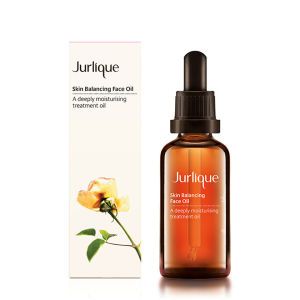
Jurlique Skin Balancing Face Oil
Works for
1 of 4 advertised claims delivered
Moisturizing12 ingredients credited for this claimGood support
“Skin Balancing Face Oil”
This product can help soften the skin and reduce its moisture loss with emollients and occlusives: butyrospermum parkii butter, caprylic/capric triglyceride.
Keep in mind that this product does not contain effective ingredients to attract water to the upper layer of the skin. This is why an additional product with humectants like glycerin or hyaluronic acid can be helpful (apply it before this product for the best results).
Anti-aging3 ingredients credited for this claimLimited support
“Benefits. . Luxurious, lightweight facial treatment to use day or night to keep skin hydrated. . Softens the appearance of fine lines & wrinkles and improves skin’s elasticity. .”
This product does not contain ingredients that are able to reduce fine lines and wrinkles or help with skin elasticity, but it can improve the look of the skin temporarily through moisturization. Well-moisturized skin might also be able to repair the sun damage better.This ingredient - butyrospermum parkii butter - could be helpful for preventing or repairing signs of aging in theory, but there is no evidence that it actually works.
Evens skin tone1 ingredient credited for this claimWeak support
“Another benefit offered by this product is that it helps tone the skin for a more even complexion.”
Effective ingredients missing or their concentration is too low
Anti-blemish2 ingredients credited for this claimWeak support
“They are committed to reducing transport emissions, using clean energy wherever possible and minimising waste output .”
Effective ingredients missing or their concentration is too low.
Can it cause trouble?
Irritancy16 strong irritants: Calendula officinalis flower extract, Rosa gallica flower extract + 14 more — patch-test recommendedHigh risk
Comedogenic2 ingredients rated 2 or more on the 0–5 pore-clogging scale2 flagged
User reviews
Be the first — your take helps the next person decide.
Ingredients
Filter by role to see what each ingredient is doing.
Carthamus tinctorius seed oil~23–34%
- Irritation risk
- Low
An emollient that helps soften the skin and might help calm down inflammation
More about Carthamus tinctorius seed oilCaprylic/capric triglyceride~5.4–8.1%
- Irritation risk
- Medium
A good mix of fatty acids that forms a protective layer on the skin. Improves the shelf life of products. Derived from coconut and glycerin
More about Caprylic/capric triglyceridePersea gratissima oil~4.4–6.6%
- Irritation risk
- Medium
An emollient that helps soften the skin and could be helpful in repairing its barrier function
More about Persea gratissima oilMacadamia ternifolia seed oil~3.6–5.4%
- Irritation risk
- Medium
Plant oil from nuts that helps soften the upper layer of the skin. Contains a high concentration of oleic acid that can weaken skin's barrier function and increase water-loss while enhancing penetration of other ingredients
More about Macadamia ternifolia seed oilRosa canina fruit oil~2.7–4%
- Irritation risk
- Medium
A great emollient. Contains vitamin E (tocopherol) which may give it some anti-oxidant properties. Can contain volatile compounds and can be irritating
More about Rosa canina fruit oilSimmondsia chinensis seed oil~2.1–3.2%
- Irritation risk
- Medium
Softens the upper layer of skin and helps restore the healthy skin barrier. Has shown to help calm down inflammation in skin. It is a stable oil, meaning that it retains its properties even when exposed to air.
More about Simmondsia chinensis seed oilButyrospermum parkii butter~1.7–2.5%
- Irritation risk
- Low
- Comedogenicity
- 3/5
A great moisturising ingredient that softens the skin and reduces water loss from its upper layer. It also can be helpful in protecting skin from free radicals
More about Butyrospermum parkii butterOenothera biennis extract~1.2–1.8%
- Irritation risk
- Low
Oenothera biennis oil~1–1.5%
- Irritation risk
- Medium
Helps soften the upper layer of the skin and can support skin barrier function
More about Oenothera biennis oilGlycine soja oil~0.8–1.2%
- Irritation risk
- Medium
- Comedogenicity
- 2/5
A good emollient that helps soften the skin and helps repair its barrier function. It can clog pores if used in high concentrations.
More about Glycine soja oilChamomilla recutita flower extract~0.45–1.05%
- Irritation risk
- High
Plant extract that can have healing and anti-inflammatory properties. It is a potential allergen and can be irritating
More about Chamomilla recutita flower extractCalendula officinalis flower extract~0.35–0.8%
- Irritation risk
- High
A plant extract that has some anti-oxidant and anti-bacterial properties. Can be irritating
More about Calendula officinalis flower extractAlthaea officinalis root extract~0.3–0.75%
- Irritation risk
- High
A plant extract that can help attract water to the upper layer of the skin and might help to reduce inflammation
More about Althaea officinalis root extractRosa gallica flower extract~0.2–0.75%
- Irritation risk
- High
Bellis perennis flower extract~0.2–0.7%
- Irritation risk
- High
A plant extract. Used as a fragrance. Can be irritating
More about Bellis perennis flower extractEchinacea purpurea extract~0.15–0.7%
- Irritation risk
- High
Plant extract that might have some anti-oxidant properties. Can be irritating
More about Echinacea purpurea extractViola odorata extract~0.15–0.65%
- Irritation risk
- Low
Viola tricolor extract~0.2–0.75%
- Irritation risk
- Medium
A plant extract that might have an anti-inflammatory effect in skin
More about Viola tricolor extractSymphytum officinale leaf extract~0.15–0.55%
- Irritation risk
- High
A plant extract that has an anti-bacterial effect
More about Symphytum officinale leaf extractDaucus carota sativa root extract~0.15–0.5%
- Irritation risk
- Low
Carrot extract. Might have anti-oxidant properties and be used to add orange color
More about Daucus carota sativa root extractTocopherol~0.15–0.65%
- Irritation risk
- Low
Pure form of vitamin E. Can help moisturise and protect the skin from free radicals. Often used to help stabilise other ingredients or the formula itself
More about TocopherolRetinyl palmitate~0.1–0.4%
- Irritation risk
- High
Three steps removed from the active form of vitamin A - retinoic acid. To have an effect in the skin, it first needs to be converted twice to become the retinoic acid. This means it is less potent than retinol, but could also be less irritating. Once converted to the retinoic acid in the skin, it helps against all signs of aging, improves skin cell turnover and helps fight blemishes and clogged pores. However, in many cosmetic formulations, it is used in a concentration that is too low to have the full effect
More about Retinyl palmitateBeta-carotene~0.1–0.45%
Parfum~0.1–0.35%
- Irritation risk
- High
An aromatic blend of unspecified and possibly irritating ingredients
More about ParfumBenzyl alcohol~0.1–0.5%
- Irritation risk
- High
A preservative. Can be used to mask unpleasant smell. Can be irritating
More about Benzyl alcoholCinnamyl alcohol~0.1–0.5%
- Irritation risk
- High
Citral~0.1–0.45%
Eugenol~0.1–0.45%
Coumarin~0.1–0.45%
Benzyl salicylate~0.1–0.4%
Geraniol~0.1–0.35%
Linalool~0.1–0.3%
Benzyl benzoate~0.1–0.3%
- Irritation risk
- High
Fragrance with sweet balsamic smell. Help to preserve products and dissolve other ingredients. Could trigger allergic reactions and be irritating
More about Benzyl benzoateCitronellol~0.05–0.25%
Hexyl cinnamal~0.05–0.2%
Limonene~0.05–0.2%
- Irritation risk
- High
A common frangrance that can easily irritate skin, especially if exposed to air, light or heat
More about LimoneneIngredient list view
Carthamus tinctorius seed oil, Caprylic/capric triglyceride, Persea gratissima oil, Macadamia ternifolia seed oil, Rosa canina fruit oil, Simmondsia chinensis seed oil, Butyrospermum parkii butter, Oenothera biennis extract, Oenothera biennis oil, Glycine soja oil, Chamomilla recutita flower extract, Calendula officinalis flower extract, Althaea officinalis root extract, Rosa gallica flower extract, Bellis perennis flower extract, Echinacea purpurea extract, Viola odorata extract, Viola tricolor extract, Symphytum officinale leaf extract, Daucus carota sativa root extract, Tocopherol, Retinyl palmitate, Beta-carotene, Parfum, Benzyl alcohol, Cinnamyl alcohol, Citral, Eugenol, Coumarin, Benzyl salicylate, Geraniol, Linalool, Benzyl benzoate, Citronellol, Hexyl cinnamal, Limonene
Compare prices
Retailers ranked by price — lowest first.

Affiliate links · prices updated regularly
Sources cited in this review
Every concentration estimate and effectiveness label is anchored to one of these 11 studies and safety reviews.
- 1
- 2
- 3
- 4
- 5
- 6

Affiliate links · As an Amazon Associate, WIMJ earns from qualifying purchases.