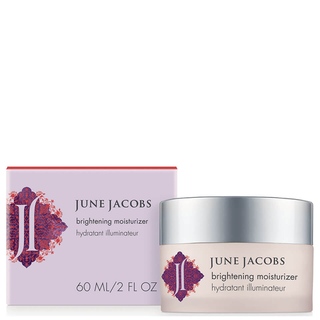
June Jacobs Spa June Jacobs Brightening Moisturizer
Works for
2 of 4 advertised claims delivered
Moisturizing29 ingredients credited for this claimGood support
“June Jacobs Brightening Moisturizer”
This product can help improve hydration of the skin with the two types of ingredients.
The first type is called “humectants”:
these ingredients help attract water.
When humectants are on the surface of the skin, they “pull in” the moisture from the outside environment, or from
within deeper layers of the skin. The following ingredients in this product do the job:
glycerin, sodium pca.
This product also contains ingredients called “occlusives”. They help reduce the speed with which our skin loses moisture to the outside environment. These ingredients also help soften the upper layer of the skin, so it feels less tight and nicer to the touch. The following ingredients in this product do the job: beeswax, cera alba.
Anti-aging6 ingredients credited for this claimModerate support
“Powerful patent pending antioxidant blend of white, red and Green Tea extracts combined with Goji Berry, Pomegranate and Grapeseed Extracts help to neutralize free radicals, protect skin from environmental toxins and combat the visible signs of premature aging.”
This product contains vitis vinifera seed extract. This ingredient might be able to help reduce and prevent fine lines and wrinkles, improve skin elasticity and firmness, but there is not enough evidence that it actually works.
Evens skin tone5 ingredients credited for this claimLimited support
“Detoxifying Lemon Peel Extract has been added to rejuvenate and increase the luster of tired skin, while Bearberry Root, Mulberry Root, Licorice Extract and Gigawhite act as natural lightening agents to help reduce the appearance of hyperpigmentation.”
This product contains ingredients (glycine soja seed extract, glycyrrhiza glabra root extract, punica granatum extract) that could help reduce hyperpigmentation (for example, post-acne marks or age spots) in theory, but there is not enough evidence that they actually work.
Exfoliation2 ingredients credited for this claimWeak support
“Fortified with Lactic Acid, the rejuvenating cream gently eliminates dead skin cells to allow Sweet Almond and Shea Butter to be better absorbed for optimum levels of moisture and hydration.”
This product does not contain effective exfoliating ingredients. It might be able to deliver physical exfoliation, that is scrub off some of the dead cells on the surface of the skin. We do not recommend physical exfoliation, because it is not uniform (some bits of skin can get exfoliated too much while others not at all). It can also traumatize the skin and aggrevate acne and other skin conditions.
Anti-oxidationNot advertised by the brand · 13 ingredients credited for this claimStrong support
This product contains antioxidants (vitis vinifera seed extract) that can help neutralize free radicals in skin. By doing so, they can lessen the damage the skin gets from the UV light (sun).
The following ingredients - punica granatum extract also can have an antioxidant effect, but there is less evidence to confirm their effectiveness in skin.
Can it cause trouble?
Irritancy10 strong irritants: Rosmarinus officinalis leaf extract, Mentha piperita leaf extract + 8 more — patch-test recommendedHigh risk
Comedogenic3 ingredients rated 2 or more on the 0–5 pore-clogging scale3 flagged

User reviews
Be the first — your take helps the next person decide.
Ingredients
Filter by role to see what each ingredient is doing.
Water~45–55%
Glycerin~4.9–6%
- Irritation risk
- Low
One of the best moisturizing ingredients. Naturally present in skin. It attracts water to the upper layer of the skin working as a humectant
More about GlycerinHydrogenated polyisobutene~4.1–5%
- Irritation risk
- Low
Used to improve the product consistency and soften the upper layer of the skin
More about Hydrogenated polyisobuteneButylene glycol~3–3.7%
- Irritation risk
- Low
Used to create a nice product texture and help delivery of other ingredients. Might be somewhat helpful in attracting water to the upper layer of the skin
More about Butylene glycolCetyl alcohol~2.3–2.8%
- Irritation risk
- Low
A non-drying alcohol that works to soften the skin and stabilize product formulations helping oil and water mix together
More about Cetyl alcoholBisabolol~1.8–2.2%
- Irritation risk
- Low
An active component of chamomile plant that historically has been used to calm down irritated skin. A recent study shows that bisabolol indeed can have some anti-inflammatory effect on skin, even though conclusive data is lacking. Bisabolol has a sweet floral scent and can be added to products for its aromatic properties
More about BisabololGlyceryl stearate~1.6–2%
- Irritation risk
- Low
An emollient that softens the skin and forms a protective layer on its surface. Helps water and oil mix together
More about Glyceryl stearatePeg-100 stearate~1.5–1.8%
- Irritation risk
- Low
Helps oil and water mix togehter and creates a nice product texture
More about Peg-100 stearateTriheptanoin~1.1–1.4%
- Irritation risk
- Low
A synthetic triglyceride. Helps soften the upper layer of the skin
More about TriheptanoinButylene glycol dicaprylate/dicaprate~0.95–1.15%
- Irritation risk
- Low
Helps soften the upper layer of the skin
More about Butylene glycol dicaprylate/dicaprateStearic acid~0.75–1.15%
- Irritation risk
- Low
Helps oil and water mix together and works as an emollient
More about Stearic acidCyclopentasiloxane~0.6–0.9%
- Irritation risk
- Low
A silicone that helps improve the product texture and spreadability. Can absorb oil creating a short-term mattifying effect on the skin
More about CyclopentasiloxaneButyrospermum parkii butter~0.55–0.8%
- Irritation risk
- Low
- Comedogenicity
- 3/5
A great moisturising ingredient that softens the skin and reduces water loss from its upper layer. It also can be helpful in protecting skin from free radicals
More about Butyrospermum parkii butter1-methylhydantoin-2-imide~0.45–0.65%
- Irritation risk
- Low
Simmondsia chinensis seed oil~0.45–0.7%
- Irritation risk
- Medium
Softens the upper layer of skin and helps restore the healthy skin barrier. Has shown to help calm down inflammation in skin. It is a stable oil, meaning that it retains its properties even when exposed to air.
More about Simmondsia chinensis seed oilElaeis guineensis oil~0.45–0.65%
- Irritation risk
- Low
Helps soften the upper layer of the skin
More about Elaeis guineensis oilDimethicone~0.5–0.75%
- Irritation risk
- Low
A silicone that helps to reduce water loss from the surface of the skin. Can temporarily "fill in" lines and wrinkles, absorb oil, and create a nice product finish
More about Dimethicone2-hexanol~0.35–0.6%
- Irritation risk
- Low
Caprylyl glycol~0.35–0.65%
- Irritation risk
- Medium
Helps preserve products and creates a nice product texture
More about Caprylyl glycolMel~0.35–0.6%
- Irritation risk
- Low
Helps to soften the upper layer of the skin and attract water to it
More about MelCamellia sinensis leaf extract~0.3–0.55%
- Irritation risk
- Low
Can contain potent anti-oxidant compounds (abbreviated ECG, GCG, EGC, and EGCG) that might help protect the skin from free radicals. Can help calm down inflammation and has some anti-bacterial properties. Unfortunately, these antioxidants are unstable and lose their effectiveness very quickly in products. The concentration of the antioxidant compounds in the extract also tends to be low to be effective in topical formulation
More about Camellia sinensis leaf extractAspalathus linearis extract~0.25–0.5%
- Irritation risk
- Low
Rosmarinus officinalis leaf extract~0.25–0.4%
- Irritation risk
- High
Can be helpful in reducing inflammation in skin, including inflamed acne. It can be irritating
More about Rosmarinus officinalis leaf extractOryza sativa extract~0.3–0.5%
- Irritation risk
- Low
A grain extract that helps to create a thicker product consistency. It might have some anti-oxidant properties and help attract water to the upper layer of the skin
More about Oryza sativa extractGlycine soja seed extract~0.3–0.55%
- Irritation risk
- Medium
An emollient that helps soften the skin. Might be somewhat helpful in evening the skin tone.
More about Glycine soja seed extractGlycyrrhiza glabra root extract~0.2–0.4%
- Irritation risk
- Medium
A plant extract that can help lighten the skin and calm down inflammation. Might be helpful in neutralizing free radicals
More about Glycyrrhiza glabra root extractArctostaphylos uva ursi leaf extract~0.25–0.45%
- Irritation risk
- Low
Pinus strobus bark extract~0.25–0.45%
- Irritation risk
- Low
Morus alba leaf extract~0.25–0.45%
- Irritation risk
- Low
Prunus amygdalus dulcis seed extract~0.25–0.45%
- Irritation risk
- Low
Almond extract (oil) - helps soften the upper layer of the skin
More about Prunus amygdalus dulcis seed extractMalva sylvestris flower/leaf/stem extract~0.25–0.45%
- Irritation risk
- Low
Mentha piperita leaf extract~0.25–0.45%
- Irritation risk
- High
Used as a fragrance and can be irritating
More about Mentha piperita leaf extractPrimula veris extract~0.25–0.5%
- Irritation risk
- High
Veronica officinalis flower/leaf/stem extract~0.25–0.45%
- Irritation risk
- Low
Melissa officinalis leaf extract~0.25–0.45%
- Irritation risk
- High
A plant extract that is added for its fragrance. Can be irritating
More about Melissa officinalis leaf extractAchillea millefolium extract~0.25–0.5%
- Irritation risk
- High
Plant extract that can help neutralize free radicals in skin. Can be used as a fragrance. Can be irritating
More about Achillea millefolium extractAlchemilla vulgaris extract~0.25–0.45%
- Irritation risk
- High
A plant extract that has astringent properties. In other words, it might be able to interact with keratin in the uppermost layer of the skin to reduce swelling and create a temporal tightening effect. It can be irritating
More about Alchemilla vulgaris extractZingiber officinale root extract~0.2–0.35%
- Irritation risk
- High
A plant extract that can contain an irritating essential oil. Might have some anti-oxidant effect, but evidence is lacking
More about Zingiber officinale root extractPunica granatum extract~0.25–0.45%
- Irritation risk
- Medium
A plant extract that can help neutralize free radicals in skin and even out the skin tone, but is typically used in products in a concentration that is too low to be effective
More about Punica granatum extractLycium barbarum fruit extract~0.25–0.45%
- Irritation risk
- Medium
A plant extract that can help neutralize free radicals in skin and attract water to its upper layer
More about Lycium barbarum fruit extractVitis vinifera seed extract~0.25–0.5%
- Irritation risk
- Low
A plant extract that contains resveratrol and other anti-oxidant compounds that can help neutralize free radicals, reduce inflammation in skin and even out its tone. Can be also used to stabilize the product formulation
More about Vitis vinifera seed extractCitrus limon peel extract~0.25–0.4%
Helianthus annuus seed oil~0.25–0.5%
- Irritation risk
- Low
A great emollient due to its high linoleic acid content. One of the most effective plant oils in helping skin hydration and repairing skin barrier function
More about Helianthus annuus seed oilChondrus crispus~0.25–0.45%
- Irritation risk
- Low
- Comedogenicity
- 3/5
Red algae extract that helps attract water to the upper layer of the skin and create a nicer product consistency
More about Chondrus crispusCarrageenan~0.25–0.5%
- Irritation risk
- Medium
- Comedogenicity
- 3/5
Helps thicken the product formula and create a nice product formulation
More about CarrageenanBeeswax~0.3–0.55%
- Irritation risk
- Low
Forms a protective barrier that holds water and keeps dry skin hydrated. Keeps an emulsion from separating into its oil and liquid components, and increases the thickness of a product. Can be an allergen
More about BeeswaxCera alba~0.35–0.65%
- Irritation risk
- Medium
Forms a protective barrier that holds water and keeps dry skin hydrated. Keeps an emulsion from separating into its oil and liquid components, and increases the thickness of a product. Can be an allergen
More about Cera albaPanthenol~0.25–0.45%
- Irritation risk
- Low
Helps attract water to the upper layer of the skin and can help improve skin barrier function
More about PanthenolAllantoin~0.2–0.4%
- Irritation risk
- Low
Helps calm down inflammation in skin and can help reduce itching. Helps to repair the skin barrier and keep skin hydrated
More about AllantoinSodium pca~0.25–0.45%
- Irritation risk
- Low
Naturally present in skin and helps to attract water to its upper layer
More about Sodium pcaPeg-23m~0.25–0.45%
- Irritation risk
- Low
Caprylic/capric triglyceride~0.3–0.55%
- Irritation risk
- Medium
A good mix of fatty acids that forms a protective layer on the skin. Improves the shelf life of products. Derived from coconut and glycerin
More about Caprylic/capric triglycerideCarbomer~0.25–0.45%
- Irritation risk
- Low
Helps create a thicker or gel-like product texture. It is not a surfactant but can be used in gentle cleansing formulations
More about CarbomerLactic acid~0.25–0.4%
- Irritation risk
- Medium
An exfoliating and moisturizing alpha-hydroxy acid (AHA). Typically causes less irritation than other AHAs, for example, glycolic acid. At high concentrations (about 15%), lactic acid can help reduce lines and wrinkles. Recent studies show that lactic acid can support the "good" bacteria living on skin's surface (healthy skin microbiome)
More about Lactic acidCitric acid~0.2–0.4%
- Irritation risk
- Medium
Can work as an exfoliant but is typically used to adjust the product pH
More about Citric acidSodium hydroxide~0.2–0.4%
Leuconostoc/radish root ferment filtrate~0.2–0.4%
- Irritation risk
- Medium
A preservative that comes from radishes fermented by a bacteria. New research suggests that the preservation properties in the ingredient come from an ammonium salt that is not present naturally in radish root but used in its cultivation. Is problematic because the exact amount of the preservative agents is difficult to determine
More about Leuconostoc/radish root ferment filtrateSodium phytate~0.2–0.35%
Dipropylene glycol~0.15–0.3%
- Irritation risk
- Low
Helps to dissolve other ingredients in a formulation. Slows down the rate of product drying
More about Dipropylene glycolMethyldihydrojasmonate~0.15–0.3%
Ambrettolide~0.15–0.25%
- Irritation risk
- Low
Citral~0.15–0.3%
Geraniol~0.15–0.25%
Limonene~0.1–0.15%
- Irritation risk
- High
A common frangrance that can easily irritate skin, especially if exposed to air, light or heat
More about LimoneneLinalool~0.1–0.15%
Ingredient list view
Water, Glycerin, Hydrogenated polyisobutene, Butylene glycol, Cetyl alcohol, Bisabolol, Glyceryl stearate, Peg-100 stearate, Triheptanoin, Butylene glycol dicaprylate/dicaprate, Stearic acid, Cyclopentasiloxane, Butyrospermum parkii butter, 1-methylhydantoin-2-imide, Simmondsia chinensis seed oil, Elaeis guineensis oil, Dimethicone, 2-hexanol, Caprylyl glycol, Mel, Camellia sinensis leaf extract, Aspalathus linearis extract, Rosmarinus officinalis leaf extract, Oryza sativa extract, Glycine soja seed extract, Glycyrrhiza glabra root extract, Arctostaphylos uva ursi leaf extract, Pinus strobus bark extract, Morus alba leaf extract, Prunus amygdalus dulcis seed extract, Malva sylvestris flower/leaf/stem extract, Mentha piperita leaf extract, Primula veris extract, Veronica officinalis flower/leaf/stem extract, Melissa officinalis leaf extract, Achillea millefolium extract, Alchemilla vulgaris extract, Zingiber officinale root extract, Punica granatum extract, Lycium barbarum fruit extract, Vitis vinifera seed extract, Citrus limon peel extract, Helianthus annuus seed oil, Chondrus crispus, Carrageenan, Beeswax, Cera alba, Panthenol, Allantoin, Sodium pca, Peg-23m, Caprylic/capric triglyceride, Carbomer, Lactic acid, Citric acid, Sodium hydroxide, Leuconostoc/radish root ferment filtrate, Sodium phytate, Dipropylene glycol, Methyldihydrojasmonate, Ambrettolide, Citral, Geraniol, Limonene, Linalool
Compare prices
Retailers ranked by price — lowest first.
Worth comparing, line by line.
Match % combines shared ingredients, the first five ingredients, shared actives and hero ingredients, irritancy (lower counts in the alternative's favour), texture and body area. Only products in the same routine step are compared.
| June Jacobs SpaJune Jacobs Brightening MoisturizerYOUR PRODUCT | January LabsRetexturizing Night Cream | OleHenriksenDewtopia 5% Acid Night Creme Dewtopia 5% Acid Night Creme | NIP+FABVitamin C Tonic | |
|---|---|---|---|---|
| Match | — | 51% | 50% | 50% |
| Price | $34.00 | $86.00+$52.00 | $59.56+$25.56 | $6.50−$27.50 |
| Shared key ingredients | — | 5 of 22 | 5 of 22 | 4 of 22 |
| Key difference | — | Niacinamide | Glycolic Acid | — |
| Irritancy | High | Medium | High | Medium |
| Drying alcohol | — | — | — | — |
| View product | Shop | Shop | Shop |


Sources cited in this review
Every concentration estimate and effectiveness label is anchored to one of these 36 studies and safety reviews.
- 1
- 2
- 3
- 4
- 5
- 6

Affiliate links · As an Amazon Associate, WIMJ earns from qualifying purchases.