Works for
MoisturizingCarthamus tinctorius seed oil, Helianthus annuus seed oil + 40 moreWorks
“• Ultra-hydrating, nourishing, and protective; combats dryness, dullness, loss of firmness, and elasticity”
This product can help improve hydration of the skin with the two types of ingredients.
The first type is called “humectants”:
these ingredients help attract water.
When humectants are on the surface of the skin, they “pull in” the moisture from the outside environment, or from
within deeper layers of the skin. The following ingredients in this product do the job:
biosaccharide gum-1, fructose.
This product also contains ingredients called “occlusives”. They help reduce the speed with which our skin loses moisture to the outside environment. These ingredients also help soften the upper layer of the skin, so it feels less tight and nicer to the touch. The following ingredients in this product do the job: beeswax, butyrospermum parkii butter.
Anti-agingButyrospermum parkii butter, Dipalmitoyl hydroxyproline + 5 moreNot delivered
“• Clinically proven to reduce the appearance of fine lines and wrinkles within 1 week”
This product does not contain ingredients that are able to reduce fine lines and wrinkles or help with skin elasticity, but it can improve the look of the skin temporarily through moisturization. Well-moisturized skin might also be able to repair the sun damage better.These ingredients - butyrospermum parkii butter, dipalmitoyl hydroxyproline - could be helpful for preventing or repairing signs of aging in theory, but there is no evidence that it actually works.
This ingredient quercetin might be able to help neutralize free radicals in skin and help it fight off some of the sun damage.
Anti-oxidationSide benefit · Quercetin, Carthamus tinctorius seed oil + 14 moreMay help
This product contains antioxidants (quercetin) that might be able to help neutralize free radicals in skin to lessen the damage it gets from the UV light (sun). There is not enough evidence to confirm their effectiveness in skin though.
Can it cause trouble?
Irritancy2 strong irritants: Psoralea corylifolia seed extract, Citrus aurantium dulcis oil — patch-test recommendedHigh risk
Comedogenic9 ingredients rated 2 or more on the 0–5 pore-clogging scale9 flagged

User reviews
Be the first — your take helps the next person decide.
Ingredients
Filter by role to see what each ingredient is doing.
Water~45–55%
Argania spinosa kernel oil~4.7–5.8%
- Irritation risk
- Medium
An emollient that helps soften the upper layer of the skin. Might have some weak anti-oxidant properties
More about Argania spinosa kernel oilCaprylic/capric triglyceride~4.1–5%
- Irritation risk
- Medium
A good mix of fatty acids that forms a protective layer on the skin. Improves the shelf life of products. Derived from coconut and glycerin
More about Caprylic/capric triglycerideGlycerin~3–3.6%
- Irritation risk
- Low
One of the best moisturizing ingredients. Naturally present in skin. It attracts water to the upper layer of the skin working as a humectant
More about GlycerinCarthamus tinctorius seed oil~2.3–2.8%
- Irritation risk
- Low
An emollient that helps soften the skin and might help calm down inflammation
More about Carthamus tinctorius seed oilCoco-caprylate/caprate~1.8–2.2%
- Irritation risk
- Low
Helps to soften the upper layer of the skin without creating a greasy texture
More about Coco-caprylate/caprateButyrospermum parkii butter~1.6–1.9%
- Irritation risk
- Low
- Comedogenicity
- 3/5
A great moisturising ingredient that softens the skin and reduces water loss from its upper layer. It also can be helpful in protecting skin from free radicals
More about Butyrospermum parkii butterCetearyl olivate~1.2–1.5%
Sorbitan olivate~1–1.2%
Aloe barbadensis leaf juice~0.65–1%
- Irritation risk
- Medium
Traditionally used to treat sunburns, dermatitis and inflammation, but evidence for its effectiveness is lacking. The extract can contain humectants that help attract water into the skin
More about Aloe barbadensis leaf juicePhenoxyethanol~0.5–0.7%
- Irritation risk
- Low
A preservative. It helps prevent bacterial growth in cosmetic products
More about PhenoxyethanolHydroxyethyl acrylate/sodium acryloyldimethyl taurate copolymer~0.45–0.65%
- Irritation risk
- Medium
A gelling agent that thickens the product consistency and leaves the skin with a velvety finish
More about Hydroxyethyl acrylate/sodium acryloyldimethyl taurate copolymerSclerotium gum~0.3–0.6%
- Irritation risk
- Low
Used to create gel-like formulas and stabilize emulsions
More about Sclerotium gumHelianthus annuus seed oil~0.3–0.55%
- Irritation risk
- Low
A great emollient due to its high linoleic acid content. One of the most effective plant oils in helping skin hydration and repairing skin barrier function
More about Helianthus annuus seed oilOctyldodecyl pca~0.3–0.55%
- Irritation risk
- Low
Squalane~0.3–0.55%
- Irritation risk
- Low
An oil naturally present in skin. Works as an emollient to soften the skin and form a protective layer on its surface without a greasy feeling.
More about SqualaneEthylhexylglycerin~0.25–0.45%
Persea gratissima oil~0.25–0.45%
- Irritation risk
- Medium
An emollient that helps soften the skin and could be helpful in repairing its barrier function
More about Persea gratissima oilCarthamus tinctorius oleosomes~0.2–0.4%
- Irritation risk
- Low
Helps soften the upper layer of the skin
More about Carthamus tinctorius oleosomesSorbitan isostearate~0.15–0.3%
- Irritation risk
- Low
Helps oil and water mix together
More about Sorbitan isostearateMedicago sativa extract~0.15–0.25%
- Irritation risk
- Medium
A plant extract that might help neutralize free radicals in skin
More about Medicago sativa extractTetrasodium glutamate diacetate~0.15–0.25%
- Irritation risk
- Low
Helps stabilize the product formulation
More about Tetrasodium glutamate diacetatePanthenol~0.1–0.2%
- Irritation risk
- Low
Helps attract water to the upper layer of the skin and can help improve skin barrier function
More about PanthenolCamellia sinensis leaf extract~0.1–0.25%
- Irritation risk
- Low
Can contain potent anti-oxidant compounds (abbreviated ECG, GCG, EGC, and EGCG) that might help protect the skin from free radicals. Can help calm down inflammation and has some anti-bacterial properties. Unfortunately, these antioxidants are unstable and lose their effectiveness very quickly in products. The concentration of the antioxidant compounds in the extract also tends to be low to be effective in topical formulation
More about Camellia sinensis leaf extractAllantoin~0.1–0.15%
- Irritation risk
- Low
Helps calm down inflammation in skin and can help reduce itching. Helps to repair the skin barrier and keep skin hydrated
More about AllantoinTocopheryl acetate~0.1–0.2%
- Irritation risk
- Medium
A more stable but less bio-available form of vitamin E compared to Tocopherol. Might help moisturize and protect the skin from free radicals, but mostly used in low concentrations to stabilize other ingredients.
More about Tocopheryl acetateLecithin~0.15–0.25%
- Irritation risk
- Low
Used mostly for creating emulsions - helping oil and water mix together. Helps soften the upper layer of the skin
More about LecithinSodium benzoate~0.1–0.2%
Quercetin~0.1–0.2%
- Irritation risk
- Low
Might be able to help neutralize free radicals in skin
More about QuercetinGluconolactone~0.1–0.15%
- Irritation risk
- Medium
A polyhydroxy acid (PHA) that helps shed the dead cells from the skin surface revealing smoother skin. Is believed to be genter than AHAs. It helps attract water to the upper layer of the skin and can stimulate production of skin's own hyaluronic acid resulting in improved hydration levels. It has been shown to be helpful against acne and clogged pores if used consistently (e.g over a period of 12 weeks) in high enough concentration. It can help reduce fine lines and wrinkles and improve skin tone with long-term application. Can help neutralize free radicals
More about GluconolactoneAlkanna tinctoria root extract~0.1–0.2%
- Irritation risk
- Low
Sodium hydroxide~0.1–0.2%
Potassium sorbate~0.1–0.2%
Zea mays oil~0.1–0.15%
- Irritation risk
- Low
- Comedogenicity
- 3/5
A good moisturizing plant oil. Due to the high linoleic acid content, it helps soften the upper layer of the skin, reduce water loss and support skin barrier function
More about Zea mays oilSymphytum officinale leaf extract~0.1–0.2%
- Irritation risk
- High
A plant extract that has an anti-bacterial effect
More about Symphytum officinale leaf extractBeta-carotene~0.1–0.2%
Citric acid~0.1–0.2%
- Irritation risk
- Medium
Can work as an exfoliant but is typically used to adjust the product pH
More about Citric acidDunaliella salina extract~0.1–0.2%
- Irritation risk
- Low
A green micro-algae extract that might help neutralize free radicals in skin, but solid evidence is lacking. It helps to soften the upper layer of the skin
More about Dunaliella salina extractOlea europaea fruit oil~0.1–0.2%
- Irritation risk
- Medium
An emollient that helps soften the skin but is not effective for restoring its barrier function. Might be helpful to calm down inflammation
More about Olea europaea fruit oilTocopherol~0.1–0.2%
- Irritation risk
- Low
Pure form of vitamin E. Can help moisturise and protect the skin from free radicals. Often used to help stabilise other ingredients or the formula itself
More about TocopherolArgania spinosa kernel oil~0.15–0.25%
- Irritation risk
- Medium
An emollient that helps soften the upper layer of the skin. Might have some weak anti-oxidant properties
More about Argania spinosa kernel oilCoconut alkanes~0.15–0.25%
- Irritation risk
- Medium
- Comedogenicity
- 2/5
An emollient that helps soften the skin
More about Coconut alkanesOleyl lactate~0.15–0.25%
- Irritation risk
- Low
Octyldodecyl pca~0.15–0.25%
- Irritation risk
- Low
Dimethyl isosorbide~0.1–0.2%
- Irritation risk
- Low
Used to dissolve other ingredients in a product and can enhance their ability to penetrate the skin
More about Dimethyl isosorbideIsosorbide disunflowerseedate~0.1–0.2%
- Irritation risk
- Low
Squalane~0.15–0.3%
- Irritation risk
- Low
An oil naturally present in skin. Works as an emollient to soften the skin and form a protective layer on its surface without a greasy feeling.
More about SqualaneIsostearyl lactate~0.15–0.25%
- Irritation risk
- Low
Glyceryl linoleate~0.15–0.3%
- Irritation risk
- Medium
Helps oil and water mix together
More about Glyceryl linoleatePsoralea corylifolia seed extract~0.1–0.2%
- Irritation risk
- High
A babchi plant seed extract. It is the source for the skincare active Bakuchiol, but it can also contain furocoumarins (psoralen, angelicin) that are phototoxic. We strongly recommend avoiding this extract in the product and use products with pure Bakuchiol instead.
More about Psoralea corylifolia seed extractCaprylic/capric triglyceride~0.15–0.3%
- Irritation risk
- Medium
A good mix of fatty acids that forms a protective layer on the skin. Improves the shelf life of products. Derived from coconut and glycerin
More about Caprylic/capric triglycerideEclipta prostrata extract~0.1–0.2%
- Irritation risk
- High
A plant extract that might help neutralize free radicals in skin. It can be irritating
More about Eclipta prostrata extractCocos nucifera oil~0.1–0.15%
- Irritation risk
- Low
- Comedogenicity
- 3/5
An emollient. Found to be as effective as a moisturizer for dry skin as mineral oil. Could be comedogenic
More about Cocos nucifera oilCoco-caprylate/caprate~0.15–0.25%
- Irritation risk
- Low
Helps to soften the upper layer of the skin without creating a greasy texture
More about Coco-caprylate/caprateGlyceryl oleate~0.15–0.25%
- Irritation risk
- High
Helps oil and water mix together. Can be irritating
More about Glyceryl oleateQuercus suber bark extract~0.1–0.2%
- Irritation risk
- Low
Glyceryl palmitate~0.15–0.25%
- Irritation risk
- Low
Pterocarpus marsupium bark extract~0.1–0.2%
- Irritation risk
- Low
Hydrogenated vegetable oil~0.15–0.25%
- Irritation risk
- Low
- Comedogenicity
- 2/5
An oil from a mixture of different vegetables. Helps soften the upper layer of the skin
More about Hydrogenated vegetable oilDipalmitoyl hydroxyproline~0.1–0.15%
- Irritation risk
- Low
Is claimed to stimulate collagen and elastin production, as well as work as an anti-oxidant. There is however not enough evidence for its effectiveness
More about Dipalmitoyl hydroxyprolineMelia azadirachta leaf extract~0.1–0.2%
- Irritation risk
- High
A plant extract that has anti-bacterial properties. Can be used to preserve the product. Can be irritating
More about Melia azadirachta leaf extractGlyceryl linolenate~0.15–0.25%
- Irritation risk
- Low
Helps soften the upper layer of the skin
More about Glyceryl linolenateGlyceryl stearate~0.15–0.3%
- Irritation risk
- Low
An emollient that softens the skin and forms a protective layer on its surface. Helps water and oil mix together
More about Glyceryl stearateOak root extract~0.1–0.2%
- Irritation risk
- Low
Lecithin~0.15–0.25%
- Irritation risk
- Low
Used mostly for creating emulsions - helping oil and water mix together. Helps soften the upper layer of the skin
More about LecithinPalmitic acid~0.15–0.3%
- Irritation risk
- Low
An emollient that is naturally present in skin and helps soften it
More about Palmitic acidDunaliella salina extract~0.1–0.2%
- Irritation risk
- Low
A green micro-algae extract that might help neutralize free radicals in skin, but solid evidence is lacking. It helps to soften the upper layer of the skin
More about Dunaliella salina extractCrithmum maritimum extract~0.1–0.15%
- Irritation risk
- Low
- Comedogenicity
- 3/5
An algae extract that might have anti-oxidant properties
More about Crithmum maritimum extractMoringa oleifera seed oil~0.15–0.25%
- Irritation risk
- Medium
A plant oil that helps soften the upper layer of the skin. Is unlikely to be helpful in restoring skin barrier function due to the low content of linoleic acid
More about Moringa oleifera seed oilOlea europaea fruit oil~0.1–0.2%
- Irritation risk
- Medium
An emollient that helps soften the skin but is not effective for restoring its barrier function. Might be helpful to calm down inflammation
More about Olea europaea fruit oilQuercetin~0.1–0.2%
- Irritation risk
- Low
Might be able to help neutralize free radicals in skin
More about QuercetinWater~0.1–0.2%
Tocopherol~0.1–0.2%
- Irritation risk
- Low
Pure form of vitamin E. Can help moisturise and protect the skin from free radicals. Often used to help stabilise other ingredients or the formula itself
More about TocopherolGlycine soja oil~0.1–0.2%
- Irritation risk
- Medium
- Comedogenicity
- 2/5
A good emollient that helps soften the skin and helps repair its barrier function. It can clog pores if used in high concentrations.
More about Glycine soja oilWater~0.1–0.2%
Butylene glycol~0.1–0.2%
- Irritation risk
- Low
Used to create a nice product texture and help delivery of other ingredients. Might be somewhat helpful in attracting water to the upper layer of the skin
More about Butylene glycolGlyceryl stearate~0.15–0.3%
- Irritation risk
- Low
An emollient that softens the skin and forms a protective layer on its surface. Helps water and oil mix together
More about Glyceryl stearateOctyldodecanol~0.15–0.3%
- Irritation risk
- Low
An emollient that helps to soften the skin and create a pleasant product texture and stabilize the formulation
More about OctyldodecanolHydrogenated olive oil unsaponifiables~0.15–0.3%
- Irritation risk
- Low
Help soften the upper layer of the skin
More about Hydrogenated olive oil unsaponifiablesCetyl alcohol~0.2–0.35%
- Irritation risk
- Low
A non-drying alcohol that works to soften the skin and stabilize product formulations helping oil and water mix together
More about Cetyl alcoholButyrospermum parkii butter~0.2–0.35%
- Irritation risk
- Low
- Comedogenicity
- 3/5
A great moisturising ingredient that softens the skin and reduces water loss from its upper layer. It also can be helpful in protecting skin from free radicals
More about Butyrospermum parkii butterSilica~0.25–0.45%
Tribehenin~0.15–0.3%
- Irritation risk
- Low
Used to create a thicker product consistency and soften the upper layer of the skin
More about TribeheninBeeswax~0.2–0.35%
- Irritation risk
- Low
Forms a protective barrier that holds water and keeps dry skin hydrated. Keeps an emulsion from separating into its oil and liquid components, and increases the thickness of a product. Can be an allergen
More about BeeswaxBenzyl alcohol~0.15–0.25%
- Irritation risk
- High
A preservative. Can be used to mask unpleasant smell. Can be irritating
More about Benzyl alcoholArgania spinosa kernel oil~0.2–0.35%
- Irritation risk
- Medium
An emollient that helps soften the upper layer of the skin. Might have some weak anti-oxidant properties
More about Argania spinosa kernel oilC9-12 alkane~0.15–0.3%
Octyldodecyl pca~0.2–0.35%
- Irritation risk
- Low
Dunaliella salina extract~0.15–0.25%
- Irritation risk
- Low
A green micro-algae extract that might help neutralize free radicals in skin, but solid evidence is lacking. It helps to soften the upper layer of the skin
More about Dunaliella salina extractOlea europaea fruit oil~0.15–0.3%
- Irritation risk
- Medium
An emollient that helps soften the skin but is not effective for restoring its barrier function. Might be helpful to calm down inflammation
More about Olea europaea fruit oilBeta-carotene~0.15–0.25%
Aesculus hippocastanum extract~0.2–0.35%
- Irritation risk
- High
A plant extract. Benefits of topical application are not confirmed
More about Aesculus hippocastanum extractCoffea arabica seed extract~0.15–0.25%
- Irritation risk
- Low
Might be helpful in neutralizing free radicals in skin
More about Coffea arabica seed extractCaffeine~0.15–0.3%
- Irritation risk
- Medium
Might be helpful in neutralizing free radicals. Can have a dehydration effect that might somewhat decrease the look of puffy eyes
More about CaffeineTerminalia arjuna extract~0.15–0.3%
- Irritation risk
- Low
Citrus aurantium dulcis oil~0.15–0.3%
- Irritation risk
- High
Used as a fragrance. It can be irritating and cause photosensitivity
More about Citrus aurantium dulcis oilBiosaccharide gum-1~0.15–0.3%
- Irritation risk
- Low
Helps attract water to the upper layer of the skin and is claimed to provide a longer-lasting hydration because of its ability to create a water-binding film on the surface of the skin
More about Biosaccharide gum-1Sodium hyaluronate~0.15–0.3%
- Irritation risk
- Low
One of the best moisturizing ingredients. Attracts water into the upper layer of the skin
More about Sodium hyaluronateQuercetin~0.15–0.3%
- Irritation risk
- Low
Might be able to help neutralize free radicals in skin
More about QuercetinPhysalis alkekengi calyx extract~0.2–0.35%
- Irritation risk
- Low
Squalane~0.25–0.45%
- Irritation risk
- Low
An oil naturally present in skin. Works as an emollient to soften the skin and form a protective layer on its surface without a greasy feeling.
More about SqualaneHelianthus annuus seed wax~0.25–0.4%
- Irritation risk
- Low
Helps soften the upper layer of the skin and support skin's barrier function while creating a thicker product consistency
More about Helianthus annuus seed waxFructose~0.2–0.4%
- Irritation risk
- Low
Helps attract water to the upper layer of the skin
More about FructoseCetearyl alcohol~0.25–0.45%
- Irritation risk
- Low
- Comedogenicity
- 2/5
A non-drying alcohol. Works as an emollient. Helps water and oil mix together and creates a nice product texture
More about Cetearyl alcoholSodium stearoyl lactylate~0.2–0.4%
- Irritation risk
- Medium
Helps oil and water mix together
More about Sodium stearoyl lactylateOleic acid~0.25–0.45%
- Irritation risk
- Medium
Helps soften the upper layer of the skin. At the same time, it can weaken the skin's barrier enhancing penetration of other ingredients and increasing the risk of skin dryness
More about Oleic acidSorbitan caprylate~0.2–0.4%
- Irritation risk
- Medium
Helps oil and water mix together
More about Sorbitan caprylateEthylhexylglycerin~0.2–0.4%
Glycerin~0.25–0.45%
- Irritation risk
- Low
One of the best moisturizing ingredients. Naturally present in skin. It attracts water to the upper layer of the skin working as a humectant
More about GlycerinXanthan gum~0.2–0.4%
- Irritation risk
- Low
Used to create a thicker product consistency
More about Xanthan gumSynthetic fluorphlogopite~0.2–0.4%
- Irritation risk
- Low
A mineral that is used as an optical filter (makes the skin looks nicer through light reflection) and to improve the texture of cosmetic products
More about Synthetic fluorphlogopiteSodium stearoyl glutamate~0.25–0.45%
- Irritation risk
- Medium
Helps oil and water mix together
More about Sodium stearoyl glutamateSucrose palmitate~0.25–0.45%
Sodium phytate~0.2–0.4%
Dehydroacetic acid~0.2–0.4%
Maltodextrin~0.2–0.4%
- Irritation risk
- Low
Used to stabilize the product formulation and can help absorb oil
More about MaltodextrinLecithin~0.25–0.5%
- Irritation risk
- Low
Used mostly for creating emulsions - helping oil and water mix together. Helps soften the upper layer of the skin
More about LecithinGlyceryl linoleate~0.25–0.5%
- Irritation risk
- Medium
Helps oil and water mix together
More about Glyceryl linoleateTocopheryl acetate~0.2–0.4%
- Irritation risk
- Medium
A more stable but less bio-available form of vitamin E compared to Tocopherol. Might help moisturize and protect the skin from free radicals, but mostly used in low concentrations to stabilize other ingredients.
More about Tocopheryl acetateSodium hydroxide~0.2–0.4%
Potassium sorbate~0.2–0.35%
Caprylic/capric triglyceride~0.25–0.45%
- Irritation risk
- Medium
A good mix of fatty acids that forms a protective layer on the skin. Improves the shelf life of products. Derived from coconut and glycerin
More about Caprylic/capric triglycerideCitric acid~0.15–0.3%
- Irritation risk
- Medium
Can work as an exfoliant but is typically used to adjust the product pH
More about Citric acidTin oxide~0.25–0.5%
- Irritation risk
- Low
A colorant that can add a pearl-like appearance to the formulation
More about Tin oxideTocopherol~0.15–0.3%
- Irritation risk
- Low
Pure form of vitamin E. Can help moisturise and protect the skin from free radicals. Often used to help stabilise other ingredients or the formula itself
More about TocopherolAscorbyl palmitate~0.15–0.25%
- Irritation risk
- Medium
Being a lipid soluble form of vitamin C, it is more stable and can penetrate the skin better than L-Ascorbic acid. It is effective in protecting the skin from free radicals, as well as evening the skin tone, but is less effective in stimulating collagen production compared to L-Ascorbic acid.
More about Ascorbyl palmitateTitanium dioxide~0.1–0.2%
- Irritation risk
- Low
Works as a UV filter when used in high concentrations. It is photostable and is effective mostly against the UVB light, with some protection in the UVA range. In small concentrations, used for its ability to improve the color of cosmetic products. Is usually well tolerated by the skin
More about Titanium dioxideIron oxides~0.1–0.15%
- Irritation risk
- Low
An umbrella term for the following three colorants: CI 77491, CI 77492, CI 77499. They might be able to offer some protection against visible light, but the degree of the protection is not clear
More about Iron oxidesIngredient list view
Water, Argania spinosa kernel oil, Caprylic/capric triglyceride, Glycerin, Carthamus tinctorius seed oil, Coco-caprylate/caprate, Butyrospermum parkii butter, Cetearyl olivate, Sorbitan olivate, Aloe barbadensis leaf juice, Phenoxyethanol, Hydroxyethyl acrylate/sodium acryloyldimethyl taurate copolymer, Sclerotium gum, Helianthus annuus seed oil, Octyldodecyl pca, Squalane, Ethylhexylglycerin, Persea gratissima oil, Carthamus tinctorius oleosomes, Sorbitan isostearate, Medicago sativa extract, Tetrasodium glutamate diacetate, Panthenol, Camellia sinensis leaf extract, Allantoin, Tocopheryl acetate, Lecithin, Sodium benzoate, Quercetin, Gluconolactone, Alkanna tinctoria root extract, Sodium hydroxide, Potassium sorbate, Zea mays oil, Symphytum officinale leaf extract, Beta-carotene, Citric acid, Dunaliella salina extract, Olea europaea fruit oil, Tocopherol, Argania spinosa kernel oil, Coconut alkanes, Oleyl lactate, Octyldodecyl pca, Dimethyl isosorbide, Isosorbide disunflowerseedate, Squalane, Isostearyl lactate, Glyceryl linoleate, Psoralea corylifolia seed extract, Caprylic/capric triglyceride, Eclipta prostrata extract, Cocos nucifera oil, Coco-caprylate/caprate, Glyceryl oleate, Quercus suber bark extract, Glyceryl palmitate, Pterocarpus marsupium bark extract, Hydrogenated vegetable oil, Dipalmitoyl hydroxyproline, Melia azadirachta leaf extract, Glyceryl linolenate, Glyceryl stearate, Oak root extract, Lecithin, Palmitic acid, Dunaliella salina extract, Crithmum maritimum extract, Moringa oleifera seed oil, Olea europaea fruit oil, Quercetin, Water, Tocopherol, Glycine soja oil, Water, Butylene glycol, Glyceryl stearate, Octyldodecanol, Hydrogenated olive oil unsaponifiables, Cetyl alcohol, Butyrospermum parkii butter, Silica, Tribehenin, Beeswax, Benzyl alcohol, Argania spinosa kernel oil, C9-12 alkane, Octyldodecyl pca, Dunaliella salina extract, Olea europaea fruit oil, Beta-carotene, Aesculus hippocastanum extract, Coffea arabica seed extract, Caffeine, Terminalia arjuna extract, Citrus aurantium dulcis oil, Biosaccharide gum-1, Sodium hyaluronate, Quercetin, Physalis alkekengi calyx extract, Squalane, Helianthus annuus seed wax, Fructose, Cetearyl alcohol, Sodium stearoyl lactylate, Oleic acid, Sorbitan caprylate, Ethylhexylglycerin, Glycerin, Xanthan gum, Synthetic fluorphlogopite, Sodium stearoyl glutamate, Sucrose palmitate, Sodium phytate, Dehydroacetic acid, Maltodextrin, Lecithin, Glyceryl linoleate, Tocopheryl acetate, Sodium hydroxide, Potassium sorbate, Caprylic/capric triglyceride, Citric acid, Tin oxide, Tocopherol, Ascorbyl palmitate, Titanium dioxide, Iron oxides
Compare prices
Retailers ranked by price — lowest first.
Worth comparing, line by line.
Match % combines shared ingredients, the first five ingredients, shared actives and hero ingredients, irritancy (lower counts in the alternative's favour), texture and body area. Only products in the same routine step are compared.
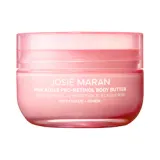
| Josie MaranPro-Retinol For AllYOUR PRODUCT | Josie MaranPink Algae Pro-Retinol Body Butter for Anti-Aging and KP | NaturiumBio-Lipid Restoring Body Lotion | Drunk ElephantSili Body Lotion | |
|---|---|---|---|---|
| Match | — | 59% | 56% | 52% |
| Price | — | $69.00 | $14.88 | $18.20 |
| Shared key ingredients | — | 11 of 21 | 8 of 21 | 8 of 21 |
| Key difference | — | Gluconolactone | Niacinamide | Ceramide Eop |
| Irritancy | High | Medium | Medium | Medium |
| Drying alcohol | — | — | — | — |
| View product | Shop | Shop | Shop |


More alternatives: Mesoestetic Fast Skin RepairToo Cool For School Egg Mellow Body Butter
Product summary
"Josie Maran Cosmetics - Pro-Retinol For All" could be helpful for: Moisturizing, but its actives are not the most effective or are not well-studied.
Ingredient callouts
- Humectants (glycerin 0.25% - 0.45%, fructose 0.20% - 0.35%, sodium hyaluronate 0.15% - 0.30%, biosaccharide gum-1 0.15% - 0.30% and glycerin 3.00% - 3.60%). These ingredients help attract water to the upper layer of the skin and improve the skin hydration.
Price
The product retails for 35.00$ in the United States.
For a detailed price comparison: click here.
Sources cited in this review
Every concentration estimate and effectiveness label is anchored to one of these 48 studies and safety reviews.
- 1
- 2
- 3Safety Assessment of Alkyl Esters as Used in Cosmeticscir-safety.org
- 4
- 5
- 6Effect of topically applied lipids on surfactant-irritated skinonlinelibrary.wiley.com

Affiliate links · As an Amazon Associate, WIMJ earns from qualifying purchases.