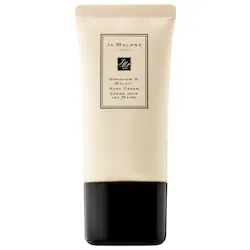
Jo Malone London Geranium & Walnut Hand Cream
Works for
1 of 1 advertised claim delivered
Moisturizing26 ingredients credited for this claimStrong support
“This lightweight, delicately scented formula with apricot kernel oil absorbs quickly, leaving hands moisturized.”
This product can help improve hydration of the skin with the two types of ingredients.
The first type is called “humectants”:
these ingredients help attract water.
When humectants are on the surface of the skin, they “pull in” the moisture from the outside environment, or from
within deeper layers of the skin. The following ingredients in this product do the job:
faex, glycerin.
This product also contains ingredients called “occlusives”. They help reduce the speed with which our skin loses moisture to the outside environment. These ingredients also help soften the upper layer of the skin, so it feels less tight and nicer to the touch. The following ingredients in this product do the job: dimethicone, squalane.
The following ingredients in this product are especially good for supporting the skin barrier and helping with the hydration level: acetyl hexapeptide-8, phytosphingosine
Anti-agingNot advertised by the brand · 4 ingredients credited for this claimModerate support
This product contains acetyl hexapeptide-8. This ingredient might be able to help reduce and prevent fine lines and wrinkles, improve skin elasticity and firmness, but there is not enough evidence that it actually works.
Can it cause trouble?
Irritancy6 strong irritants: Salvia sclarea extract, Parfum + 4 more — patch-test recommendedHigh risk
Comedogenic4 ingredients rated 2 or more on the 0–5 pore-clogging scale4 flagged
User reviews
Be the first — your take helps the next person decide.
Ingredients
Filter by role to see what each ingredient is doing.
Water~45–55%
Butylene glycol~5.5–6.7%
- Irritation risk
- Low
Used to create a nice product texture and help delivery of other ingredients. Might be somewhat helpful in attracting water to the upper layer of the skin
More about Butylene glycolCoco-caprylate/caprate~4.2–5.2%
- Irritation risk
- Low
Helps to soften the upper layer of the skin without creating a greasy texture
More about Coco-caprylate/caprateStearic acid~2.7–3.4%
- Irritation risk
- Low
Helps oil and water mix together and works as an emollient
More about Stearic acidPrunus armeniaca kernel oil~2.2–2.7%
- Irritation risk
- Medium
An emollient that helps soften the skin
More about Prunus armeniaca kernel oilEthylhexyl palmitate~1.8–2.2%
- Irritation risk
- Low
- Comedogenicity
- 3/5
An emollient that helps soften the skin and create a nice product texture
More about Ethylhexyl palmitateGlycerin~1.5–1.8%
- Irritation risk
- Low
One of the best moisturizing ingredients. Naturally present in skin. It attracts water to the upper layer of the skin working as a humectant
More about GlycerinTocopheryl acetate~1.1–1.4%
- Irritation risk
- Medium
A more stable but less bio-available form of vitamin E compared to Tocopherol. Might help moisturize and protect the skin from free radicals, but mostly used in low concentrations to stabilize other ingredients.
More about Tocopheryl acetateHydrogenated polyisobutene~1–1.3%
- Irritation risk
- Low
Used to improve the product consistency and soften the upper layer of the skin
More about Hydrogenated polyisobuteneDimethicone~0.7–1.05%
- Irritation risk
- Low
A silicone that helps to reduce water loss from the surface of the skin. Can temporarily "fill in" lines and wrinkles, absorb oil, and create a nice product finish
More about DimethiconeCetyl alcohol~0.55–0.85%
- Irritation risk
- Low
A non-drying alcohol that works to soften the skin and stabilize product formulations helping oil and water mix together
More about Cetyl alcoholButyrospermum parkii butter~0.45–0.7%
- Irritation risk
- Low
- Comedogenicity
- 3/5
A great moisturising ingredient that softens the skin and reduces water loss from its upper layer. It also can be helpful in protecting skin from free radicals
More about Butyrospermum parkii butterMorus bombycis root extract~0.3–0.55%
- Irritation risk
- High
A plant extract that might contain arbutin, a compound that has skin-lightening properties. Might have some anti-oxidant activity. Is unlikely to be effective though in the concentrations typically used in skincare products
More about Morus bombycis root extractGlycyrrhiza glabra root extract~0.25–0.5%
- Irritation risk
- Medium
A plant extract that can help lighten the skin and calm down inflammation. Might be helpful in neutralizing free radicals
More about Glycyrrhiza glabra root extractScutellaria baicalensis root extract~0.25–0.4%
- Irritation risk
- High
A plant extract that might contain a compound baicalin that could be helpful in neutralizing free radicals and reducing inflammation in skin. The baicalin concentration in skincare products is often too low for an effective action. Can be used for its fragrant properties
More about Scutellaria baicalensis root extractTriticum vulgare germ extract~0.3–0.5%
- Irritation risk
- Medium
- Comedogenicity
- 3/5
Plant extract that might have moisturizing properties. Avoid if you suffer from wheat or gluten intolerance
More about Triticum vulgare germ extractHordeum vulgare extract~0.25–0.5%
- Irritation risk
- Medium
A plant extract that might have some anti-oxidant properties. Avoid if you are sensitive to gluten
More about Hordeum vulgare extractTriticum vulgare seed extract~0.2–0.4%
- Irritation risk
- Low
- Comedogenicity
- 2/5
Olea europaea fruit extract~0.25–0.4%
- Irritation risk
- Low
An emollient that helps soften the skin but is not effective for restoring its barrier function. Might be helpful to calm down inflammation
More about Olea europaea fruit extractCaffeine~0.2–0.35%
- Irritation risk
- Medium
Might be helpful in neutralizing free radicals. Can have a dehydration effect that might somewhat decrease the look of puffy eyes
More about CaffeineCholesterol~0.25–0.45%
- Irritation risk
- Low
An emollient that is naturally found in skin
More about CholesterolLinoleic acid~0.3–0.55%
- Irritation risk
- Low
An excellent emollient. Helps soften the skin, restore its barrier function, and can help to calm down inflammation. It can be helpful to prevent blemishes and clogged pores
More about Linoleic acidSalvia sclarea extract~0.15–0.3%
- Irritation risk
- High
Used as a fragrance. Can be irritating
More about Salvia sclarea extractPersea gratissima oil~0.25–0.4%
- Irritation risk
- Medium
An emollient that helps soften the skin and could be helpful in repairing its barrier function
More about Persea gratissima oilAcetyl hexapeptide-8~0.15–0.3%
- Irritation risk
- Low
A type of peptide. Peptides are excellent moisturizers and might be able support collagen production reducing fine lines and wrinkles
More about Acetyl hexapeptide-8Phytosphingosine~0.25–0.4%
- Irritation risk
- Low
A type of lipid that is naturally present in skin. It might help in repairing skin barrier function and has anti-bacterial effect
More about PhytosphingosineSodium hyaluronate~0.2–0.35%
- Irritation risk
- Low
One of the best moisturizing ingredients. Attracts water into the upper layer of the skin
More about Sodium hyaluronateSucrose~0.15–0.3%
- Irritation risk
- Low
Can help attract water to the upper layer of the skin. In crystal form, it can work as a gentle exfoliant, gentler than the salt scrub. Helps stabilize the emulsion
More about SucroseSqualane~0.25–0.45%
- Irritation risk
- Low
An oil naturally present in skin. Works as an emollient to soften the skin and form a protective layer on its surface without a greasy feeling.
More about SqualaneAcetyl glucosamine~0.15–0.3%
- Irritation risk
- Low
An effective moisturizing ingredient that also has been shown to be effective in evening out the skin tone and reducing hyperpigmentation. It can help somewhat reduce wrinkles in skin
More about Acetyl glucosaminePropylene glycol dicaprate~0.2–0.4%
- Irritation risk
- Low
An emollient that helps soften the upper layer of the skin
More about Propylene glycol dicaprateSorbitan stearate~0.2–0.35%
Trehalose~0.2–0.35%
- Irritation risk
- Low
A sugar that attracts water to the upper layer of the skin
More about TrehaloseHydrogenated lecithin~0.2–0.35%
- Irritation risk
- Low
Helps to retain moisture by creating a protective barrier on the skin. Rich in fatty acids. Improves product texture and helps with the penetration of other ingredients.
More about Hydrogenated lecithinYeast extract~0.2–0.35%
- Irritation risk
- Low
Helps attract water to the upper layer of the skin and might have some anti-oxidant and skin lightening properties. It can help calm down inflammation in skin
More about Yeast extractFaex~0.2–0.35%
- Irritation risk
- Low
Yeast extract. Helps to attract water to the upper layer of the skin
More about FaexYeast extract~0.2–0.35%
- Irritation risk
- Low
Helps attract water to the upper layer of the skin and might have some anti-oxidant and skin lightening properties. It can help calm down inflammation in skin
More about Yeast extractEthylhexylglycerin~0.2–0.35%
Sodium dehydroacetate~0.2–0.35%
Potassium hydroxide~0.2–0.35%
Carbomer~0.2–0.35%
- Irritation risk
- Low
Helps create a thicker or gel-like product texture. It is not a surfactant but can be used in gentle cleansing formulations
More about CarbomerTetrahexyldecyl ascorbate~0.2–0.35%
- Irritation risk
- Medium
Being a lipid soluble form of vitamin C, it is more stable than ascorbic acid, but still degrades quickly and needs to be stabilized in a formulation with another ingredient. It is claimed to penetrate skin better than pure vitamin C and have the the similar benefits, but solid studies of its effectiveness are lacking. Is likely to require a higher concentration in a product than pure vitamin C to be effective. It might be able to help reduce pore clogging.
More about Tetrahexyldecyl ascorbateParfum~0.15–0.25%
- Irritation risk
- High
An aromatic blend of unspecified and possibly irritating ingredients
More about ParfumDisodium edta~0.15–0.25%
Citral~0.1–0.15%
Linalool~0.1–0.2%
Citronellol~0.1–0.15%
Geraniol~0.05%
Phenoxyethanol~0.1–0.2%
- Irritation risk
- Low
A preservative. It helps prevent bacterial growth in cosmetic products
More about PhenoxyethanolIngredient list view
Water, Butylene glycol, Coco-caprylate/caprate, Stearic acid, Prunus armeniaca kernel oil, Ethylhexyl palmitate, Glycerin, Tocopheryl acetate, Hydrogenated polyisobutene, Dimethicone, Cetyl alcohol, Butyrospermum parkii butter, Morus bombycis root extract, Glycyrrhiza glabra root extract, Scutellaria baicalensis root extract, Triticum vulgare germ extract, Hordeum vulgare extract, Triticum vulgare seed extract, Olea europaea fruit extract, Caffeine, Cholesterol, Linoleic acid, Salvia sclarea extract, Persea gratissima oil, Acetyl hexapeptide-8, Phytosphingosine, Sodium hyaluronate, Sucrose, Squalane, Acetyl glucosamine, Propylene glycol dicaprate, Sorbitan stearate, Trehalose, Hydrogenated lecithin, Yeast extract, Faex, Yeast extract, Ethylhexylglycerin, Sodium dehydroacetate, Potassium hydroxide, Carbomer, Tetrahexyldecyl ascorbate, Parfum, Disodium edta, Citral, Linalool, Citronellol, Geraniol, Phenoxyethanol
Compare prices
Retailers ranked by price — lowest first.
Product summary
"Jo Malone London - Geranium & Walnut Hand Cream" has a good moisturizing formula. The formulation is based on a combination of good humectants and emollients. Both are needed to increase the skin hydration level. Acetyl hexapeptide-8, faex, glycerin, sodium hyaluronate and sucrose in this product (humectants) attract water molecules to the upper layer of the skin (the water comes from the outside air or from the deeper layers of the skin if the air is dry). Phytosphingosine, cholesterol, prunus armeniaca kernel oil, dimethicone and squalane in this product help decrease the water evoporation from the skin, so that it stays hydrated for longer. These ingredients also soften the skin and take away the feeling of tightness and dryness.
Ingredient callouts
- As a plus, this moisturizer also contains ceramides (phytosphingosine 0.25% - 0.40%). Ceramides are a type of lipids that our skin produces itself. They are a building block of the skin's barrier. Ceramides used in skincare are synthetic or extracted from plants. They work well for softening the skin surface and "patch holes" in the skin's barrier.
- We like that this moisturizer contains peptides (acetyl hexapeptide-8 0.15% - 0.30%). There are many different kind of peptides and they are naturally present in our skin. They all are a combination of amino-acids. Some of them work as natural anti-biotics, promote wound-healing and production of collagen. The science is still not settled on how effective peptides in skincare are, but it is very likely that they have a benefit. Peptides might help restore the skin barrier and fight the signs of aging. At the very least, peptides work as humectants: they attract water to the upper layer of the skin and improve its hydration.
Irritation risk
There are quite a few common irritants in this product, including ingredients without particular skin benefits. We would not recommend it for sensitive skin. We assess the overall irritancy of this moisturizer to be high. For a detailed overview of all potential irritants: click here
You can see the detailed formula review with the breakdown of all actives in the product and the full ingredient list with estimated concentrations in the tables below.
Sources cited in this review
Every concentration estimate and effectiveness label is anchored to one of these 28 studies and safety reviews.
- 1Safety Assessment of Alkyl Esters as Used in Cosmeticscir-safety.org
- 2
- 3
- 4
- 5Final Report on the Safety Assessment of Dimethicone Copolyoljournals.sagepub.com
- 6Physiological and Whitening Effects of Morus alba Extractskoreascience.or.kr

Affiliate links · As an Amazon Associate, WIMJ earns from qualifying purchases.