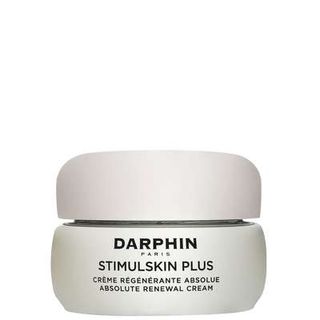
Darphin Moisturisers Stimulskin Plus Absolute Renewal Cream
Works for
1 of 1 advertised claim delivered
Moisturizing42 ingredients credited for this claimStrong support
“Moisturisers Stimulskin Plus Absolute Renewal Cream”
This product can help improve hydration of the skin with the two types of ingredients.
The first type is called “humectants”:
these ingredients help attract water.
When humectants are on the surface of the skin, they “pull in” the moisture from the outside environment, or from
within deeper layers of the skin. The following ingredients in this product do the job:
algae extract, faex.
This product also contains ingredients called “occlusives”. They help reduce the speed with which our skin loses moisture to the outside environment. These ingredients also help soften the upper layer of the skin, so it feels less tight and nicer to the touch. The following ingredients in this product do the job: butyrospermum parkii butter, dimethicone.
The following ingredients in this product are especially good for supporting the skin barrier and helping with the hydration level: acetyl glucosamine, acetyl hexapeptide-8, palmitoyl oligopeptide, phytosphingosine
Anti-agingNot advertised by the brand · 13 ingredients credited for this claimStrong support
This product can help reduce and prevent fine lines and wrinkles, improve skin elasticity and firmness because it contains acetyl glucosamine.
These ingredients in the product can also be helpful, even though there is less evidence for their effectiveness: acetyl hexapeptide-8, arabidopsis thaliana extract, creatine, palmitoyl oligopeptide.
Keep in mind that it typically takes at least 6 weeks to notice any results because the changes that are needed to improve fine lines and elasticity happen in the deeper layers of the skin. No topical anti-aging product can “erase” wrinkles or fully reverse signs of aging.
Evens skin toneNot advertised by the brand · 9 ingredients credited for this claimStrong support
This product can help reduce hypepigmentation and even out the skin tone because it contains the following effective ingredients: acetyl glucosamine
The following ingredient (ingredients) in this product might be helpful, but there is no evidence to confirm that it actually can help even out the skin tone: glycine soja protein, morus nigra root extract.
Keep in mind that you would need to apply any topical skincare targetted at hypigmentation consistently for a couple of months to get a result. No topical skincare product can help get rid of hyperpigmentation (including post-acne marks and age spots) instantly.
Anti-oxidationNot advertised by the brand · 22 ingredients credited for this claimModerate support
This product contains antioxidants (creatine, decarboxy carnosine hcl) that might be able to help neutralize free radicals in skin to lessen the damage it gets from the UV light (sun). There is not enough evidence to confirm their effectiveness in skin though.
Can it cause trouble?
Irritancy5 strong irritants: Parfum, Citronellol + 3 more — patch-test recommendedHigh risk
Comedogenic5 ingredients rated 2 or more on the 0–5 pore-clogging scale5 flagged


User reviews
Be the first — your take helps the next person decide.
Ingredients
Filter by role to see what each ingredient is doing.
Water~45–55%
Cyclopentasiloxane~6.2–7.6%
- Irritation risk
- Low
A silicone that helps improve the product texture and spreadability. Can absorb oil creating a short-term mattifying effect on the skin
More about CyclopentasiloxaneButyrospermum parkii butter~4.6–5.6%
- Irritation risk
- Low
- Comedogenicity
- 3/5
A great moisturising ingredient that softens the skin and reduces water loss from its upper layer. It also can be helpful in protecting skin from free radicals
More about Butyrospermum parkii butterCaprylic/capric/myristic/stearic triglyceride~3.3–4%
- Irritation risk
- Low
Helps to soften the upper layer of the skin
More about Caprylic/capric/myristic/stearic triglycerideDimethicone~2.5–3.1%
- Irritation risk
- Low
A silicone that helps to reduce water loss from the surface of the skin. Can temporarily "fill in" lines and wrinkles, absorb oil, and create a nice product finish
More about DimethiconeButylene glycol~2–2.4%
- Irritation risk
- Low
Used to create a nice product texture and help delivery of other ingredients. Might be somewhat helpful in attracting water to the upper layer of the skin
More about Butylene glycolDi-c12-15 alkyl fumarate~1.7–2.1%
- Irritation risk
- Medium
Used to soften the upper layer of the skin and create a nice product texture
More about Di-c12-15 alkyl fumarateSteareth-2~1.4–1.7%
Propanediol~1.2–1.5%
- Irritation risk
- Low
Acts as a solvent for other ingredients. Speeds up the absorption of other ingredients into the skin
More about PropanediolStearyl alcohol~1–1.3%
- Irritation risk
- Low
An emollient that helps soften the skin
More about Stearyl alcoholGlyceryl stearate~0.7–1.1%
- Irritation risk
- Low
An emollient that softens the skin and forms a protective layer on its surface. Helps water and oil mix together
More about Glyceryl stearatePhytosteryl/octyldodecyl lauroyl glutamate~0.6–0.9%
- Irritation risk
- Low
A mix of amino acids and plant-based lipids. Helps to soften the upper layer of the skin and reduce water loss over time
More about Phytosteryl/octyldodecyl lauroyl glutamateYeast extract~0.5–0.75%
- Irritation risk
- Low
Helps attract water to the upper layer of the skin and might have some anti-oxidant and skin lightening properties. It can help calm down inflammation in skin
More about Yeast extractFaex~0.45–0.65%
- Irritation risk
- Low
Yeast extract. Helps to attract water to the upper layer of the skin
More about FaexYeast extract~0.4–0.65%
- Irritation risk
- Low
Helps attract water to the upper layer of the skin and might have some anti-oxidant and skin lightening properties. It can help calm down inflammation in skin
More about Yeast extractSteareth-21~0.5–0.75%
Sucrose~0.3–0.6%
- Irritation risk
- Low
Can help attract water to the upper layer of the skin. In crystal form, it can work as a gentle exfoliant, gentler than the salt scrub. Helps stabilize the emulsion
More about SucroseScutellaria baicalensis root extract~0.3–0.55%
- Irritation risk
- High
A plant extract that might contain a compound baicalin that could be helpful in neutralizing free radicals and reducing inflammation in skin. The baicalin concentration in skincare products is often too low for an effective action. Can be used for its fragrant properties
More about Scutellaria baicalensis root extractGentiana lutea root extract~0.3–0.55%
- Irritation risk
- Medium
A plant extract that can help strengthen the skin barrier function and improve skin moisture levels
More about Gentiana lutea root extractHydrolyzed rice bran extract~0.25–0.5%
- Irritation risk
- Low
A plant extract that might contain an active compound orthosilicic acid that could be helpful to regulate the level of pigment in skin, but solid research is lacking
More about Hydrolyzed rice bran extractPalmaria palmata extract~0.25–0.5%
- Irritation risk
- Low
- Comedogenicity
- 3/5
Red algae extract that helps attract water to the upper layer of the skin
More about Palmaria palmata extractMorus nigra root extract~0.25–0.45%
- Irritation risk
- Medium
A plant extract that might help neutralize free radicals in skin and have some skin-lightening effect, but good evidence is missing
More about Morus nigra root extractSolanum lycopersicum fruit/leaf/stem extract~0.25–0.4%
- Irritation risk
- Low
Anogeissus leiocarpus bark extract~0.25–0.45%
- Irritation risk
- High
A tree bark extract that has antibacterial properties and might have an anti-oxidant effect. Its effectiveness in skin has not been studied
More about Anogeissus leiocarpus bark extractCrithmum maritimum extract~0.2–0.4%
- Irritation risk
- Low
- Comedogenicity
- 3/5
An algae extract that might have anti-oxidant properties
More about Crithmum maritimum extractBoswellia serrata extract~0.25–0.45%
- Irritation risk
- Low
Vitis vinifera fruit extract~0.25–0.4%
- Irritation risk
- Medium
A plant extract that helps attract water to the upper layer of the skin. It might be helpful in neutralizing free radicals in skin, but is less potent than the extract from the seeds
More about Vitis vinifera fruit extractArabidopsis thaliana extract~0.25–0.45%
- Irritation risk
- Medium
Plant extract that might be helpful in repairing sun damage but evidence of effectiveness in skin are lacking
More about Arabidopsis thaliana extractChamomilla recutita flower extract~0.25–0.4%
- Irritation risk
- High
Plant extract that can have healing and anti-inflammatory properties. It is a potential allergen and can be irritating
More about Chamomilla recutita flower extractPrunus amygdalus dulcis seed extract~0.25–0.4%
- Irritation risk
- Low
Almond extract (oil) - helps soften the upper layer of the skin
More about Prunus amygdalus dulcis seed extractSigesbeckia orientalis extract~0.2–0.4%
- Irritation risk
- Medium
A plant extract that can contain an anti-inflammatory compound
More about Sigesbeckia orientalis extractBifida ferment lysate~0.25–0.4%
- Irritation risk
- Low
Consists of remains of dead yeast bacteria cells. Helps to hydrate the skin and reduce irritation. Might has some anti-oxidant effect
More about Bifida ferment lysateCaffeine~0.25–0.45%
- Irritation risk
- Medium
Might be helpful in neutralizing free radicals. Can have a dehydration effect that might somewhat decrease the look of puffy eyes
More about CaffeineCreatine~0.25–0.4%
- Irritation risk
- Low
Can support skin's ability to neutralize free radicals and produce collagen, though further research is needed to confirm effectiveness
More about CreatineAcetyl glucosamine~0.25–0.4%
- Irritation risk
- Low
An effective moisturizing ingredient that also has been shown to be effective in evening out the skin tone and reducing hyperpigmentation. It can help somewhat reduce wrinkles in skin
More about Acetyl glucosamineHydrolyzed rice protein~0.25–0.5%
- Irritation risk
- Low
Helps attract water to the upper layer of the skin. Might have some anti-oxidant properties
More about Hydrolyzed rice proteinAlgae extract~0.35–0.6%
- Irritation risk
- Low
- Comedogenicity
- 3/5
Plant extract that helps the skin to attract water and make it more smooth for touch. Also shows promise of anti-aging properties, but research is not extensive yet
More about Algae extractCholesterol~0.3–0.6%
- Irritation risk
- Low
An emollient that is naturally found in skin
More about CholesterolCamellia sinensis leaf extract~0.3–0.55%
- Irritation risk
- Low
Can contain potent anti-oxidant compounds (abbreviated ECG, GCG, EGC, and EGCG) that might help protect the skin from free radicals. Can help calm down inflammation and has some anti-bacterial properties. Unfortunately, these antioxidants are unstable and lose their effectiveness very quickly in products. The concentration of the antioxidant compounds in the extract also tends to be low to be effective in topical formulation
More about Camellia sinensis leaf extractAscorbyl glucoside~0.25–0.5%
- Irritation risk
- Medium
A vitamin C derivative that is more stable but less potent than pure form of vitamin C. Has a potential to boost collagen production, nutralise free radicals and reduce hyperpigmentation, but the required concentration is likely to be much higher than for the pure form of vitamin C, limiting the ingredient's effectiveness in products
More about Ascorbyl glucosideLactobacillus ferment~0.25–0.5%
- Irritation risk
- Low
A fermentation product created by bacteria Lactobacillus. The fermented product has anti-bacterial properties and might be helpful in calming down inflammation, but studies are lacking. Helps attract water to the upper layer of the skin. Can be used as a preservative
More about Lactobacillus fermentGlycerin~0.3–0.55%
- Irritation risk
- Low
One of the best moisturizing ingredients. Naturally present in skin. It attracts water to the upper layer of the skin working as a humectant
More about GlycerinDecarboxy carnosine hcl~0.25–0.5%
- Irritation risk
- Low
Might be able to protect the skin from free radicals, but further evidence of effectiveness is needed
More about Decarboxy carnosine hclCaprylic/capric triglyceride~0.35–0.65%
- Irritation risk
- Medium
A good mix of fatty acids that forms a protective layer on the skin. Improves the shelf life of products. Derived from coconut and glycerin
More about Caprylic/capric triglycerideMicrococcus lysate~0.25–0.5%
- Irritation risk
- Low
Consists of remains of dead bacteria cells. Is likely helpful in attracting water to the upper layer of the skin. Might be helpful in reducing inflammation and neutralizing free radicals in skin. It is claimed to be a "DNA repair enzyme"
More about Micrococcus lysateSodium rna~0.25–0.5%
- Irritation risk
- Low
Is claimed to have anti-aging properties, but research about its effect in topical application is missing
More about Sodium rnaIsohexadecane~0.45–0.65%
- Irritation risk
- Low
Improves the texture of the product and helps soften the skin. Helps oil and water mix together and can be used as a cleansing agent
More about IsohexadecaneAcetyl hexapeptide-8~0.25–0.5%
- Irritation risk
- Low
A type of peptide. Peptides are excellent moisturizers and might be able support collagen production reducing fine lines and wrinkles
More about Acetyl hexapeptide-8Tribehenin~0.3–0.55%
- Irritation risk
- Low
Used to create a thicker product consistency and soften the upper layer of the skin
More about TribeheninTocopheryl acetate~0.3–0.55%
- Irritation risk
- Medium
A more stable but less bio-available form of vitamin E compared to Tocopherol. Might help moisturize and protect the skin from free radicals, but mostly used in low concentrations to stabilize other ingredients.
More about Tocopheryl acetatePropylene glycol dicaprate~0.3–0.6%
- Irritation risk
- Low
An emollient that helps soften the upper layer of the skin
More about Propylene glycol dicapratePhytosphingosine~0.35–0.6%
- Irritation risk
- Low
A type of lipid that is naturally present in skin. It might help in repairing skin barrier function and has anti-bacterial effect
More about PhytosphingosineSodium hyaluronate~0.3–0.5%
- Irritation risk
- Low
One of the best moisturizing ingredients. Attracts water into the upper layer of the skin
More about Sodium hyaluronateTrehalose~0.3–0.5%
- Irritation risk
- Low
A sugar that attracts water to the upper layer of the skin
More about TrehaloseLecithin~0.3–0.6%
- Irritation risk
- Low
Used mostly for creating emulsions - helping oil and water mix together. Helps soften the upper layer of the skin
More about LecithinPalmitoyl oligopeptide~0.4–0.6%
- Irritation risk
- Low
A type of peptide. Peptides are excellent moisturizers and might be able support collagen production reducing fine lines and wrinkles
More about Palmitoyl oligopeptideGlycine soja protein~0.3–0.6%
- Irritation risk
- Low
A plant extract that helps to attract water to the upper layer of the skin and soften it. It might be helpful in neutralizing free radicals. It might be somewhat helpful for evening out the skin tone. It might be able to support elastin production but solid research is lacking
More about Glycine soja proteinPotassium cetyl phosphate~0.3–0.6%
- Irritation risk
- Medium
Helps oil and water mix together
More about Potassium cetyl phosphateHordeum distichon extract~0.3–0.55%
- Irritation risk
- Low
Hordeum vulgare extract~0.3–0.55%
- Irritation risk
- Medium
A plant extract that might have some anti-oxidant properties. Avoid if you are sensitive to gluten
More about Hordeum vulgare extractGlyceryl polymethacrylate~0.3–0.6%
- Irritation risk
- Low
Used to create a nice product texture
More about Glyceryl polymethacrylatePolysorbate 80~0.3–0.6%
Ethylhexylglycerin~0.3–0.55%
Acrylates/c10-30 alkyl acrylate crosspolymer~0.3–0.55%
- Irritation risk
- Medium
Maintains the texture of skincare products. Allows the product to spread evenly. Helps oil and water mix together
More about Acrylates/c10-30 alkyl acrylate crosspolymerPolysilicone-11~0.3–0.6%
- Irritation risk
- Low
A silicone that forms a light film on the skin surface helping to bind water and temporarily absorb oils creating a matt and powdery feel
More about Polysilicone-11Caprylyl glycol~0.3–0.6%
- Irritation risk
- Medium
Helps preserve products and creates a nice product texture
More about Caprylyl glycolSodium benzoate~0.25–0.5%
Acrylamide/sodium acryloyldimethyltaurate copolymer~0.3–0.55%
- Irritation risk
- Low
Helps water and oil mix together and create gel-like textures
More about Acrylamide/sodium acryloyldimethyltaurate copolymerHydrogenated vegetable oil~0.3–0.55%
- Irritation risk
- Low
- Comedogenicity
- 2/5
An oil from a mixture of different vegetables. Helps soften the upper layer of the skin
More about Hydrogenated vegetable oilPeg-8~0.3–0.55%
- Irritation risk
- Medium
Used to create a nice product consistency
More about Peg-8Tetrahexyldecyl ascorbate~0.3–0.5%
- Irritation risk
- Medium
Being a lipid soluble form of vitamin C, it is more stable than ascorbic acid, but still degrades quickly and needs to be stabilized in a formulation with another ingredient. It is claimed to penetrate skin better than pure vitamin C and have the the similar benefits, but solid studies of its effectiveness are lacking. Is likely to require a higher concentration in a product than pure vitamin C to be effective. It might be able to help reduce pore clogging.
More about Tetrahexyldecyl ascorbateSodium hydroxide~0.3–0.5%
Parfum~0.25–0.45%
- Irritation risk
- High
An aromatic blend of unspecified and possibly irritating ingredients
More about ParfumSilica~0.45–0.65%
Disodium edta~0.25–0.45%
Phenoxyethanol~0.25–0.5%
- Irritation risk
- Low
A preservative. It helps prevent bacterial growth in cosmetic products
More about PhenoxyethanolCitronellol~0.2–0.4%
Limonene~0.2–0.35%
- Irritation risk
- High
A common frangrance that can easily irritate skin, especially if exposed to air, light or heat
More about LimoneneGeraniol~0.2–0.35%
Alpha-isomethyl ionone~0.15–0.3%
- Irritation risk
- High
A fragrance. Potential allergen and can be irritating
More about Alpha-isomethyl iononeMica~0.2–0.4%
- Irritation risk
- Low
Creates an illusion of smoother and more radiant skin tone. Adds shimmer to the skin by reflecting light
More about MicaCi 14700~0.15–0.3%
Ci 19140~0.15–0.3%
Titanium dioxide~0.1–0.25%
- Irritation risk
- Low
Works as a UV filter when used in high concentrations. It is photostable and is effective mostly against the UVB light, with some protection in the UVA range. In small concentrations, used for its ability to improve the color of cosmetic products. Is usually well tolerated by the skin
More about Titanium dioxideCi 77891~0.1–0.2%
- Irritation risk
- Low
Ingredient list view
Water, Cyclopentasiloxane, Butyrospermum parkii butter, Caprylic/capric/myristic/stearic triglyceride, Dimethicone, Butylene glycol, Di-c12-15 alkyl fumarate, Steareth-2, Propanediol, Stearyl alcohol, Glyceryl stearate, Phytosteryl/octyldodecyl lauroyl glutamate, Yeast extract, Faex, Yeast extract, Steareth-21, Sucrose, Scutellaria baicalensis root extract, Gentiana lutea root extract, Hydrolyzed rice bran extract, Palmaria palmata extract, Morus nigra root extract, Solanum lycopersicum fruit/leaf/stem extract, Anogeissus leiocarpus bark extract, Crithmum maritimum extract, Boswellia serrata extract, Vitis vinifera fruit extract, Arabidopsis thaliana extract, Chamomilla recutita flower extract, Prunus amygdalus dulcis seed extract, Sigesbeckia orientalis extract, Bifida ferment lysate, Caffeine, Creatine, Acetyl glucosamine, Hydrolyzed rice protein, Algae extract, Cholesterol, Camellia sinensis leaf extract, Ascorbyl glucoside, Lactobacillus ferment, Glycerin, Decarboxy carnosine hcl, Caprylic/capric triglyceride, Micrococcus lysate, Sodium rna, Isohexadecane, Acetyl hexapeptide-8, Tribehenin, Tocopheryl acetate, Propylene glycol dicaprate, Phytosphingosine, Sodium hyaluronate, Trehalose, Lecithin, Palmitoyl oligopeptide, Glycine soja protein, Potassium cetyl phosphate, Hordeum distichon extract, Hordeum vulgare extract, Glyceryl polymethacrylate, Polysorbate 80, Ethylhexylglycerin, Acrylates/c10-30 alkyl acrylate crosspolymer, Polysilicone-11, Caprylyl glycol, Sodium benzoate, Acrylamide/sodium acryloyldimethyltaurate copolymer, Hydrogenated vegetable oil, Peg-8, Tetrahexyldecyl ascorbate, Sodium hydroxide, Parfum, Silica, Disodium edta, Phenoxyethanol, Citronellol, Limonene, Geraniol, Alpha-isomethyl ionone, Mica, Ci 14700, Ci 19140, Titanium dioxide, Ci 77891
Compare prices
Retailers ranked by price — lowest first.
Worth comparing, line by line.
Match % combines shared ingredients, the first five ingredients, shared actives and hero ingredients, irritancy (lower counts in the alternative's favour), texture and body area. Only products in the same routine step are compared.
| DarphinMoisturisers Stimulskin Plus Absolute Renewal CreamYOUR PRODUCT | Lab Series For MenAge Rescue Water-Charged Gel Cream | Lab Series Skincare for MenLab Series Age Rescue+ Water Charged Gel Cream | CliniqueFor Men Anti-Age Moisturizer | |
|---|---|---|---|---|
| Match | — | 54% | 54% | 51% |
| Price | $156.00 | $55.00−$101.00 | $19.00−$137.00 | $37.02−$118.98 |
| Shared key ingredients | — | 14 of 29 | 14 of 29 | 7 of 29 |
| Key difference | — | Urea | Urea | Palmitoyl Hexapeptide-12 |
| Irritancy | High | Medium | Medium | Low |
| Drying alcohol | — | — | — | — |
| View product | Shop | Shop | Shop |


Product summary
Based on the ingredient list, "Darphin - Moisturisers Stimulskin Plus Absolute Renewal Cream" can work well for skin moisturization. To work well, any moisturizer needs to include a combination of water-binding and emollient ingredients. Darphin - Moisturisers Stimulskin Plus Absolute Renewal Cream ticks this box. Acetyl glucosamine, acetyl hexapeptide-8, algae extract, faex and glycerin in this product (humectants) attract water molecules to the upper layer of the skin (the water comes from the outside air or from the deeper layers of the skin if the air is dry). Phytosphingosine, algae extract, cholesterol, phytosteryl/octyldodecyl lauroyl glutamate and butyrospermum parkii butter in this product help decrease the water evoporation from the skin, so that it stays hydrated for longer. These ingredients also soften the skin and take away the feeling of tightness and dryness.
Ingredient callouts
- Another benefit is that this moisturizer contain ceramides (phytosphingosine 0.35% - 0.60%). Ceramides are an important part of our natural skin barrier. The Ceramides used in skincare are synthetic or come from plants. They help soften the skin and can help "fill the gaps" in the skin barrier, keeping the skin hydrated and resilient for longer.
- This moisturizer also contains Peptides (palmitoyl oligopeptide 0.40% - 0.60% and acetyl hexapeptide-8 0.25% - 0.50%). Peptides are a very big group of ingredients. They all consist of a different combination of aminoacids. Our skin produces Peptides naturally. Some of them work as natural antibiotics, promote wound-healing and production of collagen. The scientists are still studying how effective the topical application of Peptides is, but it is very likely that they are helpful. Peptides might be able to support skin barrier restoration and even have an anti-aging benefit. At the very least, they certainly help attract water to the skin and support the hydration in this way.
Irritation risk
There are quite a few common irritants in this product, including ingredients without particular skin benefits. We would not recommend it for sensitive skin. We assess the overall irritancy of this moisturizer to be high. For a detailed overview of all potential irritants: click here
You can see the detailed formula review with the breakdown of all actives in the product and the full ingredient list with estimated concentrations in the tables below.
Price
The product retails for 163.15£ in the United Kingdom.
For a detailed price comparison: click here.
Sources cited in this review
Every concentration estimate and effectiveness label is anchored to one of these 48 studies and safety reviews.
- 1
- 2
- 3Final Report on the Safety Assessment of Dimethicone Copolyoljournals.sagepub.com
- 4
- 5
- 6

Affiliate links · As an Amazon Associate, WIMJ earns from qualifying purchases.