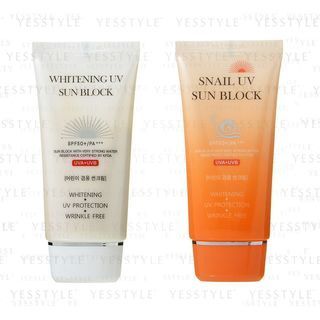
Jigott UV Sun Block SPF 50+ PA+++ - 2 Types
Works for
1 of 2 advertised claims delivered
Sun protectionSPF 50 · 2 UV filters · Partial spectrumWeak protection
This product does not offer good protection against UVA rays.
Evens skin tone3 ingredients credited for this claimModerate support
“Water-resistant sun block keeps skin moisturized while evening out skin tone and protecting it against harmful UV rays.”
The following ingredient (ingredients) in this product might be helpful, but there is no evidence to confirm that it actually works: arbutin, morus alba bark extract.
The biggest effect for evening out skin tone in this product comes from sun protection. Sun damage is the main factor causing age spots, darkening of post-acne marks and other discolorations. This is why sun protection is the best strategy for maintaining an even skin tone. We, however, do not recommend using this product as a sunscreen because the protection it offers is not strong enough).
Anti-agingNot advertised by the brand · 1 ingredient credited for this claimStrong support
This product can help reduce and prevent fine lines and wrinkles, improve skin elasticity and firmness because it contains adenosine.
Keep in mind that it typically takes at least 6 weeks to notice any results because the changes that are needed to improve fine lines and elasticity happen in the deeper layers of the skin. No topical anti-aging product can “erase” wrinkles or fully reverse signs of aging.
Anti-oxidationNot advertised by the brand · 4 ingredients credited for this claimModerate support
This product contains antioxidants (arbutin) that might be able to help neutralize free radicals in skin to lessen the damage it gets from the UV light (sun). There is not enough evidence to confirm their effectiveness in skin though.
MoisturizingNot advertised by the brand · 12 ingredients credited for this claimGood support
This product can help improve hydration of the skin with the two types of ingredients.
The first type is called “humectants”:
these ingredients help attract water.
When humectants are on the surface of the skin, they “pull in” the moisture from the outside environment, or from
within deeper layers of the skin. The following ingredients in this product do the job:
hydrolyzed collagen, butylene glycol.
This product also contains ingredients called “occlusives”. They help reduce the speed with which our skin loses moisture to the outside environment. These ingredients also help soften the upper layer of the skin, so it feels less tight and nicer to the touch. The following ingredients in this product do the job: beeswax, dimethicone.
Can it cause trouble?
Irritancy1 strong irritant: ParfumMedium risk
Comedogenic1 ingredient rated 2 or more on the 0–5 pore-clogging scale1 flagged

User reviews
Be the first — your take helps the next person decide.
Ingredients
Filter by role to see what each ingredient is doing.
Water~45–55%
Ethylhexyl methoxycinnamate~5.6–6.9%
- Irritation risk
- High
Octinoxate. When used in higher concentrations, works as a sunscreen protecting the skin from UVB rays. When used in lower concentration, helps to preserve the product formulation. Is shown to be harmful to coral reefs - consider avoiding bathing in coral reef areas when wearing a product with this ingredient. It can be irritating
More about Ethylhexyl methoxycinnamateGlyceryl stearate~3.5–4.2%
- Irritation risk
- Low
An emollient that softens the skin and forms a protective layer on its surface. Helps water and oil mix together
More about Glyceryl stearateDimethicone~3.2–3.9%
- Irritation risk
- Low
A silicone that helps to reduce water loss from the surface of the skin. Can temporarily "fill in" lines and wrinkles, absorb oil, and create a nice product finish
More about DimethiconeArbutin~2.4–3%
- Irritation risk
- Medium
Beta-arbutin. Can help to reduce hyperpigmentation and has an anti-oxidant effect when used in high enough concentration. Is less effective compared to alpha-arbutin
More about ArbutinAdenosine~1.9–2.4%
- Irritation risk
- Low
Might help improve cell turnover and reduce inflammation in skin. One study shows that the ingredients might be able to help reduce dynamic wrinkles (for example, in the corners of the eyes or on the forehead)
More about AdenosineTocopheryl acetate~1.6–2%
- Irritation risk
- Medium
A more stable but less bio-available form of vitamin E compared to Tocopherol. Might help moisturize and protect the skin from free radicals, but mostly used in low concentrations to stabilize other ingredients.
More about Tocopheryl acetateMorus alba bark extract~1.4–1.8%
- Irritation risk
- High
A plant extract that might have anti-oxidant properties and help even out skin tone, but solid evidence is lacking
More about Morus alba bark extractDisodium edta~0.5–1%
Hydrolyzed collagen~1–1.2%
- Irritation risk
- Low
A typically plant-derived compound that is supposed mimic human collagen. Cannot penetrate the skin barrier so is not particularly useful in skincare products beyond attracting water to the upper layer of the skin
More about Hydrolyzed collagenDicaprylyl carbonate~0.7–1.05%
- Irritation risk
- Low
Helps products spread more easily and works as an emollient to soften skin
More about Dicaprylyl carbonateBeeswax~0.6–0.9%
- Irritation risk
- Low
Forms a protective barrier that holds water and keeps dry skin hydrated. Keeps an emulsion from separating into its oil and liquid components, and increases the thickness of a product. Can be an allergen
More about BeeswaxTitanium dioxide~0.7–1%
- Irritation risk
- Low
Works as a UV filter when used in high concentrations. It is photostable and is effective mostly against the UVB light, with some protection in the UVA range. In small concentrations, used for its ability to improve the color of cosmetic products. Is usually well tolerated by the skin
More about Titanium dioxideButylene glycol~0.4–0.65%
- Irritation risk
- Low
Used to create a nice product texture and help delivery of other ingredients. Might be somewhat helpful in attracting water to the upper layer of the skin
More about Butylene glycolPolyglyceryl-3 methylglucose distearate~0.4–0.65%
- Irritation risk
- Medium
Helps water and oil mix together
More about Polyglyceryl-3 methylglucose distearateHydroxyethylcellulose~0.4–0.6%
- Irritation risk
- Low
Used to thicken product formulations and create gel-like textures
More about HydroxyethylcelluloseDipotassium glycyrrhizate~0.3–0.6%
- Irritation risk
- Low
A salt derived from licorice. Works as an emollient to soften the upper layer of the skin and can help calm down inflammation. Might be helpful for skin lightening
More about Dipotassium glycyrrhizateParfum~0.25–0.5%
- Irritation risk
- High
An aromatic blend of unspecified and possibly irritating ingredients
More about ParfumStearyl alcohol~0.3–0.55%
- Irritation risk
- Low
An emollient that helps soften the skin
More about Stearyl alcoholCaprylic/capric triglyceride~0.3–0.55%
- Irritation risk
- Medium
A good mix of fatty acids that forms a protective layer on the skin. Improves the shelf life of products. Derived from coconut and glycerin
More about Caprylic/capric triglycerideAloe barbadensis leaf extract~0.25–0.5%
- Irritation risk
- Medium
Traditionally used to treat sunburns, dermatitis and inflammation, but evidence for its effectiveness is lacking. The extract can contain humectants that help attract water into the skin
More about Aloe barbadensis leaf extractHexanediol~0.25–0.45%
Xanthan gum~0.2–0.4%
- Irritation risk
- Low
Used to create a thicker product consistency
More about Xanthan gumCollagen~0.2–0.35%
- Irritation risk
- Low
Cannot penetrate the skin barrier so is not particularly useful in skincare products
More about CollagenCaprylic/capric triglyceride~0.25–0.45%
- Irritation risk
- Medium
A good mix of fatty acids that forms a protective layer on the skin. Improves the shelf life of products. Derived from coconut and glycerin
More about Caprylic/capric triglycerideTitanium dioxide~0.25–0.5%
- Irritation risk
- Low
Works as a UV filter when used in high concentrations. It is photostable and is effective mostly against the UVB light, with some protection in the UVA range. In small concentrations, used for its ability to improve the color of cosmetic products. Is usually well tolerated by the skin
More about Titanium dioxideButylene glycol~0.2–0.35%
- Irritation risk
- Low
Used to create a nice product texture and help delivery of other ingredients. Might be somewhat helpful in attracting water to the upper layer of the skin
More about Butylene glycol1,2-hexanediol~0.15–0.3%
Xanthan gum~0.2–0.35%
- Irritation risk
- Low
Used to create a thicker product consistency
More about Xanthan gumAloe barbadensis leaf extract~0.25–0.45%
- Irritation risk
- Medium
Traditionally used to treat sunburns, dermatitis and inflammation, but evidence for its effectiveness is lacking. The extract can contain humectants that help attract water into the skin
More about Aloe barbadensis leaf extractMethyl hydroxyethylcellulose~0.15–0.3%
- Irritation risk
- Low
4-methylbenzylidene camphor~0.25–0.5%
Dicaprylyl carbonate~0.15–0.3%
- Irritation risk
- Low
Helps products spread more easily and works as an emollient to soften skin
More about Dicaprylyl carbonateBeeswax~0.15–0.3%
- Irritation risk
- Low
Forms a protective barrier that holds water and keeps dry skin hydrated. Keeps an emulsion from separating into its oil and liquid components, and increases the thickness of a product. Can be an allergen
More about BeeswaxCetearyl alcohol~0.15–0.25%
- Irritation risk
- Low
- Comedogenicity
- 2/5
A non-drying alcohol. Works as an emollient. Helps water and oil mix together and creates a nice product texture
More about Cetearyl alcoholIngredient list view
Water, Ethylhexyl methoxycinnamate, Glyceryl stearate, Dimethicone, Arbutin, Adenosine, Tocopheryl acetate, Morus alba bark extract, Disodium edta, Hydrolyzed collagen, Dicaprylyl carbonate, Beeswax, Titanium dioxide, Butylene glycol, Polyglyceryl-3 methylglucose distearate, Hydroxyethylcellulose, Dipotassium glycyrrhizate, Parfum, Stearyl alcohol, Caprylic/capric triglyceride, Aloe barbadensis leaf extract, Hexanediol, Xanthan gum, Collagen, Caprylic/capric triglyceride, Titanium dioxide, Butylene glycol, 1,2-hexanediol, Xanthan gum, Aloe barbadensis leaf extract, Methyl hydroxyethylcellulose, 4-methylbenzylidene camphor, Dicaprylyl carbonate, Beeswax, Cetearyl alcohol
Compare prices
Retailers ranked by price — lowest first.

Affiliate links · prices updated regularly
Worth comparing, line by line.
Match % combines shared ingredients, the first five ingredients, shared actives and hero ingredients, irritancy (lower counts in the alternative's favour), texture and body area. Only products in the same routine step are compared.
| JigottUV Sun Block SPF 50+ PA+++ - 2 TypesYOUR PRODUCT | EkelWhitening UV Sun Block SPF 50+ PA+++ | Kiehl'sUltra Light Daily UV Defense SPF50 | K-Beauty BlossomIOPE UV Shield Sun Protector XP SPF 50+ PA++++ | |
|---|---|---|---|---|
| Match | — | 57% | 56% | 52% |
| Price | $10.90 | — | $31.73+$20.83 | $25.00+$14.10 |
| Shared key ingredients | — | 8 of 9 | 4 of 9 | 4 of 9 |
| Key difference | — | Allantoin | Arginine | Niacinamide |
| Irritancy | Medium | Medium | Medium | Medium |
| SPF | SPF 50 | SPF 50 | SPF 50 | SPF 50 |
| Drying alcohol | — | — | Contains drying alcohol | — |
| View product | Shop | Shop | Shop |


Product summary
We do not recommend "Jigott - UV Sun Block SPF 50+ PA+++ - 2 Types" because it does not provide good UVA protection. UVA sun rays don't burn the skin, but they still lead to photoaging and hyperpigmentation.
Because it includes good moisturizing ingredients, it can also work as a hydrating day cream. Like all broad-spectrum sunscreens, this product has an anti-aging benefit.
Sunscreen filters
This sunscreen uses a mixture of both mineral and organic (so-called "chemical") UV filters. Here are the organic filters this product uses: octinoxate. As for the mineral filters, this sunscreen uses titanium dioxide.
Irritation risk
This formulation includes some common irritants, including ingredients that do not provide a benefit for the skin. We assess the overall irritancy of it to be medium. For a detailed overview of all potential irritants: click here
You can see the detailed formula review with the breakdown of all actives in the product and the full ingredient list with estimated concentrations in the tables below.
Price
The product retails for 10.90$ in the United States.
For a detailed price comparison: click here.
Sources cited in this review
Every concentration estimate and effectiveness label is anchored to one of these 10 studies and safety reviews.
- 1
- 2Final Report on the Safety Assessment of Dimethicone Copolyoljournals.sagepub.com
- 3Arbutin - Commentatymdedge.com
- 4TOPICAL TREATMENT OF MELASMAncbi.nlm.nih.gov
- 5
- 6

Affiliate links · As an Amazon Associate, WIMJ earns from qualifying purchases.