Works for
2 of 2 advertised claims delivered
Moisturizing27 ingredients credited for this claimStrong support
“Formulated with Deep Brightening Complex (Lycium Barbarum Fruit Extract, Euterpe Oleracea Fruit Extract, Camu Camu Extract and Hippophae Rhamnoides Oil) to nourish skin for a radiant complexion.”
This product can help improve hydration of the skin with the two types of ingredients.
The first type is called “humectants”:
these ingredients help attract water.
When humectants are on the surface of the skin, they “pull in” the moisture from the outside environment, or from
within deeper layers of the skin. The following ingredients in this product do the job:
arginine, glycerin.
This product also contains ingredients called “occlusives”. They help reduce the speed with which our skin loses moisture to the outside environment. These ingredients also help soften the upper layer of the skin, so it feels less tight and nicer to the touch. The following ingredients in this product do the job: arginine, caprylic/capric triglyceride.
The following ingredients in this product are especially good for supporting the skin barrier and helping with the hydration level: ceramide np, niacinamide, panthenol, phytosphingosine
Evens skin tone2 ingredients credited for this claimStrong support
“Infused with 69% of Hippophae Rhamnoides Fruit Extract and niacinamide to brighten skin tone.”
This product can help reduce hypepigmentation and even out the skin tone because it contains the following effective ingredients: niacinamide
Keep in mind that you would need to apply any topical skincare targetted at hypigmentation consistently for a couple of months to get a result. No topical skincare product can help get rid of hyperpigmentation (including post-acne marks and age spots) instantly.
Anti-blemishNot advertised by the brand · 5 ingredients credited for this claimStrong support
This product can help reduce breakouts and clogged pores because it contains the following ingredient: niacinamide. This ingredient is used for treating acne and can have a noticeable effect.
Anti-agingNot advertised by the brand · 7 ingredients credited for this claimStrong support
This product can help reduce and prevent fine lines and wrinkles, improve skin elasticity and firmness because it contains niacinamide.
These ingredients in the product can also be helpful, even though there is less evidence for their effectiveness: folic acid.
Keep in mind that it typically takes at least 6 weeks to notice any results because the changes that are needed to improve fine lines and elasticity happen in the deeper layers of the skin. No topical anti-aging product can “erase” wrinkles or fully reverse signs of aging.
Anti-oxidationNot advertised by the brand · 13 ingredients credited for this claimModerate support
This product contains antioxidants (lycium barbarum fruit extract, pyridoxine) that might be able to help neutralize free radicals in skin to lessen the damage it gets from the UV light (sun). There is not enough evidence to confirm their effectiveness in skin though.
Can it cause trouble?
Irritancy1 strong irritant: Retinyl palmitateMedium risk
Comedogenic1 ingredient rated 2 or more on the 0–5 pore-clogging scale1 flagged


User reviews
Be the first — your take helps the next person decide.
Ingredients
Filter by role to see what each ingredient is doing.
Hippophae rhamnoides fruit extract~22–33%
- Irritation risk
- Medium
A plant extract that might help neutralize free radicals in skin, but research on its effectiveness is lacking
More about Hippophae rhamnoides fruit extractButylene glycol~4.6–6.9%
- Irritation risk
- Low
Used to create a nice product texture and help delivery of other ingredients. Might be somewhat helpful in attracting water to the upper layer of the skin
More about Butylene glycolPentylene glycol~4.4–6.7%
- Irritation risk
- Medium
Used to preserve products, dissolve other ingredients and create a nice product texture
More about Pentylene glycolWater~3.4–5.1%
Glycerin~2.4–3.7%
- Irritation risk
- Low
One of the best moisturizing ingredients. Naturally present in skin. It attracts water to the upper layer of the skin working as a humectant
More about Glycerin1,2-hexanediol~0.35–0.85%
Niacinamide~1.3–1.9%
- Irritation risk
- Low
Is proven to be effective in reducing blemishes, evening out skin tone and helping to improve lines and wrinkles. It helps the skin to repair sun damage, calm down inflammation and keep maintain good levels of moisture. The concentration of about 2% is effective for supporting the skin barrier and evening out the skin tone. Concentration of 4-6% is better for helping with acne and balancing the sebum production
More about NiacinamideEthylhexyl palmitate~1–1.5%
- Irritation risk
- Low
- Comedogenicity
- 3/5
An emollient that helps soften the skin and create a nice product texture
More about Ethylhexyl palmitateCaprylic/capric triglyceride~0.9–1.35%
- Irritation risk
- Medium
A good mix of fatty acids that forms a protective layer on the skin. Improves the shelf life of products. Derived from coconut and glycerin
More about Caprylic/capric triglycerideMoringa oleifera seed oil~0.45–1.05%
- Irritation risk
- Medium
A plant oil that helps soften the upper layer of the skin. Is unlikely to be helpful in restoring skin barrier function due to the low content of linoleic acid
More about Moringa oleifera seed oilLycium barbarum fruit extract~0.3–0.75%
- Irritation risk
- Medium
A plant extract that can help neutralize free radicals in skin and attract water to its upper layer
More about Lycium barbarum fruit extractEuterpe oleracea fruit extract~0.2–0.75%
- Irritation risk
- Medium
A plant extract that can have some anti-oxidant effect in skin
More about Euterpe oleracea fruit extractMyrciaria dubia fruit extract~0.15–0.6%
- Irritation risk
- Medium
A plant extract that might help neutralize free radicals in skin, but research on its effectiveness is lacking
More about Myrciaria dubia fruit extractHippophae rhamnoides oil~0.15–0.7%
- Irritation risk
- High
A good emollient. Contains various ingredients including vitamins and fatty acids that could work in the skin to neutralize free radicals and minimize moisture loss - if enough of these compounds is able to penetrate the skin in an active form.
More about Hippophae rhamnoides oilCaprylyl glycol~0.15–0.65%
- Irritation risk
- Medium
Helps preserve products and creates a nice product texture
More about Caprylyl glycolBeta-glucan~0.15–0.5%
- Irritation risk
- Low
Helps attract water to the upper layer of the skin, calm down inflammation and irritation, restore the barrier function and support wound healing. It can be helpful in reducing fine lines and wrinkles
More about Beta-glucanOlea europaea fruit oil~0.15–0.6%
- Irritation risk
- Medium
An emollient that helps soften the skin but is not effective for restoring its barrier function. Might be helpful to calm down inflammation
More about Olea europaea fruit oilCarthamus tinctorius seed oil~0.15–0.6%
- Irritation risk
- Low
An emollient that helps soften the skin and might help calm down inflammation
More about Carthamus tinctorius seed oilPhytosphingosine~0.15–0.6%
- Irritation risk
- Low
A type of lipid that is naturally present in skin. It might help in repairing skin barrier function and has anti-bacterial effect
More about PhytosphingosineFolic acid~0.1–0.4%
- Irritation risk
- Low
Can help stimulate collagen production in skin. While available studies are promising, more research is needed to confirm the efficacy in skin
More about Folic acidCyanocobalamin~0.1–0.4%
- Irritation risk
- Low
Can support skin barrier function and reduce inflammation in skin
More about CyanocobalaminSodium ascorbyl phosphate~0.1–0.4%
- Irritation risk
- Medium
A stable derivative of vitamin C. It is oil-soluble which means it is more likely to penetrate the skin compared to the pure form of vitamin C (which is water-soluble), but it is less bio-available and is way less effective in stimulating collagen and reducing wrinkles compared to the pure form of vitamin C (L-ascorbic acid) and its other derivatives (for example, magnesium ascorbyl phosphate). At the same time, this vitamin C derivative has been shown in studies to be effective in reducing acne, blemishes and clogged pores. It is less irritating then the pure form of vitamin C
More about Sodium ascorbyl phosphateBiotin~0.1–0.35%
- Irritation risk
- Low
Might have some moisturising properties. Is not effective when applied topically beyond some moisturizing effect
More about BiotinThiamine hcl~0.1–0.35%
- Irritation risk
- Medium
Can help attract water to the upper layer of the skin. Is studied as a mosquito repellent
More about Thiamine hclPyridoxine~0.1–0.35%
- Irritation risk
- High
Might help neutralize free radicals in skin, but evidence of effectiveness in skin is lacking. It might be irritating
More about PyridoxineGlyceryl arachidonate~0.15–0.55%
- Irritation risk
- Medium
Helps water and oil mix together
More about Glyceryl arachidonateMangifera indica seed butter~0.1–0.35%
- Irritation risk
- Low
Helps to soften the upper layer of the skin and might have some anti-oxidant effect
More about Mangifera indica seed butterSodium acrylate/sodium acryloyldimethyl taurate copolymer~0.15–0.6%
- Irritation risk
- Low
Used to create a thicker product consistency
More about Sodium acrylate/sodium acryloyldimethyl taurate copolymerIsohexadecane~0.15–0.65%
- Irritation risk
- Low
Improves the texture of the product and helps soften the skin. Helps oil and water mix together and can be used as a cleansing agent
More about IsohexadecaneCeramide np~0.15–0.5%
- Irritation risk
- Low
A type of lipid similar to ceramides naturally present in skin. Helps to soften the upper layer of the skin and supports the skin barrier function to keep it hydrated. Can help to prevent inflammation in skin
More about Ceramide npArgania spinosa kernel oil~0.15–0.5%
- Irritation risk
- Medium
An emollient that helps soften the upper layer of the skin. Might have some weak anti-oxidant properties
More about Argania spinosa kernel oilHydrogenated lecithin~0.1–0.4%
- Irritation risk
- Low
Helps to retain moisture by creating a protective barrier on the skin. Rich in fatty acids. Improves product texture and helps with the penetration of other ingredients.
More about Hydrogenated lecithinMacadamia ternifolia seed oil~0.15–0.5%
- Irritation risk
- Medium
Plant oil from nuts that helps soften the upper layer of the skin. Contains a high concentration of oleic acid that can weaken skin's barrier function and increase water-loss while enhancing penetration of other ingredients
More about Macadamia ternifolia seed oilPolyglyceryl-10 stearate~0.1–0.4%
- Irritation risk
- Medium
Helps water and oil mix together and softens the upper layer of the skin
More about Polyglyceryl-10 stearateTocopherol~0.1–0.35%
- Irritation risk
- Low
Pure form of vitamin E. Can help moisturise and protect the skin from free radicals. Often used to help stabilise other ingredients or the formula itself
More about TocopherolHydroxypropyl guar~0.1–0.45%
- Irritation risk
- Medium
Used to create a thicker product consistency and stabilize emulsions
More about Hydroxypropyl guarPanthenol~0.1–0.35%
- Irritation risk
- Low
Helps attract water to the upper layer of the skin and can help improve skin barrier function
More about PanthenolTocopheryl acetate~0.1–0.5%
- Irritation risk
- Medium
A more stable but less bio-available form of vitamin E compared to Tocopherol. Might help moisturize and protect the skin from free radicals, but mostly used in low concentrations to stabilize other ingredients.
More about Tocopheryl acetateGlyceryl linolenate~0.15–0.6%
- Irritation risk
- Low
Helps soften the upper layer of the skin
More about Glyceryl linolenateCarbomer~0.1–0.45%
- Irritation risk
- Low
Helps create a thicker or gel-like product texture. It is not a surfactant but can be used in gentle cleansing formulations
More about CarbomerPolysorbate 80~0.1–0.5%
Ethyl hexanediol~0.1–0.4%
- Irritation risk
- High
Used to dissolve other ingredients. Might be irritating
More about Ethyl hexanediolGlyceryl acrylate/acrylic acid copolymer~0.1–0.3%
- Irritation risk
- Medium
Helps attract water to the upper layer of the skin and provide a longer-lasting hydration. Can create a thicker product consistency
More about Glyceryl acrylate/acrylic acid copolymerArginine~0.05–0.2%
- Irritation risk
- Low
An amino acid that is naturally present in skin and helps keep it hydrated. When used together with AHAs, it can reduce their irritating effect on the skin
More about ArginineSucrose distearate~0.15–0.55%
Pvm/ma copolymer~0.05–0.3%
- Irritation risk
- Low
Retinyl palmitate~0.05–0.15%
- Irritation risk
- High
Three steps removed from the active form of vitamin A - retinoic acid. To have an effect in the skin, it first needs to be converted twice to become the retinoic acid. This means it is less potent than retinol, but could also be less irritating. Once converted to the retinoic acid in the skin, it helps against all signs of aging, improves skin cell turnover and helps fight blemishes and clogged pores. However, in many cosmetic formulations, it is used in a concentration that is too low to have the full effect
More about Retinyl palmitateDisodium edta~0.05–0.1%
Ingredient list view
Hippophae rhamnoides fruit extract, Butylene glycol, Pentylene glycol, Water, Glycerin, 1,2-hexanediol, Niacinamide, Ethylhexyl palmitate, Caprylic/capric triglyceride, Moringa oleifera seed oil, Lycium barbarum fruit extract, Euterpe oleracea fruit extract, Myrciaria dubia fruit extract, Hippophae rhamnoides oil, Caprylyl glycol, Beta-glucan, Olea europaea fruit oil, Carthamus tinctorius seed oil, Phytosphingosine, Folic acid, Cyanocobalamin, Sodium ascorbyl phosphate, Biotin, Thiamine hcl, Pyridoxine, Glyceryl arachidonate, Mangifera indica seed butter, Sodium acrylate/sodium acryloyldimethyl taurate copolymer, Isohexadecane, Ceramide np, Argania spinosa kernel oil, Hydrogenated lecithin, Macadamia ternifolia seed oil, Polyglyceryl-10 stearate, Tocopherol, Hydroxypropyl guar, Panthenol, Tocopheryl acetate, Glyceryl linolenate, Carbomer, Polysorbate 80, Ethyl hexanediol, Glyceryl acrylate/acrylic acid copolymer, Arginine, Sucrose distearate, Pvm/ma copolymer, Retinyl palmitate, Disodium edta
Compare prices
Retailers ranked by price — lowest first.

Affiliate links · prices updated regularly
Worth comparing, line by line.
Match % combines shared ingredients, the first five ingredients, shared actives and hero ingredients, irritancy (lower counts in the alternative's favour), texture and body area. Only products in the same routine step are compared.
| ISNTREEТонізуючий крем C-NiacinYOUR PRODUCT | iUNIKBeta Glucan 3X Barrier Cream 50ml | flounCarrot Blending Intense Cream | Mary&MayIdebenone + Blackberry Complex Intensive Cream | |
|---|---|---|---|---|
| Match | — | 88% | 86% | 85% |
| Price | $11.22 | $23.78+$12.56 | $14.54+$3.32 | $25.97+$14.75 |
| Shared key ingredients | — | 7 of 17 | 5 of 17 | 8 of 17 |
| Key difference | — | Adenosine | Ceramide Ns | Adenosine |
| Irritancy | Medium | Low | Low | Medium |
| Drying alcohol | — | — | — | — |
| View product | Shop | Shop | Shop |


Product summary
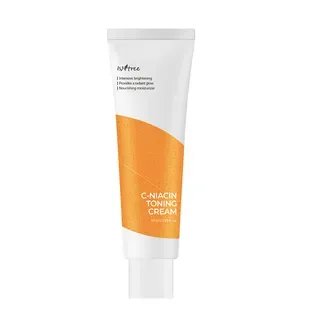
"ISNTREE - Тонізуючий крем C-Niacin" is effective for: Anti-blemish, Evens skin tone, Anti-aging and Moisturizing
Ingredient callouts
- this product includes a form of Retinoids (vitamin A) - retinyl palmitate 0.05% - 0.15%, but this type of vitamin A is not very effective. It could in theory help with fine lines and wrinkles, but the effect is most likely minimal.
- Ceramides (ceramide np 0.15% - 0.50% and phytosphingosine 0.15% - 0.60%). Ceramides are a type of lipids that our skin produces itself. They are a building block of the skin's barrier. Ceramides used in skincare are synthetic or extracted from plants. They work well for softening the skin surface and "patch holes" in the skin's barrier.
- Humectants (glyceryl acrylate/acrylic acid copolymer 0.10% - 0.30% and glycerin 2.40% - 3.70%). These ingredients help attract water to the upper layer of the skin and improve the skin hydration.
About the brand
According to Cruelty-Free Kitty "ISNTREE" is cruelty free and so is its parent company.
Price
The product retails for 12.07$ in the United States.
For a detailed price comparison: click here.
Sources cited in this review
Every concentration estimate and effectiveness label is anchored to one of these 46 studies and safety reviews.
- 1Abundance of active ingredients in sea-buckthorn oilncbi.nlm.nih.gov
- 2
- 3
- 4
- 5
- 6

Affiliate links · As an Amazon Associate, WIMJ earns from qualifying purchases.