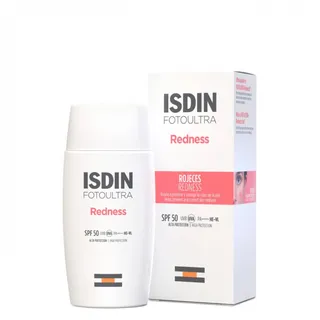
ISDIN Foto Ultra Redness SPF50

ISDIN Foto Ultra Redness SPF50

SPF 50Efficacy100/100IrritancyLow·5 UV filters

Works for

Sun protection
SPF 50 · 5 UV filters
Broad spectrum
SPF 50Broad spectrumChemical filtersNano filters

This product offers a good level of protection against both UVB and UVA rays.

This sunscreen uses organic (so-called "chemical") sunscreen filters. Organic, or "chemical" filters usually provide reliable sun protection and rarely leave a white cast. Sunscreens with organic filters can sting eyes.

This product can be considered "reef safe" because it does not contain the UV filters (oxybenzone and octinoxate) that can be harmful to coral reefs when present in the water in high concentrations.

UV spectrum
UVB290–320 nmUVA II320–340 nmUVA I340–400 nm
Octisalate
Uvinul T
Tinosorb S
Tinosorb M
Uvinul A Plus
FilterCoverageWhat it doesEst. amount
OctisalateEthylhexyl SalicylateUVBOctisalate. A UV filter. It offers some protection against the sun rays that cause sunburn (UVB), but does not protect against the most aging sun rays (UVA). It loses its effectiveness quickly when exposed to sunlight. It is an organic, or so called "chemical" sunscreen~3.5–4.3%
Uvinul TEthylhexyl TriazoneUVB Photo-stable Uvinul T. A UV filter. Effective against UVB rays. It is photostable. Can increase water resistance properties of the sunscreen. Unfortunately, not approved by the FDA (US) yet~3.2–3.9%
Tinosorb SBis-ethylhexyloxyphenol Methoxyphenyl TriazineUVBUVA Photo-stable Tinosorb S. One of the most effective broad spectrum sunscreen ingredients. Protects from both UVA and UVB rays. It is photostable. Approved by the US FDA in 2026 (listed as bemotrizinol on US labels).~2.5–3.1%
Tinosorb MMethylene Bis-benzotriazolyl TetramethylbutylphenolUVBUVA Photo-stable Tinosorb M. A UV filter. Is effective against both UVA and UVB rays. It also provides some protection against visible light. It is photostable and can also be used to improve photostability of other sunscreen ingredients. Its physical properties help to create lightweight sunscreen formulations. It can leave a slight white cast. Unfortunately, it is not approved by the FDA (US) yet~1.6–1.9%
Uvinul A PlusDiethylamino Hydroxybenzoyl Hexyl BenzoateUVA1 Photo-stable Uvinul A Plus. A new generation broad spectrum sunscreen that offers an effective protection especially in the UVA range. It is stable in formulations. Unfortunately, is not approved by the FDA (US) yet~2.1–2.6%
~ marks concentrations estimated from label position and typical use levels
Reef-safe
No oxybenzone or octinoxate — the two filters banned in Hawaii, Florida Keys and Aruba.
Evens skin tone
Niacinamide, Potassium azeloyl diglycinate
Works well

This product offers broad spectrum sun protection. It means that it can prevent hyperpigmentation and help keep the skin tone even (sun damage is the main factor causing age spots, darkening of post-acne marks and other discolorations).

NiacinamideKey activeEffect: HighIs proven to be effective in reducing blemishes, evening out skin tone and helping to improve lines and wrinkles. It helps the skin to repair sun damage, calm down inflammation and keep maintain good levels of moisture. The concentration of about 2% is effective for supporting the skin barrier and evening out the skin tone. Concentration of 4-6% is better for helping with acne and balancing the sebum production~1.4–1.7%
Potassium azeloyl diglycinateKey activeEffect: HighA derivative of azelaic acid. It is obtained by reacting the chloride of azelaic acid with two molecules of glycine (an amino acid) and potassium hydroxide. It is less studied than azelaic acid, but the available research suggests that it also can be effective in reducing skin redness, hyperpigmentation and blemishes. There are claims that it is more bio-available and more effective than azelaic acid, but no comparison study is available. Potassium azeloyl diglycinate is better soluble in water compared with azelaic acid. Because of this property, products with potassium azeloyl digclycinate can have a nicer texture~0.7–1.05%
Anti-aging
Side benefit · Niacinamide, Tocopherol
Works well

This product can help reduce and prevent fine lines and wrinkles, improve skin elasticity and firmness because it contains niacinamide.

Keep in mind that it typically takes at least 6 weeks to notice any results because the changes that are needed to improve fine lines and elasticity happen in the deeper layers of the skin. No topical anti-aging product can “erase” wrinkles or fully reverse signs of aging.

This product can also help prevent early signs of skin aging because it offers a good level of broad spectrum sun protection. Sun damage is the main cause of premature skin aging, and protecting your skin from the sun is the best anti-aging strategy.

NiacinamideKey activeEffect: HighIs proven to be effective in reducing blemishes, evening out skin tone and helping to improve lines and wrinkles. It helps the skin to repair sun damage, calm down inflammation and keep maintain good levels of moisture. The concentration of about 2% is effective for supporting the skin barrier and evening out the skin tone. Concentration of 4-6% is better for helping with acne and balancing the sebum production~1.4–1.7%
TocopherolEffect: Low, below effective dosePure form of vitamin E. Can help moisturise and protect the skin from free radicals. Often used to help stabilise other ingredients or the formula itself~0.05–0.15%
Anti-blemish
Side benefit · Niacinamide, Potassium azeloyl diglycinate
Works well

This product can help reduce breakouts and clogged pores because it contains the following ingredient: niacinamide. This ingredient is used for treating acne and can have a noticeable effect.

In addition, this product contains potassium azeloyl diglycinate. It can help in reducing blemishes, even though it is less effective.

NiacinamideHeroEffect: HighIs proven to be effective in reducing blemishes, evening out skin tone and helping to improve lines and wrinkles. It helps the skin to repair sun damage, calm down inflammation and keep maintain good levels of moisture. The concentration of about 2% is effective for supporting the skin barrier and evening out the skin tone. Concentration of 4-6% is better for helping with acne and balancing the sebum production~1.4–1.7%
Potassium azeloyl diglycinateKey activeEffect: HighA derivative of azelaic acid. It is obtained by reacting the chloride of azelaic acid with two molecules of glycine (an amino acid) and potassium hydroxide. It is less studied than azelaic acid, but the available research suggests that it also can be effective in reducing skin redness, hyperpigmentation and blemishes. There are claims that it is more bio-available and more effective than azelaic acid, but no comparison study is available. Potassium azeloyl diglycinate is better soluble in water compared with azelaic acid. Because of this property, products with potassium azeloyl digclycinate can have a nicer texture~0.7–1.05%
Moisturizing
Side benefit · Niacinamide, Coco-caprylate/caprate + 8 more
Works

The following ingredients in this product are especially good for supporting the skin barrier and helping with the hydration level: niacinamide

NiacinamideHeroEffect: HighIs proven to be effective in reducing blemishes, evening out skin tone and helping to improve lines and wrinkles. It helps the skin to repair sun damage, calm down inflammation and keep maintain good levels of moisture. The concentration of about 2% is effective for supporting the skin barrier and evening out the skin tone. Concentration of 4-6% is better for helping with acne and balancing the sebum production~1.4–1.7%
Coco-caprylate/caprateKey active· EmollientEffect: MediumHelps to soften the upper layer of the skin without creating a greasy texture~4–4.9%
Potassium azeloyl diglycinateKey activeEffect: MediumA derivative of azelaic acid. It is obtained by reacting the chloride of azelaic acid with two molecules of glycine (an amino acid) and potassium hydroxide. It is less studied than azelaic acid, but the available research suggests that it also can be effective in reducing skin redness, hyperpigmentation and blemishes. There are claims that it is more bio-available and more effective than azelaic acid, but no comparison study is available. Potassium azeloyl diglycinate is better soluble in water compared with azelaic acid. Because of this property, products with potassium azeloyl digclycinate can have a nicer texture~0.7–1.05%
Alpha-glucan oligosaccharideKey activeEffect: HighHelps attract water to the upper layer of the skin~0.65–0.95%
Polyglyceryl-6 stearateKey active· EmollientEffect: MediumHelps soften the upper layer of the skin~0.55–0.8%
C15-19 alkaneEffect: LowHelps soften the upper layer of the skin and create a nice product texture~0.95–1.15%
Pentylene glycol· EmollientEffect: LowUsed to preserve products, dissolve other ingredients and create a nice product texture~0.6–0.85%
Caprylyl glycol· Humectant, EmollientEffect: LowHelps preserve products and creates a nice product texture~0.5–0.75%
Propylene glycol· HumectantEffect: LowHelps oil and water mix together and can enhance the penetration of other ingredients into the skin. It can be irritating~0.15–0.3%
TocopherolEffect: Low, below effective dosePure form of vitamin E. Can help moisturise and protect the skin from free radicals. Often used to help stabilise other ingredients or the formula itself~0.05–0.15%

Can it cause trouble?

Irritancy
15 flagged ingredients
Low risk
We flag 15 ingredients with irritancy potential; the product's overall irritancy is low. The table lists each ingredient's own rating.
IngredientFunctionIrritationEst. amount
Decyl glucosideHelps oil and water mix together. Can be irritatingHigh~0.45–0.65%est.
Hesperidin methyl chalconeMight help neutralize free radicals in skin. Is claimed to be able to improve the appearance of undereye darkness but evidence is missing. Can be an allergen and cause irritationHigh~0.25–0.45%est.
Propylene glycolHelps oil and water mix together and can enhance the penetration of other ingredients into the skin. It can be irritatingHigh~0.15–0.3%est.
Ethylhexyl triazoneUvinul T. A UV filter. Effective against UVB rays. It is photostable. Can increase water resistance properties of the sunscreen. Unfortunately, not approved by the FDA (US) yetMedium~3.2–3.9%est.
Bis-ethylhexyloxyphenol methoxyphenyl triazineTinosorb S. One of the most effective broad spectrum sunscreen ingredients. Protects from both UVA and UVB rays. It is photostable. Approved by the US FDA in 2026 (listed as bemotrizinol on US labels).Medium~2.5–3.1%est.
Diethylamino hydroxybenzoyl hexyl benzoateUvinul A Plus. A new generation broad spectrum sunscreen that offers an effective protection especially in the UVA range. It is stable in formulations. Unfortunately, is not approved by the FDA (US) yetMedium~2.1–2.6%est.
Methylene bis-benzotriazolyl tetramethylbutylphenolTinosorb M. A UV filter. Is effective against both UVA and UVB rays. It also provides some protection against visible light. It is photostable and can also be used to improve photostability of other sunscreen ingredients. Its physical properties help to create lightweight sunscreen formulations. It can leave a slight white cast. Unfortunately, it is not approved by the FDA (US) yetMedium~1.6–1.9%est.
Pentylene glycolUsed to preserve products, dissolve other ingredients and create a nice product textureMedium~0.6–0.85%est.
1,2-hexanediolA preservativeMedium~0.45–0.7%est.
Caprylyl glycolHelps preserve products and creates a nice product textureMedium~0.5–0.75%est.
Tocopheryl acetateA more stable but less bio-available form of vitamin E compared to Tocopherol. Might help moisturize and protect the skin from free radicals, but mostly used in low concentrations to stabilize other ingredients.Medium~0.45–0.7%est.
Polysorbate 60Helps oil and water mix togetherMedium~0.4–0.6%est.
HydroxyacetophenoneUsed to increase effectiveness of preservativesMedium~0.3–0.55%est.
Citric acidCan work as an exfoliant but is typically used to adjust the product pHMedium~0.2–0.35%est.
Polyglyceryl-6 behenateHelps oil and water mix togetherMedium~0.2–0.35%est.
Comedogenic
Clean of flagged comedogenic ingredients
None flagged

User reviews

Would you recommend?
No community reviews yet.

Be the first — your take helps the next person decide.

Ingredients

Filter by role to see what each ingredient is doing.

Water~45–55%
Formula
Irritation risk
Low

Plain old water

More about Water
Propylene glycol dicaprylate/dicaprate~4.6–5.7%
Formula
Coco-caprylate/caprate~4–4.9%
Key active
Irritation risk
Low
Works for
Moisturizing

Helps to soften the upper layer of the skin without creating a greasy texture

More about Coco-caprylate/caprate
Ethylhexyl salicylate~3.5–4.3%
UV filter
Irritation risk
Low
Works for
Sun protection

Octisalate. A UV filter. It offers some protection against the sun rays that cause sunburn (UVB), but does not protect against the most aging sun rays (UVA). It loses its effectiveness quickly when exposed to sunlight. It is an organic, or so called "chemical" sunscreen

More about Ethylhexyl salicylate
Ethylhexyl triazone~3.2–3.9%
UV filterKey activeIrritant · medium
Irritation risk
Medium
Works for
Sun protection

Uvinul T. A UV filter. Effective against UVB rays. It is photostable. Can increase water resistance properties of the sunscreen. Unfortunately, not approved by the FDA (US) yet

More about Ethylhexyl triazone
Bis-ethylhexyloxyphenol methoxyphenyl triazine~2.5–3.1%
UV filterKey activeIrritant · medium
Irritation risk
Medium
Works for
Sun protection

Tinosorb S. One of the most effective broad spectrum sunscreen ingredients. Protects from both UVA and UVB rays. It is photostable. Approved by the US FDA in 2026 (listed as bemotrizinol on US labels).

More about Bis-ethylhexyloxyphenol methoxyphenyl triazine
Diethylamino hydroxybenzoyl hexyl benzoate~2.1–2.6%
UV filterKey activeIrritant · medium
Irritation risk
Medium
Works for
Sun protection

Uvinul A Plus. A new generation broad spectrum sunscreen that offers an effective protection especially in the UVA range. It is stable in formulations. Unfortunately, is not approved by the FDA (US) yet

More about Diethylamino hydroxybenzoyl hexyl benzoate
Niacinamide~1.4–1.7%
Hero · Moisturizing, Anti-blemish
Irritation risk
Low
Works for
Evens skin toneAnti-agingMoisturizingAnti-blemishReduces irritationAnti-inflammatoryAntibacterialReduces redness

Is proven to be effective in reducing blemishes, evening out skin tone and helping to improve lines and wrinkles. It helps the skin to repair sun damage, calm down inflammation and keep maintain good levels of moisture. The concentration of about 2% is effective for supporting the skin barrier and evening out the skin tone. Concentration of 4-6% is better for helping with acne and balancing the sebum production

More about Niacinamide
Methylene bis-benzotriazolyl tetramethylbutylphenol~1.6–1.9%
UV filterKey activeIrritant · medium
Irritation risk
Medium
Works for
Sun protection

Tinosorb M. A UV filter. Is effective against both UVA and UVB rays. It also provides some protection against visible light. It is photostable and can also be used to improve photostability of other sunscreen ingredients. Its physical properties help to create lightweight sunscreen formulations. It can leave a slight white cast. Unfortunately, it is not approved by the FDA (US) yet

More about Methylene bis-benzotriazolyl tetramethylbutylphenol
C15-19 alkane~0.95–1.15%
Formula
Irritation risk
Low
Works for
Moisturizing

Helps soften the upper layer of the skin and create a nice product texture

More about C15-19 alkane
Potassium azeloyl diglycinate~0.7–1.05%
Key active
Irritation risk
Low
Works for
Anti-blemishEvens skin toneAnti-inflammatoryMoisturizing

A derivative of azelaic acid. It is obtained by reacting the chloride of azelaic acid with two molecules of glycine (an amino acid) and potassium hydroxide. It is less studied than azelaic acid, but the available research suggests that it also can be effective in reducing skin redness, hyperpigmentation and blemishes. There are claims that it is more bio-available and more effective than azelaic acid, but no comparison study is available. Potassium azeloyl diglycinate is better soluble in water compared with azelaic acid. Because of this property, products with potassium azeloyl digclycinate can have a nicer texture

More about Potassium azeloyl diglycinate
Alpha-glucan oligosaccharide~0.65–0.95%
Key active
Irritation risk
Low
Works for
Moisturizing

Helps attract water to the upper layer of the skin

More about Alpha-glucan oligosaccharide
Pentylene glycol~0.6–0.85%
Irritant · medium
Irritation risk
Medium
Works for
Moisturizing

Used to preserve products, dissolve other ingredients and create a nice product texture

More about Pentylene glycol
Polyglyceryl-6 stearate~0.55–0.8%
Key active
Irritation risk
Low
Works for
Moisturizing

Helps soften the upper layer of the skin

More about Polyglyceryl-6 stearate
1,2-hexanediol~0.45–0.7%
Irritant · medium
Irritation risk
Medium

A preservative

More about 1,2-hexanediol
Caprylyl glycol~0.5–0.75%
Irritant · medium
Irritation risk
Medium
Works for
Moisturizing

Helps preserve products and creates a nice product texture

More about Caprylyl glycol
Tocopheryl acetate~0.45–0.7%
Irritant · medium
Irritation risk
Medium
Works for
Anti-oxidation

A more stable but less bio-available form of vitamin E compared to Tocopherol. Might help moisturize and protect the skin from free radicals, but mostly used in low concentrations to stabilize other ingredients.

More about Tocopheryl acetate
4-t-butylcyclohexanol~0.35–0.65%
Formula
Polysorbate 60~0.4–0.6%
Irritant · medium
Irritation risk
Medium
Works for
Cleansing

Helps oil and water mix together

More about Polysorbate 60
Decyl glucoside~0.45–0.65%
Irritant · high
Irritation risk
High
Works for
Cleansing

Helps oil and water mix together. Can be irritating

More about Decyl glucoside
Hydroxyacetophenone~0.3–0.55%
Irritant · medium
Irritation risk
Medium

Used to increase effectiveness of preservatives

More about Hydroxyacetophenone
Pentaerythrityl tetra-di-t-butyl hydroxyhydrocinnamate~0.3–0.55%
Formula
Irritation risk
Low

Used to increase stability of product formulations

More about Pentaerythrityl tetra-di-t-butyl hydroxyhydrocinnamate
Hesperidin methyl chalcone~0.25–0.45%
Irritant · high
Irritation risk
High
Works for
Anti-oxidation

Might help neutralize free radicals in skin. Is claimed to be able to improve the appearance of undereye darkness but evidence is missing. Can be an allergen and cause irritation

More about Hesperidin methyl chalcone
Sphingomonas ferment extract~0.25–0.5%
Formula
Ci 77891~0.2–0.4%
Formula
Irritation risk
Low
More about Ci 77891
Tetrasodium glutamate diacetate~0.2–0.4%
Formula
Irritation risk
Low

Helps stabilize the product formulation

More about Tetrasodium glutamate diacetate
Citric acid~0.2–0.35%
Irritant · medium
Irritation risk
Medium

Can work as an exfoliant but is typically used to adjust the product pH

More about Citric acid
Polyglyceryl-6 behenate~0.2–0.35%
Irritant · medium
Irritation risk
Medium

Helps oil and water mix together

More about Polyglyceryl-6 behenate
Mica~0.2–0.35%
Formula
Irritation risk
Low

Creates an illusion of smoother and more radiant skin tone. Adds shimmer to the skin by reflecting light

More about Mica
Propylene glycol~0.15–0.3%
Irritant · high
Irritation risk
High
Works for
Moisturizing

Helps oil and water mix together and can enhance the penetration of other ingredients into the skin. It can be irritating

More about Propylene glycol
Acrylates/beheneth-25 methacrylate copolymer~0.1–0.25%
Formula
Xanthan gum~0.1–0.2%
Formula
Irritation risk
Low
Works for
Cleansing

Used to create a thicker product consistency

More about Xanthan gum
Tin oxide~0.15–0.3%
Formula
Irritation risk
Low

A colorant that can add a pearl-like appearance to the formulation

More about Tin oxide
Tocopherol~0.05–0.15%
Formula
Irritation risk
Low
Works for
Anti-oxidationAnti-agingAnti-inflammatoryMoisturizing

Pure form of vitamin E. Can help moisturise and protect the skin from free radicals. Often used to help stabilise other ingredients or the formula itself

More about Tocopherol
Ingredient list view

Water, Propylene glycol dicaprylate/dicaprate, Coco-caprylate/caprate, Ethylhexyl salicylate, Ethylhexyl triazone, Bis-ethylhexyloxyphenol methoxyphenyl triazine, Diethylamino hydroxybenzoyl hexyl benzoate, Niacinamide, Methylene bis-benzotriazolyl tetramethylbutylphenol, C15-19 alkane, Potassium azeloyl diglycinate, Alpha-glucan oligosaccharide, Pentylene glycol, Polyglyceryl-6 stearate, 1,2-hexanediol, Caprylyl glycol, Tocopheryl acetate, 4-t-butylcyclohexanol, Polysorbate 60, Decyl glucoside, Hydroxyacetophenone, Pentaerythrityl tetra-di-t-butyl hydroxyhydrocinnamate, Hesperidin methyl chalcone, Sphingomonas ferment extract, Ci 77891, Tetrasodium glutamate diacetate, Citric acid, Polyglyceryl-6 behenate, Mica, Propylene glycol, Acrylates/beheneth-25 methacrylate copolymer, Xanthan gum, Tin oxide, Tocopherol

Compare prices

Retailers ranked by price — lowest first.

ISDIN
Price unavailable
Check

Affiliate links · As an Amazon Associate, WIMJ earns from qualifying purchases.

Worth comparing, line by line.

Match % combines shared ingredients, the first five ingredients, shared actives and hero ingredients, irritancy (lower counts in the alternative's favour), texture and body area. Only products in the same routine step are compared.

Side-by-side comparison of this product against its closest alternatives
ISDINFoto Ultra Redness SPF50YOUR PRODUCTCeraVeInvisible Hydrating Fluid Sunscreen SPF 50SCINICEnjoy Super Mild Sun Essence SPF 50+ PA++++BellflowerAvocado Moisture Sunscreen
Match—63%61%59%
Price—$18.73$9.14$14.90
Shared key ingredients—5 of 75 of 74 of 7
Key difference—Ceramide NpAdenosineAdenosine
Irritancy Low Low Low Low
SPFSPF 50SPF 50SPF 50SPF 50
Drying alcohol————
View product Shop Shop Shop

More alternatives: Beplain Clean Ocean Moisture SunscreenROUND LAB Birch Juice Moisturizing Sunscreen SPF 50+ PA++++

Cheaper alternatives? Browse formulas in the same category.
We compare ingredient profiles across our catalog — pick the closest match for your budget.
Open dupe finder

Product summary

"ISDIN - Foto Ultra Redness" is effective for: Evens skin tone, Anti-aging and Anti-blemish

This product could be helpful for: Moisturizing, but its actives are not the most effective or are not well-studied.

Sources cited in this review

Every concentration estimate and effectiveness label is anchored to one of these 18 studies and safety reviews.

  1. 1
  2. 2
  3. 3
  4. 4
  5. 5
  6. 6
ISDIN Foto Ultra Redness SPF50
ISDINFoto Ultra Redness SPF50

Affiliate links · As an Amazon Associate, WIMJ earns from qualifying purchases.

As an Amazon Associate, WIMJ earns from qualifying purchases.