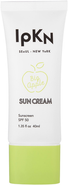
IPKN Big Apple Sun Cream SPF 50
Works for
0 of 1 advertised claim delivered
Sun protectionSPF 50 · 5 UV filters · Partial spectrumWeak protectionLow filter dose
This product does not offer good protection against UVA rays.
Anti-oxidationNot advertised by the brand · 4 ingredients credited for this claimStrong support
This product contains antioxidants (vitis vinifera seed extract) that can help neutralize free radicals in skin. By doing so, they can lessen the damage the skin gets from the UV light (sun).
MoisturizingNot advertised by the brand · 11 ingredients credited for this claimGood support
This product can help improve hydration of the skin with the two types of ingredients.
The first type is called “humectants”:
these ingredients help attract water.
When humectants are on the surface of the skin, they “pull in” the moisture from the outside environment, or from
within deeper layers of the skin. The following ingredients in this product do the job:
cyclomethicone, glycerin.
This product also contains ingredients called “occlusives”. They help reduce the speed with which our skin loses moisture to the outside environment. These ingredients also help soften the upper layer of the skin, so it feels less tight and nicer to the touch. The following ingredients in this product do the job: dimethicone, methicone.
Can it cause trouble?
Irritancy15 strong irritants: Lavandula angustifolia extract, Rosmarinus officinalis extract + 13 more — patch-test recommendedHigh risk
ComedogenicClean of flagged comedogenic ingredientsNone flagged
User reviews
Be the first — your take helps the next person decide.
Ingredients
Filter by role to see what each ingredient is doing.
Malus domestica fruit extract~22–33%
- Irritation risk
- Medium
Helps attract water to the upper layer of the skin
More about Malus domestica fruit extractLavandula angustifolia extract~2.9–4.4%
- Irritation risk
- High
Used for fragrance and contains volatile compounds that can irritate the skin
More about Lavandula angustifolia extractRosmarinus officinalis extract~4.3–6.5%
- Irritation risk
- High
Citrus aurantium dulcis seed extract~3.5–5.3%
- Irritation risk
- High
Acer saccharum extract~2.6–3.9%
- Irritation risk
- Medium
A plant extract that contains small percentage of AHAs. Is unlikely to have any skin benefit due the small concentration of the active compounds
More about Acer saccharum extractThymus vulgaris extract~1.7–2.6%
- Irritation risk
- High
Salvia officinalis extract~1.3–2%
- Irritation risk
- High
Water~1.2–1.8%
Cyclopentasiloxane~1.1–1.6%
- Irritation risk
- Low
A silicone that helps improve the product texture and spreadability. Can absorb oil creating a short-term mattifying effect on the skin
More about CyclopentasiloxaneEthylhexyl methoxycinnamate~1.2–1.8%
- Irritation risk
- High
Octinoxate. When used in higher concentrations, works as a sunscreen protecting the skin from UVB rays. When used in lower concentration, helps to preserve the product formulation. Is shown to be harmful to coral reefs - consider avoiding bathing in coral reef areas when wearing a product with this ingredient. It can be irritating
More about Ethylhexyl methoxycinnamateGlycerin~0.45–1.05%
- Irritation risk
- Low
One of the best moisturizing ingredients. Naturally present in skin. It attracts water to the upper layer of the skin working as a humectant
More about GlycerinZinc oxide~0.6–1.35%
- Irritation risk
- Low
A broad spectrum sunblock (protects from both UVA and UVB rays). Is suitable for most sensitive skins. In small concentrations, can be used as a colorant
More about Zinc oxideEthylhexyl salicylate~0.4–0.95%
- Irritation risk
- Low
Octisalate. A UV filter. It offers some protection against the sun rays that cause sunburn (UVB), but does not protect against the most aging sun rays (UVA). It loses its effectiveness quickly when exposed to sunlight. It is an organic, or so called "chemical" sunscreen
More about Ethylhexyl salicylatePeg-10 dimethicone~0.2–0.75%
- Irritation risk
- Low
A silicone that works to soften the upper layer of the skin and reduce its water loss
More about Peg-10 dimethiconeCyclomethicone~0.15–0.65%
- Irritation risk
- Low
A type of silicone that leaves a nice silky finish on the skin and can help soften its upper layer
More about CyclomethiconeTitanium dioxide~0.2–0.75%
- Irritation risk
- Low
Works as a UV filter when used in high concentrations. It is photostable and is effective mostly against the UVB light, with some protection in the UVA range. In small concentrations, used for its ability to improve the color of cosmetic products. Is usually well tolerated by the skin
More about Titanium dioxideButyloctyl salicylate~0.15–0.55%
- Irritation risk
- Medium
A synthetic ester of salicylic acid that is used to help disperse pigments and boost effectiveness of sunscreen ingredients. It is able to absorb UV light (working as an organic, or chemical filter), but is not approved as a sunscreen ingredient on its own
More about Butyloctyl salicylateDipropylene glycol~0.15–0.5%
- Irritation risk
- Low
Helps to dissolve other ingredients in a formulation. Slows down the rate of product drying
More about Dipropylene glycolDisteardimonium hectorite~0.15–0.55%
- Irritation risk
- Low
A type of clay that is used to thicken the product consistency
More about Disteardimonium hectoriteMagnesium sulfate~0.15–0.6%
Talc~0.2–0.75%
Diphenyl dimethicone/vinyl diphenyl dimethicone/silsesquioxane crosspolymer~0.1–0.45%
Pyrus malus fruit extract~0.1–0.4%
- Irritation risk
- Medium
Can have some moisturizing properties due to its sugar content
More about Pyrus malus fruit extractPhenoxyethanol~0.1–0.4%
- Irritation risk
- Low
A preservative. It helps prevent bacterial growth in cosmetic products
More about PhenoxyethanolDimethicone/vinyl dimethicone crosspolymer~0.1–0.4%
- Irritation risk
- Low
Used to stabilize product formulations and create a nice product texture
More about Dimethicone/vinyl dimethicone crosspolymerAluminum hydroxide~0.15–0.55%
- Irritation risk
- Low
Is used to add opaque (non-transparent) appearance to formulations. Can be used to coat other ingredients for even dispersion. This is a different ingredient compared to the ones used in antipersperants (aluminium chloride and aluminium chlorohydrate)
More about Aluminum hydroxideAluminum stearate~0.1–0.4%
- Irritation risk
- Medium
Used to help evenly disperse other ingredients (for example, pigment) in a formulation
More about Aluminum stearateMethicone~0.15–0.5%
- Irritation risk
- Low
A type of silicone that helps soften the upper layer of the skin and reduces the water loss from the skin surface
More about MethiconeCaprylyl glycol~0.15–0.5%
- Irritation risk
- Medium
Helps preserve products and creates a nice product texture
More about Caprylyl glycolParfum~0.1–0.35%
- Irritation risk
- High
An aromatic blend of unspecified and possibly irritating ingredients
More about ParfumGlyceryl caprylate~0.15–0.55%
- Irritation risk
- Low
An emollient that can also help water and oil mix together, as well as prevent bacteria growth in products
More about Glyceryl caprylateDimethicone~0.15–0.6%
- Irritation risk
- Low
A silicone that helps to reduce water loss from the surface of the skin. Can temporarily "fill in" lines and wrinkles, absorb oil, and create a nice product finish
More about DimethiconeOpuntia ficus-indica extract~0.1–0.4%
- Irritation risk
- Low
Polyglyceryl-6 polyricinoleate~0.1–0.45%
- Irritation risk
- Medium
Helps oil and water mix together
More about Polyglyceryl-6 polyricinoleateAnthemis nobilis flower extract~0.1–0.35%
- Irritation risk
- High
A plant extract that one one hand, can contain compounds that can help calm down skin irritation, but, on the other hand, its other compounds (especially fragrant ones) can themselves be irritating
More about Anthemis nobilis flower extractFoeniculum vulgare leaf extract~0.1–0.35%
- Irritation risk
- Low
Laurus nobilis leaf extract~0.1–0.35%
- Irritation risk
- Low
Lavandula angustifolia flower/leaf/stem extract~0.1–0.4%
Mentha piperita extract~0.1–0.5%
Rosmarinus officinalis extract~0.1–0.35%
- Irritation risk
- High
Chromium oxide greens~0.1–0.35%
- Irritation risk
- Low
Vaccinium myrtillus fruit extract~0.1–0.35%
- Irritation risk
- Medium
A plant extract that might help neutralize free radicals in skin, but research on its efficacy in skin is lacking
More about Vaccinium myrtillus fruit extractSaccharum officinarum extract~0.1–0.4%
- Irritation risk
- Low
Sugar extract that helps attract water to the upper layer of the skin
More about Saccharum officinarum extractCitrus aurantium dulcis fruit extract~0.1–0.4%
- Irritation risk
- High
A plant extract that is used as a fragrance. Can be irritating and lead to photosensitivity
More about Citrus aurantium dulcis fruit extractCitrus limon fruit extract~0.1–0.45%
- Irritation risk
- High
Used as a fragrance. Can be irritating and cause photosensitivity
More about Citrus limon fruit extractAcer saccharum extract~0.1–0.45%
- Irritation risk
- Medium
A plant extract that contains small percentage of AHAs. Is unlikely to have any skin benefit due the small concentration of the active compounds
More about Acer saccharum extractBellis perennis flower extract~0.1–0.5%
- Irritation risk
- High
A plant extract. Used as a fragrance. Can be irritating
More about Bellis perennis flower extractCitric acid~0.1–0.4%
- Irritation risk
- Medium
Can work as an exfoliant but is typically used to adjust the product pH
More about Citric acidThymus vulgaris oil~0.1–0.35%
- Irritation risk
- High
Vitis vinifera seed extract~0.1–0.45%
- Irritation risk
- Low
A plant extract that contains resveratrol and other anti-oxidant compounds that can help neutralize free radicals, reduce inflammation in skin and even out its tone. Can be also used to stabilize the product formulation
More about Vitis vinifera seed extractOcimum basilicum leaf extract~0.1–0.4%
- Irritation risk
- High
Used as a frangrance. Can be irritating. Might have some anti-bacterial properties
More about Ocimum basilicum leaf extractOriganum majorana leaf extract~0.05–0.25%
- Irritation risk
- High
Salvia officinalis leaf extract~0.1–0.45%
- Irritation risk
- High
Sage leaf extract. It can be irritating
More about Salvia officinalis leaf extractIngredient list view
Malus domestica fruit extract, Lavandula angustifolia extract, Rosmarinus officinalis extract, Citrus aurantium dulcis seed extract, Acer saccharum extract, Thymus vulgaris extract, Salvia officinalis extract, Water, Cyclopentasiloxane, Ethylhexyl methoxycinnamate, Glycerin, Zinc oxide, Ethylhexyl salicylate, Peg-10 dimethicone, Cyclomethicone, Titanium dioxide, Butyloctyl salicylate, Dipropylene glycol, Disteardimonium hectorite, Magnesium sulfate, Talc, Diphenyl dimethicone/vinyl diphenyl dimethicone/silsesquioxane crosspolymer, Pyrus malus fruit extract, Phenoxyethanol, Dimethicone/vinyl dimethicone crosspolymer, Aluminum hydroxide, Aluminum stearate, Methicone, Caprylyl glycol, Parfum, Glyceryl caprylate, Dimethicone, Opuntia ficus-indica extract, Polyglyceryl-6 polyricinoleate, Anthemis nobilis flower extract, Foeniculum vulgare leaf extract, Laurus nobilis leaf extract, Lavandula angustifolia flower/leaf/stem extract, Mentha piperita extract, Rosmarinus officinalis extract, Chromium oxide greens, Vaccinium myrtillus fruit extract, Saccharum officinarum extract, Citrus aurantium dulcis fruit extract, Citrus limon fruit extract, Acer saccharum extract, Bellis perennis flower extract, Citric acid, Thymus vulgaris oil, Vitis vinifera seed extract, Ocimum basilicum leaf extract, Origanum majorana leaf extract, Salvia officinalis leaf extract
Compare prices
Retailers ranked by price — lowest first.
Product summary
"IPKN - Big Apple Sun Cream SPF 50" does not provide enough UVA protection. UVA rays do not cause sunburn, but still damage the skin, leading to early signs of aging and pigmentation issues.
This moisturizer should also be hydrating enough to use without an additional moisturizer during the day.
Sunscreen filters
This sunscreen uses so-called "chemical", or organic UV filters (organic simply means that their molecules contain atoms of carbon). These filters typically give good sun protection and rarely leave a white cast, but they can be irritating for sensitive skin. Here are the exact UV filters in this sunscreen: butyloctyl salicylate 0.15% - 0.55% and octinoxate 1.20% - 1.80%.
Irritation risk
There are quite a few common irritants in this product, including ingredients without particular skin benefits. We would not recommend it for sensitive skin. We assess the overall irritancy of this moisturizer to be high. For a detailed overview of all potential irritants: click here
You can see the detailed formula review with the breakdown of all actives in the product and the full ingredient list with estimated concentrations in the tables below.
Sources cited in this review
Every concentration estimate and effectiveness label is anchored to one of these 20 studies and safety reviews.
- 1
- 2A review of inorganic UV filters zinc oxide and titanium dioxideonlinelibrary.wiley.com
- 3
- 4
- 5
- 6

Affiliate links · As an Amazon Associate, WIMJ earns from qualifying purchases.