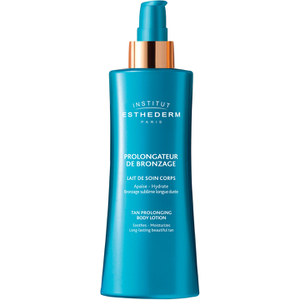
Institut Esthederm Tan Enhancing Lotion
Works for
1 of 1 advertised claim delivered
Moisturizing19 ingredients credited for this claimStrong support
“Tan Enhancing Lotion”
This product can help improve hydration of the skin with the two types of ingredients.
The first type is called “humectants”:
these ingredients help attract water.
When humectants are on the surface of the skin, they “pull in” the moisture from the outside environment, or from
within deeper layers of the skin. The following ingredients in this product do the job:
algae extract, aspartic acid.
This product also contains ingredients called “occlusives”. They help reduce the speed with which our skin loses moisture to the outside environment. These ingredients also help soften the upper layer of the skin, so it feels less tight and nicer to the touch. The following ingredients in this product do the job: helianthus annuus seed oil, algae extract.
The following ingredients in this product are especially good for supporting the skin barrier and helping with the hydration level: acetyl hexapeptide-1, lanolin, paraffinum liquidum
Anti-oxidationNot advertised by the brand · 8 ingredients credited for this claimStrong support
This product contains antioxidants (carnosine, glycyrrhetinic acid) that can help neutralize free radicals in skin. By doing so, they can lessen the damage the skin gets from the UV light (sun).
Evens skin toneNot advertised by the brand · 2 ingredients credited for this claimModerate support
The following ingredient (ingredients) in this product might be helpful, but there is no evidence to confirm that it actually works: glycyrrhetinic acid.
Anti-agingNot advertised by the brand · 6 ingredients credited for this claimModerate support
This product contains acetyl hexapeptide-1, aspartic acid, carnosine. These ingredients might be able to help reduce and prevent fine lines and wrinkles, improve skin elasticity and firmness, but there is not enough evidence that it actually works.
Can it cause trouble?
Irritancy9 strong irritants: Parfum, Limonene + 7 more — patch-test recommendedHigh risk
Comedogenic1 ingredient rated 2 or more on the 0–5 pore-clogging scale1 flagged
User reviews
Be the first — your take helps the next person decide.
Ingredients
Filter by role to see what each ingredient is doing.
Water~45–55%
Paraffinum liquidum~6.5–7.9%
- Irritation risk
- Low
Mineral oil. One of the most effective and well studied occlusive and emollient moisturizing ingredients. Helps reduce moisture loss in skin and repair skin barrier function
More about Paraffinum liquidumGlycerin~4.5–5.4%
- Irritation risk
- Low
One of the best moisturizing ingredients. Naturally present in skin. It attracts water to the upper layer of the skin working as a humectant
More about GlycerinLanolin~3.5–4.2%
- Irritation risk
- Low
Sebum of wool-bearing animals (most commonly sheep). Helps soften the upper layer of the skin and reduce the skin water loss. In rare cases could be an allergen. Not suitable for vegans
More about LanolinTriethanolamine~2.5–3%
- Irritation risk
- Medium
Used to adjust pH of the product and can help improve the product's smell
More about TriethanolamineGlyceryl stearate~2.1–2.6%
- Irritation risk
- Low
An emollient that softens the skin and forms a protective layer on its surface. Helps water and oil mix together
More about Glyceryl stearatePalmitic acid~1.8–2.2%
- Irritation risk
- Low
An emollient that is naturally present in skin and helps soften it
More about Palmitic acidPeg-100 stearate~1.6–2%
- Irritation risk
- Low
Helps oil and water mix togehter and creates a nice product texture
More about Peg-100 stearateStearic acid~1.4–1.7%
- Irritation risk
- Low
Helps oil and water mix together and works as an emollient
More about Stearic acidAscorbyl methylsilanol pectinate~1–1.2%
- Irritation risk
- Medium
A stable derivative of pectin and vitamin C. It might help neutralize free radicals in skin, but evidence of effectiveness is lacking. Helps create a thicker product consistency and stabilize the product formulation
More about Ascorbyl methylsilanol pectinateMethylpropanediol~0.75–1.15%
Carbomer~0.65–1%
- Irritation risk
- Low
Helps create a thicker or gel-like product texture. It is not a surfactant but can be used in gentle cleansing formulations
More about CarbomerPhenoxyethanol~0.6–0.9%
- Irritation risk
- Low
A preservative. It helps prevent bacterial growth in cosmetic products
More about PhenoxyethanolTrilinolein~0.55–0.85%
- Irritation risk
- Low
Chlorphenesin~0.16–0.32%
Acetyl tyrosine~0.5–0.8%
- Irritation risk
- Low
Aspartic acid~0.5–0.75%
- Irritation risk
- Low
An amino-acid that helps increase skin hydration and might help to slightly improve skin firmness, potentially reducing lines and wrinkles
More about Aspartic acidHelianthus annuus seed oil~0.5–0.8%
- Irritation risk
- Low
A great emollient due to its high linoleic acid content. One of the most effective plant oils in helping skin hydration and repairing skin barrier function
More about Helianthus annuus seed oilParfum~0.45–0.65%
- Irritation risk
- High
An aromatic blend of unspecified and possibly irritating ingredients
More about ParfumTocopheryl acetate~0.45–0.65%
- Irritation risk
- Medium
A more stable but less bio-available form of vitamin E compared to Tocopherol. Might help moisturize and protect the skin from free radicals, but mostly used in low concentrations to stabilize other ingredients.
More about Tocopheryl acetateOleoyl tyrosine~0.4–0.6%
- Irritation risk
- Low
Propylene glycol~0.35–0.65%
- Irritation risk
- High
Helps oil and water mix together and can enhance the penetration of other ingredients into the skin. It can be irritating
More about Propylene glycolLimonene~0.3–0.6%
- Irritation risk
- High
A common frangrance that can easily irritate skin, especially if exposed to air, light or heat
More about LimoneneButylene glycol~0.35–0.65%
- Irritation risk
- Low
Used to create a nice product texture and help delivery of other ingredients. Might be somewhat helpful in attracting water to the upper layer of the skin
More about Butylene glycolTrilinolenin~0.4–0.6%
- Irritation risk
- Low
Triolein~0.35–0.6%
Citrus paradisi fruit extract~0.35–0.6%
- Irritation risk
- High
Oleic acid~0.45–0.65%
- Irritation risk
- Medium
Helps soften the upper layer of the skin. At the same time, it can weaken the skin's barrier enhancing penetration of other ingredients and increasing the risk of skin dryness
More about Oleic acidPentaerythrityl tetra-di-t-butyl hydroxyhydrocinnamate~0.4–0.6%
- Irritation risk
- Low
Used to increase stability of product formulations
More about Pentaerythrityl tetra-di-t-butyl hydroxyhydrocinnamatePotassium sorbate~0.4–0.6%
Tripalmitin~0.35–0.6%
- Irritation risk
- Low
Medicago sativa extract~0.35–0.6%
- Irritation risk
- Medium
A plant extract that might help neutralize free radicals in skin
More about Medicago sativa extractTristearin~0.35–0.6%
- Irritation risk
- Low
Alcohol~0.35–0.65%
- Irritation risk
- High
Can be drying and contribute to skin irritation. Used in formulars to dissolve other ingredients, create a thinner product consistency or for its antibacterial properties
More about AlcoholHexyl cinnamal~0.3–0.6%
Ascorbyl palmitate~0.35–0.6%
- Irritation risk
- Medium
Being a lipid soluble form of vitamin C, it is more stable and can penetrate the skin better than L-Ascorbic acid. It is effective in protecting the skin from free radicals, as well as evening the skin tone, but is less effective in stimulating collagen production compared to L-Ascorbic acid.
More about Ascorbyl palmitateTris(tetramethylhydroxypiperidinol) citrate~0.35–0.65%
- Irritation risk
- Low
Linalool~0.3–0.6%
Carnosine~0.35–0.6%
- Irritation risk
- Low
A type of peptide. It attracts water to the upper layer of the skin. It can help neutralize free radicals in skin combatting the sun damage
More about CarnosineCopper gluconate~0.35–0.6%
- Irritation risk
- Medium
Typically used to stabilize the product formulations. It is a salt of polyhydroxy acid (PHA) and in larger concentrations, can help shed the dead cells from the skin surface revealing smoother skin. It can help attract water to the upper layer of the skin. Might to be helpful against acne and clogged pores. Could be helpful in neutralizing free radicals, but solid research is missing
More about Copper gluconateAlpha-isomethyl ionone~0.3–0.55%
- Irritation risk
- High
A fragrance. Potential allergen and can be irritating
More about Alpha-isomethyl iononeAlgae extract~0.45–0.7%
- Irritation risk
- Low
- Comedogenicity
- 3/5
Plant extract that helps the skin to attract water and make it more smooth for touch. Also shows promise of anti-aging properties, but research is not extensive yet
More about Algae extractDisodium adenosine triphosphate~0.35–0.6%
- Irritation risk
- Low
Benzyl benzoate~0.3–0.6%
- Irritation risk
- High
Fragrance with sweet balsamic smell. Help to preserve products and dissolve other ingredients. Could trigger allergic reactions and be irritating
More about Benzyl benzoateCitral~0.3–0.55%
Morus alba leaf extract~0.3–0.6%
- Irritation risk
- Low
Aminoethanesulfinic acid~0.3–0.6%
- Irritation risk
- Low
Glycyrrhetinic acid~0.3–0.55%
- Irritation risk
- Medium
Active compound of licorice root. Works to calm down inflammation, as an anti-oxidant, and might be helpful in lightening the skin and reducing hyperpigmentation
More about Glycyrrhetinic acidAcetyl hexapeptide-1~0.3–0.5%
- Irritation risk
- Low
A type of peptide. Peptides are excellent moisturizers and might be able support collagen production reducing fine lines and wrinkles
More about Acetyl hexapeptide-1Dextran~0.25–0.5%
- Irritation risk
- Low
Helps attract water to the most upper layer of the skin. Derived from sugar
More about DextranLecithin~0.3–0.55%
- Irritation risk
- Low
Used mostly for creating emulsions - helping oil and water mix together. Helps soften the upper layer of the skin
More about LecithinMicrococcus lysate~0.2–0.4%
- Irritation risk
- Low
Consists of remains of dead bacteria cells. Is likely helpful in attracting water to the upper layer of the skin. Might be helpful in reducing inflammation and neutralizing free radicals in skin. It is claimed to be a "DNA repair enzyme"
More about Micrococcus lysateWater~0.2–0.4%
Disodium adenosine triphosphate~0.2–0.35%
- Irritation risk
- Low
Carnosine~0.1–0.25%
- Irritation risk
- Low
A type of peptide. It attracts water to the upper layer of the skin. It can help neutralize free radicals in skin combatting the sun damage
More about CarnosineMineral salts~0.1–0.25%
- Irritation risk
- Low
Used to thicked product formulations. Might help to add minerals to the surface of the skin
More about Mineral saltsIngredient list view
Water, Paraffinum liquidum, Glycerin, Lanolin, Triethanolamine, Glyceryl stearate, Palmitic acid, Peg-100 stearate, Stearic acid, Ascorbyl methylsilanol pectinate, Methylpropanediol, Carbomer, Phenoxyethanol, Trilinolein, Chlorphenesin, Acetyl tyrosine, Aspartic acid, Helianthus annuus seed oil, Parfum, Tocopheryl acetate, Oleoyl tyrosine, Propylene glycol, Limonene, Butylene glycol, Trilinolenin, Triolein, Citrus paradisi fruit extract, Oleic acid, Pentaerythrityl tetra-di-t-butyl hydroxyhydrocinnamate, Potassium sorbate, Tripalmitin, Medicago sativa extract, Tristearin, Alcohol, Hexyl cinnamal, Ascorbyl palmitate, Tris(tetramethylhydroxypiperidinol) citrate, Linalool, Carnosine, Copper gluconate, Alpha-isomethyl ionone, Algae extract, Disodium adenosine triphosphate, Benzyl benzoate, Citral, Morus alba leaf extract, Aminoethanesulfinic acid, Glycyrrhetinic acid, Acetyl hexapeptide-1, Dextran, Lecithin, Micrococcus lysate, Water, Disodium adenosine triphosphate, Carnosine, Mineral salts
Compare prices
Retailers ranked by price — lowest first.
.png)

Product summary
Judging from the ingredient list, "Institut Esthederm - Tan Enhancing Lotion" works well for improving skin hydration This moisturizer uses a good combo of humectants and emollients. These both types of ingredients are essentials for improving the skin hydration and keeping the skin barrier healthy. Humectants in this product (algae extract, aspartic acid, carnosine, dextran and glycerin) help to increase the water content in the upper layer of the skin. (These ingredients do so by "capturing" water molecules from the outside air or from within the deeper layers of the skin). Emollients in this formulation (lanolin, paraffinum liquidum, algae extract, helianthus annuus seed oil and glyceryl stearate) help to reduce the moisture loss from the skin. They also soften the skin surface and relieve the feeling of dryness and tightness.
Ingredient callouts
- This moisturizer also contains Peptides (acetyl hexapeptide-1 0.30% - 0.50%). Peptides are a very big group of ingredients. They all consist of a different combination of aminoacids. Our skin produces Peptides naturally. Some of them work as natural antibiotics, promote wound-healing and production of collagen. The scientists are still studying how effective the topical application of Peptides is, but it is very likely that they are helpful. Peptides might be able to support skin barrier restoration and even have an anti-aging benefit. At the very least, they certainly help attract water to the skin and support the hydration in this way.
Irritation risk
There are quite a few common irritants in this product, including ingredients without particular skin benefits. We would not recommend it for sensitive skin. We assess the overall irritancy of this moisturizer to be high. For a detailed overview of all potential irritants: click here
You can see the detailed formula review with the breakdown of all actives in the product and the full ingredient list with estimated concentrations in the tables below.
Price
The product retails from 42.00£ up to 44.00£ in the United Kingdom.
For a detailed price comparison: click here.
Sources cited in this review
Every concentration estimate and effectiveness label is anchored to one of these 21 studies and safety reviews.
- 1A review on the extensive skin benefits of mineral oilncbi.nlm.nih.gov
- 2
- 3
- 4
- 5
- 6

Affiliate links · As an Amazon Associate, WIMJ earns from qualifying purchases.