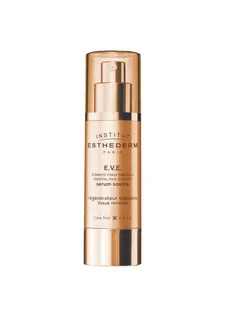
Institut Esthederm EVE ESSENTIAL VITAL ELEMENTS SOURCE SERUM
Works for
Evens skin toneNiacinamide, Ascorbic acidWorks well
“evens out skin tone, restores natural radiance and refines skin texture.”
This product can help reduce hypepigmentation and even out the skin tone because it contains the following effective ingredients: niacinamide
Keep in mind that you would need to apply any topical skincare targetted at hypigmentation consistently for a couple of months to get a result. No topical skincare product can help get rid of hyperpigmentation (including post-acne marks and age spots) instantly.
Anti-oxidationSide benefit · Thioctic acid, Pyridoxine hcl + 3 moreWorks well
This product contains antioxidants (thioctic acid) that can help neutralize free radicals in skin. By doing so, they can lessen the damage the skin gets from the UV light (sun).
MoisturizingSide benefit · Niacinamide, Isoleucine + 4 moreWorks well
This product contains good ingredients to attract water to the upper layer of the skin. These ingredients are called "humectants": sodium lactate.
When humectants are on the surface of the skin, they “pull in” the moisture from the outside environment, or from within deeper layers of the skin. If the air is dry, humectants can speed up the moisture loss from the skin. This is why it is a good idea to use another product on top of this one to help "seal in" the moisture (look for ingredients like dimethicone, squalane, oils and butters).
The following ingredients in this product are especially good for supporting the skin barrier and helping with the hydration level: niacinamide
Anti-agingSide benefit · Folic acid, Niacinamide + 3 moreWorks well
This product can help reduce and prevent fine lines and wrinkles, improve skin elasticity and firmness because it contains adenosine, niacinamide.
These ingredients in the product can also be helpful, even though there is less evidence for their effectiveness: folic acid.
Keep in mind that it typically takes at least 6 weeks to notice any results because the changes that are needed to improve fine lines and elasticity happen in the deeper layers of the skin. No topical anti-aging product can “erase” wrinkles or fully reverse signs of aging.
Anti-blemishSide benefit · Niacinamide, Salix alba bark extractWorks well
This product can help reduce breakouts and clogged pores because it contains the following ingredient: niacinamide. This ingredient is used for treating acne and can have a noticeable effect.
Can it cause trouble?
Irritancy1 strong irritant: ParfumMedium risk
ComedogenicClean of flagged comedogenic ingredientsNone flagged
User reviews
Be the first — your take helps the next person decide.
Ingredients
Filter by role to see what each ingredient is doing.
Tryptophan~26–40%
- Irritation risk
- Low
Isoleucine~3.8–5.8%
- Irritation risk
- Low
An amino acid that can help attract water to the upper layer of the skin and support skin's barrier function
More about IsoleucineSodium sulfate~3.7–5.5%
- Irritation risk
- Medium
Used to improve the product consistency and stabilize formulations
More about Sodium sulfateFolic acid~2.7–4%
- Irritation risk
- Low
Can help stimulate collagen production in skin. While available studies are promising, more research is needed to confirm the efficacy in skin
More about Folic acidFerrous sulfate~2–3%
- Irritation risk
- Low
Calcium pantothenate~1.6–2.4%
- Irritation risk
- Low
Helps support skin barrier function improving skin hydration and reducing sensitivity
More about Calcium pantothenateThiamine hcl~1.4–2%
- Irritation risk
- Medium
Can help attract water to the upper layer of the skin. Is studied as a mosquito repellent
More about Thiamine hclPyridoxine hcl~1.1–1.7%
- Irritation risk
- Medium
Might help neutralize free radicals in skin
More about Pyridoxine hclNiacinamide~0.95–1.45%
- Irritation risk
- Low
Is proven to be effective in reducing blemishes, evening out skin tone and helping to improve lines and wrinkles. It helps the skin to repair sun damage, calm down inflammation and keep maintain good levels of moisture. The concentration of about 2% is effective for supporting the skin barrier and evening out the skin tone. Concentration of 4-6% is better for helping with acne and balancing the sebum production
More about NiacinamideAscorbic acid~0.85–1.25%
- Irritation risk
- High
The most well-researched antioxidant that works in skin. Helps neutralize free radicals supporting collagen production, helping to even out the skin tone and preventing early signs of aging
More about Ascorbic acidThymidine~0.45–1.05%
- Irritation risk
- Low
Thioctic acid~0.4–1%
Riboflavin~0.3–0.75%
- Irritation risk
- Low
Sodium metasilicate~0.2–0.8%
- Irritation risk
- Low
Zinc sulfate~0.35–0.8%
Adenosine~0.2–0.7%
- Irritation risk
- Low
Might help improve cell turnover and reduce inflammation in skin. One study shows that the ingredients might be able to help reduce dynamic wrinkles (for example, in the corners of the eyes or on the forehead)
More about AdenosineGuanine~0.2–0.8%
- Irritation risk
- Low
Ribose~0.15–0.6%
- Irritation risk
- Low
Biotin~0.15–0.55%
- Irritation risk
- Low
Might have some moisturising properties. Is not effective when applied topically beyond some moisturizing effect
More about BiotinAmmonium molybdate~0.15–0.55%
- Irritation risk
- Low
Ammonium vanadate~0.15–0.5%
- Irritation risk
- Low
Copper sulfate~0.1–0.45%
- Irritation risk
- Low
Manganese chloride~0.1–0.45%
- Irritation risk
- Low
Sea salt~0.1–0.4%
- Irritation risk
- Medium
Used to thicken the product formulation and might help to add minerals to the surface of the skin. It is used in scrubs as a physical exfoliant. Can increase sensitivity to other ingredients if left on the skin or used in high concentration
More about Sea saltSodium lactate~0.1–0.4%
- Irritation risk
- Medium
Helps attract water to the upper layer of the skin. Is often used to adjust the pH level of the product
More about Sodium lactateAminoethanesulfinic acid~0.1–0.5%
- Irritation risk
- Low
Citric acid~0.1–0.35%
- Irritation risk
- Medium
Can work as an exfoliant but is typically used to adjust the product pH
More about Citric acidSodium acetate~0.1–0.35%
- Irritation risk
- Low
Leuconostoc/radish root ferment filtrate~0.1–0.3%
- Irritation risk
- Medium
A preservative that comes from radishes fermented by a bacteria. New research suggests that the preservation properties in the ingredient come from an ammonium salt that is not present naturally in radish root but used in its cultivation. Is problematic because the exact amount of the preservative agents is difficult to determine
More about Leuconostoc/radish root ferment filtrateSalix alba bark extract~0.1–0.3%
- Irritation risk
- High
A plant extract that can help neutralize free radicals in skin. It contains a compound salicin that can theoretically be converted into salicylic acid that, in turn, helps reduce inflammation in skin, but the evidence of effectiveness in skin is lacking and the extract is usually not used in a concentration that would enable an exfoliating effect
More about Salix alba bark extractPolyglyceryl-4 caprylate~0.1–0.4%
Disodium phosphate~0.05–0.2%
- Irritation risk
- Low
Helps adjust the product pH and stabilize the formulation
More about Disodium phosphateSodium benzoate~0.05–0.2%
Potassium sorbate~0.05–0.2%
Parfum~0.01–0.1%
- Irritation risk
- High
An aromatic blend of unspecified and possibly irritating ingredients
More about ParfumIngredient list view
Tryptophan, Isoleucine, Sodium sulfate, Folic acid, Ferrous sulfate, Calcium pantothenate, Thiamine hcl, Pyridoxine hcl, Niacinamide, Ascorbic acid, Thymidine, Thioctic acid, Riboflavin, Sodium metasilicate, Zinc sulfate, Adenosine, Guanine, Ribose, Biotin, Ammonium molybdate, Ammonium vanadate, Copper sulfate, Manganese chloride, Sea salt, Sodium lactate, Aminoethanesulfinic acid, Citric acid, Sodium acetate, Leuconostoc/radish root ferment filtrate, Salix alba bark extract, Polyglyceryl-4 caprylate, Disodium phosphate, Sodium benzoate, Potassium sorbate, Parfum
Compare prices
Retailers ranked by price — lowest first.

Sources cited in this review
Every concentration estimate and effectiveness label is anchored to one of these 12 studies and safety reviews.
- 1
- 2
- 3Folic acid and creatine improve the firmness of human skin in vivopubmed.ncbi.nlm.nih.gov
- 4Calcium pantothenate modulates gene expression in proliferating human dermal fibroblastsonlinelibrary.wiley.com
- 5
- 6

Affiliate links · As an Amazon Associate, WIMJ earns from qualifying purchases.