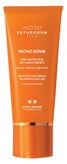
Institut Esthederm Bronz Repair Protective Anti-Wrinkle and Firming Face Care Moderate Sun
Works for
2 of 2 advertised claims delivered
Moisturizing32 ingredients credited for this claimStrong support
“Bronz Repair Protective Anti-Wrinkle and Firming Face Care Moderate Sun”
This product can help improve hydration of the skin with the two types of ingredients.
The first type is called “humectants”:
these ingredients help attract water.
When humectants are on the surface of the skin, they “pull in” the moisture from the outside environment, or from
within deeper layers of the skin. The following ingredients in this product do the job:
artemia extract, aspartic acid.
This product also contains ingredients called “occlusives”. They help reduce the speed with which our skin loses moisture to the outside environment. These ingredients also help soften the upper layer of the skin, so it feels less tight and nicer to the touch. The following ingredients in this product do the job: cera alba, helianthus annuus seed oil.
The following ingredients in this product are especially good for supporting the skin barrier and helping with the hydration level: palmitoyl tetrapeptide-7, palmitoyl tripeptide-1
Anti-aging9 ingredients credited for this claimModerate support
“Bronz Repair Protective Anti-Wrinkle and Firming Face Care Moderate Sun”
This product contains asiaticoside, aspartic acid, carnosine, creatine, palmitoyl tetrapeptide-7, palmitoyl tripeptide-1. These ingredients might be able to help reduce and prevent fine lines and wrinkles, improve skin elasticity and firmness, but there is not enough evidence that it actually works.
Anti-oxidationNot advertised by the brand · 11 ingredients credited for this claimStrong support
This product contains antioxidants (asiaticoside, carnosine, glycyrrhetinic acid) that can help neutralize free radicals in skin. By doing so, they can lessen the damage the skin gets from the UV light (sun).
The following ingredients - creatine also can have an antioxidant effect, but there is less evidence to confirm their effectiveness in skin.
Evens skin toneNot advertised by the brand · 3 ingredients credited for this claimModerate support
The following ingredient (ingredients) in this product might be helpful, but there is no evidence to confirm that it actually works: glycyrrhetinic acid.
Can it cause trouble?
Irritancy12 strong irritants: Parfum, Linalool + 10 more — patch-test recommendedHigh risk
Comedogenic1 ingredient rated 2 or more on the 0–5 pore-clogging scale1 flagged
User reviews
Be the first — your take helps the next person decide.
Ingredients
Filter by role to see what each ingredient is doing.
Water~45–55%
Dicaprylyl carbonate~4.5–5.5%
- Irritation risk
- Low
Helps products spread more easily and works as an emollient to soften skin
More about Dicaprylyl carbonateDipropylene glycol~4.3–5.3%
- Irritation risk
- Low
Helps to dissolve other ingredients in a formulation. Slows down the rate of product drying
More about Dipropylene glycolEthylhexyl methoxycrylene~3.1–3.8%
- Irritation risk
- Medium
Helps improve stability of sunscreen filters and boost their effectiveness
More about Ethylhexyl methoxycryleneGlyceryl stearate~2.3–2.9%
- Irritation risk
- Low
An emollient that softens the skin and forms a protective layer on its surface. Helps water and oil mix together
More about Glyceryl stearateGlycerin~2–2.5%
- Irritation risk
- Low
One of the best moisturizing ingredients. Naturally present in skin. It attracts water to the upper layer of the skin working as a humectant
More about GlycerinPeg-100 stearate~1.7–2.1%
- Irritation risk
- Low
Helps oil and water mix togehter and creates a nice product texture
More about Peg-100 stearateButyl methoxydibenzoylmethane~1.9–2.3%
- Irritation risk
- Medium
Avobenzone. An organic, or so-called "chemical" UV filter. Protects against both UVA and UVB rays. Needs to be combined with other filters in a formulation to be stable.
More about Butyl methoxydibenzoylmethaneCyclopentasiloxane~1.2–1.4%
- Irritation risk
- Low
A silicone that helps improve the product texture and spreadability. Can absorb oil creating a short-term mattifying effect on the skin
More about CyclopentasiloxaneCetyl alcohol~1–1.2%
- Irritation risk
- Low
A non-drying alcohol that works to soften the skin and stabilize product formulations helping oil and water mix together
More about Cetyl alcoholCera alba~0.8–1.2%
- Irritation risk
- Medium
Forms a protective barrier that holds water and keeps dry skin hydrated. Keeps an emulsion from separating into its oil and liquid components, and increases the thickness of a product. Can be an allergen
More about Cera albaMethyl methacrylate crosspolymer~0.55–0.85%
- Irritation risk
- Low
Helps thicken the product consistency
More about Methyl methacrylate crosspolymerTocopheryl acetate~0.45–0.7%
- Irritation risk
- Medium
A more stable but less bio-available form of vitamin E compared to Tocopherol. Might help moisturize and protect the skin from free radicals, but mostly used in low concentrations to stabilize other ingredients.
More about Tocopheryl acetateCreatine~0.4–0.6%
- Irritation risk
- Low
Can support skin's ability to neutralize free radicals and produce collagen, though further research is needed to confirm effectiveness
More about CreatineParfum~0.3–0.6%
- Irritation risk
- High
An aromatic blend of unspecified and possibly irritating ingredients
More about ParfumGlycyrrhetinic acid~0.3–0.6%
- Irritation risk
- Medium
Active compound of licorice root. Works to calm down inflammation, as an anti-oxidant, and might be helpful in lightening the skin and reducing hyperpigmentation
More about Glycyrrhetinic acidMannitol~0.3–0.55%
- Irritation risk
- Low
Helps to attract water to the upper layer of the skin
More about MannitolMethylpropanediol~0.3–0.55%
Oryza sativa bran oil~0.3–0.55%
- Irritation risk
- Low
Helps soften the upper layer of the skin and might have some anti-oxidant properties
More about Oryza sativa bran oilPotassium cetyl phosphate~0.25–0.5%
- Irritation risk
- Medium
Helps oil and water mix together
More about Potassium cetyl phosphateButylene glycol~0.25–0.4%
- Irritation risk
- Low
Used to create a nice product texture and help delivery of other ingredients. Might be somewhat helpful in attracting water to the upper layer of the skin
More about Butylene glycolPhenoxyethanol~0.25–0.45%
- Irritation risk
- Low
A preservative. It helps prevent bacterial growth in cosmetic products
More about PhenoxyethanolTrilinolein~0.2–0.35%
- Irritation risk
- Low
Paraffinum liquidum~0.25–0.45%
- Irritation risk
- Low
Mineral oil. One of the most effective and well studied occlusive and emollient moisturizing ingredients. Helps reduce moisture loss in skin and repair skin barrier function
More about Paraffinum liquidumChlorphenesin~0.16–0.32%
Xanthan gum~0.2–0.4%
- Irritation risk
- Low
Used to create a thicker product consistency
More about Xanthan gumAcetyl tyrosine~0.2–0.35%
- Irritation risk
- Low
Aspartic acid~0.2–0.35%
- Irritation risk
- Low
An amino-acid that helps increase skin hydration and might help to slightly improve skin firmness, potentially reducing lines and wrinkles
More about Aspartic acidCerium oxide~0.2–0.4%
- Irritation risk
- Low
Helianthus annuus seed oil~0.25–0.45%
- Irritation risk
- Low
A great emollient due to its high linoleic acid content. One of the most effective plant oils in helping skin hydration and repairing skin barrier function
More about Helianthus annuus seed oilPolyethylene~0.3–0.6%
Disodium edta~0.25–0.45%
Hydrogenated castor oil~0.25–0.5%
- Irritation risk
- Medium
A plant oil that can help soften the skin. It might be helpful in calming down inflammation, but solid research is lacking. Is often used in lip products to create the needed product consistency
More about Hydrogenated castor oilSodium dextran sulfate~0.25–0.45%
- Irritation risk
- Low
Polysilicone-11~0.25–0.5%
- Irritation risk
- Low
A silicone that forms a light film on the skin surface helping to bind water and temporarily absorb oils creating a matt and powdery feel
More about Polysilicone-11Hydrolyzed soy protein~0.25–0.45%
- Irritation risk
- Low
Helps attract water to the upper layer of the skin. Might have some anti-aging, anti-oxidant, and skin lightening properties, but solid evidence is missing
More about Hydrolyzed soy proteinOleoyl tyrosine~0.25–0.4%
- Irritation risk
- Low
Sodium hydroxide~0.25–0.45%
Tripalmitin~0.25–0.45%
- Irritation risk
- Low
Acrylates/c10-30 alkyl acrylate crosspolymer~0.25–0.5%
- Irritation risk
- Medium
Maintains the texture of skincare products. Allows the product to spread evenly. Helps oil and water mix together
More about Acrylates/c10-30 alkyl acrylate crosspolymerHydrolyzed wheat protein~0.25–0.45%
- Irritation risk
- Medium
Can help attract water to the upper layer of the skin. Avoid if sensitive to gluten
More about Hydrolyzed wheat proteinLinalool~0.25–0.4%
Hexyl cinnamal~0.25–0.4%
Hydroxycitronellal~0.25–0.4%
- Irritation risk
- High
A fragrance. A likely allergen and can be irritating
More about HydroxycitronellalOleic acid~0.3–0.55%
- Irritation risk
- Medium
Helps soften the upper layer of the skin. At the same time, it can weaken the skin's barrier enhancing penetration of other ingredients and increasing the risk of skin dryness
More about Oleic acidPentaerythrityl tetra-di-t-butyl hydroxyhydrocinnamate~0.25–0.5%
- Irritation risk
- Low
Used to increase stability of product formulations
More about Pentaerythrityl tetra-di-t-butyl hydroxyhydrocinnamatePropylene glycol~0.25–0.45%
- Irritation risk
- High
Helps oil and water mix together and can enhance the penetration of other ingredients into the skin. It can be irritating
More about Propylene glycolMedicago sativa extract~0.25–0.45%
- Irritation risk
- Medium
A plant extract that might help neutralize free radicals in skin
More about Medicago sativa extractTriolein~0.25–0.45%
Alcohol~0.25–0.45%
- Irritation risk
- High
Can be drying and contribute to skin irritation. Used in formulars to dissolve other ingredients, create a thinner product consistency or for its antibacterial properties
More about AlcoholSilica~0.4–0.6%
Limonene~0.25–0.4%
- Irritation risk
- High
A common frangrance that can easily irritate skin, especially if exposed to air, light or heat
More about LimoneneCarbomer~0.25–0.45%
- Irritation risk
- Low
Helps create a thicker or gel-like product texture. It is not a surfactant but can be used in gentle cleansing formulations
More about CarbomerSodium lactate~0.25–0.45%
- Irritation risk
- Medium
Helps attract water to the upper layer of the skin. Is often used to adjust the pH level of the product
More about Sodium lactateTris(tetramethylhydroxypiperidinol) citrate~0.25–0.45%
- Irritation risk
- Low
Tristearin~0.25–0.45%
- Irritation risk
- Low
Caprylyl glycol~0.3–0.5%
- Irritation risk
- Medium
Helps preserve products and creates a nice product texture
More about Caprylyl glycolBenzyl benzoate~0.25–0.4%
- Irritation risk
- High
Fragrance with sweet balsamic smell. Help to preserve products and dissolve other ingredients. Could trigger allergic reactions and be irritating
More about Benzyl benzoatePolysorbate 20~0.3–0.5%
Geraniol~0.25–0.4%
Copper gluconate~0.25–0.45%
- Irritation risk
- Medium
Typically used to stabilize the product formulations. It is a salt of polyhydroxy acid (PHA) and in larger concentrations, can help shed the dead cells from the skin surface revealing smoother skin. It can help attract water to the upper layer of the skin. Might to be helpful against acne and clogged pores. Could be helpful in neutralizing free radicals, but solid research is missing
More about Copper gluconateCitronellol~0.25–0.4%
Carnosine~0.25–0.45%
- Irritation risk
- Low
A type of peptide. It attracts water to the upper layer of the skin. It can help neutralize free radicals in skin combatting the sun damage
More about CarnosineAsiaticoside~0.2–0.4%
- Irritation risk
- Medium
An active compound of Centella Asiatica plant extract. In combination with other active compounds of Centella Asiatica extract (madecasosside, asiatic acid and madecassic acid), asiaticoside has been shown to be helpful in wound-healing, restoring skin barrier function and supporting collagen production in skin. It can, however, itself be irritating
More about AsiaticosideArtemia extract~0.25–0.45%
- Irritation risk
- Low
Zooplankton extract that can attract water to the upper level of the skin and might have some anti-oxidant effect
More about Artemia extractMadecassic acid~0.25–0.45%
- Irritation risk
- Medium
An active compound of Centella Asiatica plant extract. In combination with other active compounds of Centella Asiatica extract (asiaticoside, madecasosside and asiatic acid), madecassic acid has been shown to be helpful in wound-healing, restoring skin barrier function and supporting collagen production in skin. It can, however, itself be irritating
More about Madecassic acidBht~0.25–0.45%
Asiatic acid~0.25–0.5%
- Irritation risk
- Medium
An active compound of Centella Asiatica plant extract. In combination with other active compounds of Centella Asiatica extract (asiaticoside, madecasosside and madecassic acid) asiatic acid has been shown to be helpful in wound-healing, restoring skin barrier function and supporting collagen production in skin. It can, however, itself be irritating
More about Asiatic acidTriarachidin~0.3–0.55%
Tocopherol~0.25–0.5%
- Irritation risk
- Low
Pure form of vitamin E. Can help moisturise and protect the skin from free radicals. Often used to help stabilise other ingredients or the formula itself
More about TocopherolIsoeugenol~0.2–0.4%
- Irritation risk
- High
Coumarin~0.2–0.4%
Disodium adenosine triphosphate~0.25–0.4%
- Irritation risk
- Low
Laminaria digitata extract~0.2–0.4%
- Irritation risk
- Low
- Comedogenicity
- 3/5
Seaweed extract that helps the skin to attract water and make it more smooth for touch. Also shows promise of anti-aging properties, but good research is lacking at the moment
More about Laminaria digitata extractCitral~0.2–0.35%
Potassium sorbate~0.15–0.3%
Palmitoyl tripeptide-1~0.2–0.4%
- Irritation risk
- Low
A type of peptide. Peptides are excellent moisturizers and might be able support collagen production reducing fine lines and wrinkles
More about Palmitoyl tripeptide-1Palmitoyl tetrapeptide-7~0.2–0.4%
- Irritation risk
- Low
A type of peptide. Peptides are excellent moisturizers and might be able support collagen production reducing fine lines and wrinkles
More about Palmitoyl tetrapeptide-7Ci 17200~0.15–0.3%
Hexapeptide-1~0.1–0.2%
- Irritation risk
- Low
Dextran~0.1–0.2%
- Irritation risk
- Low
Helps attract water to the most upper layer of the skin. Derived from sugar
More about DextranIngredient list view
Water, Dicaprylyl carbonate, Dipropylene glycol, Ethylhexyl methoxycrylene, Glyceryl stearate, Glycerin, Peg-100 stearate, Unknown, Butyl methoxydibenzoylmethane, Cyclopentasiloxane, Cetyl alcohol, Cera alba, Methyl methacrylate crosspolymer, Tocopheryl acetate, Creatine, Parfum, Glycyrrhetinic acid, Mannitol, Methylpropanediol, Oryza sativa bran oil, Potassium cetyl phosphate, Butylene glycol, Phenoxyethanol, Trilinolein, Paraffinum liquidum, Chlorphenesin, Xanthan gum, Acetyl tyrosine, Aspartic acid, Cerium oxide, Helianthus annuus seed oil, Polyethylene, Disodium edta, Hydrogenated castor oil, Sodium dextran sulfate, Polysilicone-11, Hydrolyzed soy protein, Oleoyl tyrosine, Sodium hydroxide, Tripalmitin, Acrylates/c10-30 alkyl acrylate crosspolymer, Hydrolyzed wheat protein, Linalool, Hexyl cinnamal, Hydroxycitronellal, Oleic acid, Pentaerythrityl tetra-di-t-butyl hydroxyhydrocinnamate, Propylene glycol, Medicago sativa extract, Triolein, Alcohol, Silica, Limonene, Carbomer, Sodium lactate, Tris(tetramethylhydroxypiperidinol) citrate, Tristearin, Caprylyl glycol, Benzyl benzoate, Polysorbate 20, Geraniol, Copper gluconate, Citronellol, Carnosine, Asiaticoside, Artemia extract, Madecassic acid, Bht, Asiatic acid, Triarachidin, Tocopherol, Isoeugenol, Coumarin, Disodium adenosine triphosphate, Laminaria digitata extract, Citral, Potassium sorbate, Palmitoyl tripeptide-1, Palmitoyl tetrapeptide-7, Ci 17200, Hexapeptide-1, Dextran
Compare prices
Retailers ranked by price — lowest first.

Affiliate links · prices updated regularly
Product summary
"Institut Esthederm - Bronz Repair Protective Anti-Wrinkle and Firming Face Care Moderate Sun" is a well-rounded moisturizing product. This moisturizer uses a good combo of humectants and emollients. These both types of ingredients are essentials for improving the skin hydration and keeping the skin barrier healthy. Artemia extract, aspartic acid, carnosine, dextran and glycerin in this product (humectants) attract water molecules to the upper layer of the skin (the water comes from the outside air or from the deeper layers of the skin if the air is dry). Palmitoyl tetrapeptide-7, palmitoyl tripeptide-1, oryza sativa bran oil, cera alba and helianthus annuus seed oil in this product help decrease the water evoporation from the skin, so that it stays hydrated for longer. These ingredients also soften the skin and take away the feeling of tightness and dryness.
Ingredient callouts
- We like that this moisturizer contains peptides (palmitoyl tetrapeptide-7 0.20% - 0.40% and palmitoyl tripeptide-1 0.20% - 0.40%). There are many different kind of Peptides and they are naturally present in our skin. They all are a combination of aminoacids. Some of them work as natural antibiotics, promote wound-healing and production of collagen. The science is still not settled on how effective Peptides are in skincare, but it is very likely that they have a benefit. Peptides might help restore the skin barrier and fight the signs of aging. At the very least, Peptides work as humectants: they attract water to the upper layer of the skin and improve its hydration.
- Actives derived from an extract of the Centella Asiatica plant (also known as Gotu Kola) - asiatic acid 0.25% - 0.50%, madecassic acid 0.25% - 0.45% and asiaticoside 0.20% - 0.40% The Centella Asiatica Actives, even in low concentration, can help reduce inflammation in skin, strengthen the skin barrier and reduce photodamage. They can also help to decrease scarring.
Irritation risk
This moisturizer contains a bunch of common irritants, including ingredients that do not provide any known benefit for the skin. It might not be the best choice if your skin is sensitive. We assess the overall irritancy of this moisturizer to be high. For a detailed overview of all potential irritants: click here
You can see the detailed formula review with the breakdown of all actives in the product and the full ingredient list with estimated concentrations in the tables below.
Price
The product retails for 65.04£ in the United Kingdom.
For a detailed price comparison: click here.
Sources cited in this review
Every concentration estimate and effectiveness label is anchored to one of these 41 studies and safety reviews.
- 1
- 2
- 3
- 4
- 5
- 6

Affiliate links · As an Amazon Associate, WIMJ earns from qualifying purchases.