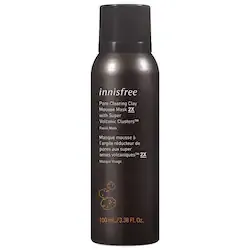
innisfree Pore Clearing Clay Mousse Mask with Super Volcanic Clusters
Works for
ExfoliationSalicylic acid, Lactic acidWorks well
“What it is: A clay mask in a light-as-air mousse that helps clear pores with Jeju Super Volcanic ClustersTM while AHA and BHA dually exfoliate skin.”
This product can help exfoliate the skin. In other words, it helps break down the bonds between dead cells on the surface of the skin and speed up the skin turnover. Skin often appears softer and brighter after exfoliation, but overdoing it can result in disrupted skin barrier. The following ingredient is doing the exfoliating job in this product: salicylic acid.
Anti-blemishSide benefit the brand mentions · Salicylic acid, Kaolin + 2 moreWorks well
“Pore Clearing Clay Mousse Mask with Super Volcanic Clusters”
This product can help reduce breakouts and clogged pores because it contains the following ingredient: salicylic acid. This ingredient is used for treating acne and can have a noticeable effect.
MoisturizingSide benefit · Dimethicone, Glycerin + 7 moreWorks
This product can help improve hydration of the skin with the two types of ingredients.
The first type is called “humectants”:
these ingredients help attract water.
When humectants are on the surface of the skin, they “pull in” the moisture from the outside environment, or from
within deeper layers of the skin. The following ingredients in this product do the job:
arginine, glycerin.
This product also contains ingredients called “occlusives”. They help reduce the speed with which our skin loses moisture to the outside environment. These ingredients also help soften the upper layer of the skin, so it feels less tight and nicer to the touch. The following ingredients in this product do the job: arginine, caprylic/capric triglyceride.
Can it cause trouble?
Irritancy2 strong irritants: Alcohol, Juglans regia shell powderMedium risk
Comedogenic2 ingredients rated 2 or more on the 0–5 pore-clogging scale2 flagged


User reviews
1 of 1 community members would buy it again.
Ingredients
Filter by role to see what each ingredient is doing.
Water~45–55%
Silica~6.8–8.4%
Titanium dioxide~4.5–5.5%
- Irritation risk
- Low
Works as a UV filter when used in high concentrations. It is photostable and is effective mostly against the UVB light, with some protection in the UVA range. In small concentrations, used for its ability to improve the color of cosmetic products. Is usually well tolerated by the skin
More about Titanium dioxideKaolin~3.3–4.1%
- Irritation risk
- Low
A type of clay that consists mainly of aluminum silicate. Helps absorb oil and creates a thicker product consistency. Can be used to add a white color
More about KaolinPropanediol~2.7–3.3%
- Irritation risk
- Low
Acts as a solvent for other ingredients. Speeds up the absorption of other ingredients into the skin
More about PropanediolDimethicone~2.3–2.8%
- Irritation risk
- Low
A silicone that helps to reduce water loss from the surface of the skin. Can temporarily "fill in" lines and wrinkles, absorb oil, and create a nice product finish
More about DimethiconeAlcohol~1.8–2.2%
- Irritation risk
- High
Can be drying and contribute to skin irritation. Used in formulars to dissolve other ingredients, create a thinner product consistency or for its antibacterial properties
More about AlcoholVolcanic ash~1.7–2.1%
- Irritation risk
- Low
Glycerin~1.4–1.8%
- Irritation risk
- Low
One of the best moisturizing ingredients. Naturally present in skin. It attracts water to the upper layer of the skin working as a humectant
More about GlycerinPolyvinyl alcohol~1.2–1.5%
Caprylic/capric triglyceride~1.1–1.3%
- Irritation risk
- Medium
A good mix of fatty acids that forms a protective layer on the skin. Improves the shelf life of products. Derived from coconut and glycerin
More about Caprylic/capric triglycerideStearic acid~1–1.2%
- Irritation risk
- Low
Helps oil and water mix together and works as an emollient
More about Stearic acidBentonite~0.8–1.2%
Palmitic acid~0.8–1.2%
- Irritation risk
- Low
An emollient that is naturally present in skin and helps soften it
More about Palmitic acidCetearyl alcohol~0.75–1.15%
- Irritation risk
- Low
- Comedogenicity
- 2/5
A non-drying alcohol. Works as an emollient. Helps water and oil mix together and creates a nice product texture
More about Cetearyl alcohol1,2-hexanediol~0.7–1.05%
Arginine~0.65–0.95%
- Irritation risk
- Low
An amino acid that is naturally present in skin and helps keep it hydrated. When used together with AHAs, it can reduce their irritating effect on the skin
More about ArginineHydroxypropyl starch phosphate~0.65–0.95%
- Irritation risk
- Medium
Helps oil and water mix together and used to stabilize product formulations
More about Hydroxypropyl starch phosphateSorbitan stearate~0.6–0.9%
Juglans regia shell powder~0.65–0.95%
- Irritation risk
- High
Iron oxides~0.55–0.85%
- Irritation risk
- Low
An umbrella term for the following three colorants: CI 77491, CI 77492, CI 77499. They might be able to offer some protection against visible light, but the degree of the protection is not clear
More about Iron oxidesLactic acid~0.4–0.65%
- Irritation risk
- Medium
An exfoliating and moisturizing alpha-hydroxy acid (AHA). Typically causes less irritation than other AHAs, for example, glycolic acid. At high concentrations (about 15%), lactic acid can help reduce lines and wrinkles. Recent studies show that lactic acid can support the "good" bacteria living on skin's surface (healthy skin microbiome)
More about Lactic acidSalicylic acid~0.35–0.65%
- Irritation risk
- High
Used for skin exfoliation. It has an anti-inflammatory and anti-bacterial effect, helps to unclog pores, prevent blemishes and speed up healing of the existing ones. Sometimes referred to as a BHA (beta-hydroxy acid)
More about Salicylic acidPolysorbate 20~0.45–0.65%
Lactic acid/glycolic acid copolymer~0.35–0.65%
- Irritation risk
- Low
Xanthan gum~0.35–0.6%
- Irritation risk
- Low
Used to create a thicker product consistency
More about Xanthan gumIron oxides~0.3–0.55%
- Irritation risk
- Low
An umbrella term for the following three colorants: CI 77491, CI 77492, CI 77499. They might be able to offer some protection against visible light, but the degree of the protection is not clear
More about Iron oxidesDisodium edta~0.25–0.5%
Ethylhexylglycerin~0.25–0.45%
Iron oxides~0.2–0.4%
- Irritation risk
- Low
An umbrella term for the following three colorants: CI 77491, CI 77492, CI 77499. They might be able to offer some protection against visible light, but the degree of the protection is not clear
More about Iron oxidesColloidal sulfur~0.2–0.35%
Myristic acid~0.2–0.4%
- Irritation risk
- Medium
- Comedogenicity
- 3/5
Helps oil and water mix together. Could be comedogenic
More about Myristic acidArachidic acid~0.25–0.45%
Aluminum hydroxide~0.15–0.3%
- Irritation risk
- Low
Is used to add opaque (non-transparent) appearance to formulations. Can be used to coat other ingredients for even dispersion. This is a different ingredient compared to the ones used in antipersperants (aluminium chloride and aluminium chlorohydrate)
More about Aluminum hydroxideTriethoxycaprylylsilane~0.1–0.2%
- Irritation risk
- Low
A type of silicone that helps oil and water mix well together. Helps to disperse other ingredients, e.g. pigments, evenly in a formulation
More about TriethoxycaprylylsilaneTocopherol~0.1–0.15%
- Irritation risk
- Low
Pure form of vitamin E. Can help moisturise and protect the skin from free radicals. Often used to help stabilise other ingredients or the formula itself
More about TocopherolNitrogen~0.05–0.1%
Ingredient list view
Water, Silica, Titanium dioxide, Kaolin, Propanediol, Dimethicone, Alcohol, Volcanic ash, Glycerin, Polyvinyl alcohol, Caprylic/capric triglyceride, Stearic acid, Bentonite, Palmitic acid, Cetearyl alcohol, 1,2-hexanediol, Arginine, Hydroxypropyl starch phosphate, Sorbitan stearate, Juglans regia shell powder, Iron oxides, Lactic acid, Salicylic acid, Polysorbate 20, Lactic acid/glycolic acid copolymer, Xanthan gum, Iron oxides, Disodium edta, Ethylhexylglycerin, Iron oxides, Colloidal sulfur, Myristic acid, Arachidic acid, Aluminum hydroxide, Triethoxycaprylylsilane, Tocopherol, Nitrogen
Compare prices
Retailers ranked by price — lowest first.

Worth comparing, line by line.
Match % combines shared ingredients, the first five ingredients, shared actives and hero ingredients, irritancy (lower counts in the alternative's favour), texture and body area. Only products in the same routine step are compared.
| innisfreePore Clearing Clay Mousse Mask with Super Volcanic ClustersYOUR PRODUCT | TricociRefine Exfoliator | Jan MariniMarini Multi-Acid Exfoliating Pads | VotarySensitive Resurfacing Peel | |
|---|---|---|---|---|
| Match | — | 78% | 75% | 75% |
| Price | $21.00 | $37.00+$16.00 | — | $92.60+$71.60 |
| Shared key ingredients | — | 5 of 8 | 4 of 8 | 4 of 8 |
| Key difference | — | Glycolic Acid | Glycolic Acid | Lactobacillus Ferment |
| Irritancy | Medium | Low | Low | Low |
| Drying alcohol | Contains drying alcohol | — | — | — |
| View product | Shop | Shop | Shop |


More alternatives: Dermalogica breakout clearing liquid peelPaula's choice Skin Perfecting 25% AHA and 2% BHA Exfoliant Peel
Sources cited in this review
Every concentration estimate and effectiveness label is anchored to one of these 14 studies and safety reviews.
- 1
- 2Final Report on the Safety Assessment of Dimethicone Copolyoljournals.sagepub.com
- 3
- 4
- 5Epidermal and dermal effects of topical lactic acidncbi.nlm.nih.gov
- 6Dual Effects of Alpha-Hydroxy Acids on the Skinpdfs.semanticscholar.org

Affiliate links · As an Amazon Associate, WIMJ earns from qualifying purchases.