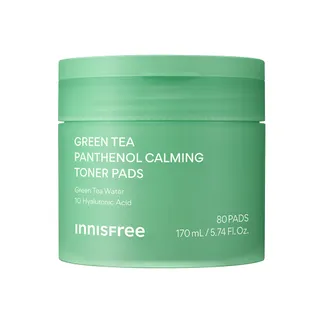
innisfree Green Tea Panthenol Calming Toner Pads
Works for
MoisturizingPanthenol, Glycerin + 15 moreWorks well
“Lock in hydration + cool skin with our lightweight Korean toner pads.”
This product contains good ingredients to attract water to the upper layer of the skin. These ingredients are called "humectants": allantoin, biosaccharide gum-1.
When humectants are on the surface of the skin, they “pull in” the moisture from the outside environment, or from within deeper layers of the skin. If the air is dry, humectants can speed up the moisture loss from the skin. This is why it is a good idea to use another product on top of this one to help "seal in" the moisture (look for ingredients like dimethicone, squalane, oils and butters).
The following ingredients in this product are especially good for supporting the skin barrier and helping with the hydration level: panthenol
ExfoliationSide benefit · Capryloyl salicylic acid, AllantoinWorks well
This product can help exfoliate the skin. In other words, it helps break down the bonds between dead cells on the surface of the skin and speed up the skin turnover. Skin often appears softer and brighter after exfoliation, but overdoing it can result in disrupted skin barrier. The following ingredient is doing the exfoliating job in this product: capryloyl salicylic acid.
Evens skin toneSide benefit · Capryloyl salicylic acid, Camellia sinensis leaf extractMay help
The following ingredient (ingredients) in this product might be helpful, but there is no evidence to confirm that it actually works: capryloyl salicylic acid.
Can it cause trouble?
Irritancy3 strong irritants: Eucalyptus globulus leaf extract, Mentha arvensis extract + 1 more — patch-test recommendedHigh risk
ComedogenicClean of flagged comedogenic ingredientsNone flagged


User reviews
Be the first — your take helps the next person decide.
Ingredients
Filter by role to see what each ingredient is doing.
Water~40–60%
Glycerin~4.4–6.6%
- Irritation risk
- Low
One of the best moisturizing ingredients. Naturally present in skin. It attracts water to the upper layer of the skin working as a humectant
More about GlycerinMethylpropanediol~3.5–5.2%
Butylene glycol~2.5–3.8%
- Irritation risk
- Low
Used to create a nice product texture and help delivery of other ingredients. Might be somewhat helpful in attracting water to the upper layer of the skin
More about Butylene glycol1,2-hexanediol~1–1.5%
Xylitol~1.6–2.4%
- Irritation risk
- Low
Helps attract water to the upper layer of the skin and repair the skin barrier function
More about XylitolErythritol~1.4–2.1%
- Irritation risk
- Low
Helps to attract water to the upper layer of the skin
More about ErythritolPropanediol~1.3–1.9%
- Irritation risk
- Low
Acts as a solvent for other ingredients. Speeds up the absorption of other ingredients into the skin
More about PropanediolAllantoin~0.9–1.3%
- Irritation risk
- Low
Helps calm down inflammation in skin and can help reduce itching. Helps to repair the skin barrier and keep skin hydrated
More about AllantoinEthylhexylglycerin~0.55–1.35%
Panthenol~0.4–1%
- Irritation risk
- Low
Helps attract water to the upper layer of the skin and can help improve skin barrier function
More about PanthenolXanthan gum~0.35–0.75%
- Irritation risk
- Low
Used to create a thicker product consistency
More about Xanthan gumPolyglyceryl-10 laurate~0.15–0.65%
- Irritation risk
- Medium
Helps water and oil mix together
More about Polyglyceryl-10 lauratePolyglyceryl-10 myristate~0.15–0.55%
- Irritation risk
- Low
Sodium hyaluronate~0.15–0.5%
- Irritation risk
- Low
One of the best moisturizing ingredients. Attracts water into the upper layer of the skin
More about Sodium hyaluronateSodium phytate~0.15–0.5%
Biosaccharide gum-1~0.15–0.5%
- Irritation risk
- Low
Helps attract water to the upper layer of the skin and is claimed to provide a longer-lasting hydration because of its ability to create a water-binding film on the surface of the skin
More about Biosaccharide gum-1Aloe barbadensis leaf extract~0.15–0.65%
- Irritation risk
- Medium
Traditionally used to treat sunburns, dermatitis and inflammation, but evidence for its effectiveness is lacking. The extract can contain humectants that help attract water into the skin
More about Aloe barbadensis leaf extractEucalyptus globulus leaf extract~0.1–0.45%
- Irritation risk
- High
Used as a fragrance. Can be irritating
More about Eucalyptus globulus leaf extractMentha arvensis extract~0.1–0.45%
- Irritation risk
- High
Cymbopogon citratus extract~0.1–0.4%
- Irritation risk
- High
Citric acid~0.1–0.4%
- Irritation risk
- Medium
Can work as an exfoliant but is typically used to adjust the product pH
More about Citric acidHyaluronic acid~0.1–0.3%
- Irritation risk
- Low
One of the best moisturizing ingredients. Attracts water into the upper layer of the skin. Naturally present in skin. Typically has large molecule size unless advertised otherwise on the product label. Helps support skin's barrier function and may help to reduce inflammation
More about Hyaluronic acidSodium metaphosphate~0.1–0.3%
Camellia sinensis leaf extract~0.1–0.35%
- Irritation risk
- Low
Can contain potent anti-oxidant compounds (abbreviated ECG, GCG, EGC, and EGCG) that might help protect the skin from free radicals. Can help calm down inflammation and has some anti-bacterial properties. Unfortunately, these antioxidants are unstable and lose their effectiveness very quickly in products. The concentration of the antioxidant compounds in the extract also tends to be low to be effective in topical formulation
More about Camellia sinensis leaf extractSodium citrate~0.1–0.3%
- Irritation risk
- Medium
Helps to control the skin's pH level. Maintains the skin's natural film of amino-lactic acids and oils. Helps to preserve products
More about Sodium citrateCapryloyl salicylic acid~0.1–0.3%
- Irritation risk
- High
Propylene glycol~0.05–0.3%
- Irritation risk
- High
Helps oil and water mix together and can enhance the penetration of other ingredients into the skin. It can be irritating
More about Propylene glycolGlyceryl oleate~0.1–0.35%
- Irritation risk
- High
Helps oil and water mix together. Can be irritating
More about Glyceryl oleateTromethamine~0.1–0.3%
Tocopherol~0.1–0.3%
- Irritation risk
- Low
Pure form of vitamin E. Can help moisturise and protect the skin from free radicals. Often used to help stabilise other ingredients or the formula itself
More about TocopherolLecithin~0.1–0.5%
- Irritation risk
- Low
Used mostly for creating emulsions - helping oil and water mix together. Helps soften the upper layer of the skin
More about LecithinLauryl glucoside~0.15–0.6%
Hydrolyzed hyaluronic acid~0.1–0.4%
- Irritation risk
- Low
One of the best moisturizing ingredients. Attracts water into the upper layer of the skin. A version of it is naturally present in skin
More about Hydrolyzed hyaluronic acidPolyglyceryl-6 laurate~0.1–0.4%
- Irritation risk
- Medium
Helps oil and water mix together
More about Polyglyceryl-6 laurateMyristyl glucoside~0.15–0.5%
- Irritation risk
- Low
Sodium hyaluronate crosspolymer~0.05–0.3%
- Irritation risk
- Medium
Attracts water into the upper layer of the skin
More about Sodium hyaluronate crosspolymerGlyceryl caprylate~0.1–0.35%
- Irritation risk
- Low
An emollient that can also help water and oil mix together, as well as prevent bacteria growth in products
More about Glyceryl caprylateSodium trimetaphosphate~0.05–0.1%
- Irritation risk
- Low
Sodium acetylated hyaluronate~0.05–0.15%
- Irritation risk
- Low
A type of hyaluronic acid that works as an excellent moisturizer by attracting water into the upper layer of the skin. Is typically feels less sticky on the skin compared to the usual hyaluronic acid
More about Sodium acetylated hyaluronateIngredient list view
Water, Glycerin, Methylpropanediol, Butylene glycol, 1,2-hexanediol, Xylitol, Erythritol, Propanediol, Allantoin, Ethylhexylglycerin, Panthenol, Xanthan gum, Polyglyceryl-10 laurate, Polyglyceryl-10 myristate, Sodium hyaluronate, Sodium phytate, Biosaccharide gum-1, Aloe barbadensis leaf extract, Eucalyptus globulus leaf extract, Mentha arvensis extract, Cymbopogon citratus extract, Citric acid, Hyaluronic acid, Sodium metaphosphate, Camellia sinensis leaf extract, Sodium citrate, Capryloyl salicylic acid, Propylene glycol, Glyceryl oleate, Tromethamine, Tocopherol, Lecithin, Lauryl glucoside, Hydrolyzed hyaluronic acid, Polyglyceryl-6 laurate, Myristyl glucoside, Sodium hyaluronate crosspolymer, Glyceryl caprylate, Sodium trimetaphosphate, Sodium acetylated hyaluronate
Worth comparing, line by line.
Match % combines shared ingredients, the first five ingredients, shared actives and hero ingredients, irritancy (lower counts in the alternative's favour), texture and body area. Only products in the same routine step are compared.
| innisfreeGreen Tea Panthenol Calming Toner PadsYOUR PRODUCT | Milk TouchHedera Helix Jumbo Pad | AbibGlutathiosome Dark Spot Pad Vita Touch | ROUND LABSoybean Panthenol Toner | |
|---|---|---|---|---|
| Match | — | 67% | 58% | 55% |
| Price | $25.00 | $16.60−$8.40 | $16.99−$8.01 | $15.45−$9.55 |
| Shared key ingredients | — | 8 of 12 | 4 of 12 | 3 of 12 |
| Key difference | — | Aspartic Acid | Niacinamide | Adenosine |
| Irritancy | High | Medium | Medium | Medium |
| Drying alcohol | — | — | — | — |
| View product | Shop | Shop | Shop |
More alternatives: Equlib Eau Calm PadI'm from Pear Soothing Pad
Sources cited in this review
Every concentration estimate and effectiveness label is anchored to one of these 19 studies and safety reviews.
- 1
- 2
- 3
- 4Skin moisturizing effects of panthenol-based formulationspdfs.semanticscholar.org
- 5
- 6
