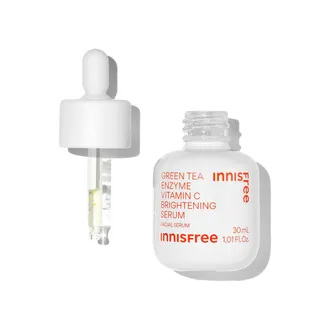
innisfree Green Tea Enzyme Vitamin C Brightening Sérum Éclat et Anti-Taches

innisfree Green Tea Enzyme Vitamin C Brightening Sérum Éclat et Anti-Taches

Efficacy66/100IrritancyMedium

Works for

Moisturizing
Panthenol, Madecassoside + 15 more
Works well
What the product description says
“Résultats ? La peau est douce, lisse, hydratée et éclatante.”
Source: Oh my cream

This product can help improve hydration of the skin with the two types of ingredients.

The first type is called “humectants”:
these ingredients help attract water. When humectants are on the surface of the skin, they “pull in” the moisture from the outside environment, or from within deeper layers of the skin. The following ingredients in this product do the job: glycerin, hyaluronic acid.

This product also contains ingredients called “occlusives”. They help reduce the speed with which our skin loses moisture to the outside environment. These ingredients also help soften the upper layer of the skin, so it feels less tight and nicer to the touch. The following ingredients in this product do the job: helianthus annuus seed oil, squalane.

The following ingredients in this product are especially good for supporting the skin barrier and helping with the hydration level: madecassoside, panthenol

PanthenolHero· HumectantEffect: HighHelps attract water to the upper layer of the skin and can help improve skin barrier function~0.15–0.6%
MadecassosideHeroEffect: HighAn antioxidant that is typically derived from plant Centella Asiatica. It can help neutralize free radicals in skin and support skin barrier function. It could, however, itself be irritating. It is often unstable in formulations~0.1–0.4%
GlycerinKey active· HumectantEffect: HighOne of the best moisturizing ingredients. Naturally present in skin. It attracts water to the upper layer of the skin working as a humectant~2.5–3.7%
Lactobacillus ferment lysateKey activeEffect: MediumA "broth" with parts of dead cells of lactobacteria. Might be helpful supporting diverse microbiome in skin, but evidence is lacking~1.4–2.1%
SqualaneKey active· Emollient, OcclusiveEffect: HighAn oil naturally present in skin. Works as an emollient to soften the skin and form a protective layer on its surface without a greasy feeling.~1.3–1.9%
Helianthus annuus seed oilKey active· Emollient, OcclusiveEffect: HighA great emollient due to its high linoleic acid content. One of the most effective plant oils in helping skin hydration and repairing skin barrier function~1–1.6%
Hyaluronic acidKey active· HumectantEffect: HighOne of the best moisturizing ingredients. Attracts water into the upper layer of the skin. Naturally present in skin. Typically has large molecule size unless advertised otherwise on the product label. Helps support skin's barrier function and may help to reduce inflammation~0.1–0.5%
GlutathioneKey activeEffect: HighA peptide that can help neutralize free radicals in skin and reduce melanin production resulting in skin lightening effect and reduction in hyperpigmentation. It can also help attract moisture to the upper layer of the skin~0.05–0.3%
Butylene glycol· HumectantEffect: LowUsed to create a nice product texture and help delivery of other ingredients. Might be somewhat helpful in attracting water to the upper layer of the skin~1.6–2.4%
Dextrin· HumectantEffect: LowA sugar that is used to stabilize the product formulation. Can help attract water to the upper layer of the skin~0.8–1.25%
Pentylene glycol· EmollientEffect: LowUsed to preserve products, dissolve other ingredients and create a nice product texture~0.15–0.55%
Ascorbyl tetraisopalmitateEffect: Low, below effective doseA vitamin C derivative. Studies show that is might be effective in reducing hyperpigmentation, but there are no studies confirming that it is effectively converted into the bioavailable form of Vitamin C in skin. It is not clear how this derivative compares in effectiveness to the topical application of bioavailable form of vitamin C (L-ascorbic acid)~0.1–0.4%
TocopherolEffect: Low, below effective dosePure form of vitamin E. Can help moisturise and protect the skin from free radicals. Often used to help stabilise other ingredients or the formula itself~0.1–0.4%
Caprylic/capric triglycerideUnder-dosedA good mix of fatty acids that forms a protective layer on the skin. Improves the shelf life of products. Derived from coconut and glycerin~0.4–0.95%
GluconolactoneUnder-dosedA polyhydroxy acid (PHA) that helps shed the dead cells from the skin surface revealing smoother skin. Is believed to be genter than AHAs. It helps attract water to the upper layer of the skin and can stimulate production of skin's own hyaluronic acid resulting in improved hydration levels. It has been shown to be helpful against acne and clogged pores if used consistently (e.g over a period of 12 weeks) in high enough concentration. It can help reduce fine lines and wrinkles and improve skin tone with long-term application. Can help neutralize free radicals~0.15–0.55%
NiacinamideUnder-dosedIs proven to be effective in reducing blemishes, evening out skin tone and helping to improve lines and wrinkles. It helps the skin to repair sun damage, calm down inflammation and keep maintain good levels of moisture. The concentration of about 2% is effective for supporting the skin barrier and evening out the skin tone. Concentration of 4-6% is better for helping with acne and balancing the sebum production~0.15–0.6%
AllantoinUnder-dosedHelps calm down inflammation in skin and can help reduce itching. Helps to repair the skin barrier and keep skin hydrated~0.15–0.55%
Evens skin tone
3-o-ethyl ascorbic acid, Glutathione + 5 more
Works well
What the product description says
“Un sérum éclaircissant à base de vitamine C et d'enzymes de thé vert qui atténue les taches pour un teint plus uniforme.”
Source: Oh my cream

This product can help reduce hypepigmentation and even out the skin tone because it contains the following effective ingredients: glutathione

The following ingredient (ingredients) in this product might be helpful, but there is no evidence to confirm that it actually can help even out the skin tone: 3-o-ethyl ascorbic acid, ferulic acid, madecassoside.

Keep in mind that you would need to apply any topical skincare targetted at hypigmentation consistently for a couple of months to get a result. No topical skincare product can help get rid of hyperpigmentation (including post-acne marks and age spots) instantly.

3-o-ethyl ascorbic acidKey activeEffect: MediumA vitamin C derivative that is more stable but less potent than pure form of vitamin C. Can help neutralize free radicals and help reduce hyperpigmentation, but the required concentration is likely to be much higher than for the pure form of vitamin C, limiting the ingredient's effectiveness in products~2–3%
GlutathioneKey activeEffect: HighA peptide that can help neutralize free radicals in skin and reduce melanin production resulting in skin lightening effect and reduction in hyperpigmentation. It can also help attract moisture to the upper layer of the skin~0.05–0.3%
Ferulic acidKey activeEffect: MediumA potent anti-oxidant that has been shown to be effective in neutralizing free radicals in skin. There seem to have a synergetic effect of ferulic acid, vitamin E and C, meaning that when the ingredients are used together, they enhance each other's ability protect the skin against free radicals. Ferulic acid also helps to stabilize other ingredients - including vitamins C and E. It can help to even out the skin tone. Ferulic acid is approved for use as a sunscreen ingredient in Japan in concentrations up to 10%~0.01–0.1%
MadecassosideEffect: LowAn antioxidant that is typically derived from plant Centella Asiatica. It can help neutralize free radicals in skin and support skin barrier function. It could, however, itself be irritating. It is often unstable in formulations~0.1–0.4%
GluconolactoneUnder-dosedA polyhydroxy acid (PHA) that helps shed the dead cells from the skin surface revealing smoother skin. Is believed to be genter than AHAs. It helps attract water to the upper layer of the skin and can stimulate production of skin's own hyaluronic acid resulting in improved hydration levels. It has been shown to be helpful against acne and clogged pores if used consistently (e.g over a period of 12 weeks) in high enough concentration. It can help reduce fine lines and wrinkles and improve skin tone with long-term application. Can help neutralize free radicals~0.15–0.55%
NiacinamideUnder-dosedIs proven to be effective in reducing blemishes, evening out skin tone and helping to improve lines and wrinkles. It helps the skin to repair sun damage, calm down inflammation and keep maintain good levels of moisture. The concentration of about 2% is effective for supporting the skin barrier and evening out the skin tone. Concentration of 4-6% is better for helping with acne and balancing the sebum production~0.15–0.6%
Ascorbyl tetraisopalmitateUnder-dosedA vitamin C derivative. Studies show that is might be effective in reducing hyperpigmentation, but there are no studies confirming that it is effectively converted into the bioavailable form of Vitamin C in skin. It is not clear how this derivative compares in effectiveness to the topical application of bioavailable form of vitamin C (L-ascorbic acid)~0.1–0.4%
Exfoliation
Gluconolactone ~0.15–0.55%, below the ~1% it needs
Under-dosed
What the product description says
“Formulé à partir d'enzyme de thé vert, il exfolie en douceur et affine le grain de peau.”
Source: Oh my cream

This product does not contain effective exfoliating ingredients. It might be able to deliver physical exfoliation, that is scrub off some of the dead cells on the surface of the skin. We do not recommend physical exfoliation, because it is not uniform (some bits of skin can get exfoliated too much while others not at all). It can also traumatize the skin and aggrevate acne and other skin conditions.

AllantoinEffect: Low, below effective doseHelps calm down inflammation in skin and can help reduce itching. Helps to repair the skin barrier and keep skin hydrated~0.15–0.55%
GluconolactoneUnder-dosedA polyhydroxy acid (PHA) that helps shed the dead cells from the skin surface revealing smoother skin. Is believed to be genter than AHAs. It helps attract water to the upper layer of the skin and can stimulate production of skin's own hyaluronic acid resulting in improved hydration levels. It has been shown to be helpful against acne and clogged pores if used consistently (e.g over a period of 12 weeks) in high enough concentration. It can help reduce fine lines and wrinkles and improve skin tone with long-term application. Can help neutralize free radicals~0.15–0.55%
Anti-oxidation
Side benefit · 3-o-ethyl ascorbic acid, Madecassoside + 8 more
Works well

This product contains antioxidants (ferulic acid, glutathione, madecassoside) that can help neutralize free radicals in skin. By doing so, they can lessen the damage the skin gets from the UV light (sun).

The following ingredients - 3-o-ethyl ascorbic acid also can have an antioxidant effect, but there is less evidence to confirm their effectiveness in skin.

3-o-ethyl ascorbic acidKey activeEffect: MediumA vitamin C derivative that is more stable but less potent than pure form of vitamin C. Can help neutralize free radicals and help reduce hyperpigmentation, but the required concentration is likely to be much higher than for the pure form of vitamin C, limiting the ingredient's effectiveness in products~2–3%
MadecassosideKey activeEffect: HighAn antioxidant that is typically derived from plant Centella Asiatica. It can help neutralize free radicals in skin and support skin barrier function. It could, however, itself be irritating. It is often unstable in formulations~0.1–0.4%
GlutathioneKey activeEffect: HighA peptide that can help neutralize free radicals in skin and reduce melanin production resulting in skin lightening effect and reduction in hyperpigmentation. It can also help attract moisture to the upper layer of the skin~0.05–0.3%
Ferulic acidKey activeEffect: HighA potent anti-oxidant that has been shown to be effective in neutralizing free radicals in skin. There seem to have a synergetic effect of ferulic acid, vitamin E and C, meaning that when the ingredients are used together, they enhance each other's ability protect the skin against free radicals. Ferulic acid also helps to stabilize other ingredients - including vitamins C and E. It can help to even out the skin tone. Ferulic acid is approved for use as a sunscreen ingredient in Japan in concentrations up to 10%~0.01–0.1%
Daucus carota sativa root extractEffect: LowCarrot extract. Might have anti-oxidant properties and be used to add orange color~0.15–0.5%
Citrus reticulata peel extractEffect: LowA likely irritant. Might have some anti-oxidant activity, but is mostly used as a fragrance in cosmetic products~0.15–0.55%
Achillea millefolium extractEffect: LowPlant extract that can help neutralize free radicals in skin. Can be used as a fragrance. Can be irritating~0.1–0.45%
GluconolactoneUnder-dosedA polyhydroxy acid (PHA) that helps shed the dead cells from the skin surface revealing smoother skin. Is believed to be genter than AHAs. It helps attract water to the upper layer of the skin and can stimulate production of skin's own hyaluronic acid resulting in improved hydration levels. It has been shown to be helpful against acne and clogged pores if used consistently (e.g over a period of 12 weeks) in high enough concentration. It can help reduce fine lines and wrinkles and improve skin tone with long-term application. Can help neutralize free radicals~0.15–0.55%
Ascorbyl tetraisopalmitateUnder-dosedA vitamin C derivative. Studies show that is might be effective in reducing hyperpigmentation, but there are no studies confirming that it is effectively converted into the bioavailable form of Vitamin C in skin. It is not clear how this derivative compares in effectiveness to the topical application of bioavailable form of vitamin C (L-ascorbic acid)~0.1–0.4%
TocopherolUnder-dosedPure form of vitamin E. Can help moisturise and protect the skin from free radicals. Often used to help stabilise other ingredients or the formula itself~0.1–0.4%
Anti-aging
Side benefit the brand mentions · Madecassoside, Ferulic acid + 6 more
May help
What the product description says
“Green Tea Enzyme Vitamin C Brightening Sérum Éclat et Anti-Taches”
From product name

This product contains ferulic acid, madecassoside. There is some human evidence that these ingredients help reduce and prevent fine lines and wrinkles and improve skin elasticity and firmness, though it is smaller or less consistent than the evidence for the best anti-aging ingredients.

MadecassosideKey activeEffect: MediumAn antioxidant that is typically derived from plant Centella Asiatica. It can help neutralize free radicals in skin and support skin barrier function. It could, however, itself be irritating. It is often unstable in formulations~0.1–0.4%
Ferulic acidKey activeEffect: MediumA potent anti-oxidant that has been shown to be effective in neutralizing free radicals in skin. There seem to have a synergetic effect of ferulic acid, vitamin E and C, meaning that when the ingredients are used together, they enhance each other's ability protect the skin against free radicals. Ferulic acid also helps to stabilize other ingredients - including vitamins C and E. It can help to even out the skin tone. Ferulic acid is approved for use as a sunscreen ingredient in Japan in concentrations up to 10%~0.01–0.1%
3-o-ethyl ascorbic acidEffect: LowA vitamin C derivative that is more stable but less potent than pure form of vitamin C. Can help neutralize free radicals and help reduce hyperpigmentation, but the required concentration is likely to be much higher than for the pure form of vitamin C, limiting the ingredient's effectiveness in products~2–3%
Hyaluronic acidEffect: LowOne of the best moisturizing ingredients. Attracts water into the upper layer of the skin. Naturally present in skin. Typically has large molecule size unless advertised otherwise on the product label. Helps support skin's barrier function and may help to reduce inflammation~0.1–0.5%
TocopherolEffect: Low, below effective dosePure form of vitamin E. Can help moisturise and protect the skin from free radicals. Often used to help stabilise other ingredients or the formula itself~0.1–0.4%
GluconolactoneUnder-dosedA polyhydroxy acid (PHA) that helps shed the dead cells from the skin surface revealing smoother skin. Is believed to be genter than AHAs. It helps attract water to the upper layer of the skin and can stimulate production of skin's own hyaluronic acid resulting in improved hydration levels. It has been shown to be helpful against acne and clogged pores if used consistently (e.g over a period of 12 weeks) in high enough concentration. It can help reduce fine lines and wrinkles and improve skin tone with long-term application. Can help neutralize free radicals~0.15–0.55%
NiacinamideUnder-dosedIs proven to be effective in reducing blemishes, evening out skin tone and helping to improve lines and wrinkles. It helps the skin to repair sun damage, calm down inflammation and keep maintain good levels of moisture. The concentration of about 2% is effective for supporting the skin barrier and evening out the skin tone. Concentration of 4-6% is better for helping with acne and balancing the sebum production~0.15–0.6%
Ascorbyl tetraisopalmitateUnder-dosedA vitamin C derivative. Studies show that is might be effective in reducing hyperpigmentation, but there are no studies confirming that it is effectively converted into the bioavailable form of Vitamin C in skin. It is not clear how this derivative compares in effectiveness to the topical application of bioavailable form of vitamin C (L-ascorbic acid)~0.1–0.4%

Can it cause trouble?

Irritancy
2 strong irritants: Citrus reticulata peel extract, Achillea millefolium extract
Medium risk
We flagged 13 ingredients with irritancy potential. Severity depends on your sensitivity threshold; the table lists the worst offenders first.
IngredientFunctionIrritationEst. amount
3-o-ethyl ascorbic acidA vitamin C derivative that is more stable but less potent than pure form of vitamin C. Can help neutralize free radicals and help reduce hyperpigmentation, but the required concentration is likely to be much higher than for the pure form of vitamin C, limiting the ingredient's effectiveness in productsHigh~2–3%est.
Citrus reticulata peel extractA likely irritant. Might have some anti-oxidant activity, but is mostly used as a fragrance in cosmetic productsHigh~0.15–0.55%est.
Achillea millefolium extractPlant extract that can help neutralize free radicals in skin. Can be used as a fragrance. Can be irritatingHigh~0.1–0.45%est.
1,2-hexanediolA preservativeMedium~1.5–2.2%est.
Acrylates/c10-30 alkyl acrylate crosspolymerMaintains the texture of skincare products. Allows the product to spread evenly. Helps oil and water mix togetherMedium~0.45–1.1%est.
Caprylic/capric triglycerideA good mix of fatty acids that forms a protective layer on the skin. Improves the shelf life of products. Derived from coconut and glycerinMedium~0.4–0.95%est.
GluconolactoneA polyhydroxy acid (PHA) that helps shed the dead cells from the skin surface revealing smoother skin. Is believed to be genter than AHAs. It helps attract water to the upper layer of the skin and can stimulate production of skin's own hyaluronic acid resulting in improved hydration levels. It has been shown to be helpful against acne and clogged pores if used consistently (e.g over a period of 12 weeks) in high enough concentration. It can help reduce fine lines and wrinkles and improve skin tone with long-term application. Can help neutralize free radicalsMedium~0.15–0.55%est.
Pentylene glycolUsed to preserve products, dissolve other ingredients and create a nice product textureMedium~0.15–0.55%est.
Sodium metaphosphateA preservativeMedium~0.1–0.45%est.
EthylhexylglycerinA preservativeMedium~0.1–0.35%est.
MadecassosideAn antioxidant that is typically derived from plant Centella Asiatica. It can help neutralize free radicals in skin and support skin barrier function. It could, however, itself be irritating. It is often unstable in formulationsMedium~0.1–0.4%est.
Ascorbyl tetraisopalmitateA vitamin C derivative. Studies show that is might be effective in reducing hyperpigmentation, but there are no studies confirming that it is effectively converted into the bioavailable form of Vitamin C in skin. It is not clear how this derivative compares in effectiveness to the topical application of bioavailable form of vitamin C (L-ascorbic acid)Medium~0.1–0.4%est.
GlutathioneA peptide that can help neutralize free radicals in skin and reduce melanin production resulting in skin lightening effect and reduction in hyperpigmentation. It can also help attract moisture to the upper layer of the skinMedium~0.05–0.3%est.
Comedogenic
Clean of flagged comedogenic ingredients
None flagged
Did this help you decide?

User reviews

Would you recommend?
No community reviews yet.

Be the first — your take helps the next person decide.

Ingredients

Filter by role to see what each ingredient is doing.

Water~40–60%
Formula
Irritation risk
Low

Plain old water

More about Water
Propanediol~4.3–6.4%
Formula
Irritation risk
Low

Acts as a solvent for other ingredients. Speeds up the absorption of other ingredients into the skin

More about Propanediol
1,2-hexanediol~1.5–2.2%
Irritant · medium
Irritation risk
Medium

A preservative

More about 1,2-hexanediol
Glycerin~2.5–3.7%
Key active
Irritation risk
Low
Works for
Moisturizing

One of the best moisturizing ingredients. Naturally present in skin. It attracts water to the upper layer of the skin working as a humectant

More about Glycerin
3-o-ethyl ascorbic acid~2–3%
Key activeIrritant · high
Irritation risk
High
Works for
Anti-oxidationEvens skin toneAnti-aging

A vitamin C derivative that is more stable but less potent than pure form of vitamin C. Can help neutralize free radicals and help reduce hyperpigmentation, but the required concentration is likely to be much higher than for the pure form of vitamin C, limiting the ingredient's effectiveness in products

More about 3-o-ethyl ascorbic acid
Butylene glycol~1.6–2.4%
Formula
Irritation risk
Low
Works for
Moisturizing

Used to create a nice product texture and help delivery of other ingredients. Might be somewhat helpful in attracting water to the upper layer of the skin

More about Butylene glycol
Lactobacillus ferment lysate~1.4–2.1%
Key active
Irritation risk
Low
Works for
Moisturizing

A "broth" with parts of dead cells of lactobacteria. Might be helpful supporting diverse microbiome in skin, but evidence is lacking

More about Lactobacillus ferment lysate
Squalane~1.3–1.9%
Key active
Irritation risk
Low
Works for
Moisturizing

An oil naturally present in skin. Works as an emollient to soften the skin and form a protective layer on its surface without a greasy feeling.

More about Squalane
Helianthus annuus seed oil~1–1.6%
Key active
Irritation risk
Low
Works for
Moisturizing

A great emollient due to its high linoleic acid content. One of the most effective plant oils in helping skin hydration and repairing skin barrier function

More about Helianthus annuus seed oil
Dextrin~0.8–1.25%
Formula
Irritation risk
Low
Works for
Moisturizing

A sugar that is used to stabilize the product formulation. Can help attract water to the upper layer of the skin

More about Dextrin
Acrylates/c10-30 alkyl acrylate crosspolymer~0.45–1.1%
Irritant · medium
Irritation risk
Medium

Maintains the texture of skincare products. Allows the product to spread evenly. Helps oil and water mix together

More about Acrylates/c10-30 alkyl acrylate crosspolymer
Caprylic/capric triglyceride~0.4–0.95%
Under-dosedIrritant · medium
Irritation risk
Medium
Works for
Moisturizing

A good mix of fatty acids that forms a protective layer on the skin. Improves the shelf life of products. Derived from coconut and glycerin

More about Caprylic/capric triglyceride
Tromethamine~0.2–0.7%
Formula
Irritation risk
Low

Helps adjust pH in products

More about Tromethamine
Xanthan gum~0.15–0.65%
Formula
Irritation risk
Low
Works for
Cleansing

Used to create a thicker product consistency

More about Xanthan gum
Gluconolactone~0.15–0.55%
Under-dosedIrritant · medium
Irritation risk
Medium
Works for
MoisturizingAnti-agingEvens skin toneExfoliationAnti-oxidationAnti-blemish

A polyhydroxy acid (PHA) that helps shed the dead cells from the skin surface revealing smoother skin. Is believed to be genter than AHAs. It helps attract water to the upper layer of the skin and can stimulate production of skin's own hyaluronic acid resulting in improved hydration levels. It has been shown to be helpful against acne and clogged pores if used consistently (e.g over a period of 12 weeks) in high enough concentration. It can help reduce fine lines and wrinkles and improve skin tone with long-term application. Can help neutralize free radicals

More about Gluconolactone
Citrus reticulata peel extract~0.15–0.55%
Irritant · high
Irritation risk
High
Works for
Anti-oxidation

A likely irritant. Might have some anti-oxidant activity, but is mostly used as a fragrance in cosmetic products

More about Citrus reticulata peel extract
Panthenol~0.15–0.6%
Hero · Moisturizing
Irritation risk
Low
Works for
MoisturizingReduces rednessReduces irritation

Helps attract water to the upper layer of the skin and can help improve skin barrier function

More about Panthenol
Niacinamide~0.15–0.6%
Under-dosed
Irritation risk
Low
Works for
Anti-blemishEvens skin toneAnti-agingMoisturizingReduces irritationAntibacterialReduces rednessAnti-inflammatory

Is proven to be effective in reducing blemishes, evening out skin tone and helping to improve lines and wrinkles. It helps the skin to repair sun damage, calm down inflammation and keep maintain good levels of moisture. The concentration of about 2% is effective for supporting the skin barrier and evening out the skin tone. Concentration of 4-6% is better for helping with acne and balancing the sebum production

More about Niacinamide
Allantoin~0.15–0.55%
Under-dosed
Irritation risk
Low
Works for
Anti-inflammatoryMoisturizingAnti-blemishReduces rednessReduces irritationExfoliation

Helps calm down inflammation in skin and can help reduce itching. Helps to repair the skin barrier and keep skin hydrated

More about Allantoin
Daucus carota sativa root extract~0.15–0.5%
Formula
Irritation risk
Low
Works for
Anti-oxidation

Carrot extract. Might have anti-oxidant properties and be used to add orange color

More about Daucus carota sativa root extract
Hyaluronic acid~0.1–0.5%
Key active
Irritation risk
Low
Works for
MoisturizingAnti-inflammatoryAnti-aging

One of the best moisturizing ingredients. Attracts water into the upper layer of the skin. Naturally present in skin. Typically has large molecule size unless advertised otherwise on the product label. Helps support skin's barrier function and may help to reduce inflammation

More about Hyaluronic acid
Pentylene glycol~0.15–0.55%
Irritant · medium
Irritation risk
Medium
Works for
Moisturizing

Used to preserve products, dissolve other ingredients and create a nice product texture

More about Pentylene glycol
Sodium metaphosphate~0.1–0.45%
Irritant · medium
Irritation risk
Medium

A preservative

More about Sodium metaphosphate
Silica dimethyl silylate~0.1–0.45%
Formula
Irritation risk
Low

Used to create a thicker product consistency

More about Silica dimethyl silylate
Cyclodextrin~0.1–0.35%
Formula
Irritation risk
Low

A type of sugar that is used to support delivery of active ingredients and can enhance their penetration into the skin without disrupting the skin's barrier

More about Cyclodextrin
Tocopherol~0.1–0.4%
Under-dosed
Irritation risk
Low
Works for
Anti-oxidationMoisturizingAnti-inflammatoryAnti-aging

Pure form of vitamin E. Can help moisturise and protect the skin from free radicals. Often used to help stabilise other ingredients or the formula itself

More about Tocopherol
Ethylhexylglycerin~0.1–0.35%
Irritant · medium
Irritation risk
Medium

A preservative

More about Ethylhexylglycerin
Madecassoside~0.1–0.4%
Hero · MoisturizingIrritant · medium
Irritation risk
Medium
Works for
Anti-oxidationMoisturizingAnti-agingEvens skin tone

An antioxidant that is typically derived from plant Centella Asiatica. It can help neutralize free radicals in skin and support skin barrier function. It could, however, itself be irritating. It is often unstable in formulations

More about Madecassoside
Hydrogenated poly(c6-20 olefin)~0.15–0.55%
Formula
Protease~0.1–0.35%
Formula
Irritation risk
Low
More about Protease
Ascorbyl tetraisopalmitate~0.1–0.4%
Under-dosedIrritant · medium
Irritation risk
Medium
Works for
Anti-oxidationEvens skin toneAnti-agingMoisturizing

A vitamin C derivative. Studies show that is might be effective in reducing hyperpigmentation, but there are no studies confirming that it is effectively converted into the bioavailable form of Vitamin C in skin. It is not clear how this derivative compares in effectiveness to the topical application of bioavailable form of vitamin C (L-ascorbic acid)

More about Ascorbyl tetraisopalmitate
Glutathione~0.05–0.3%
Key activeIrritant · medium
Irritation risk
Medium
Works for
Evens skin toneMoisturizingAnti-oxidation

A peptide that can help neutralize free radicals in skin and reduce melanin production resulting in skin lightening effect and reduction in hyperpigmentation. It can also help attract moisture to the upper layer of the skin

More about Glutathione
Achillea millefolium extract~0.1–0.45%
Irritant · high
Irritation risk
High
Works for
Anti-oxidation

Plant extract that can help neutralize free radicals in skin. Can be used as a fragrance. Can be irritating

More about Achillea millefolium extract
Hdi/trimethylol hexyllactone crosspolymer~0.05–0.2%
Formula
Irritation risk
Low

Used to create a silky product texture and add volume to products

More about Hdi/trimethylol hexyllactone crosspolymer
Beta-carotene~0.05–0.15%
Formula
Irritation risk
Low

A colorant adding orange or bright yellow color

More about Beta-carotene
Ferulic acid~0.01–0.1%
Key active
Irritation risk
Low
Works for
Anti-oxidationAnti-agingEvens skin toneAnti-inflammatory

A potent anti-oxidant that has been shown to be effective in neutralizing free radicals in skin. There seem to have a synergetic effect of ferulic acid, vitamin E and C, meaning that when the ingredients are used together, they enhance each other's ability protect the skin against free radicals. Ferulic acid also helps to stabilize other ingredients - including vitamins C and E. It can help to even out the skin tone. Ferulic acid is approved for use as a sunscreen ingredient in Japan in concentrations up to 10%

More about Ferulic acid
Ingredient list view

Water, Propanediol, 1,2-hexanediol, Glycerin, 3-o-ethyl ascorbic acid, Butylene glycol, Lactobacillus ferment lysate, Squalane, Helianthus annuus seed oil, Dextrin, Acrylates/c10-30 alkyl acrylate crosspolymer, Caprylic/capric triglyceride, Tromethamine, Xanthan gum, Gluconolactone, Citrus reticulata peel extract, Panthenol, Niacinamide, Allantoin, Daucus carota sativa root extract, Hyaluronic acid, Pentylene glycol, Sodium metaphosphate, Silica dimethyl silylate, Cyclodextrin, Tocopherol, Ethylhexylglycerin, Madecassoside, Hydrogenated poly(c6-20 olefin), Protease, Ascorbyl tetraisopalmitate, Glutathione, Achillea millefolium extract, Hdi/trimethylol hexyllactone crosspolymer, Beta-carotene, Ferulic acid

Compare prices

Retailers ranked by price — lowest first.

Oh my cream
$25.20 Out of stock
Check

Affiliate links

Worth comparing, line by line.

Match % combines shared ingredients, the first five ingredients, shared actives and hero ingredients, irritancy (lower counts in the alternative's favour), texture and body area. Only products in the same routine step are compared.

Side-by-side comparison of this product against its closest alternatives
innisfreeGreen Tea Enzyme Vitamin C Brightening Sérum Éclat et Anti-TachesYOUR PRODUCTSKIN 1004.Madagascar Centella Tone Brightening Capsule AmpouleSCINICHyaluronic Acid Ampoule SerumINNBEAUTY PROJECTPro C Serum Brightening & Dark Spot Solution with 15% Vitamin C + Ferulic Acid - Refillable
Match—79%77%76%
Price—$6.12$17.60$64.00
Shared key ingredients—5 of 135 of 1310 of 13
Key difference—AnhydroxylitolAdenosineVitamin C
Irritancy Medium Low Low Medium
Drying alcohol————
View product Shop Shop Shop

More alternatives: ilso Heartleaf Tendersome Double Calming Ampoulethe Torriden Store Cellmazing Brightening Ampoule

Cheaper alternatives? See how this stacks up against similar formulas.
We compare ingredient profiles across our catalog — pick the closest match for your budget.
Open dupe finder

Product summary

"innisfree - Green Tea Enzyme Vitamin C Brightening Sérum Éclat et Anti-Taches" is effective for: Moisturizing and Evens skin tone

This product could be helpful for: Anti-aging, but its actives are not the most effective or are not well-studied.

Ingredient callouts

  • Actives derived from an extract of the Centella Asiatica plant (also known as Gotu Kola) - madecassoside 0.10% - 0.40% The Centella Asiatica Actives, even in low concentration, can help reduce inflammation in skin, strengthen the skin barrier and reduce photodamage. They can also help to decrease scarring.
  • Humectants (hyaluronic acid 0.10% - 0.50% and glycerin 2.50% - 3.70%). These ingredients help attract water to the upper layer of the skin and improve the skin hydration.

About the brand

According to Cruelty-Free Kitty "innisfree" is cruelty free, but its parent company is not.

Price

The product retails for 25.20$ in the United States.

For a detailed price comparison: click here.

Sources cited in this review

Every concentration estimate and effectiveness label is anchored to one of these 49 studies and safety reviews.

  1. 1
  2. 2
  3. 3
  4. 4
  5. 5
  6. 6
innisfree Green Tea Enzyme Vitamin C Brightening Sérum Éclat et Anti-Taches
innisfreeGreen Tea Enzyme Vitamin C Brightening Sérum Éclat et Anti-Taches

Affiliate links · As an Amazon Associate, WIMJ earns from qualifying purchases.

As an Amazon Associate, WIMJ earns from qualifying purchases.