Works for
Anti-blemishSulfur, Kaolin + 4 moreWorks well
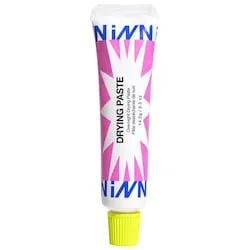
“What it is: A fast-acting spot paste that zaps blemishes overnight without irritation and visibly brightens hyperpigmentation from past breakouts.”
This product can help reduce breakouts and clogged pores because it contains the following ingredient: sulfur. This ingredient is used for treating acne and can have a noticeable effect.
Evens skin toneAscorbyl glucoside, Potassium azeloyl diglycinateMay help
“What it is: A fast-acting spot paste that zaps blemishes overnight without irritation and visibly brightens hyperpigmentation from past breakouts.”
The following ingredient (ingredients) in this product might be helpful, but there is no evidence to confirm that it actually works: ascorbyl glucoside.
Anti-agingNot advertised by the brand · Ascorbyl glucoside, Magnesium aluminum silicate + 1 moreMay help
This product contains ascorbyl glucoside. This ingredient might be able to help reduce and prevent fine lines and wrinkles, improve skin elasticity and firmness, but there is not enough evidence that it actually works.
MoisturizingNot advertised by the brand · Arginine, Algin + 2 moreWorks
This product can help improve hydration of the skin with the two types of ingredients.
The first type is called “humectants”:
these ingredients help attract water.
When humectants are on the surface of the skin, they “pull in” the moisture from the outside environment, or from
within deeper layers of the skin. The following ingredients in this product do the job:
arginine.
This product also contains ingredients called “occlusives”. They help reduce the speed with which our skin loses moisture to the outside environment. These ingredients also help soften the upper layer of the skin, so it feels less tight and nicer to the touch. The following ingredients in this product do the job: arginine.
Anti-oxidationNot advertised by the brand · Ascorbyl glucoside, Salix alba bark extract + 1 moreMay help
This product contains antioxidants (ascorbyl glucoside) that might be able to help neutralize free radicals in skin to lessen the damage it gets from the UV light (sun). There is not enough evidence to confirm their effectiveness in skin though.
Can it cause trouble?
Irritancy4 strong irritants: Thymus vulgaris flower/leaf oil, Origanum vulgare leaf oil + 2 more — patch-test recommendedHigh risk
Comedogenic1 ingredient rated 2 or more on the 0–5 pore-clogging scale1 flagged

User reviews
Be the first — your take helps the next person decide.
Ingredients
Filter by role to see what each ingredient is doing.
Water~40–60%
Kaolin~4.8–7.2%
- Irritation risk
- Low
A type of clay that consists mainly of aluminum silicate. Helps absorb oil and creates a thicker product consistency. Can be used to add a white color
More about KaolinBentonite~3.8–5.7%
Propanediol~2.7–4%
- Irritation risk
- Low
Acts as a solvent for other ingredients. Speeds up the absorption of other ingredients into the skin
More about PropanediolSalix alba bark extract~1.9–2.9%
- Irritation risk
- High
A plant extract that can help neutralize free radicals in skin. It contains a compound salicin that can theoretically be converted into salicylic acid that, in turn, helps reduce inflammation in skin, but the evidence of effectiveness in skin is lacking and the extract is usually not used in a concentration that would enable an exfoliating effect
More about Salix alba bark extractSulfur~1.6–2.4%
Magnesium aluminum silicate~1.4–2.1%
- Irritation risk
- Low
Might be helpful in restoring skin barrier function and, when combined with zinc carbonate and malonic acid, reducing fine lines and wrinkles by stimulating elastin production. Also helps stabilize the product formulation
More about Magnesium aluminum silicate1,2-hexanediol~0.5–1.15%
Ascorbyl glucoside~1.1–1.6%
- Irritation risk
- Medium
A vitamin C derivative that is more stable but less potent than pure form of vitamin C. Has a potential to boost collagen production, nutralise free radicals and reduce hyperpigmentation, but the required concentration is likely to be much higher than for the pure form of vitamin C, limiting the ingredient's effectiveness in products
More about Ascorbyl glucosideSilica~1.1–1.6%
Thymus vulgaris flower/leaf oil~0.5–1.15%
- Irritation risk
- High
Origanum vulgare leaf oil~0.4–0.95%
- Irritation risk
- High
Melaleuca alternifolia leaf oil~0.35–0.8%
- Irritation risk
- High
An essential oil that can be irritating. Has some anti-bacterial properties
More about Melaleuca alternifolia leaf oilPotassium azeloyl diglycinate~0.35–0.75%
- Irritation risk
- Low
A derivative of azelaic acid. It is obtained by reacting the chloride of azelaic acid with two molecules of glycine (an amino acid) and potassium hydroxide. It is less studied than azelaic acid, but the available research suggests that it also can be effective in reducing skin redness, hyperpigmentation and blemishes. There are claims that it is more bio-available and more effective than azelaic acid, but no comparison study is available. Potassium azeloyl diglycinate is better soluble in water compared with azelaic acid. Because of this property, products with potassium azeloyl digclycinate can have a nicer texture
More about Potassium azeloyl diglycinateMagnesium sulfate~0.3–0.75%
Zinc sulfate~0.35–0.8%
Aloe barbadensis leaf juice~0.2–0.8%
- Irritation risk
- Medium
Traditionally used to treat sunburns, dermatitis and inflammation, but evidence for its effectiveness is lacking. The extract can contain humectants that help attract water into the skin
More about Aloe barbadensis leaf juiceCinnamomum camphora bark oil~0.15–0.7%
- Irritation risk
- High
Citrullus lanatus fruit extract~0.15–0.65%
- Irritation risk
- Medium
A plant extract that can contain an antioxidant compound
More about Citrullus lanatus fruit extractGenipa americana extract~0.15–0.6%
- Irritation risk
- Low
Arginine~0.15–0.5%
- Irritation risk
- Low
An amino acid that is naturally present in skin and helps keep it hydrated. When used together with AHAs, it can reduce their irritating effect on the skin
More about ArginineAcacia senegal gum~0.15–0.55%
- Irritation risk
- Medium
Helps mask the small of other ingredients and improve the product texture
More about Acacia senegal gumCitric acid~0.1–0.45%
- Irritation risk
- Medium
Can work as an exfoliant but is typically used to adjust the product pH
More about Citric acidCellulose gum~0.1–0.5%
- Irritation risk
- Low
Used to create thicker product consistency and stabilize emulsions
More about Cellulose gumAlgin~0.1–0.45%
- Irritation risk
- Low
- Comedogenicity
- 3/5
Used to thicken product formulation. Can help attract water to the upper layer of the skin
More about AlginXanthan gum~0.1–0.45%
- Irritation risk
- Low
Used to create a thicker product consistency
More about Xanthan gumMaltodextrin~0.1–0.4%
- Irritation risk
- Low
Used to stabilize the product formulation and can help absorb oil
More about MaltodextrinSodium citrate~0.1–0.3%
- Irritation risk
- Medium
Helps to control the skin's pH level. Maintains the skin's natural film of amino-lactic acids and oils. Helps to preserve products
More about Sodium citrateSodium phytate~0.05–0.3%
Polyacrylate crosspolymer-6~0.05–0.3%
- Irritation risk
- Low
Aluminum hydroxide~0.05–0.3%
- Irritation risk
- Low
Is used to add opaque (non-transparent) appearance to formulations. Can be used to coat other ingredients for even dispersion. This is a different ingredient compared to the ones used in antipersperants (aluminium chloride and aluminium chlorohydrate)
More about Aluminum hydroxideHydroxyacetophenone~0.05–0.15%
Titanium dioxide~0.05–0.2%
- Irritation risk
- Low
Works as a UV filter when used in high concentrations. It is photostable and is effective mostly against the UVB light, with some protection in the UVA range. In small concentrations, used for its ability to improve the color of cosmetic products. Is usually well tolerated by the skin
More about Titanium dioxideIngredient list view
Water, Kaolin, Bentonite, Propanediol, Salix alba bark extract, Sulfur, Magnesium aluminum silicate, 1,2-hexanediol, Ascorbyl glucoside, Silica, Thymus vulgaris flower/leaf oil, Origanum vulgare leaf oil, Melaleuca alternifolia leaf oil, Potassium azeloyl diglycinate, Magnesium sulfate, Zinc sulfate, Aloe barbadensis leaf juice, Cinnamomum camphora bark oil, Citrullus lanatus fruit extract, Genipa americana extract, Arginine, Acacia senegal gum, Citric acid, Cellulose gum, Algin, Xanthan gum, Maltodextrin, Sodium citrate, Sodium phytate, Polyacrylate crosspolymer-6, Aluminum hydroxide, Hydroxyacetophenone, Titanium dioxide
Compare prices
Retailers ranked by price — lowest first.

Worth comparing, line by line.
Match % combines shared ingredients, the first five ingredients, shared actives and hero ingredients, irritancy (lower counts in the alternative's favour), texture and body area. Only products in the same routine step are compared.
| INNBEAUTY PROJECTPimple PasteYOUR PRODUCT | Transparent LabAdult Acne Treatment | Transparent LabsPIH SUN SPOT FADING TREATMENT | PlenaireViolet Paste Overnight Blemish Treatment | |
|---|---|---|---|---|
| Match | — | 72% | 70% | 69% |
| Price | $22.00 | $20.10−$1.90 | $18.74−$3.26 | $42.00+$20.00 |
| Shared key ingredients | — | 1 of 5 | 1 of 5 | 1 of 5 |
| Key difference | — | Salicylic Acid | Salicylic Acid | Salicylic Acid |
| Irritancy | High | Low | Low | Medium |
| Drying alcohol | — | — | — | — |
| View product | Shop | Shop | Shop |


More alternatives: Versed Skin Game Over Acne Drying TreatmentHydroPeptide Spot Correction - Acne Eliminating Treatment
Product summary
"INNBEAUTY PROJECT - Pimple Paste" is effective for: Anti-blemish
This product could be helpful for: Moisturizing, Evens skin tone and Anti-aging, but its actives are not the most effective or are not well-studied.
Ingredient callouts
- Humectants (arginine 0.15% - 0.55%). These ingredients help attract water to the upper layer of the skin and improve the skin hydration.
Price
The product retails for 75.54A$ in Australia, for 34.00$ in the United States, for 92.20£ in the United Kingdom and for 23.00CA$ in Canada.
For a detailed price comparison: click here.
Sources cited in this review
Every concentration estimate and effectiveness label is anchored to one of these 15 studies and safety reviews.
- 1Efficacy and Safety of White Willow Bark (Salix alba) Extractonlinelibrary.wiley.com
- 2
- 3
- 4
- 5
- 6The Roles of Vitamin C in Skin Healthncbi.nlm.nih.gov

Affiliate links · As an Amazon Associate, WIMJ earns from qualifying purchases.