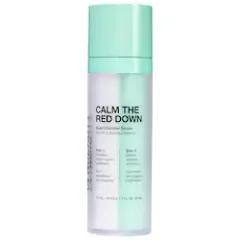
INNBEAUTY PROJECT Calm The Red Down Redness & Color Correcting Dual Serum with Centella + Azelaic Acid
Works for:
based on ingredients and %- Moisturizing
- Anti-oxidation
- Evens skin tone
- Anti-aging
Can it cause trouble?
- Irritation risk: high
- Comedogenic risk ingredients: 2
Key actives


Anti-oxidation
This product contains antioxidants (madecassoside) that can help neutralize free radicals in skin. By doing so, they can lessen the damage the skin gets from the UV light (sun).
An antioxidant that is typically derived from plant Centella Asiatica. It can help neutralize free radicals in skin and support skin barrier function. It could, however, itself be irritating. It is often unstable in formulations
A fruit extract that might have an anti-oxidant effect in skin
A berry extract that might help neutralize free radicals on the surface of the skin
An emollient that helps soften the upper layer of the skin. Might have some weak anti-oxidant properties
Pure form of vitamin E. Can help moisturise and protect the skin from free radicals. Often used to help stabilise other ingredients or the formula itself
Might be somewhat helpful in reducing hyperpigmentation and neutralizing free radicals but its typical concentration in a product is too low for having an effect
A great emollient. Contains vitamin E (tocopherol) which may give it some anti-oxidant properties. Can contain volatile compounds and can be irritating
An active component of chamomile plant that historically has been used to calm down irritated skin. A recent study shows that bisabolol indeed can have some anti-inflammatory effect on skin, even though conclusive data is lacking. Bisabolol has a sweet floral scent and can be added to products for its aromatic properties
Evens skin tone
This product can help reduce hypepigmentation and even out the skin tone because it contains the following effective ingredients: potassium azeloyl diglycinate
The following ingredient (ingredients) in this product might be helpful, but there is no evidence to confirm that it actually can help even out the skin tone: madecassoside.
Keep in mind that you would need to apply any topical skincare targetted at hypigmentation consistently for a couple of months to get a result. No topical skincare product can help get rid of hyperpigmentation (including post-acne marks and age spots) instantly.
A derivative of azelaic acid. It is obtained by reacting the chloride of azelaic acid with two molecules of glycine (an amino acid) and potassium hydroxide. It is less studied than azelaic acid, but the available research suggests that it also can be effective in reducing skin redness, hyperpigmentation and blemishes. There are claims that it is more bio-available and more effective than azelaic acid, but no comparison study is available. Potassium azeloyl diglycinate is better soluble in water compared with azelaic acid. Because of this property, products with potassium azeloyl digclycinate can have a nicer texture
An antioxidant that is typically derived from plant Centella Asiatica. It can help neutralize free radicals in skin and support skin barrier function. It could, however, itself be irritating. It is often unstable in formulations
Moisturizing
What does the product description say?
Snow Mushroom and Centella Stem Cells: Provide a boost of hydration and support skin barrier.
Source: Sephora
This product can help improve hydration of the skin with the two types of ingredients.
The first type is called “humectants”:
these ingredients help attract water.
When humectants are on the surface of the skin, they “pull in” the moisture from the outside environment, or from
within deeper layers of the skin. The following ingredients in this product do the job:
glycerin, glyceryl glucoside.
This product also contains ingredients called “occlusives”. They help reduce the speed with which our skin loses moisture to the outside environment. These ingredients also help soften the upper layer of the skin, so it feels less tight and nicer to the touch. The following ingredients in this product do the job: caprylic/capric triglyceride, dimethicone.
The following ingredients in this product are especially good for supporting the skin barrier and helping with the hydration level: ceramide ap, ceramide eop, ceramide np, hexapeptide-9, madecassoside, panthenol, phytosphingosine
An emollient that is naturally found in skin
Can help to restore skin barrier function and soften its upper layer
A type of peptide. Peptides are excellent moisturizers and might be able support collagen production reducing fine lines and wrinkles
An antioxidant that is typically derived from plant Centella Asiatica. It can help neutralize free radicals in skin and support skin barrier function. It could, however, itself be irritating. It is often unstable in formulations
Helps attract water to the upper layer of the skin and can help improve skin barrier function
A type of silicone that can decrease loss of moisture from the skin surface. It helps create a nice product texture
A type of lipid that is naturally present in skin. It might help in repairing skin barrier function and has anti-bacterial effect
Naturally present in skin and helps to attract water to its upper layer
An oil naturally present in skin. Works as an emollient to soften the skin and form a protective layer on its surface without a greasy feeling.
Helps soften the upper layer of the skin
Softens the upper layer of skin and helps restore the healthy skin barrier. Has shown to help calm down inflammation in skin. It is a stable oil, meaning that it retains its properties even when exposed to air.
An emollient that helps soften the upper layer of the skin. Might have some weak anti-oxidant properties
A product of bacterial fermentation. Can help attract water to the upper layer of the skin
A good mix of fatty acids that forms a protective layer on the skin. Improves the shelf life of products. Derived from coconut and glycerin
A type of lipid similar to ceramides naturally present in skin. Helps to soften the upper layer of the skin and supports the skin barrier function to keep it hydrated. Can help to prevent inflammation in skin
A type of lipid similar to ceramides naturally present in skin. Helps to soften the upper layer of the skin and supports the skin barrier function to keep it hydrated. Can help to prevent inflammation in skin
A type of lipid similar to ceramides naturally present in skin. Helps to soften the upper layer of the skin and supports the skin barrier function to keep it hydrated. Can help to prevent inflammation in skin
A silicone that helps to reduce water loss from the surface of the skin. Can temporarily "fill in" lines and wrinkles, absorb oil, and create a nice product finish
One of the best moisturizing ingredients. Naturally present in skin. It attracts water to the upper layer of the skin working as a humectant
A non-drying alcohol. Works as an emollient. Helps water and oil mix together and creates a nice product texture
A derivative of azelaic acid. It is obtained by reacting the chloride of azelaic acid with two molecules of glycine (an amino acid) and potassium hydroxide. It is less studied than azelaic acid, but the available research suggests that it also can be effective in reducing skin redness, hyperpigmentation and blemishes. There are claims that it is more bio-available and more effective than azelaic acid, but no comparison study is available. Potassium azeloyl diglycinate is better soluble in water compared with azelaic acid. Because of this property, products with potassium azeloyl digclycinate can have a nicer texture
Helps products spread more easily and works as an emollient to soften skin
Helps attract water to the upper layer of the skin and improves the product texture
Helps preserve products and creates a nice product texture
An emollient that softens the skin and forms a protective layer on its surface. Helps water and oil mix together
Used to create a thicker product consistency and soften the upper layer of the skin
Non-drying alcohol that helps water and oil mix together. Also serves as an emollient
Used to preserve products, dissolve other ingredients and create a nice product texture
Used to create a nice product texture and help delivery of other ingredients. Might be somewhat helpful in attracting water to the upper layer of the skin
Helps water and oil mix together and softens the upper layer of the skin
A great emollient. Contains vitamin E (tocopherol) which may give it some anti-oxidant properties. Can contain volatile compounds and can be irritating
Helps calm down inflammation in skin and can help reduce itching. Helps to repair the skin barrier and keep skin hydrated
Pure form of vitamin E. Can help moisturise and protect the skin from free radicals. Often used to help stabilise other ingredients or the formula itself
Might be somewhat helpful in reducing hyperpigmentation and neutralizing free radicals but its typical concentration in a product is too low for having an effect
Anti-aging
This product contains centella asiatica leaf extract, hexapeptide-9, madecassoside. These ingredients might be able to help reduce and prevent fine lines and wrinkles, improve skin elasticity and firmness, but there is not enough evidence that it actually works.
A type of peptide. Peptides are excellent moisturizers and might be able support collagen production reducing fine lines and wrinkles
A plant extract that has been shown to be able to reduce inflammation in skin, support restoration of skin barrier function, as well as support collagen production. It can be irritating to sensitive skin. Might be helpful in preventing stretch marks. It could, however, itself be irritating.
An antioxidant that is typically derived from plant Centella Asiatica. It can help neutralize free radicals in skin and support skin barrier function. It could, however, itself be irritating. It is often unstable in formulations
Pure form of vitamin E. Can help moisturise and protect the skin from free radicals. Often used to help stabilise other ingredients or the formula itself
Anti-blemish
This product might be able to help reduce blemishes and clogged pores because it contains potassium azeloyl diglycinate.
A derivative of azelaic acid. It is obtained by reacting the chloride of azelaic acid with two molecules of glycine (an amino acid) and potassium hydroxide. It is less studied than azelaic acid, but the available research suggests that it also can be effective in reducing skin redness, hyperpigmentation and blemishes. There are claims that it is more bio-available and more effective than azelaic acid, but no comparison study is available. Potassium azeloyl diglycinate is better soluble in water compared with azelaic acid. Because of this property, products with potassium azeloyl digclycinate can have a nicer texture
A plant extract that has been shown to be able to reduce inflammation in skin, support restoration of skin barrier function, as well as support collagen production. It can be irritating to sensitive skin. Might be helpful in preventing stretch marks. It could, however, itself be irritating.
A type of lipid that is naturally present in skin. It might help in repairing skin barrier function and has anti-bacterial effect
Helps calm down inflammation in skin and can help reduce itching. Helps to repair the skin barrier and keep skin hydrated
How honest is this product?
| Promise | Can it deliver? |
|---|---|
| Moisturizing |
Total Promises Fulfilled score: 100/100.
We receive a small commission for purchases made through these links at no cost for you. Thank you for your support! Learn more
Potential irritants
Comedogenic ingredients
User reviews (0)
Averages from community submissions.
No reviews yet for this product.
Be the first to share your experience!
Tried this product?
Help capture what the ingredient list can't—texture, finish, pilling, scent, and more. Answer what you can, skip the rest.
Takes ~30 seconds.
Reviews are shown in aggregate. No personal details.
| Product | Similarity | Price | Irritancy |
|---|---|---|---|
 INNBEAUTY PROJECT Calm The Red Down Redness & Color Correcting Dual Serum with Centella + Azelaic Acid | Current | $56.00 | |
 UltraLuxe 9 OC Age Control Complex Oil Control | 59% | - | |
SkinTra Ceramide Cuddles | 51% | ≈ $18.42 | |
MEDI-PEEL Luminous Silk Oil Serum | 50% | $30.20 | |
 Hanskin Seven Layer Ceramide Serum | 50% | $14.00 | |
 Dermatica Retinal 0.2% | 50% | $47.99 |
Key Actives
Helps calm down inflammation in skin and can help reduce itching. Helps to repair the skin barrier and keep skin hydrated
Helps calm down inflammation in skin and can help reduce itching. Helps to repair the skin barrier and keep skin hydrated
A plant extract that has been shown to be able to reduce inflammation in skin, support restoration of skin barrier function, as well as support collagen production. It can be irritating to sensitive skin. Might be helpful in preventing stretch marks. It could, however, itself be irritating.
A derivative of azelaic acid. It is obtained by reacting the chloride of azelaic acid with two molecules of glycine (an amino acid) and potassium hydroxide. It is less studied than azelaic acid, but the available research suggests that it also can be effective in reducing skin redness, hyperpigmentation and blemishes. There are claims that it is more bio-available and more effective than azelaic acid, but no comparison study is available. Potassium azeloyl diglycinate is better soluble in water compared with azelaic acid. Because of this property, products with potassium azeloyl digclycinate can have a nicer texture
An antioxidant that is typically derived from plant Centella Asiatica. It can help neutralize free radicals in skin and support skin barrier function. It could, however, itself be irritating. It is often unstable in formulations
Pure form of vitamin E. Can help moisturise and protect the skin from free radicals. Often used to help stabilise other ingredients or the formula itself
Pure form of vitamin E. Can help moisturise and protect the skin from free radicals. Often used to help stabilise other ingredients or the formula itself
Helps attract water to the upper layer of the skin and can help improve skin barrier function
A type of lipid similar to ceramides naturally present in skin. Helps to soften the upper layer of the skin and supports the skin barrier function to keep it hydrated. Can help to prevent inflammation in skin
A type of lipid similar to ceramides naturally present in skin. Helps to soften the upper layer of the skin and supports the skin barrier function to keep it hydrated. Can help to prevent inflammation in skin
A type of lipid similar to ceramides naturally present in skin. Helps to soften the upper layer of the skin and supports the skin barrier function to keep it hydrated. Can help to prevent inflammation in skin
An active component of chamomile plant that historically has been used to calm down irritated skin. A recent study shows that bisabolol indeed can have some anti-inflammatory effect on skin, even though conclusive data is lacking. Bisabolol has a sweet floral scent and can be added to products for its aromatic properties
Helps attract water to the upper layer of the skin and can help improve skin barrier function
A type of lipid that is naturally present in skin. It might help in repairing skin barrier function and has anti-bacterial effect
An emollient that helps soften the upper layer of the skin. Might have some weak anti-oxidant properties
A type of peptide. Peptides are excellent moisturizers and might be able support collagen production reducing fine lines and wrinkles
A silicone that helps to reduce water loss from the surface of the skin. Can temporarily "fill in" lines and wrinkles, absorb oil, and create a nice product finish
An emollient that is naturally found in skin
One of the best moisturizing ingredients. Naturally present in skin. It attracts water to the upper layer of the skin working as a humectant
A good mix of fatty acids that forms a protective layer on the skin. Improves the shelf life of products. Derived from coconut and glycerin
An oil naturally present in skin. Works as an emollient to soften the skin and form a protective layer on its surface without a greasy feeling.
Softens the upper layer of skin and helps restore the healthy skin barrier. Has shown to help calm down inflammation in skin. It is a stable oil, meaning that it retains its properties even when exposed to air.
Can help to restore skin barrier function and soften its upper layer
A product of bacterial fermentation. Can help attract water to the upper layer of the skin
A type of silicone that can decrease loss of moisture from the skin surface. It helps create a nice product texture
One of the best moisturizing ingredients. Naturally present in skin. It attracts water to the upper layer of the skin working as a humectant
Works as a UV filter when used in high concentrations. It is photostable and is effective mostly against the UVB light, with some protection in the UVA range. In small concentrations, used for its ability to improve the color of cosmetic products. Is usually well tolerated by the skin
Helps soften the upper layer of the skin
An oil naturally present in skin. Works as an emollient to soften the skin and form a protective layer on its surface without a greasy feeling.
Naturally present in skin and helps to attract water to its upper layer
Potential irritants
Plant extract that can have healing and anti-inflammatory properties. It is a potential allergen and can be irritating
A plant extract that can be irritating. It can have some anti-bacterial properties, but there are no evidence of a beneficial effect for skin
Hops extract. Can contain common irritants and allergens geraniol, limonene, linalool
Helps mask the smell of other ingredients and helps preserve the product formulation
A good mix of fatty acids that forms a protective layer on the skin. Improves the shelf life of products. Derived from coconut and glycerin
A fruit extract that might have an anti-oxidant effect in skin
An emollient that helps soften the upper layer of the skin. Might have some weak anti-oxidant properties
Softens the upper layer of skin and helps restore the healthy skin barrier. Has shown to help calm down inflammation in skin. It is a stable oil, meaning that it retains its properties even when exposed to air.
An antioxidant that is typically derived from plant Centella Asiatica. It can help neutralize free radicals in skin and support skin barrier function. It could, however, itself be irritating. It is often unstable in formulations
Might be somewhat helpful in reducing hyperpigmentation and neutralizing free radicals but its typical concentration in a product is too low for having an effect
A berry extract that might help neutralize free radicals on the surface of the skin
A great emollient. Contains vitamin E (tocopherol) which may give it some anti-oxidant properties. Can contain volatile compounds and can be irritating
Maintains the texture of skincare products. Allows the product to spread evenly. Helps oil and water mix together
Helps preserve products and creates a nice product texture
Helps to control the skin's pH level. Maintains the skin's natural film of amino-lactic acids and oils. Helps to preserve products
Can work as an exfoliant but is typically used to adjust the product pH
Used to preserve products, dissolve other ingredients and create a nice product texture
Used to create a thicker product consistency and soften the upper layer of the skin
A plant extract that has been shown to be able to reduce inflammation in skin, support restoration of skin barrier function, as well as support collagen production. It can be irritating to sensitive skin. Might be helpful in preventing stretch marks. It could, however, itself be irritating.
A preservative that comes from radishes fermented by a bacteria. New research suggests that the preservation properties in the ingredient come from an ammonium salt that is not present naturally in radish root but used in its cultivation. Is problematic because the exact amount of the preservative agents is difficult to determine
Helps water and oil mix together and softens the upper layer of the skin
Helps water and oil mix together and works as a cleansing agent
Used to improve stability of the formulation
Comedogenic ingredients
A non-drying alcohol. Works as an emollient. Helps water and oil mix together and creates a nice product texture
All ingredients
One of the best moisturizing ingredients. Naturally present in skin. It attracts water to the upper layer of the skin working as a humectant
A good mix of fatty acids that forms a protective layer on the skin. Improves the shelf life of products. Derived from coconut and glycerin
Helps products spread more easily and works as an emollient to soften skin
A fruit extract that might have an anti-oxidant effect in skin
An oil naturally present in skin. Works as an emollient to soften the skin and form a protective layer on its surface without a greasy feeling.
Acts as a solvent for other ingredients. Speeds up the absorption of other ingredients into the skin
An emollient that helps soften the upper layer of the skin. Might have some weak anti-oxidant properties
Softens the upper layer of skin and helps restore the healthy skin barrier. Has shown to help calm down inflammation in skin. It is a stable oil, meaning that it retains its properties even when exposed to air.
A derivative of azelaic acid. It is obtained by reacting the chloride of azelaic acid with two molecules of glycine (an amino acid) and potassium hydroxide. It is less studied than azelaic acid, but the available research suggests that it also can be effective in reducing skin redness, hyperpigmentation and blemishes. There are claims that it is more bio-available and more effective than azelaic acid, but no comparison study is available. Potassium azeloyl diglycinate is better soluble in water compared with azelaic acid. Because of this property, products with potassium azeloyl digclycinate can have a nicer texture
An antioxidant that is typically derived from plant Centella Asiatica. It can help neutralize free radicals in skin and support skin barrier function. It could, however, itself be irritating. It is often unstable in formulations
A type of peptide. Peptides are excellent moisturizers and might be able support collagen production reducing fine lines and wrinkles
Plant extract that can have healing and anti-inflammatory properties. It is a potential allergen and can be irritating
Might be somewhat helpful in reducing hyperpigmentation and neutralizing free radicals but its typical concentration in a product is too low for having an effect
Helps calm down inflammation in skin and can help reduce itching. Helps to repair the skin barrier and keep skin hydrated
Can help to restore skin barrier function and soften its upper layer
A plant extract that can be irritating. It can have some anti-bacterial properties, but there are no evidence of a beneficial effect for skin
A berry extract that might help neutralize free radicals on the surface of the skin
Hops extract. Can contain common irritants and allergens geraniol, limonene, linalool
A product of bacterial fermentation. Can help attract water to the upper layer of the skin
A great emollient. Contains vitamin E (tocopherol) which may give it some anti-oxidant properties. Can contain volatile compounds and can be irritating
Helps attract water to the upper layer of the skin and can help improve skin barrier function
Helps attract water to the upper layer of the skin and improves the product texture
Used to create a nice product texture and help delivery of other ingredients. Might be somewhat helpful in attracting water to the upper layer of the skin
A non-drying alcohol that helps stabilize product formulations
Maintains the texture of skincare products. Allows the product to spread evenly. Helps oil and water mix together
Non-drying alcohol that helps water and oil mix together. Also serves as an emollient
Helps mask the smell of other ingredients and helps preserve the product formulation
Helps preserve products and creates a nice product texture
An emollient that softens the skin and forms a protective layer on its surface. Helps water and oil mix together
Pure form of vitamin E. Can help moisturise and protect the skin from free radicals. Often used to help stabilise other ingredients or the formula itself
Helps to control the skin's pH level. Maintains the skin's natural film of amino-lactic acids and oils. Helps to preserve products
Can work as an exfoliant but is typically used to adjust the product pH
Helps mask the smell of other ingredients and helps preserve the product formulation
A type of silicone that can decrease loss of moisture from the skin surface. It helps create a nice product texture
A silicone that helps to reduce water loss from the surface of the skin. Can temporarily "fill in" lines and wrinkles, absorb oil, and create a nice product finish
Used to create a nice product texture and help delivery of other ingredients. Might be somewhat helpful in attracting water to the upper layer of the skin
One of the best moisturizing ingredients. Naturally present in skin. It attracts water to the upper layer of the skin working as a humectant
Works as a UV filter when used in high concentrations. It is photostable and is effective mostly against the UVB light, with some protection in the UVA range. In small concentrations, used for its ability to improve the color of cosmetic products. Is usually well tolerated by the skin
A type of silicone that helps create a nice product consistency and support the delivery of other ingredients
Used to preserve products, dissolve other ingredients and create a nice product texture
A type of clay that is used to thicken the product consistency
Used to stabilize product formulations and create a nice product texture
Creates an illusion of smoother and more radiant skin tone. Adds shimmer to the skin by reflecting light
A type of silicone that create a smooth product finish and can create an optical soft-focus effect on the skin. Helps to thicken the product consistency
An oil naturally present in skin. Works as an emollient to soften the skin and form a protective layer on its surface without a greasy feeling.
Used to create a thicker product consistency and soften the upper layer of the skin
A plant extract that has been shown to be able to reduce inflammation in skin, support restoration of skin barrier function, as well as support collagen production. It can be irritating to sensitive skin. Might be helpful in preventing stretch marks. It could, however, itself be irritating.
A type of lipid similar to ceramides naturally present in skin. Helps to soften the upper layer of the skin and supports the skin barrier function to keep it hydrated. Can help to prevent inflammation in skin
A type of lipid similar to ceramides naturally present in skin. Helps to soften the upper layer of the skin and supports the skin barrier function to keep it hydrated. Can help to prevent inflammation in skin
A type of lipid similar to ceramides naturally present in skin. Helps to soften the upper layer of the skin and supports the skin barrier function to keep it hydrated. Can help to prevent inflammation in skin
An active component of chamomile plant that historically has been used to calm down irritated skin. A recent study shows that bisabolol indeed can have some anti-inflammatory effect on skin, even though conclusive data is lacking. Bisabolol has a sweet floral scent and can be added to products for its aromatic properties
Helps attract water to the upper layer of the skin and can help improve skin barrier function
Helps calm down inflammation in skin and can help reduce itching. Helps to repair the skin barrier and keep skin hydrated
Naturally present in skin and helps to attract water to its upper layer
A preservative that comes from radishes fermented by a bacteria. New research suggests that the preservation properties in the ingredient come from an ammonium salt that is not present naturally in radish root but used in its cultivation. Is problematic because the exact amount of the preservative agents is difficult to determine
A type of lipid that is naturally present in skin. It might help in repairing skin barrier function and has anti-bacterial effect
Helps water and oil mix together and softens the upper layer of the skin
Helps water and oil mix together and works as a cleansing agent
A non-drying alcohol. Works as an emollient. Helps water and oil mix together and creates a nice product texture
An emollient that softens the skin and forms a protective layer on its surface. Helps water and oil mix together
Can work as an exfoliant but is typically used to adjust the product pH
Pure form of vitamin E. Can help moisturise and protect the skin from free radicals. Often used to help stabilise other ingredients or the formula itself
Used to improve stability of the formulation
A type of silicone that helps oil and water mix well together. Helps to disperse other ingredients, e.g. pigments, evenly in a formulation
An umbrella term for the following three colorants: CI 77491, CI 77492, CI 77499. They might be able to offer some protection against visible light, but the degree of the protection is not clear
An umbrella term for the following three colorants: CI 77491, CI 77492, CI 77499. They might be able to offer some protection against visible light, but the degree of the protection is not clear
An umbrella term for the following three colorants: CI 77491, CI 77492, CI 77499. They might be able to offer some protection against visible light, but the degree of the protection is not clear
Ingredient list view
Water, Glycerin, Caprylic/capric triglyceride, Dicaprylyl carbonate, Annona cherimola fruit extract, Squalane, Propanediol, Argania spinosa kernel oil, Simmondsia chinensis seed oil, Potassium azeloyl diglycinate, Madecassoside, Heptapeptide-6, Hexapeptide-9, Chamomilla recutita flower extract, Cucumis sativus fruit extract, Allantoin, Glyceryl glucoside, Arnica montana flower extract, Schisandra chinensis fruit extract, Phoenix dactylifera seed extract, Humulus lupulus extract, Bacillus ferment, Sphingomonas ferment extract, Tasmannia lanceolata leaf extract, Rosa canina fruit oil, Panthenol, Sorbitol, Butylene glycol, C12-20 alkyl glucoside, C14-22 alcohols, Acrylates/c10-30 alkyl acrylate crosspolymer, Behenyl alcohol, Phenylpropanol, Caprylyl glycol, Polyglyceryl-10 laurate, Silica, 1,2-hexanediol, Glyceryl stearate, Tocopherol, Sodium citrate, Citric acid, Sodium dehydroacetate, Ethylhexylglycerin, Sodium hydroxide, Phenylpropanol, Sodium phytate, Hydroxyacetophenone, Water, Phenyl trimethicone, Dimethicone, Butylene glycol, Glycerin, Titanium dioxide, Lauryl polyglyceryl-3 polydimethylsiloxyethyl dimethicone, Trimethylsiloxysilicate, Triethylhexanoin, Pentylene glycol, Polyglyceryl-3 polydimethylsiloxyethyl dimethicone, Disteardimonium hectorite, Dimethicone/vinyl dimethicone crosspolymer, Mica, 1,2-hexanediol, Magnesium sulfate, Vinyl dimethicone/methicone silsesquioxane crosspolymer, Squalane, Silica, Tridecyl trimellitate, Centella asiatica leaf extract, Centella asiatica leaf water, Centella asiatica meristem cell culture, Ceramide ap, Ceramide eop, Ceramide np, Cucumis sativus fruit water, Bisabolol, Panthenol, Allantoin, Sodium pca, Leuconostoc/radish root ferment filtrate, Cholesterol, Phytosphingosine, Polyglyceryl-10 stearate, Sodium cetearyl sulfate, Acrylates/ammonium methacrylate copolymer, Polyglyceryl-6 behenate, Cetearyl alcohol, Glyceryl stearate, Behenic acid, Cellulose acetate, Potassium sorbate, Citric acid, Xanthan gum, Ethylhexylglycerin, Sodium levulinate, Tocopherol, Magnesium stearate, Trisodium ethylenediamine disuccinate, Propylene glycol stearate, Triethoxycaprylylsilane, Triethyl citrate, Iron oxides, Iron oxides, Chromium oxide greens, Iron oxides
- Glycerol and the skin: holistic approach to its origin and functions
- Annona cherimola Miller Fruit as a Promising Candidate against Diabetic Complications: An In Vitro Study and Preliminary Clinical Results
- Assessment of the antioxidant, cytotoxic, and genotoxic potential of the Annona muricata leaves and their influence on genomic stability
- Natural vegetable fats in the prevention of irritant contact dermatitis
- Clinical and instrumental assessment of the effects of a new product based on hydroxypropyl chitosan and potassium azeloyl diglycinate in the management of rosacea
- A Preliminary Clinical Evaluation of a Topical Product for Reducing Slight Rosacea Imperfections
- Azeloyl-Glycine: A new active in skin disequilibrium
- Formulation and evaluation of the cream made from potassium azeloyl diglycinate as an anti-aging
- Centella asiatica in Dermatology: An Overview
- Protective effect of madecassoside on H2O2-induced oxidative stress and autophagy activation in human melanocytes
- Madecassoside, a triterpenoid saponin isolated from Centella asiatica herbs, protects endothelial cells against oxidative stress
- Madecassoside Inhibits Melanin Synthesis by Blocking Ultraviolet-Induced Inflammation
- Contact dermatitis due to Madecassol
- The Effects of a Standardized Extract of Centella asiatica on Postlaser Resurfacing Wound Healing on the Face: A Split-Face, Double-Blind, Randomized, Placebo-Controlled Trial
- Stability Study of the Active Constituents in the Centella asiatica Extract Formulations
- Profile of wound healing process induced by allantoin
- Effects of glyceryl glucoside on AQP3 expression, barrier function and hydration of human skin
- Treatment of Xerosis with a Topical Formulation Containing Glyceryl Glucoside, Natural Moisturizing Factors, and Ceramide
- Effects of Topical Arnica Gel on Post-Laser Treatment Bruises
- Effects of microcurrent application alone or in combination with topical Hypericum perforatum L. and Arnica montana L. on surgically induced wound healing in Wistar rats
- The seamy side of natural medicines: contact sensitization to arnica (Arnica montana L.) and marigold (Calendula officinalis L.)
- Accelerated resolution of laser‐induced bruising with topical 20% arnica: a rater‐blinded randomized controlled trial
- Skin moisturizing effects of panthenol-based formulations
- Safety Assessment of Panthenol, Pantothenic Acid, and Derivatives as Used in Cosmetics
- Contact dermatitis caused by alkyl glucosides in the modern cosmetic industry and contact dermatitis in the Canadian aircraft industry
- Safety Assessment of Decyl Glucoside and Other Alkyl Glucosides as Used in Cosmetics
- In Vitro Assessment of Skin Irritation Potential of Surfactant-based Formulations by Using a 3-D Skin Reconstructed Tissue Model and Cytokine Response
- The influence of alkane chain length on the skin irritation potential of 1,2-alkanediols
- Vitamin E in dermatology
- Vitamin E and Skin Health
- 4 Final Report on the Safety Assessment of Sodium Dehydroacetate and Dehydroacetic Acid
- Dimethicone as a protective ingredient in topical medications
- Final Report on the Safety Assessment of Dimethicone Copolyol
- Amended Safety Assessment of Triglycerides as Used in Cosmetics
- Safety Assessment of Magnesium Sulfate as Used in Cosmetics
- Centella asiatica in Dermatology: An Overview
- Topically Applied Ceramides Interact with the Stratum Corneum Lipid Matrix in Compromised Ex Vivo Skin
- Topical emulsions containing ceramides: Effects on the skin barrier function and anti‐inflammatory properties
- Skin hydration is significantly increased by a cream formulated to mimic the skin’s own natural moisturizing systems
- α-(-)-Bisabolol Reduces Pro-Inflammatory Cytokine Production and Ameliorates Skin Inflammation
- Safety Assessment of Polyglyceryl Fatty Acid Esters as Used in Cosmetics
- Final Report on the Safety Assessment of Sodium Cetearyl Sulfate
- Citric Acid, Inorganic Citrate Salts and Alkyl Citrate Esters As Used in Cosmetics