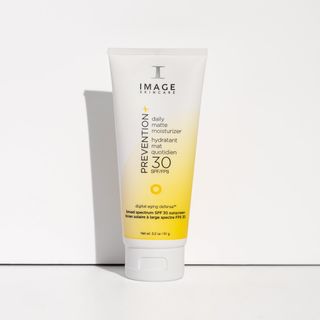
Image skincare PREVENTION+ daily matte moisturizer SPF 30
Works for
3 of 3 advertised claims delivered
Sun protectionSPF 30 · 3 UV filtersBroad spectrum
This product offers a good level of protection against both UVB and UVA rays.
This sunscreen uses organic (so-called "chemical") sunscreen filters. Organic, or "chemical" filters usually provide reliable sun protection and rarely leave a white cast. Sunscreens with organic filters can sting eyes.
This product can be considered "reef safe" because it does not contain the UV filters (oxybenzone and octinoxate) that can be harmful to coral reefs when present in the water in high concentrations.
Anti-aging5 ingredients credited for this claimStrong support
“This matte moisturizer with SPF 30 prepares your skin to face the day with broad-spectrum sunscreen protection while fighting future signs of skin aging and delivering light hydration to help reinforce the moisture barrier.”
This product can help prevent early signs of skin aging because it offers a good level of broad spectrum sun protection. Sun damage is the main cause of premature skin aging, and protecting your skin from the sun is the best anti-aging strategy.
These ingredients in the product might also be helpful for reducing and preventing fine lines, wrinkles, and skin elasticity, even though there is no conclusive evidence for their effectiveness: acetyl zingerone.
Moisturizing22 ingredients credited for this claimStrong support
“This matte moisturizer with SPF 30 prepares your skin to face the day with broad-spectrum sunscreen protection while fighting future signs of skin aging and delivering light hydration to help reinforce the moisture barrier.”
This product can help improve hydration of the skin with the two types of ingredients.
The first type is called “humectants”:
these ingredients help attract water.
When humectants are on the surface of the skin, they “pull in” the moisture from the outside environment, or from
within deeper layers of the skin. The following ingredients in this product do the job:
glycerin, mannitol.
This product also contains ingredients called “occlusives”. They help reduce the speed with which our skin loses moisture to the outside environment. These ingredients also help soften the upper layer of the skin, so it feels less tight and nicer to the touch. The following ingredients in this product do the job: dimethicone, squalane.
The following ingredients in this product are especially good for supporting the skin barrier and helping with the hydration level: panthenol
Evens skin toneNot advertised by the brand · 2 ingredients credited for this claimStrong support
This product offers broad spectrum sun protection. It means that it can prevent hyperpigmentation and help keep the skin tone even (sun damage is the main factor causing age spots, darkening of post-acne marks and other discolorations).
Anti-oxidationNot advertised by the brand · 5 ingredients credited for this claimStrong support
This product contains antioxidants (acetyl zingerone) that can help neutralize free radicals in skin. By doing so, they can lessen the damage the skin gets from the UV light (sun).
The following ingredients - haematococcus pluvialis extract also can have an antioxidant effect, but there is less evidence to confirm their effectiveness in skin.
Can it cause trouble?
Irritancy1 strong irritant: Vanilla planifolia fruit extractMedium risk
Comedogenic2 ingredients rated 2 or more on the 0–5 pore-clogging scale2 flagged


User reviews
Be the first — your take helps the next person decide.
Ingredients
Filter by role to see what each ingredient is doing.
Homosalate5%
- Irritation risk
- Medium
A weak sunscreen that offers some protection against the sun rays that cause sunburn (UVB), but does not offer meaningful protection against protect against the most aging sun rays (UVA). It loses its effectiveness quickly when exposed to sunlight. It is an organic, or so called "chemical" sunscreen. When used in low concentrations, helps to stabilize the product formulation
More about HomosalateEthylhexyl salicylate5%
- Irritation risk
- Low
Octisalate. A UV filter. It offers some protection against the sun rays that cause sunburn (UVB), but does not protect against the most aging sun rays (UVA). It loses its effectiveness quickly when exposed to sunlight. It is an organic, or so called "chemical" sunscreen
More about Ethylhexyl salicylateZinc oxide9.3%
- Irritation risk
- Low
A broad spectrum sunblock (protects from both UVA and UVB rays). Is suitable for most sensitive skins. In small concentrations, can be used as a colorant
More about Zinc oxideWater~45–55%
Cyclopentasiloxane~5.7–7%
- Irritation risk
- Low
A silicone that helps improve the product texture and spreadability. Can absorb oil creating a short-term mattifying effect on the skin
More about CyclopentasiloxanePolyhydroxystearic acid~4.1–5%
- Irritation risk
- Medium
Used to create a thicker product consistency and stabilize the formulation
More about Polyhydroxystearic acidDimethicone~4.3–5.2%
- Irritation risk
- Low
A silicone that helps to reduce water loss from the surface of the skin. Can temporarily "fill in" lines and wrinkles, absorb oil, and create a nice product finish
More about DimethiconeCoconut alkanes~3.2–3.9%
- Irritation risk
- Medium
- Comedogenicity
- 2/5
An emollient that helps soften the skin
More about Coconut alkanesStearic acid~2.3–2.8%
- Irritation risk
- Low
Helps oil and water mix together and works as an emollient
More about Stearic acidLecithin~1.7–2.1%
- Irritation risk
- Low
Used mostly for creating emulsions - helping oil and water mix together. Helps soften the upper layer of the skin
More about LecithinAloe barbadensis leaf juice~1.3–1.6%
- Irritation risk
- Medium
Traditionally used to treat sunburns, dermatitis and inflammation, but evidence for its effectiveness is lacking. The extract can contain humectants that help attract water into the skin
More about Aloe barbadensis leaf juiceIsohexadecane~1.2–1.4%
- Irritation risk
- Low
Improves the texture of the product and helps soften the skin. Helps oil and water mix together and can be used as a cleansing agent
More about IsohexadecaneIsododecane~0.95–1.15%
- Irritation risk
- Low
An emollient that helps soften the skin and can decrease moisture loss. Helps create a nice product texture
More about IsododecaneMagnesium sulfate~0.75–1.15%
Polyglyceryl-3 polydimethylsiloxyethyl dimethicone~0.65–0.95%
- Irritation risk
- Low
Triethoxysilylethyl polydimethylsiloxyethyl hexyl dimethicone~0.6–0.9%
- Irritation risk
- Low
Polysilicone-11~0.65–0.95%
- Irritation risk
- Low
A silicone that forms a light film on the skin surface helping to bind water and temporarily absorb oils creating a matt and powdery feel
More about Polysilicone-11Coco-caprylate/caprate~0.6–0.9%
- Irritation risk
- Low
Helps to soften the upper layer of the skin without creating a greasy texture
More about Coco-caprylate/caprateDimethicone/peg-10/15 crosspolymer~0.65–0.95%
Dipropylene glycol~0.5–0.75%
- Irritation risk
- Low
Helps to dissolve other ingredients in a formulation. Slows down the rate of product drying
More about Dipropylene glycolSodium citrate~0.45–0.7%
- Irritation risk
- Medium
Helps to control the skin's pH level. Maintains the skin's natural film of amino-lactic acids and oils. Helps to preserve products
More about Sodium citrateTocopherol~0.45–0.65%
- Irritation risk
- Low
Pure form of vitamin E. Can help moisturise and protect the skin from free radicals. Often used to help stabilise other ingredients or the formula itself
More about TocopherolCetearyl olivate~0.45–0.65%
Sorbitan olivate~0.4–0.6%
Sodium hyaluronate~0.35–0.65%
- Irritation risk
- Low
One of the best moisturizing ingredients. Attracts water into the upper layer of the skin
More about Sodium hyaluronatePhenoxyethanol~0.35–0.65%
- Irritation risk
- Low
A preservative. It helps prevent bacterial growth in cosmetic products
More about PhenoxyethanolHydroxyethyl acrylate/sodium acryloyldimethyl taurate copolymer~0.4–0.6%
- Irritation risk
- Medium
A gelling agent that thickens the product consistency and leaves the skin with a velvety finish
More about Hydroxyethyl acrylate/sodium acryloyldimethyl taurate copolymerSqualane~0.45–0.7%
- Irritation risk
- Low
An oil naturally present in skin. Works as an emollient to soften the skin and form a protective layer on its surface without a greasy feeling.
More about SqualanePolysorbate 60~0.4–0.6%
Sorbitan isostearate~0.35–0.65%
- Irritation risk
- Low
Helps oil and water mix together
More about Sorbitan isostearateCaprylyl glycol~0.45–0.65%
- Irritation risk
- Medium
Helps preserve products and creates a nice product texture
More about Caprylyl glycolEthylhexylglycerin~0.35–0.6%
Hexylene glycol~0.3–0.6%
- Irritation risk
- Medium
Helps create a more spreadable product texture
More about Hexylene glycolPhosphatidylcholine~0.4–0.6%
- Irritation risk
- Medium
Used to enhance the delivery of other ingredients
More about PhosphatidylcholineMannitol~0.3–0.5%
- Irritation risk
- Low
Helps to attract water to the upper layer of the skin
More about MannitolGlycerin~0.35–0.65%
- Irritation risk
- Low
One of the best moisturizing ingredients. Naturally present in skin. It attracts water to the upper layer of the skin working as a humectant
More about GlycerinMethylpropanediol~0.3–0.55%
Caprylic/capric triglyceride~0.45–0.65%
- Irritation risk
- Medium
A good mix of fatty acids that forms a protective layer on the skin. Improves the shelf life of products. Derived from coconut and glycerin
More about Caprylic/capric triglycerideEctoin~0.3–0.55%
- Irritation risk
- Low
Softens the upper layer of the skin and can support skin barrier function
More about EctoinPalmitic acid~0.3–0.55%
- Irritation risk
- Low
An emollient that is naturally present in skin and helps soften it
More about Palmitic acidHaematococcus pluvialis extract~0.2–0.4%
- Irritation risk
- Medium
Green algae extract that might contain antioxidant astaxanthin
More about Haematococcus pluvialis extractTetrahexyldecyl ascorbate~0.2–0.4%
- Irritation risk
- Medium
Being a lipid soluble form of vitamin C, it is more stable than ascorbic acid, but still degrades quickly and needs to be stabilized in a formulation with another ingredient. It is claimed to penetrate skin better than pure vitamin C and have the the similar benefits, but solid studies of its effectiveness are lacking. Is likely to require a higher concentration in a product than pure vitamin C to be effective. It might be able to help reduce pore clogging.
More about Tetrahexyldecyl ascorbatePanthenol~0.2–0.35%
- Irritation risk
- Low
Helps attract water to the upper layer of the skin and can help improve skin barrier function
More about PanthenolPhenylpropanol~0.2–0.35%
- Irritation risk
- High
Helps mask the smell of other ingredients and helps preserve the product formulation
More about PhenylpropanolVanilla planifolia fruit extract~0.2–0.4%
- Irritation risk
- High
A plant extract used as a fragrance. Can be irritating
More about Vanilla planifolia fruit extractSilica~0.3–0.6%
Dimethicone/vinyl dimethicone crosspolymer~0.2–0.35%
- Irritation risk
- Low
Used to stabilize product formulations and create a nice product texture
More about Dimethicone/vinyl dimethicone crosspolymerAcetyl zingerone~0.15–0.3%
- Irritation risk
- Medium
An active compound sourced from ginger root. It can help neutralize free radicals in skin. It might be able to help reduce fine lines and wrinkles and improve the skin tone. In small concentrations, used as a chelating agent and helps preserve stability of product formulations.
More about Acetyl zingeroneCamellia sinensis leaf extract~0.15–0.3%
- Irritation risk
- Low
Can contain potent anti-oxidant compounds (abbreviated ECG, GCG, EGC, and EGCG) that might help protect the skin from free radicals. Can help calm down inflammation and has some anti-bacterial properties. Unfortunately, these antioxidants are unstable and lose their effectiveness very quickly in products. The concentration of the antioxidant compounds in the extract also tends to be low to be effective in topical formulation
More about Camellia sinensis leaf extractSodium benzoate~0.1–0.2%
Potassium sorbate~0.1–0.15%
Octyldodecanol~0.2–0.35%
- Irritation risk
- Low
An emollient that helps to soften the skin and create a pleasant product texture and stabilize the formulation
More about OctyldodecanolSorbitan oleate~0.1–0.2%
- Irritation risk
- Medium
- Comedogenicity
- 2/5
Helps oil and water mix together
More about Sorbitan oleateCi 77491~0.05–0.1%
- Irritation risk
- Low
A red colorant made of iron oxide. Typically is not irritating
More about Ci 77491Ci 77492~0.05–0.1%
Ingredient list view
Homosalate, Ethylhexyl salicylate, Zinc oxide, Water, Cyclopentasiloxane, Polyhydroxystearic acid, Dimethicone, Coconut alkanes, Stearic acid, Lecithin, Aloe barbadensis leaf juice, Isohexadecane, Isododecane, Magnesium sulfate, Polyglyceryl-3 polydimethylsiloxyethyl dimethicone, Triethoxysilylethyl polydimethylsiloxyethyl hexyl dimethicone, Polysilicone-11, Coco-caprylate/caprate, Dimethicone/peg-10/15 crosspolymer, Dipropylene glycol, Sodium citrate, Tocopherol, Cetearyl olivate, Sorbitan olivate, Sodium hyaluronate, Phenoxyethanol, Hydroxyethyl acrylate/sodium acryloyldimethyl taurate copolymer, Squalane, Polysorbate 60, Sorbitan isostearate, Caprylyl glycol, Ethylhexylglycerin, Hexylene glycol, Phosphatidylcholine, Mannitol, Glycerin, Methylpropanediol, Caprylic/capric triglyceride, Ectoin, Palmitic acid, Haematococcus pluvialis extract, Tetrahexyldecyl ascorbate, Panthenol, Phenylpropanol, Vanilla planifolia fruit extract, Silica, Dimethicone/vinyl dimethicone crosspolymer, Acetyl zingerone, Camellia sinensis leaf extract, Sodium benzoate, Potassium sorbate, Octyldodecanol, Sorbitan oleate, Ci 77491, Ci 77492
Compare prices
Retailers ranked by price — lowest first.

Worth comparing, line by line.
Match % combines shared ingredients, the first five ingredients, shared actives and hero ingredients, irritancy (lower counts in the alternative's favour), texture and body area. Only products in the same routine step are compared.
| Image skincarePREVENTION+ daily matte moisturizer SPF 30YOUR PRODUCT | SkinMedicaTotal Defense and Repair SPF 50 | e.l.f. CosmeticsCamo CC Cream | e.l.f.Camo CC Cream | |
|---|---|---|---|---|
| Match | — | 60% | 59% | 59% |
| Price | $52.00 | $61.20+$9.20 | $12.53−$39.47 | $16.00−$36.00 |
| Shared key ingredients | — | 9 of 16 | 6 of 16 | 6 of 16 |
| Key difference | — | Niacinamide | Niacinamide | Niacinamide |
| Irritancy | Medium | Low | Low | Low |
| SPF | SPF 30 | SPF 50 | SPF 30 | SPF 30 |
| Drying alcohol | — | — | — | — |
| View product | Shop | Shop | Shop |


Product summary
The ingredient list suggests that "Image skincare - PREVENTION+ daily matte moisturizer SPF 30" can provide reliable sun protection. It can protect from both UVA and UVB rays. This is great news because not all sunscreens with SPF ratings give UVA protection. (UVA rays do not cause sunburn, but still damage our skin and lead to early aging).
Because it includes good moisturizing ingredients, it can also work as a hydrating day cream. Like all broad-spectrum sunscreens, this product has an anti-aging benefit.
Sunscreen filters
This is a "mixed" sunscreen in the sense that it uses both mineral and organic (so-called "chemical") sun filters. The organic filters in the product are: homosalate. As for the mineral filters, this sunscreen uses zinc oxide.
Irritation risk
This moisturizer contains a bunch of common irritants, including ingredients that do not provide any known benefit for the skin. It might not be the best choice if your skin is sensitive. We assess the overall irritancy of this moisturizer to be high. For a detailed overview of all potential irritants: click here
You can see the detailed formula review with the breakdown of all actives in the product and the full ingredient list with estimated concentrations in the tables below.
Price
The product retails from 48.00$ up to 50.00$ in the United States.
For a detailed price comparison: click here.
Sources cited in this review
Every concentration estimate and effectiveness label is anchored to one of these 24 studies and safety reviews.
- 1
- 2A review of inorganic UV filters zinc oxide and titanium dioxideonlinelibrary.wiley.com
- 3
- 4
- 5
- 6

Affiliate links · As an Amazon Associate, WIMJ earns from qualifying purchases.