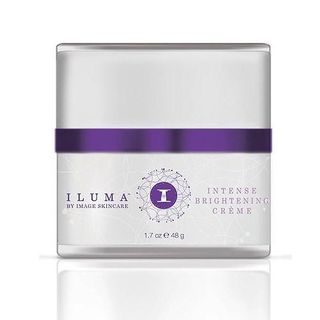
Image skincare Iluma Intense Brightening Creme
Works for
2 of 2 advertised claims delivered
Moisturizing18 ingredients credited for this claimGood support
“Powered by botanical brightening agents, including daisy flower and turmeric extracts, along with stabilised vitamin C, the formula helps to soften the look of dark spots and uneven tone while delivering lasting hydration.”
This product can help improve hydration of the skin with the two types of ingredients.
The first type is called “humectants”:
these ingredients help attract water.
When humectants are on the surface of the skin, they “pull in” the moisture from the outside environment, or from
within deeper layers of the skin. The following ingredients in this product do the job:
glycerin, butylene glycol.
This product also contains ingredients called “occlusives”. They help reduce the speed with which our skin loses moisture to the outside environment. These ingredients also help soften the upper layer of the skin, so it feels less tight and nicer to the touch. The following ingredients in this product do the job: caprylic/capric triglyceride, dimethicone.
Evens skin tone5 ingredients credited for this claimModerate support
“With botanical brightening agents and stabilized vitamin C, it helps to minimize the appearance of discoloration and dark spots.”
The following ingredient (ingredients) in this product might be helpful, but there is no evidence to confirm that it actually works: arbutin, glycyrrhiza glabra root extract, hexylresorcinol.
Anti-oxidationNot advertised by the brand · 9 ingredients credited for this claimModerate support
This product contains antioxidants (arbutin, hexylresorcinol) that might be able to help neutralize free radicals in skin to lessen the damage it gets from the UV light (sun). There is not enough evidence to confirm their effectiveness in skin though.
Can it cause trouble?
Irritancy17 flagged ingredientsMedium risk
Comedogenic2 ingredients rated 2 or more on the 0–5 pore-clogging scale2 flagged


User reviews
Be the first — your take helps the next person decide.
Ingredients
Filter by role to see what each ingredient is doing.
Water~40–60%
Bellis perennis extract~4.4–6.7%
- Irritation risk
- Low
Caprylic/capric triglyceride~3.8–5.7%
- Irritation risk
- Medium
A good mix of fatty acids that forms a protective layer on the skin. Improves the shelf life of products. Derived from coconut and glycerin
More about Caprylic/capric triglycerideTetrahexyldecyl ascorbate~2.6–3.9%
- Irritation risk
- Medium
Being a lipid soluble form of vitamin C, it is more stable than ascorbic acid, but still degrades quickly and needs to be stabilized in a formulation with another ingredient. It is claimed to penetrate skin better than pure vitamin C and have the the similar benefits, but solid studies of its effectiveness are lacking. Is likely to require a higher concentration in a product than pure vitamin C to be effective. It might be able to help reduce pore clogging.
More about Tetrahexyldecyl ascorbateButylene glycol dicaprylate/dicaprate~2–2.9%
- Irritation risk
- Low
Helps soften the upper layer of the skin
More about Butylene glycol dicaprylate/dicaprateGlycerin~1.6–2.4%
- Irritation risk
- Low
One of the best moisturizing ingredients. Naturally present in skin. It attracts water to the upper layer of the skin working as a humectant
More about GlycerinCetyl alcohol~1.2–1.8%
- Irritation risk
- Low
A non-drying alcohol that works to soften the skin and stabilize product formulations helping oil and water mix together
More about Cetyl alcoholCetearyl alcohol~1–1.5%
- Irritation risk
- Low
- Comedogenicity
- 2/5
A non-drying alcohol. Works as an emollient. Helps water and oil mix together and creates a nice product texture
More about Cetearyl alcoholDimethicone~0.6–1.4%
- Irritation risk
- Low
A silicone that helps to reduce water loss from the surface of the skin. Can temporarily "fill in" lines and wrinkles, absorb oil, and create a nice product finish
More about DimethiconeGlyceryl stearate~0.5–1.1%
- Irritation risk
- Low
An emollient that softens the skin and forms a protective layer on its surface. Helps water and oil mix together
More about Glyceryl stearatePeg-100 stearate~0.4–0.9%
- Irritation risk
- Low
Helps oil and water mix togehter and creates a nice product texture
More about Peg-100 stearateElaeis guineensis oil~0.3–0.75%
- Irritation risk
- Low
Helps soften the upper layer of the skin
More about Elaeis guineensis oilErgothioneine~0.15–0.6%
- Irritation risk
- Low
Can help neutralize free radicals in skin. Preliminary studies show that it can be more effective than coenzyme Q10 but studies on effective concentration for topical applications are lacking
More about ErgothioneineStearic acid~0.3–0.7%
- Irritation risk
- Low
Helps oil and water mix together and works as an emollient
More about Stearic acidGossypium herbaceum seed oil~0.1–0.5%
- Irritation risk
- Low
- Comedogenicity
- 3/5
Cottonseed oil. It is used as an emollient and occlusive in products. It is rich palmitic, oleic acid, and linoleic fatty acids.
More about Gossypium herbaceum seed oilBidens pilosa extract~0.1–0.45%
- Irritation risk
- Low
Curcuma longa root extract~0.1–0.4%
- Irritation risk
- High
A plant extract that can contain an active compound curcumin, that may have some anti-inflammatory properties when applied to the skin, but solid research is lacking and the typical concentration used in skincare products is too low. Can be an irritant
More about Curcuma longa root extractHippophae rhamnoides oil~0.15–0.5%
- Irritation risk
- High
A good emollient. Contains various ingredients including vitamins and fatty acids that could work in the skin to neutralize free radicals and minimize moisture loss - if enough of these compounds is able to penetrate the skin in an active form.
More about Hippophae rhamnoides oilPropylene glycol~0.1–0.35%
- Irritation risk
- High
Helps oil and water mix together and can enhance the penetration of other ingredients into the skin. It can be irritating
More about Propylene glycolLinum usitatissimum seed oil~0.05–0.25%
Hydroxyethyl acrylate/sodium acryloyldimethyl taurate copolymer~0.1–0.35%
- Irritation risk
- Medium
A gelling agent that thickens the product consistency and leaves the skin with a velvety finish
More about Hydroxyethyl acrylate/sodium acryloyldimethyl taurate copolymerCeteth-10 phosphate~0.1–0.5%
Dicetyl phosphate~0.1–0.3%
Squalane~0.1–0.35%
- Irritation risk
- Low
An oil naturally present in skin. Works as an emollient to soften the skin and form a protective layer on its surface without a greasy feeling.
More about SqualaneCaprylyl glycol~0.1–0.3%
- Irritation risk
- Medium
Helps preserve products and creates a nice product texture
More about Caprylyl glycolXanthan gum~0.05–0.3%
- Irritation risk
- Low
Used to create a thicker product consistency
More about Xanthan gum3-o-ethyl ascorbic acid~0.05–0.25%
- Irritation risk
- High
A vitamin C derivative that is more stable but less potent than pure form of vitamin C. Can help neutralize free radicals and help reduce hyperpigmentation, but the required concentration is likely to be much higher than for the pure form of vitamin C, limiting the ingredient's effectiveness in products
More about 3-o-ethyl ascorbic acidAminomethyl propanol~0.05–0.25%
Disodium edta~0.05–0.25%
Ethylhexylglycerin~0.05–0.25%
Hexylene glycol~0.05–0.25%
- Irritation risk
- Medium
Helps create a more spreadable product texture
More about Hexylene glycolPpg-12/smdi copolymer~0.1–0.35%
Tocopheryl acetate~0.05–0.3%
- Irritation risk
- Medium
A more stable but less bio-available form of vitamin E compared to Tocopherol. Might help moisturize and protect the skin from free radicals, but mostly used in low concentrations to stabilize other ingredients.
More about Tocopheryl acetatePolysorbate 60~0.1–0.35%
Peg-12 glyceryl dimyristate~0.05–0.3%
- Irritation risk
- Low
Butylene glycol~0.05–0.3%
- Irritation risk
- Low
Used to create a nice product texture and help delivery of other ingredients. Might be somewhat helpful in attracting water to the upper layer of the skin
More about Butylene glycolArbutin~0.05–0.3%
- Irritation risk
- Medium
Beta-arbutin. Can help to reduce hyperpigmentation and has an anti-oxidant effect when used in high enough concentration. Is less effective compared to alpha-arbutin
More about ArbutinLecithin~0.1–0.45%
- Irritation risk
- Low
Used mostly for creating emulsions - helping oil and water mix together. Helps soften the upper layer of the skin
More about LecithinHexylresorcinol~0.1–0.35%
- Irritation risk
- Medium
Might be helpful in reducing hyperpigmentation and neutralizing free radicals in skin
More about HexylresorcinolMethyl undecylenoyl dipeptide-16~0.1–0.3%
- Irritation risk
- Low
Sorbitan isostearate~0.1–0.35%
- Irritation risk
- Low
Helps oil and water mix together
More about Sorbitan isostearateGlycyrrhiza glabra root extract~0.05–0.25%
- Irritation risk
- Medium
A plant extract that can help lighten the skin and calm down inflammation. Might be helpful in neutralizing free radicals
More about Glycyrrhiza glabra root extractLepidium sativum sprout extract~0.05–0.25%
- Irritation risk
- Low
Pueraria lobata root extract~0.05–0.25%
- Irritation risk
- Low
Melia azadirachta leaf extract~0.05–0.2%
- Irritation risk
- High
A plant extract that has anti-bacterial properties. Can be used to preserve the product. Can be irritating
More about Melia azadirachta leaf extractTocopherol~0.05–0.1%
- Irritation risk
- Low
Pure form of vitamin E. Can help moisturise and protect the skin from free radicals. Often used to help stabilise other ingredients or the formula itself
More about TocopherolPhenoxyethanol~0.05–0.2%
- Irritation risk
- Low
A preservative. It helps prevent bacterial growth in cosmetic products
More about PhenoxyethanolIngredient list view
Water, Bellis perennis extract, Caprylic/capric triglyceride, Tetrahexyldecyl ascorbate, Butylene glycol dicaprylate/dicaprate, Glycerin, Cetyl alcohol, Cetearyl alcohol, Dimethicone, Glyceryl stearate, Peg-100 stearate, Elaeis guineensis oil, Ergothioneine, Stearic acid, Gossypium herbaceum seed oil, Bidens pilosa extract, Curcuma longa root extract, Hippophae rhamnoides oil, Propylene glycol, Linum usitatissimum seed oil, Hydroxyethyl acrylate/sodium acryloyldimethyl taurate copolymer, Ceteth-10 phosphate, Dicetyl phosphate, Squalane, Caprylyl glycol, Xanthan gum, 3-o-ethyl ascorbic acid, Aminomethyl propanol, Disodium edta, Ethylhexylglycerin, Hexylene glycol, Ppg-12/smdi copolymer, Tocopheryl acetate, Polysorbate 60, Peg-12 glyceryl dimyristate, Butylene glycol, Arbutin, Lecithin, Hexylresorcinol, Methyl undecylenoyl dipeptide-16, Sorbitan isostearate, Glycyrrhiza glabra root extract, Lepidium sativum sprout extract, Pueraria lobata root extract, Melia azadirachta leaf extract, Tocopherol, Phenoxyethanol
Compare prices
Retailers ranked by price — lowest first.

Worth comparing, line by line.
Match % combines shared ingredients, the first five ingredients, shared actives and hero ingredients, irritancy (lower counts in the alternative's favour), texture and body area. Only products in the same routine step are compared.
| Image skincareIluma Intense Brightening CremeYOUR PRODUCT | Colleen Rothschild BeautyVitamin C Nourishing Cream | PillowtalkDermMajor Fade Active Seal Moisturizer | OFRAVitamin C Cream | |
|---|---|---|---|---|
| Match | — | 59% | 59% | 56% |
| Price | $64.38 | — | — | — |
| Shared key ingredients | — | 5 of 9 | 4 of 9 | 4 of 9 |
| Key difference | — | Panthenol | Hexapeptide-2 | Oxybenzone |
| Irritancy | Medium | Medium | Low | Medium |
| Drying alcohol | — | — | — | — |
| View product | Shop | Shop | Shop |


Sources cited in this review
Every concentration estimate and effectiveness label is anchored to one of these 20 studies and safety reviews.
- 1
- 2
- 3
- 4
- 5Final Report on the Safety Assessment of Dimethicone Copolyoljournals.sagepub.com
- 6

Affiliate links · As an Amazon Associate, WIMJ earns from qualifying purchases.