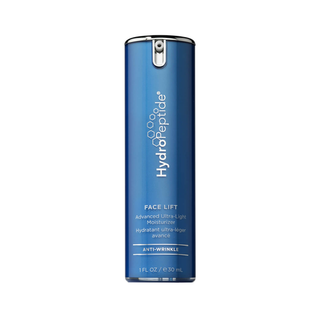
HydroPeptide Face Lift Advanced Ultra-Light Moisturizer
Works for
3 of 3 advertised claims delivered
MoisturizingAcetyl tetrapeptide-2, Oligopeptide-68 + 29 moreStrong evidence
“Face Lift Advanced Ultra-Light Moisturizer”
This product can help improve hydration of the skin with the two types of ingredients.
The first type is called “humectants”:
these ingredients help attract water.
When humectants are on the surface of the skin, they “pull in” the moisture from the outside environment, or from
within deeper layers of the skin. The following ingredients in this product do the job:
copper pca, dextran.
This product also contains ingredients called “occlusives”. They help reduce the speed with which our skin loses moisture to the outside environment. These ingredients also help soften the upper layer of the skin, so it feels less tight and nicer to the touch. The following ingredients in this product do the job: squalane, c13-16 isoparaffin.
The following ingredients in this product are especially good for supporting the skin barrier and helping with the hydration level: acetyl tetrapeptide-2, oligopeptide-68, palmitoyl oligopeptide, palmitoyl tetrapeptide-7, pentapeptide-18, pentapeptide-28
Anti-agingAcetyl tetrapeptide-2, Palmitoyl oligopeptide + 8 moreModerate evidence
“The blend of 9 powerful peptides offers superior anti-ageing benefits.”
This product contains acetyl tetrapeptide-2, oligopeptide-68, palmitoyl oligopeptide, palmitoyl tetrapeptide-7, pentapeptide-18, pentapeptide-28. These ingredients might be able to help reduce and prevent fine lines and wrinkles, improve skin elasticity and firmness, but there is not enough evidence that it actually works.
Evens skin toneGlucosamine hcl, Glycyrrhiza glabra root extract + 4 moreModerate evidence
“Packed with multi-performance peptides, this hydrating formula reduces the appearance of fine lines and wrinkles, and diminishes dark spots for a more even skin tone.”
The following ingredient (ingredients) in this product might be helpful, but there is no evidence to confirm that it actually works: glucosamine hcl, glycyrrhiza glabra root extract.
Anti-oxidationNot advertised by the brand · Superoxide dismutase, Lactobacillus ferment + 8 moreStrong evidence
This product contains antioxidants (superoxide dismutase) that can help neutralize free radicals in skin. By doing so, they can lessen the damage the skin gets from the UV light (sun).
Can it cause trouble?
Irritancy9 strong irritants: Menthyl lactate, Rosmarinus officinalis leaf extract + 7 more — patch-test recommendedHigh risk
ComedogenicClean of flagged comedogenic ingredientsNone flagged
User reviews
Be the first — your take helps the next person decide.
Ingredients
Filter by role to see what each ingredient is doing.
Water~45–55%
Glycerin~5.1–6.2%
- Irritation risk
- Low
One of the best moisturizing ingredients. Naturally present in skin. It attracts water to the upper layer of the skin working as a humectant
More about GlycerinPentapeptide-18~4–4.9%
- Irritation risk
- Low
A type of peptide. Peptides are excellent moisturizers and might be able support collagen production reducing fine lines and wrinkles
More about Pentapeptide-18Caprylyl glycol~2.9–3.6%
- Irritation risk
- Medium
Helps preserve products and creates a nice product texture
More about Caprylyl glycolButylene glycol~2.1–2.6%
- Irritation risk
- Low
Used to create a nice product texture and help delivery of other ingredients. Might be somewhat helpful in attracting water to the upper layer of the skin
More about Butylene glycolCarbomer~1.6–2%
- Irritation risk
- Low
Helps create a thicker or gel-like product texture. It is not a surfactant but can be used in gentle cleansing formulations
More about CarbomerPolysorbate 20~1.5–1.8%
Palmitoyl oligopeptide~1.4–1.7%
- Irritation risk
- Low
A type of peptide. Peptides are excellent moisturizers and might be able support collagen production reducing fine lines and wrinkles
More about Palmitoyl oligopeptidePalmitoyl tetrapeptide-7~1.1–1.3%
- Irritation risk
- Low
A type of peptide. Peptides are excellent moisturizers and might be able support collagen production reducing fine lines and wrinkles
More about Palmitoyl tetrapeptide-7Isohexadecane~0.9–1.1%
- Irritation risk
- Low
Improves the texture of the product and helps soften the skin. Helps oil and water mix together and can be used as a cleansing agent
More about IsohexadecaneC13-16 isoparaffin~0.6–0.9%
- Irritation risk
- Low
Is mostly used to dissolve other ingredients. Helps soften the upper layer of the skin. It might be comedogenic when used in high concentrations
More about C13-16 isoparaffinC12-14 isoparaffin~0.45–0.65%
- Irritation risk
- Medium
Helps soften the upper layer of the skin, dissolve other ingredients and create a thicker product consistency
More about C12-14 isoparaffinC13-15 alkane~0.3–0.6%
Leuconostoc/radish root ferment filtrate~0.3–0.5%
- Irritation risk
- Medium
A preservative that comes from radishes fermented by a bacteria. New research suggests that the preservation properties in the ingredient come from an ammonium salt that is not present naturally in radish root but used in its cultivation. Is problematic because the exact amount of the preservative agents is difficult to determine
More about Leuconostoc/radish root ferment filtrateLactobacillus ferment~0.25–0.45%
- Irritation risk
- Low
A fermentation product created by bacteria Lactobacillus. The fermented product has anti-bacterial properties and might be helpful in calming down inflammation, but studies are lacking. Helps attract water to the upper layer of the skin. Can be used as a preservative
More about Lactobacillus fermentPropanediol~0.25–0.5%
- Irritation risk
- Low
Acts as a solvent for other ingredients. Speeds up the absorption of other ingredients into the skin
More about PropanediolPopulus tremuloides bark extract~0.25–0.4%
- Irritation risk
- Low
C12-15 alkyl benzoate~0.2–0.4%
- Irritation risk
- Low
Enhances the product texture and makes it more spreadable. Helps reduce water loss from the outer layer of skin. Extands the shelf life by preventing bacteria growth
More about C12-15 alkyl benzoateHydroxyethyl acrylate/sodium acryloyldimethyl taurate copolymer~0.2–0.35%
- Irritation risk
- Medium
A gelling agent that thickens the product consistency and leaves the skin with a velvety finish
More about Hydroxyethyl acrylate/sodium acryloyldimethyl taurate copolymerSqualane~0.2–0.35%
- Irritation risk
- Low
An oil naturally present in skin. Works as an emollient to soften the skin and form a protective layer on its surface without a greasy feeling.
More about SqualanePolysorbate 60~0.2–0.35%
Stearyl alcohol~0.2–0.35%
- Irritation risk
- Low
An emollient that helps soften the skin
More about Stearyl alcoholCetyl alcohol~0.15–0.3%
- Irritation risk
- Low
A non-drying alcohol that works to soften the skin and stabilize product formulations helping oil and water mix together
More about Cetyl alcoholGlyceryl stearate~0.15–0.3%
- Irritation risk
- Low
An emollient that softens the skin and forms a protective layer on its surface. Helps water and oil mix together
More about Glyceryl stearateArctostaphylos uva-ursi leaf extract~0.1–0.2%
- Irritation risk
- Low
Magnesium ascorbyl phosphate~0.1–0.2%
- Irritation risk
- Medium
A derivative of vitamin C that is more stable, but less bioavailable than the pure form of vitamin C. It does not penetrate the skin well, but has been shown to convert to pure vitamin C once in skin. It can be helpful in stimulating collagen production and lightening the skin tone, but the required concentration is likely to be very high
More about Magnesium ascorbyl phosphatePentapeptide-28~0.1–0.25%
Hydrogenated lecithin~0.15–0.25%
- Irritation risk
- Low
Helps to retain moisture by creating a protective barrier on the skin. Rich in fatty acids. Improves product texture and helps with the penetration of other ingredients.
More about Hydrogenated lecithinSodium oleate~0.55–0.8%
- Irritation risk
- Medium
Helps oil and water mix together and create a thicker product consistency
More about Sodium oleateOligopeptide-68~0.15–0.25%
- Irritation risk
- Low
A type of peptide. Peptides are excellent moisturizers and might be able support collagen production reducing fine lines and wrinkles
More about Oligopeptide-68Dextran~0.1–0.25%
- Irritation risk
- Low
Helps attract water to the most upper layer of the skin. Derived from sugar
More about DextranAcetyl tetrapeptide-2~0.1–0.2%
- Irritation risk
- Low
A type of peptide. Peptides are excellent moisturizers and might be able support collagen production reducing fine lines and wrinkles
More about Acetyl tetrapeptide-2Tropolone~0.1–0.2%
- Irritation risk
- Low
1,2-hexanediol~0.1–0.2%
Glucosamine hcl~0.1–0.25%
- Irritation risk
- Low
Might be able to stimulate production of skin's natural moisturizing compounds such as hyaluronic acid. Could be helpful for evening the skin tone.
More about Glucosamine hclBambusa vulgaris extract~0.1–0.2%
- Irritation risk
- Low
Pisum sativum extract~0.15–0.25%
- Irritation risk
- Medium
Might be helpful in protecting skin collagen and elastin from breaking down but solid research is lacking
More about Pisum sativum extractYeast polysaccharides~0.15–0.25%
- Irritation risk
- Low
Menthyl lactate~0.15–0.25%
Tetrahexyldecyl ascorbate~0.15–0.3%
- Irritation risk
- Medium
Being a lipid soluble form of vitamin C, it is more stable than ascorbic acid, but still degrades quickly and needs to be stabilized in a formulation with another ingredient. It is claimed to penetrate skin better than pure vitamin C and have the the similar benefits, but solid studies of its effectiveness are lacking. Is likely to require a higher concentration in a product than pure vitamin C to be effective. It might be able to help reduce pore clogging.
More about Tetrahexyldecyl ascorbateEchinacea purpurea extract~0.1–0.2%
- Irritation risk
- High
Plant extract that might have some anti-oxidant properties. Can be irritating
More about Echinacea purpurea extractRosmarinus officinalis leaf extract~0.1–0.2%
- Irritation risk
- High
Can be helpful in reducing inflammation in skin, including inflamed acne. It can be irritating
More about Rosmarinus officinalis leaf extractPanthenol~0.15–0.25%
- Irritation risk
- Low
Helps attract water to the upper layer of the skin and can help improve skin barrier function
More about PanthenolSodium hyaluronate~0.15–0.25%
- Irritation risk
- Low
One of the best moisturizing ingredients. Attracts water into the upper layer of the skin
More about Sodium hyaluronateHydrolyzed hyaluronic acid~0.15–0.25%
- Irritation risk
- Low
One of the best moisturizing ingredients. Attracts water into the upper layer of the skin. A version of it is naturally present in skin
More about Hydrolyzed hyaluronic acidEthylhexyl stearate~0.2–0.35%
- Irritation risk
- Low
Helps soften the upper layer of the skin
More about Ethylhexyl stearateSodium hyaluronate crosspolymer~0.15–0.25%
- Irritation risk
- Medium
Attracts water into the upper layer of the skin
More about Sodium hyaluronate crosspolymerPolyglyceryl-4 diisostearate/polyhydroxystearate/sebacate~0.15–0.3%
- Irritation risk
- Medium
Helps water and oil mix together
More about Polyglyceryl-4 diisostearate/polyhydroxystearate/sebacateSodium isostearate~0.2–0.4%
Glycyrrhiza glabra root extract~0.1–0.2%
- Irritation risk
- Medium
A plant extract that can help lighten the skin and calm down inflammation. Might be helpful in neutralizing free radicals
More about Glycyrrhiza glabra root extractSteareth-20~0.2–0.4%
Caprylic/capric triglyceride~0.2–0.35%
- Irritation risk
- Medium
A good mix of fatty acids that forms a protective layer on the skin. Improves the shelf life of products. Derived from coconut and glycerin
More about Caprylic/capric triglycerideCitrus aurantium dulcis peel extract~0.1–0.2%
Cucumis sativus fruit extract~0.15–0.25%
- Irritation risk
- Medium
Might be somewhat helpful in reducing hyperpigmentation and neutralizing free radicals but its typical concentration in a product is too low for having an effect
More about Cucumis sativus fruit extractCitrus limon peel extract~0.1–0.2%
Citrus aurantium dulcis fruit extract~0.15–0.25%
- Irritation risk
- High
A plant extract that is used as a fragrance. Can be irritating and lead to photosensitivity
More about Citrus aurantium dulcis fruit extractGardenia taitensis flower extract~0.15–0.25%
Camellia sinensis leaf extract~0.15–0.25%
- Irritation risk
- Low
Can contain potent anti-oxidant compounds (abbreviated ECG, GCG, EGC, and EGCG) that might help protect the skin from free radicals. Can help calm down inflammation and has some anti-bacterial properties. Unfortunately, these antioxidants are unstable and lose their effectiveness very quickly in products. The concentration of the antioxidant compounds in the extract also tends to be low to be effective in topical formulation
More about Camellia sinensis leaf extractCi 77163~0.15–0.25%
Xanthan gum~0.15–0.25%
- Irritation risk
- Low
Used to create a thicker product consistency
More about Xanthan gumSuperoxide dismutase~0.15–0.25%
- Irritation risk
- Low
An antioxidant enzyme that is naturally present in skin. It can help support skin barrier function and reduce inflammation in skin. It is used in topical medications for inflammatory skin conditions including atopic dermatitis (eczema) and psoriasis. There are three types of natural Superoxide Dismutase in human skin. The compound used in topical treatments and cosmetics are mimics of typically one of these natural variants
More about Superoxide dismutaseCopper pca~0.15–0.25%
- Irritation risk
- Low
Helps attract water to the upper layer of the skin
More about Copper pcaGlyceryl caprylate~0.2–0.35%
- Irritation risk
- Low
An emollient that can also help water and oil mix together, as well as prevent bacteria growth in products
More about Glyceryl caprylateGlyceryl undecylenate~0.2–0.35%
- Irritation risk
- Medium
Helps oil and water mix together and helps preserve the product formulation
More about Glyceryl undecylenateDisodium edta~0.1–0.2%
Aminomethyl propanol~0.1–0.2%
Citric acid~0.1–0.2%
- Irritation risk
- Medium
Can work as an exfoliant but is typically used to adjust the product pH
More about Citric acidLimonene~0.1–0.2%
- Irritation risk
- High
A common frangrance that can easily irritate skin, especially if exposed to air, light or heat
More about LimoneneCitral~0.05–0.1%
Hydroxycitronellal~0.05–0.1%
- Irritation risk
- High
A fragrance. A likely allergen and can be irritating
More about HydroxycitronellalIngredient list view
Water, Glycerin, Pentapeptide-18, Caprylyl glycol, Butylene glycol, Carbomer, Polysorbate 20, Palmitoyl oligopeptide, Palmitoyl tetrapeptide-7, Isohexadecane, C13-16 isoparaffin, C12-14 isoparaffin, C13-15 alkane, Leuconostoc/radish root ferment filtrate, Lactobacillus ferment, Propanediol, Populus tremuloides bark extract, C12-15 alkyl benzoate, Hydroxyethyl acrylate/sodium acryloyldimethyl taurate copolymer, Squalane, Polysorbate 60, Stearyl alcohol, Cetyl alcohol, Glyceryl stearate, Arctostaphylos uva-ursi leaf extract, Magnesium ascorbyl phosphate, Pentapeptide-28, Hydrogenated lecithin, Sodium oleate, Oligopeptide-68, Unknown, Dextran, Acetyl tetrapeptide-2, Tropolone, 1,2-hexanediol, Glucosamine hcl, Bambusa vulgaris extract, Pisum sativum extract, Yeast polysaccharides, Menthyl lactate, Tetrahexyldecyl ascorbate, Echinacea purpurea extract, Rosmarinus officinalis leaf extract, Panthenol, Sodium hyaluronate, Hydrolyzed hyaluronic acid, Ethylhexyl stearate, Sodium hyaluronate crosspolymer, Polyglyceryl-4 diisostearate/polyhydroxystearate/sebacate, Sodium isostearate, Glycyrrhiza glabra root extract, Steareth-20, Caprylic/capric triglyceride, Citrus aurantium dulcis peel extract, Cucumis sativus fruit extract, Citrus limon peel extract, Citrus aurantium dulcis fruit extract, Gardenia taitensis flower extract, Camellia sinensis leaf extract, Ci 77163, Xanthan gum, Superoxide dismutase, Copper pca, Glyceryl caprylate, Glyceryl undecylenate, Disodium edta, Aminomethyl propanol, Citric acid, Limonene, Citral, Hydroxycitronellal
Compare prices
Retailers ranked by price — lowest first.

Sources cited in this review
Every concentration estimate and effectiveness label is anchored to one of these 30 studies and safety reviews.
- 1
- 2Safety Assessment of Isoparaffins as Used in Cosmeticsjournals.sagepub.com
- 3
- 4
- 5Use of Probiotics for Dermal Applicationsresearchgate.net
- 6

Affiliate links · As an Amazon Associate, WIMJ earns from qualifying purchases.